

.png?width=1200&quality=80)
YAKITORI Moe es
Yakitori · Minato, Tokyo
Restaurant in Tokyo, Japan
 Book with Pearl
The Read
French-Inflected Yakitori Omakase
Price
¥¥¥
Chef
Daisuke Numano
Why go
YAKITORI Moe es is a Tabelog Bronze Award and Michelin Plate yakitori counter in Roppongi where chef Daisuke Numano applies French technique to an omakase-only format. Sixteen seats, two sittings per night, reservation required. Budget JPY 15,000–19,999 all-in. Book ahead via Tabelog; there is no official website.
About YAKITORI Moe es
Sixteen seats, two sittings, no walk-ins: book before you plan the rest of your evening
YAKITORI Moe es operates on strict scarcity. The restaurant runs two omakase sittings per evening — 18:00 and 19:00 — with eight seats available per slot. All dishes are served simultaneously, which means arriving late directly reduces how much you eat. There are no à la carte options and no walk-ins accepted. If this format works for you, you are looking at one of the most consistently decorated yakitori counters in Tokyo: a Tabelog Bronze Award winner in both 2025 and 2026, a Michelin Plate holder in 2024 and 2025, and a member of the Tabelog Yakitori Top 100 every year since 2022. The score sits at 4.27 on Tabelog, with review-based spending typically landing in the JPY 15,000–19,999 range once drinks and the 10% service charge are factored in.
What makes this worth the booking
Chef Daisuke Numano brings French technique to yakitori in a way that changes the opening and closing of the meal without disrupting its core identity. The omakase begins with appetisers that read more like a French kitchen than a grill, smoked chicken preparations and terrine de foie gras appear before the skewers arrive. The chicken soup that follows is described as clear as consommé, reflecting stock discipline more common in haute cuisine than a yakitori-ya. The meal closes with simple chicken soba noodles, a deliberately understated finish that keeps the focus on the bird throughout. Numano sources whole chickens from a breed with an extended breeding cycle, then rests the meat for several days to deepen flavour concentration. Seasoning philosophy leans heavily on salt over sauce, which is a deliberate choice to let the quality of the chicken speak rather than masking it. This approach distinguishes Moe es from the sauce-forward style common at many Tokyo yakitori counters.
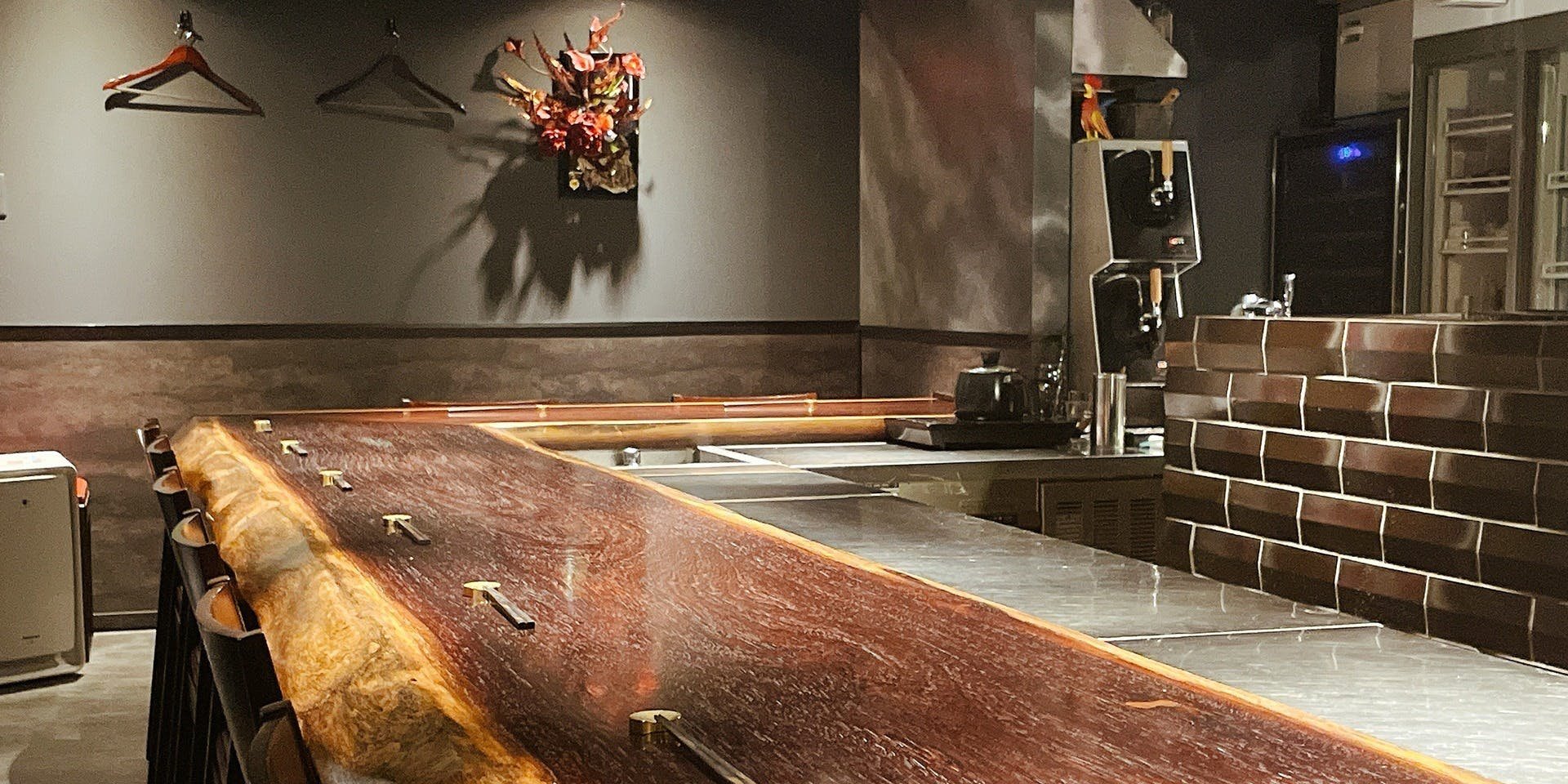
The room opened in June 2021 and seats 16 people across 12 counter seats and a private room for up to four. The counter is the right choice for solo diners and couples; the private room suits small business dinners or occasions where discretion matters. Tabelog users specifically flag this venue for business occasions. No smoking throughout. Children are not permitted.
The drinks program
The beverage offering at Moe es is more considered than you typically find at this price point in the yakitori category. The restaurant is described as particular about both sake (nihonshu) and wine, and a sommelier is available, an unusual provision for a 16-seat yakitori counter. If you are coming with a specific bottle in mind, call ahead; the database does not confirm a corkage policy, so verification is worth the effort before arrival. The sake selection is the more natural pairing with the salt-forward skewer style here, but the wine focus suggests the kitchen is comfortable serving guests who prefer to drink European. For a comparable drinks-forward yakitori experience in Tokyo, BIRD LAND in Ginza also takes the beverage program seriously, though it operates at a different price point and without omakase-only restrictions. Asagaya BIRD LAND offers a more neighbourhood-focused version of the same lineage if you are exploring beyond central Tokyo.
Ratings and recognition
- Tabelog Bronze Award, 2025 and 2026
- Tabelog Score, 4.27
- Tabelog Yakitori East Top 100, every year from 2022 to 2025
- Michelin Plate, 2024 and 2025
- Opinionated About Dining Leading Restaurants in Japan, ranked #612 (2025)
Booking and practical details
Reservations: Omakase only; reservation required. Two sittings nightly, 18:00 (ends 20:15) and 19:00 (ends 20:40). Late arrivals result in fewer courses served. Book as far ahead as possible; with only eight seats per sitting and no official website listed in the database, reservations are most reliably made through Tabelog. Budget: Listed at JPY 10,000–14,999; review-based average is JPY 15,000–19,999 before the 10% service charge. Plan for the higher end. Dress: No formal dress code is listed, but the stylish counter setting, business occasion recommendation, and prix-fixe format suggest smart-casual at minimum. Access: 3 minutes on foot from Roppongi Station (Tokyo Metro Hibiya Line or Toei Oedo Line). Payment: Credit cards accepted; electronic money and QR code payments are not. Private room: Available for up to four guests, suitable for a business dinner or a small occasion. Children: Not permitted. Parking: Not available.
How it compares
See the full comparison below. For other high-quality yakitori in Tokyo, Yakitori Omino and Aramaki are worth considering, as is 124. KAGURAZAKA for a different neighbourhood setting. If you are building a broader Japan itinerary, the yakitori category extends well beyond Tokyo: Ichimatsu in Osaka and Torisaki in Kyoto are both worth a visit. For fine dining in other Japanese cities, consider HAJIME in Osaka, Gion Sasaki in Kyoto, akordu in Nara, Goh in Fukuoka, 1000 in Yokohama, or 6 in Okinawa.
For everything else in Tokyo: our full Tokyo restaurants guide, Tokyo hotels, Tokyo bars, Tokyo wineries, and Tokyo experiences.
Planning details
- Location
- Japan, 〒106-0032 Tokyo, Minato City, Roppongi, 3 Chome−8−12 TSビル 1階
- Website
- tablecheck.com/shops/yakitori-moe/reserve
- Phone
- +81 3-5414-1141
The take
The Take
The Vibe
YAKITORI Moe es presents a compact, highly disciplined counter that blends French technique with traditional yakitori grilling. With just sixteen seats and two nightly seatings, the room feels intimate and intensely focused; service follows a tasting-menu rhythm rather than the improvisational back-and-forth typical of many kushiyaki bars. The kitchen’s sourcing and resting protocols for whole chickens echo classical French thinking, and the restaurant’s critical acclaim and awards underscore a sophisticated, precise approach. The overall impression is of a refined, low-key counter where technical rigor and restrained service define the atmosphere.
Best For
This is a dinner-focused destination best suited to diners seeking a tightly curated yakitori tasting rather than casual late-night skewering. The limited seating and two nightly services make it well matched to business dinners and special-occasion meals where a structured, sit-down experience is expected. The formula—set seating, simultaneous plating, and a counter layout—rewards attention to technique and provenance, so guests who value culinary rigor and a measured, course-driven progression will get the most from a visit.
Ordering Tips
Seats are extremely limited and the service runs on a strict two-seating nightly schedule, so booking in advance is essential. Expect a tasting-style, counter-only experience where all dishes are served in a single protocol rather than à la carte ordering; arrive on time and prepared for a unified service. The menu emphasizes long-reared birds and rested meat for concentrated flavor, so let the kitchen set the pace and focus on the sequence of skewers and accompaniments rather than requesting ad hoc substitutions.
Venue details
Ambiance
Stylish, refined, and intimate, with a polished counter-dining feel suited to a focused omakase experience.
Tags
Vibe
Best For
Experience
Sourcing
At the Table
- Service Style
- Omakase Bar
- Meal Pacing
- Extended Experience
- Capacity
- Small
Signature Dishes
- yakitori skewers
- omakase course
Know before you go
Know Before You Go
- Getting there
- Japan, 〒106-0032 Tokyo, Minato City, Roppongi, 3 Chome−8−12 TSビル 1階
Planning details
Location
Japan, 〒106-0032 Tokyo, Minato City, Roppongi, 3 Chome−8−12 TSビル 1階 · Directions
Recognition and awards

Also consider
Also Consider
- Harutaka, Sushi, ¥¥¥¥
- L'Effervescence, French, ¥¥¥¥
- RyuGin, Kaiseki, Japanese, ¥¥¥¥
- HOMMAGE, Innovtive French, French, ¥¥¥¥
- Crony, Innovative, French, ¥¥¥¥
Restaurant context
At ¥¥¥, YAKITORI Moe es sits a tier below the ¥¥¥¥ venues that dominate Tokyo's serious fine dining conversation, and that price gap matters. Compared to RyuGin or L'Effervescence, Moe es costs meaningfully less while still offering omakase-level discipline, sommelier service, and multi-year award recognition. If your priority is a technically serious tasting experience without spending ¥¥¥¥ across the board, Moe es is the sharper choice on value.
Against HOMMAGE and Crony, both of which operate in innovative French territory, Moe es occupies different culinary ground but shares the Franco-Japanese ambition. If French technique applied to Japanese ingredients is what you are after, HOMMAGE and Crony offer more explicitly French menus; Moe es gives you that sensibility filtered through a yakitori counter, which is a more singular proposition for a food-focused traveller who has already done the standard fine dining circuit. Harutaka at ¥¥¥¥ is the benchmark for omakase precision in a different category (sushi), and while the formats are not directly comparable, both reward guests who want a single-subject tasting experience at the top of its discipline.
Within the yakitori category specifically, Moe es is harder to book and more expensive than BIRD LAND but offers a more structured, occasion-ready experience. BIRD LAND is the better choice if you want flexibility and a more casual counter; Moe es is the right call if you are planning a business dinner or want the full French-influenced omakase treatment. For groups of four who want a private room at the yakitori level, Moe es is one of the few counters in the category that provides it.
Explore Tokyo
Around this place
Discover more on Pearl
Unlock the full YAKITORI Moe es guide in Pearl, including awards, comparisons, FAQs, planning details, and nearby places.
FAQ
Frequently Asked Questions
Is YAKITORI Moe es good for a special occasion?
Yes, and it's specifically flagged on Tabelog as recommended for business occasions. The format — omakase only, 16 seats, a sommelier on hand, and a drinks list that takes sake and wine seriously — suits a dinner where the meal itself is the event. Just know that children are not allowed, and late arrivals lose courses, so plan your evening around the sitting time rather than the other way around.
Can I eat at the bar at YAKITORI Moe es?
Yes — 12 of the 16 seats are counter seats, which is the primary way to eat here. There is no walk-in option, however; every seat, counter or private room, requires a reservation. The counter is the format to book unless you have a party of four that wants the private room.
What should I wear to YAKITORI Moe es?
No dress code is listed in the venue data, but the setting is described as a stylish space, the price point sits at ¥15,000–19,999 per head based on review averages, and it draws a business crowd. Smart-casual to business-casual is a reasonable read; arriving in shorts and trainers would be out of step with the room.
Can YAKITORI Moe es accommodate groups?
Only up to a point. The restaurant seats 16 in total, split between a 12-seat counter and one private room for four. Groups of exactly four can book the private room; larger groups cannot be accommodated, and private buyout of the full venue is not available. For larger Tokyo group dinners, you'll need to look elsewhere.
Is the tasting menu worth it at YAKITORI Moe es?
For yakitori at this price — ¥10,000–14,999 listed, closer to ¥15,000–19,999 in practice with the 10% service charge — the format delivers something genuinely different: French technique applied to the opening and closing courses, sourcing from slow-reared birds rested for several days, and a drinks program with a sommelier. Tabelog scores it 4.27 and has named it to its Yakitori Top 100 every year since 2022. If omakase yakitori is a format you want to try in Tokyo, this is one of the stronger cases for booking it.
What are alternatives to YAKITORI Moe es in Tokyo?
For high-quality yakitori in Tokyo, Yakitori Omino and Aramaki are worth considering if you want a more traditional approach without the French-inflected framing. For a different neighbourhood and format, 124. KAGURAZAKA is another Tabelog-recognised option. If you want to stay in Roppongi but want European fine dining rather than yakitori, RyuGin and L'Effervescence serve very different meals at a higher price point.
Is YAKITORI Moe es worth the price?
At ¥15,000–19,999 all-in per head, it sits at the serious end of the yakitori category, but the credentials back it up: Tabelog Bronze 2025 and 2026, a 4.27 score, four consecutive years in the Yakitori Top 100, and a Michelin Plate in both 2024 and 2025. The French technique applied to the omakase structure — consommé-style chicken soup, terrine de foie gras as an opener, chicken soba to close — gives the meal a coherence that justifies the premium over a standard yakitori counter. If you're comparing it to a Michelin-starred omakase at ¥30,000+, it's strong value; if you're comparing it to a neighbourhood yakitori at ¥5,000, it's a different category entirely.