

.png?width=1200&quality=80)
Sanwa
Italian · Minato, Tokyo
Restaurant in Tokyo, Japan
 Book with Pearl
The Read
Three-Ingredient Italian Precision
Price
$150–200per person
Dress
Smart Casual
Why go
Sanwa is a Tabelog Silver Award winner in Shirokanedai, Tokyo, operating a charcoal-grill Italian prix fixe for eleven diners in a quiet basement room. At JPY 20,000–30,000 per head, it delivers award-level quality below the price point of most comparable Tokyo Italian restaurants. Book by phone for a date or small celebration; counter seats offer the best experience.
About Sanwa
Verdict
Sanwa is one of the most credible Italian restaurants in Tokyo, and it costs less than most of its peers. At JPY 20,000–30,000 per head (with reviewers averaging JPY 30,000–40,000 including wine), you are getting a Tabelog Silver Award winner three years running (2024, 2025, 2026), a Michelin Plate recognition for two consecutive years, and a place on the Tabelog Italian Tokyo Top 100 for 2023 and 2025. The room holds eleven people. Book it for a date, a small celebration, or any meal where the quality-to-price ratio matters.
About Sanwa
The most common mistake people make about Sanwa is assuming it is a conventional Italian restaurant. It is not. The name itself signals the philosophy: sanwa translates roughly as three-part harmony, referring to the relationship between producers, chef, and guest. That triangle shapes every element of the meal. Producers are named on the menu. The number of primary ingredients per dish is held to three. The format is a flexible prix fixe built around charcoal-grilled meat, seasonal produce, and a closing pasta course that inverts the usual Italian sequence.
Opened in October 2021 in the basement of the THE1000 building in Shirokanedai, Minato City, Sanwa has now been operating for over three years and has collected its award credentials at an unusual pace for a restaurant this young. Three consecutive Tabelog Silver Awards before its fourth anniversary puts it in a small group of Tokyo Italian rooms that have established themselves quickly on the city's most-reviewed platform.
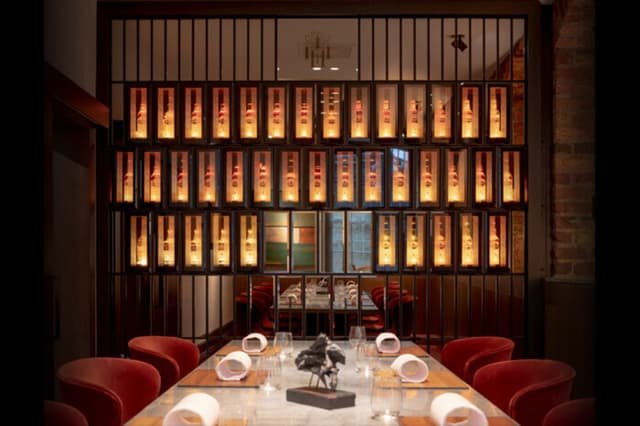
The room is the first thing to recalibrate your expectations. Eleven seats across a five-seat counter and a six-seat table section is a format that forces the kitchen to cook at a different register than a larger Italian restaurant. There is no hiding behind volume. The counter seats, in particular, deliver a different experience from the table: you are close to the kitchen, the pacing is visible, and the meal feels more like a dialogue than a service transaction. For a special occasion where the atmosphere matters as much as the food, the counter is the better choice if available. The space is described as stylish and relaxing, which in this context means no music competition, no crowding, and a room that takes the meal seriously without formality.
The structure of the meal follows a logic that rewards the curious rather than the habitual. It opens with dry-cured ham and gnocco fritto, moves through charcoal-grilled courses featuring seasonal ingredients including venison and beef, and closes with pasta. That closing pasta is the most explicit signal that this kitchen is working in its own framework. Italian convention usually ends with pasta before meat; Sanwa inverts it, making the pasta a landing point rather than a midpoint. It is a small structural choice that signals precision over convention.
Wine program is taken seriously. The listing describes the venue as particular about wine, and at a price point where the per-head spend can reach JPY 35,000–40,000 with drinks, the expectation is that the list is curated to match the kitchen's register. Credit cards (VISA, Mastercard, JCB, AMEX, Diners) are accepted. A 10% service charge applies. There is no QR payment, no electronic money.
Compared to Italian alternatives at similar or higher price points in Tokyo, Sanwa occupies a specific position. Aroma Fresca and PRISMA offer more formal Italian fine dining at the top tier; Gucci Osteria da Massimo Bottura Tokyo brings a known international name to a different price band. Principio and AlCeppo represent the broader Italian scene in the city. Sanwa's value comes from delivering award-level quality in a 11-seat room without the surcharge that often accompanies this kind of recognition. The charcoal-grill focus and the producer-first sourcing philosophy give it a point of difference from Italian restaurants that rely on imported Italian ingredients as their primary credential. For Italian cooking outside Tokyo, consider cenci in Kyoto, which takes a comparably personal approach to Italian cuisine in Japan.
Sanwa does not take walk-ins in any practical sense. With eleven covers, the room fills and reservations are the only reliable path in. Phone reservations are available between 12 PM and 4 PM on open days. Wednesday is the weekly closure. Hours run 18:00 to midnight Monday, Tuesday, Thursday, Friday, Saturday, and Sunday. There are no private rooms and private buyout is not available, which makes this a poor fit for groups larger than six or for anyone needing exclusivity. For parties of two to four, it is well-suited. Parking is unavailable; the venue is approximately 300 metres from Shirokanedai station.
For context on what a similar investment looks like elsewhere in Japan: HAJIME in Osaka, Gion Sasaki in Kyoto, and akordu in Nara represent the award-level dining tier in their respective cities. Internationally, 8½ Otto e Mezzo Bombana in Hong Kong is the most direct regional comparison for Italian at this level in Asia. Sanwa delivers that tier of seriousness at a price that sits below what those rooms typically charge.
For the broader Tokyo picture, see our full Tokyo restaurants guide, our full Tokyo hotels guide, our full Tokyo bars guide, our full Tokyo wineries guide, and our full Tokyo experiences guide. For regional dining beyond Tokyo: Goh in Fukuoka, 1000 in Yokohama, and 6 in Okinawa each represent strong options at their level.
Practical Details
Reservations by phone only, available 12 PM–4 PM on open days (+81-3-5422-8050). Wednesday closed. Dinner service runs 18:00–00:00. Eleven seats total (5 counter, 6 table). No private rooms or buyout. 10% service charge applies. Credit cards accepted (VISA, Mastercard, JCB, AMEX, Diners). No electronic money or QR payment. No parking. Non-smoking throughout. Budget JPY 20,000–30,000 per head (reviewer average JPY 30,000–40,000 with drinks). Closest station: Shirokanedai (approx. 300m).
Quick reference: Phone reservation 12–16:00 | Dinner only | 11 seats | Wed closed | 10% service charge | Cards accepted | JPY 20,000–40,000 all-in.
FAQ
What should a first-timer know about Sanwa?
- The format is a flexible prix fixe, not à la carte. The meal moves through charcoal-grilled courses and closes with pasta.
- With only eleven seats, the room is quiet and unhurried. This is not a place for loud groups or spontaneous drop-ins.
- Budget JPY 25,000–40,000 all-in depending on how far you go on wine. The 10% service charge is added on leading.
- Book by phone between noon and 4 PM. No online reservation system is listed.
Is Sanwa worth the price?
- At JPY 20,000–30,000 for dinner (averaging higher with wine), Sanwa is delivering Tabelog Silver Award quality three years running at a price that sits below many comparable Tokyo Italian rooms.
- The producer-named sourcing and charcoal-grill focus give the kitchen a clear point of difference from comparable Italian prix fixe menus in the city.
- If you are comparing spend, this is less expensive than most ¥¥¥¥ competitors while carrying equivalent or stronger award credentials.
Can Sanwa accommodate groups?
- The maximum party size is limited by the room: eleven seats across a counter and a table section.
- No private rooms and no buyout option are available, so parties of more than six will struggle to sit together.
- For groups of two to four, Sanwa is a good fit. For larger celebrations requiring a private room, look elsewhere in Tokyo's Italian tier.
What should I wear to Sanwa?
- No formal dress code is listed, but the room is described as stylish and relaxing. At JPY 20,000–30,000 per head in Shirokanedai, smart casual is the practical baseline.
- Overly casual dress (trainers, shorts) would feel out of place given the setting and price point, but a suit is not required.
Is the tasting menu worth it at Sanwa?
- The flexible prix fixe is the only format. This is not a venue where you can order selectively from a menu.
- The structure (ham and gnocco fritto, charcoal-grilled meat courses, closing pasta) is well-constructed and the three-ingredient-per-dish discipline keeps the meal from over-extending.
- Tabelog Silver three years running and a Michelin Plate in 2024 and 2025 are strong independent signals that the kitchen is executing at a high level consistently, not just on launch buzz.
What are alternatives to Sanwa in Tokyo?
- For Italian at a higher price tier: Aroma Fresca and PRISMA.
- For a named international Italian brand: Gucci Osteria da Massimo Bottura Tokyo.
- For Italian outside Tokyo: cenci in Kyoto takes a comparably personal approach at a similar price tier.
- For the ¥¥¥ Italian tier with broader menus: Principio and AlCeppo.
Is Sanwa good for a special occasion?
- Yes, with one clear caveat: no private rooms. If privacy or a buyout is essential, Sanwa is not the right call.
- For a dinner for two or a small group where the intimacy of an 11-seat room works in your favour, it is a strong choice. The counter seats in particular create a close, personal atmosphere.
- The award credentials (Tabelog Silver, Michelin Plate) give it the weight appropriate for a significant occasion without requiring you to move to a ¥¥¥¥ price band.
Can I eat at the bar at Sanwa?
- Yes. Five of the eleven seats are at the counter. These are the seats to request if you want to be close to the kitchen and see the charcoal-grill work up close.
- There is no separate walk-in bar. All seating, counter included, is reservation-only given the size of the room.
Planning details
- Location
- Japan, 〒108-0071 Tokyo, Minato City, Shirokanedai, 5 Chome−13−14 THE1000 地下一階
- Website
- tabelog.com/en/tokyo/A1316/A131602/13264755
- Phone
- +81 3-5422-8050
The take
The Take
The Vibe
Sanwa reads like a quiet, classic neighbourhood trattoria transplanted into Tokyo’s exacting culinary culture. The basement room’s eleven seats create a compact, cozy environment that downplays theatricality in favor of quietly confident cooking. The write-up emphasizes local patronage rather than tourist traffic and frames the restaurant as part of a tradition adapted to precise technique, so the room feels restrained and familiar rather than showy. Its steady stream of Tabelog Silver Awards and Michelin Plate recognition reinforces a sense of unflashy competence—an intimate, low-key place where quality and restraint define the atmosphere.
Best For
The restaurant’s compact scale and refined, neighbourhood-trattoria approach make it best suited to intimate evening plans and small special occasions. With just eleven seats and a counter-and-table setup, Sanwa favors one-on-one meals, quiet celebrations and low-capacity gatherings where focused cooking and close service matter. The sustained Tabelog recognition and Michelin Plate signal consistent culinary standards, so diners seeking a quietly elevated Italian dinner—rather than a large or loud group experience—will find this room especially appropriate.
Ordering Tips
Given the trattoria framing and the room’s counter-and-table setup, prioritize dishes that showcase the kitchen’s precision and seasonal focus. Signature items noted for this venue include the Caprese and the Ham Nyokko Frit; both reflect the simple, ingredient-forward logic of neighbourhood Italian cooking. Counter seating brings you close to the action, offering a direct line to the chefs’ technique, so consider selecting a handful of highlights to sample rather than trying to force a large multi-course menu into the compact setting. Awards and steady ratings indicate reliably executed preparations.
Venue details
Ambiance
Quiet and refined atmosphere in a residential area basement location.
Tags
Vibe
Best For
Sourcing
At the Table
- Dress Code
- Smart Casual
- Noise Level
- Quiet
- Service Style
- Upscale Casual
- Meal Pacing
- Leisurely
- Capacity
- Intimate
- Kitchen
- Modern
- Menu Format
- Prix fixe
- Wine Program
- Deep wine list
- Drinks Focus
- Wine
Signature Dishes
- Caprese
- Ham Nyokko Frit
Know before you go
Know Before You Go
- Getting there
- Japan, 〒108-0071 Tokyo, Minato City, Shirokanedai, 5 Chome−13−14 THE1000 地下一階
Planning details
Location
Japan, 〒108-0071 Tokyo, Minato City, Shirokanedai, 5 Chome−13−14 THE1000 地下一階 · Directions

Also consider
Also Consider
- Harutaka, Sushi, ¥¥¥¥
- L'Effervescence, French, ¥¥¥¥
- RyuGin, Kaiseki, Japanese, ¥¥¥¥
- HOMMAGE, Innovtive French, French, ¥¥¥¥
- Crony, Innovative, French, ¥¥¥¥
Restaurant context
Sanwa sits at ¥¥¥ while most of its serious competition in Tokyo's Italian and broader fine-dining tier operates at ¥¥¥¥. That price gap is relevant when deciding where to spend. L'Effervescence and HOMMAGE both deliver French fine dining at the ¥¥¥¥ level with more formal service infrastructure and larger rooms; if a full-dress occasion is the priority, either will offer a more conventional luxury experience. But if you are weighing award credentials against per-head spend, Sanwa's three consecutive Tabelog Silver Awards and Michelin Plate recognition make it the more efficient choice for a dinner where the food, not the formality, is the centrepiece.
Crony and RyuGin operate at ¥¥¥¥ with stronger booking difficulty and higher name recognition among international visitors. RyuGin in particular is a kaiseki benchmark that appeals to a different diner than Sanwa; the two are not direct substitutes, but both represent the case for spending serious money on a small-room, tasting-format meal in Tokyo. Sanwa is the easier booking at a lower price with a more relaxed atmosphere. Harutaka is the correct comparison if sushi at ¥¥¥¥ is also on your shortlist: that room is similarly small and reservation-driven, but the format and price point are different enough that the two do not compete directly.
The practical recommendation: if budget is fixed below JPY 30,000 per head and you want Tokyo's Italian tier rather than its French or kaiseki tier, Sanwa is the most credentialed option at its price point. If budget extends to ¥¥¥¥ and you want a larger room or private dining capability, L'Effervescence or HOMMAGE are the better choices. For Italian specifically at higher spend, Aroma Fresca and PRISMA are the relevant alternatives within Tokyo.
Explore Tokyo
Around this place
Discover more on Pearl
Unlock the full Sanwa guide in Pearl, including awards, comparisons, FAQs, planning details, and nearby places.
FAQ
Frequently Asked Questions
What should a first-timer know about Sanwa?
Sanwa runs a prix fixe format, there is no à la carte option. The format opens with dry-cured ham and gnocco fritto, moves through charcoal-grilled meat courses, and closes with pasta. Reservations are phone-only (03-5422-8050), accepted 12 PM–4 PM on open days, and the 11-seat room fills quickly, call well in advance. Budget JPY 20,000–30,000 per person at the stated price range, though reviewer-reported averages run JPY 30,000–40,000 with drinks and the 10% service charge.
Is Sanwa worth the price?
Yes, by the standards of Tokyo's serious Italian category. Sanwa holds a Tabelog Silver Award three consecutive years (2024–2026) and a Tabelog score of 4.47, placing it among Tokyo's top-ranked Italian restaurants for value at this tier. At JPY 20,000–30,000 before drinks, it sits below many comparable prix fixe Italian venues in the city. The charcoal-grill focus and three-ingredient discipline give the format a clear identity, you are paying for restraint and precision, not spectacle.
Can Sanwa accommodate groups?
Groups of more than four will struggle. Total capacity is 11 seats split between a 5-seat counter and a 6-seat table, with no private room available and no private-use option. A group of six can theoretically occupy the table section, but availability will be tight and booking lead time should be long. For larger parties, a venue with a private dining room is a better fit.
What should I wear to Sanwa?
The venue is described as a stylish, relaxing space in a basement of a residential building in Shirokanedai. No dress code is listed in the venue data, but the setting, price point, and format are consistent with smart casual being appropriate, neat, put-together, nothing too casual. When in doubt, call to confirm on 03-5422-8050 during reservation hours (12 PM–4 PM).
Is the tasting menu worth it at Sanwa?
If a tasting format built around charcoal-grilled meat, seasonal produce, and Italian structure appeals to you, yes. Sanwa limits main ingredients per dish to three, sourcing from named producers, the menu is about restraint, not volume. The prix fixe is the only format on offer, so the question is really whether this style suits you. If you want a broader Italian spread or à la carte flexibility, Sanwa is the wrong venue.
What are alternatives to Sanwa in Tokyo?
HOMMAGE and Crony are the closest comparison points at a similar price tier in Tokyo, both run tight, chef-driven formats with a premium on seasonal ingredients. L'Effervescence and RyuGin operate at a higher price point and a more classical fine-dining register. Harutaka is an entirely different category (omakase sushi), useful only if you are deciding between cuisines rather than between Italian options.
Is Sanwa good for a special occasion?
Yes, with caveats. The format is intimate, 11 seats, no background noise from a large room, and the multi-course structure suits a celebratory dinner. There are no private rooms, so you will be sharing the space with other diners at the counter or adjacent table. If total privacy matters, look elsewhere. If a focused, personal dinner in a low-key Shirokanedai setting is the goal, Sanwa fits.