
Restaurant in Tokyo, Japan
Ginza Kojyu
1,580Pearl PointsTwo Michelin stars. Plan months ahead.





About Ginza Kojyu
Ginza Kojyu holds two Michelin stars and a 94-point La Liste score, making it one of Tokyo's most credentialled kaiseki counters. Chef Toru Okuda's Shizuoka-focused provenance gives the menu a clear point of view. Booking is near impossible without advance planning and concierge support — build in four to six weeks minimum.
Verdict: Book Ginza Kojyu if kaiseki at the highest level is the point of your trip
The most common mistake visitors make is treating Ginza Kojyu as one option among many in Tokyo's dense fine-dining grid. It is not. With two Michelin stars held across multiple consecutive years, a 94-point La Liste score in both 2025 and 2026, and a counter built from 700-year-old cypress, this is one of the most deliberately constructed kaiseki experiences in the city. If you are in Tokyo for food and kaiseki is on your agenda, Ginza Kojyu deserves serious consideration. If kaiseki is not your format, or if a ¥¥¥¥ price point requires justification beyond prestige, RyuGin or Kanda are worth comparing before you commit.
The Experience: What You Are Actually Booking
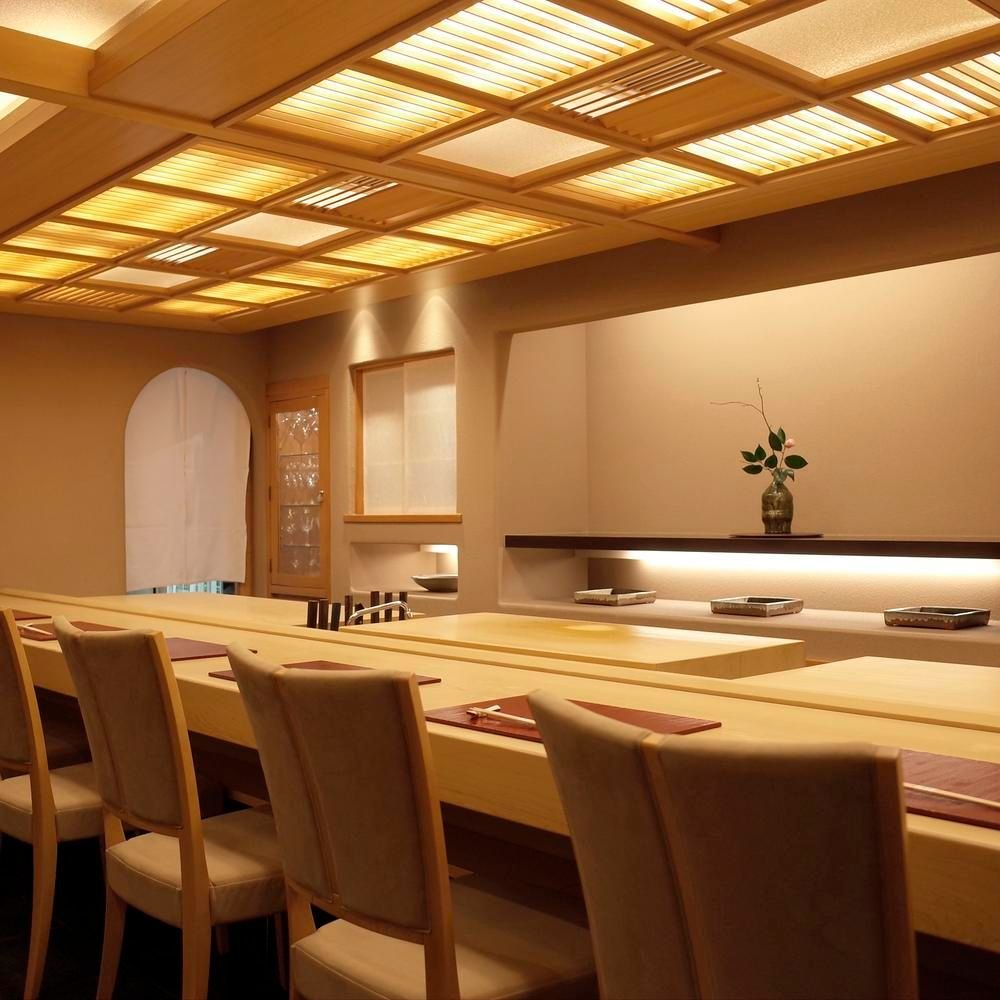
Ginza Kojyu sits on the fourth floor of the Ginza Carioca Building in Chuo City, a deliberately understated address for a restaurant operating at this level. The room is not about visual spectacle in the contemporary sense. The atmosphere is precise, composed, and quiet in a way that mid-range Ginza restaurants rarely achieve. Noise levels stay low throughout service, which makes this a genuinely good choice for conversation-centred occasions — a contrast to louder, more performative high-end rooms elsewhere in the neighbourhood. If you are sensitive to ambient noise or are planning a dinner where the conversation matters as much as the food, the room works in your favour.
Chef Toru Okuda's philosophy is grounded in provenance: water sourced from his native Shizuoka prefecture, fish from Suruga Bay, wasabi and tea from the same region. This is not decoration. It means the menu has a consistent geographic logic that distinguishes it from kaiseki restaurants that draw more broadly from Japanese produce. For the food-focused traveller who wants to understand what a chef's point of view actually means in practice, that specificity is the most interesting thing about the restaurant. Okuda also operates a branch in Paris, where he has applied ikejime fish-handling practices in a country without that tradition — a fact that signals both conviction and technical ambition.
One point worth resetting expectations on: Ginza Kojyu does not function as a takeout or delivery option, and this is not a limitation to work around. The kaiseki format depends entirely on sequencing, service temperature, and the room. Food from this kitchen does not travel. If you are looking for Ginza-level Japanese cuisine in an off-premise format, that option does not exist here, and no credible equivalent fills that gap at this tier. The restaurant's value is inseparable from the act of being present at the counter.
Timing: When to Go
The restaurant is open Monday through Saturday, with a tight lunch seating running 12–1 pm and dinner from 6–9:30 pm. Sunday is closed. Lunch is worth considering seriously: it gives you access to the same kitchen and counter at a format that typically runs shorter and, in kaiseki at this tier, often at a meaningfully lower price point than the evening menu. If your schedule allows and the cost difference matters, lunch is the smarter entry point. Dinner is the fuller experience and the one to choose if you want the complete arc of a kaiseki progression with sake pairings.
The lunch window is narrow , a one-hour seating starting at noon , so treat it as a firm commitment rather than a loose reservation. Arriving late compresses your time and puts pressure on kitchen pacing. For dinner, the 6 pm start allows you to finish before 10 pm, which leaves room for a nightcap in Ginza proper. For broader context on where to go before or after, see our full Tokyo bars guide and our full Tokyo restaurants guide.
Booking: Treat This as Near Impossible Without Planning
Booking difficulty at Ginza Kojyu is rated near impossible. This is a small counter restaurant in one of Tokyo's most reservation-competitive neighbourhoods. The one-hour lunch seating in particular has very limited covers. International visitors without a Japanese contact or concierge access face a real structural barrier: the restaurant does not publish an English-language online booking system in the venue record, and phone-based reservations in Japanese are the standard channel. If you are travelling from outside Japan, build in lead time of at least four to six weeks, and use your hotel concierge if the property has relationships with Ginza restaurants. Arriving without a reservation and hoping for a walk-in is not a realistic strategy at this level.
For comparison, Ginza Shinohara and Kohaku are also difficult to book in this tier but may have marginally more flexibility for international guests depending on the season. If Ginza Kojyu is unavailable, Kutan is another Ginza-area option worth adding to your shortlist.
In the Broader Japan Context
Ginza Kojyu fits within a specific tier of Tokyo kaiseki that sits above casual kaiseki bento experiences and below the most ceremonially rigid Kyoto-style formats. If you are building a Japan itinerary and want to compare the kaiseki register across cities, Hyotei and Kikunoi Honten in Kyoto, Gion Sasaki also in Kyoto, and HAJIME in Osaka are all relevant reference points. Outside the kaiseki category, Goh in Fukuoka, akordu in Nara, 1000 in Yokohama, and 6 in Okinawa cover different corners of Japan's fine-dining map worth knowing. For everything else in the capital, our full Tokyo hotels guide, our full Tokyo wineries guide, and our full Tokyo experiences guide provide practical context for building the full trip around your meals.
Frequently Asked Questions
Is the tasting menu worth it at Ginza Kojyu?
Yes, if kaiseki is the format you are specifically after. Ginza Kojyu holds two Michelin stars and scored 94 points on La Liste 2026, placing it among a small group of Tokyo restaurants operating at that documented level. Chef Toru Okuda's sourcing from Suruga Bay and Shizuoka prefecture is a deliberate part of the menu's identity, not a marketing footnote. At ¥¥¥¥ pricing, this is not a casual spend, but the credential set justifies it for serious kaiseki dining.
Does Ginza Kojyu handle dietary restrictions?
The venue database does not include documented dietary restriction policy, so check the venue's official channels before booking. Kaiseki as a format is highly structured and ingredient-specific, meaning major substitutions are typically harder to accommodate than at a la carte venues. Communicate restrictions at the reservation stage, not on arrival.
Is Ginza Kojyu good for solo dining?
Yes, the counter format at Ginza Kojyu suits solo diners well. Sitting at a counter made from 700-year-old cypress is an active part of the experience, and solo guests typically get unobstructed sight lines to the kitchen. For solo diners willing to commit to the ¥¥¥¥ price point, this format works better here than at a large table-service restaurant where solo seating can feel awkward.
Can Ginza Kojyu accommodate groups?
Ginza Kojyu is a small counter restaurant, which limits group capacity significantly. Parties larger than four should confirm availability directly when booking. For larger celebrations or corporate groups requiring private dining, venues with dedicated private room infrastructure will be a more practical fit than a counter-only space.
Is Ginza Kojyu worth the price?
At ¥¥¥¥ with two Michelin stars and 94 La Liste points across both 2025 and 2026, the price is supported by verifiable recognition. The more useful question is whether kaiseki at a counter, with sourcing tied to Okuda's home prefecture of Shizuoka, is the experience you want to pay for. If you want broader flexibility or a more social table-service format, the value case is weaker. If focused kaiseki with a documented pedigree is the goal, it holds up.
Is lunch or dinner better at Ginza Kojyu?
Lunch runs 12–1 pm, a tight one-hour seating that is worth considering if you want to keep your evening free or if dinner reservations are already exhausted. Dinner runs 6–9:30 pm and gives more time. Both seatings operate Monday through Saturday; Sunday is closed. For a first visit, dinner is the more spacious option, but lunch is a legitimate entry point if that is what you can secure.
Is Ginza Kojyu good for a special occasion?
Yes, with the right expectations. Two Michelin stars and a counter built around a 700-year-old cypress make the setting feel deliberate rather than generic. The format is intimate, which suits a celebratory meal for two more than a large group gathering. Book as far in advance as possible given the reservation difficulty, and communicate the occasion at the time of booking.
Location
Japan, 〒104-0061 Tokyo, Chuo City, Ginza, 5 Chome−4−8 銀座カリオカビル 4F
Tokyo, Japan
Compare Ginza Kojyu
| Venue | Price | Value |
|---|---|---|
| Ginza Kojyu | ¥¥¥¥ | , |
| Harutaka | ¥¥¥¥ | , |
| L'Effervescence | ¥¥¥¥ | , |
| RyuGin | ¥¥¥¥ | , |
| HOMMAGE | ¥¥¥¥ | , |
| Crony | ¥¥¥¥ | , |
What to weigh when choosing between Ginza Kojyu and alternatives.
Also Consider
- Harutaka, Sushi, ¥¥¥¥
- L'Effervescence, French, ¥¥¥¥
- RyuGin, Kaiseki, Japanese, ¥¥¥¥
- HOMMAGE, Innovtive French, French, ¥¥¥¥
- Crony, Innovative, French, ¥¥¥¥
At the top of Tokyo's kaiseki tier, Ginza Kojyu's closest direct comparison is RyuGin. Both hold two Michelin stars and operate at ¥¥¥¥ pricing, but the experiences are meaningfully different. RyuGin leans into a more contemporary, technically inventive interpretation of Japanese cuisine, while Ginza Kojyu is more restrained and rooted in geographic provenance. If you want kaiseki that feels progressive and visually dramatic, RyuGin is the better call. If you want a quieter, more classically structured counter meal with a strong regional identity, Ginza Kojyu is the stronger choice.
Against French-influenced options at the same price point, L'Effervescence, HOMMAGE, and Crony offer a different register entirely. L'Effervescence is the most established of the three for overseas visitors and arguably easier to book than Ginza Kojyu, while HOMMAGE and Crony appeal to diners who want French technique with Japanese ingredients. If your group is split on format, one person wants kaiseki, another prefers French, L'Effervescence is the more neutral compromise. But if kaiseki is the specific goal, do not substitute format for convenience. Harutaka is the relevant alternative if you want to stay in the Japanese tradition but prefer sushi omakase over kaiseki: similar price, similar booking difficulty, fundamentally different meal.
On booking difficulty, Ginza Kojyu is among the harder reservations in this peer group for international visitors, particularly for the lunch seating. RyuGin is marginally more accessible through international booking platforms. If you are building a Tokyo itinerary and want to lock in at least one kaiseki experience, prioritise Ginza Kojyu first and use RyuGin as your fallback. For a wider view of what the city offers across all categories, see our full Tokyo restaurants guide.
Hours
- Monday
- 12–1 pm, 6–9:30 pm
- Tuesday
- 12–1 pm, 6–9:30 pm
- Wednesday
- 12–1 pm, 6–9:30 pm
- Thursday
- 12–1 pm, 6–9:30 pm
- Friday
- 12–1 pm, 6–9:30 pm
- Saturday
- 12–1 pm, 6–9:30 pm
- Sunday
- Closed
Recognized By


Explore Tokyo
Save or rate Ginza Kojyu on Pearl
Keep this venue in your Pearl passport, rate it after you visit, and track it alongside every other place you collect.