














Jungsik New York
Progressive Korean, Korean · Tribeca-Civic Center, New York City
Restaurant in New York City, United States
 Book with Pearl
The Read
New Korean Fine Dining
Price
$200–300per person
Chef
Jungsik Yim
Dress
Smart Casual
Why go
Jungsik New York is a restaurant on Harrison Street in New York City.
About Jungsik New York
Jungsik New York is a $$$$ New York City restaurant from chef and owner Jungsik Yim, with a focus on progressive Korean and Korean cuisine. The strongest reason to consider it is that specific point of view: it is not simply a generic luxury booking, but a high-end restaurant built around a Korean culinary identity.
For planning, treat it as a dinner-only option: closed Monday; open Tuesday through Thursday 5:30–9 pm, Friday and Saturday 5–9:30 pm, and Sunday 5–9 pm. The dress code is smart casual, so polished clothing is the safest fit for the price level and occasion.
Progressive Korean cooking is the reason to choose it
Book Jungsik New York for chef Jungsik Yim's progressive Korean lens. The useful distinction is that the restaurant's appeal comes from Korean cuisine presented at a high-end level, rather than from a broadly interchangeable luxury format.
Confirm current dishes, menu structure, and service format directly with the restaurant before booking. The key details to plan around are the cuisine, the chef-owner, the $$$$ price level, the smart casual dress code, and the dinner hours.
This is well suited to diners who specifically want progressive Korean cooking in New York City. If your group is looking for a different style of high-end meal, compare it with other New York City options such as Atera, L'Abeille, One White Street, or Shion 69 Leonard Street.
Worth it for occasions where identity matters as much as luxury
At a $$$$ level, the price makes the most sense when the cuisine itself is part of the reason you are booking. For diners who simply want an expensive dinner, New York City has many possibilities; Jungsik New York is most compelling when progressive Korean cooking is the draw.
The recognition profile supports its standing: Michelin 3 Stars in 2024, a 2025 James Beard Award Outstanding Chef #1 recognition, La Liste Top Restaurants 2026 with 98 points, Pearl Recommended Restaurant in 2025, World's Best Wine Lists 2022 with 3-Star recognition, The Best Chef Two Knives in 2025, and AAA 5 Diamond in 2025.
Dress for the level of the meal. The dress code is smart casual, and polished evening clothing fits a $$$$ restaurant in New York City.
Who should book, and who should cross-shop
Book Jungsik New York if you want a high-end New York City dinner centered on progressive Korean cuisine from Jungsik Yim. Cross-shop if your priority is a different cuisine, a different price level, or a less formal-feeling night. Other high-end comparisons can include Atera, L'Abeille, L'abeille à Côté, One White Street, and Shion 69 Leonard Street, depending on the kind of meal you want.
Planning details
- Hours
- Monday: Closed · Tuesday: 5:30–9 pm
- Location
- 2 Harrison St, New York, NY 10013
- Reservations
- Book on Tock
- Website
- jungsik.com
- Phone
- (212) 219-0900
The take
The Take
The Vibe
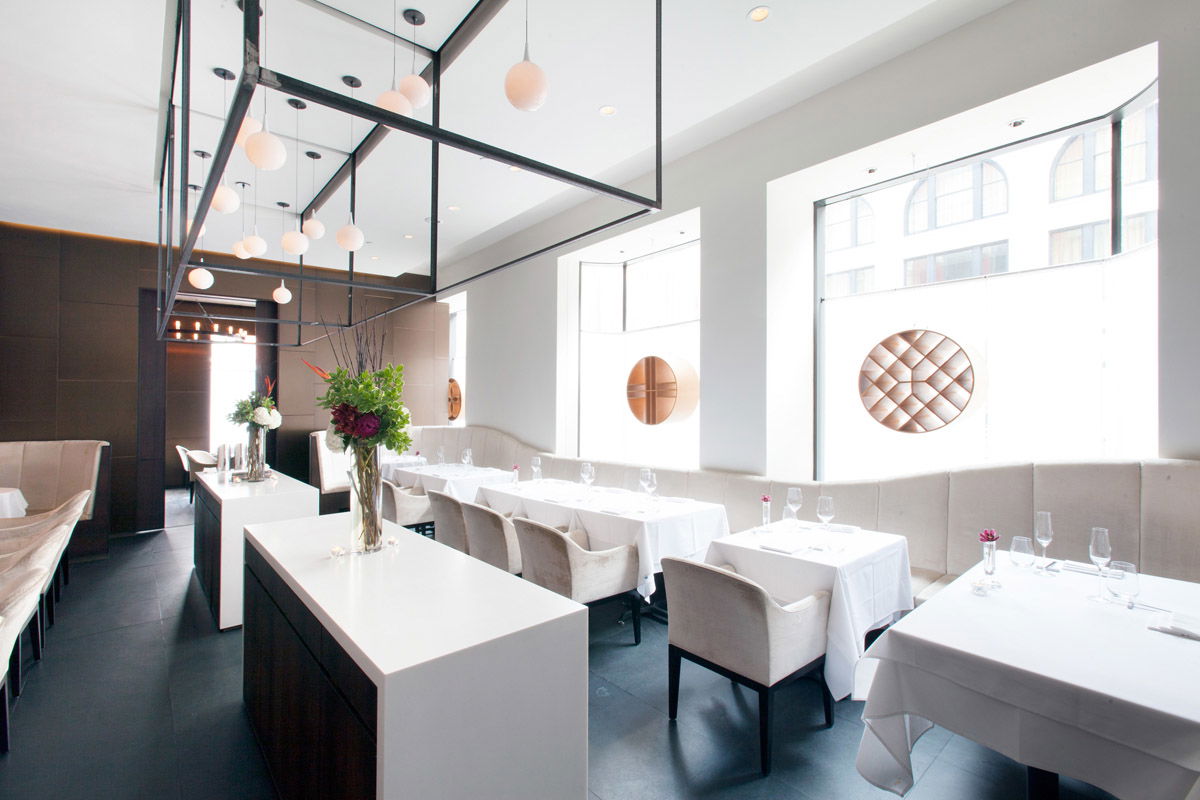
Jungsik sits quietly on a cobblestoned Tribeca street yet reads like one of New York's most serious fine-dining rooms. The dining room balances dark and light tones with clean lines, white tablecloths and precise glassware so the focus stays on the kitchen's output. That low-key, restrained presentation — set inside converted industrial architecture — feels serene and classic rather than flamboyant. The restaurant's three‑Michelin‑star standing and formal registration of its service amplify the sense of a landmark tasting‑menu destination where detail and discipline matter as much as flavor.
Best For
This is a dinner destination built around a multi-course tasting menu and an ambitious wine program, so it suits committed evenings: milestone dinners, formal business meals and other special evenings where the full-service format is part of the appeal. The write-up emphasizes the restaurant's place among three‑star peers, its award-winning chef and a full evening experience rather than a quick meal, making it a natural choice for diners seeking a high‑stakes, refined tasting‑menu night out.
Ordering Tips
Expect the nine‑course tasting‑menu format to be the main offering; the copy repeatedly frames the restaurant around its tasting menu and the idea of 'the full evening.' Given the $$$$ price bracket and a noted wine program, plan for an extended service and consider wine pairings if you want the full experience. The description emphasizes formal service and precision in plating and glassware, so approach the meal as a curated, multi‑course commitment rather than à la carte or casual dining.
Venue details
Ambiance
Cool and polished dining room with low-key elegance, dark and light color scheme, modern clean style, unadorned walls, well-spaced tables, and intimate proportions.
Tags
Vibe
Best For
Experience
At the Table
- Dress Code
- Smart Casual
- Noise Level
- Quiet
- Service Style
- Formal
- Meal Pacing
- Extended Experience
- Capacity
- Intimate
- Kitchen
- Modern
- Menu Format
- Tasting menu, Prix fixe
- Wine Program
- Exceptional
- Dietary
- Vegetarian friendly, Allergy accommodating
Signature Dishes
- Royal Bibimbap with black truffle
- Foie Gras Mandoo
- Black Cod
Know before you go
Know Before You Go
- Getting there
- 2 Harrison St, New York, NY 10013
Planning details
Hours
- Monday
- Closed
- Tuesday
- 5:30–9 pm
- Wednesday
- 5:30–9 pm
- Thursday
- 5:30–9 pm
- Friday
- 5–9:30 pm
- Saturday
- 5–9:30 pm
- Sunday
- 5–9 pm
Location
Recognition and awards







Also consider
Also Consider
- One White Street, New American, Contemporary, $$$$
- Shion 69 Leonard Street, Sushi, $$$$
- L'abeille à Côté, French, $$$$
- Atera, New Nordic, Contemporary, $$$$
- L'Abeille, French, $$$$
Restaurant context
How It Compares
Against One White Street, Jungsik New York is the more formal and cuisine-specific commitment. One White Street is better for diners who want $$$$ New American cooking with a broader comfort zone; Jungsik is the stronger pick when the table actively wants progressive Korean fine dining and a more controlled special-occasion rhythm.
Shion 69 Leonard Street is the closest rival for diners choosing between two serious, format-led meals in Tribeca. Pick Shion if sushi is the whole point and the counter experience is the draw. Pick Jungsik if the group wants a composed tasting-menu arc with Korean flavors rather than a sushi-first evening.
Atera competes most directly on contemporary tasting-menu ambition, while L'Abeille and L'abeille à Côté are safer French alternatives for guests who prefer a more familiar luxury vocabulary. For value, none of these are casual spends; the better question is identity. Choose Jungsik when Korean technique and seasonal progression are central to the decision, not incidental.
Explore New York City
Around this place
Discover more on Pearl
Unlock the full Jungsik New York guide in Pearl, including awards, comparisons, FAQs, planning details, and nearby places.
Compare Jungsik New York
| Venue | Location | Cuisine | Awards | Price |
|---|---|---|---|---|
| Jungsik New York | New York City | Progressive Korean, Korean | 2026 North America's 50 Best Restaurants · #182026 New York Times Best Restaurants in New York City · #412026 OAD Top Restaurants in North America Ranked · #482026 Wine Spectator Best of Award of Excellence2026 La Liste Top Restaurants2025 James Beard Awards · #12025 World's 50 North America's Best Restaurants · #352025 Robb Report 100 Greatest American Restaurants of the 21st Century · #442025 OAD Top Restaurants in North America Ranked · #50 | $$$$ |
| One White Street | New York City | New American, Contemporary | Star Wine Lists 2026 · #12026 OAD Top Restaurants in North America Recommended2026 Wine Spectator Best of Award of Excellence2025 OAD Top Restaurants in North America Ranked · #231World's Best Wine Lists 20252025 Wine Spectator Best of Award of Excellence2025 Michelin 1 Star2025 Michelin Plate2024 OAD Top Restaurants in North America Ranked · #312 | $$$$ |
| Shion 69 Leonard Street | New York City | Sushi | No published awards | $$$$ |
| L’abeille à Côté | New York City | French | 2026 OAD Casual in North America Recommended2025 Michelin Plate | $$$$ |
| Atera | New York City | New Nordic, Contemporary | 2026 OAD Top Restaurants in North America Ranked · #41Star Wine Lists 20262026 Wine Spectator Best of Award of Excellence2026 La Liste Top Restaurants2025 OAD Top Restaurants in North America Ranked · #352025 The Best Chef One Knife2025 Wine Spectator Best of Award of Excellence2025 AAA 5 Diamond Restaurant2025 La Liste Top Restaurants | $$$$ |
| L’Abeille | New York City | French | 2026 OAD Top Restaurants in North America Highly Recommended2026 Wine Spectator Best of Award of Excellence2025 OAD Top Restaurants in North America Ranked · #1902025 The Best Chef One Knife2025 Michelin 1 Star2024 OAD Top Restaurants in North America Ranked · #2222024 Michelin 1 Star2023 OAD Top Restaurants in North America Highly Recommended | $$$$ |


.png?width=1200&quality=80)

How Jungsik New York compares with similar nearby venues.
FAQ
Frequently Asked Questions
Does Jungsik New York handle dietary restrictions?
Contact Jungsik New York directly before booking if your party has allergies, restrictions, or substitution needs, especially because it is a $$$$ progressive Korean restaurant in New York City.
Is Jungsik New York good for a special occasion?
Yes, if your occasion calls for a $$$$ New York City restaurant focused on progressive Korean cuisine. Its recognition includes Michelin 3 Stars, a James Beard Award Outstanding Chef #1 recognition, AAA 5 Diamond, and other high-end accolades. For a different luxury option, you might also compare L'abeille à Côté.
What should I order at Jungsik New York?
Check the current offering directly with the restaurant. The reason to choose Jungsik New York is its progressive Korean and Korean cuisine from chef-owner Jungsik Yim. If you want a different high-end New York City option, L'Abeille is another restaurant to consider.
Is Jungsik New York worth the price?
It can be worth the $$$$ price if you specifically want high-end progressive Korean cuisine in New York City with major recognition, including Michelin 3 Stars and a James Beard Award Outstanding Chef #1 recognition. If the Korean point of view is not important to you, compare it with other premium options such as Shion 69 Leonard Street.
Is the tasting menu worth it at Jungsik New York?
Check directly with the restaurant before assuming a tasting-menu format. The key planning details are the $$$$ price level, progressive Korean and Korean cuisine, chef-owner Jungsik Yim, and major recognition. For another high-end New York City comparison, consider Atera.