Book Enclos. After two meals, one when it held two Michelin stars and one after it earned three, it is my favorite restaurant in California. The food is the first reason, but it is not the only one. Brian Limoges has built a tasting menu with a point of view, while Ian, Sam, Jason, Jaclyn, and the rest of the team deliver the kind of warm, alert service that makes four hours at the table pass much faster than four hours should.
My first visit was November 20, 2025. Enclos had gone from opening in December 2024 to two Michelin stars and a Green Star in roughly six months. I returned on July 24, 2026, four weeks after Michelin promoted it to three stars. The second dinner did not feel like a restaurant trying to behave differently because a plaque had changed. It felt like the same deeply personal house operating with even more range and confidence.
That continuity is the point of this Enclos Sonoma review. The autumn menu and early-summer menu were almost entirely different, yet both meals had the same identity: Sonoma produce, Pacific seafood, French technique, flashes of Japan, and direct references to Limoges’s New England childhood. One course might place ten farm-grown squash varieties in front of you; another might turn clam chowder into chawanmushi or compress a Maine lobster roll into one crisp bite. The ideas are easy to understand. The execution is why I went back.
Disclosure: Neither meal was hosted or comped.
The short answer: should you book Enclos?
Yes. Book Enclos if dinner is the main event of your Sonoma trip, if you value a wine program as much as the cooking, or if you want three-star precision without a cold or ceremonial dining room. At $295 per person for the tasting menu, before beverages and any current service charge, it belongs in the same decision set as The French Laundry, SingleThread, and Quince. I would choose Enclos again.
Here is the practical version, last checked August 2026:
- Location: 139 East Napa Street, Sonoma, California, a few steps from Sonoma Plaza.
- Michelin status: three stars in the 2026 California Guide; two stars plus a Green Star in 2025.
- Format: a 30-seat dining room with an eight-to-ten-course seasonal menu, preceded by canapés and followed by mignardises.
- Price: $295 per person for the tasting menu. Confirm the current total and service charge on Tock before booking.
- Time commitment: reserve roughly four hours. Our first dinner ran about three and a half hours; the second ran nearly four.
- Reservations: released on the last Friday of each month at noon Pacific, two months in advance, through Tock.
- Schedule: dinner Wednesday through Saturday, reservation only.
- Groups: up to six during regular service; larger parties require a buyout.
- Age and dress: the official policy requires guests to be 12 or older and excludes shorts, sandals, athleisure, and hats.
- Corkage: the official policy lists $125 per 750 ml bottle, maximum two bottles.
- Dietary needs: notify the restaurant at least 72 hours ahead. A vegetarian menu is possible with notice; fully vegan and celiac-safe menus are not. Review the current restrictions before purchasing the prepaid experience.
- Parking: street parking nearby, with ADA-accessible parking behind the building.
Enclos is in Sonoma, not Napa
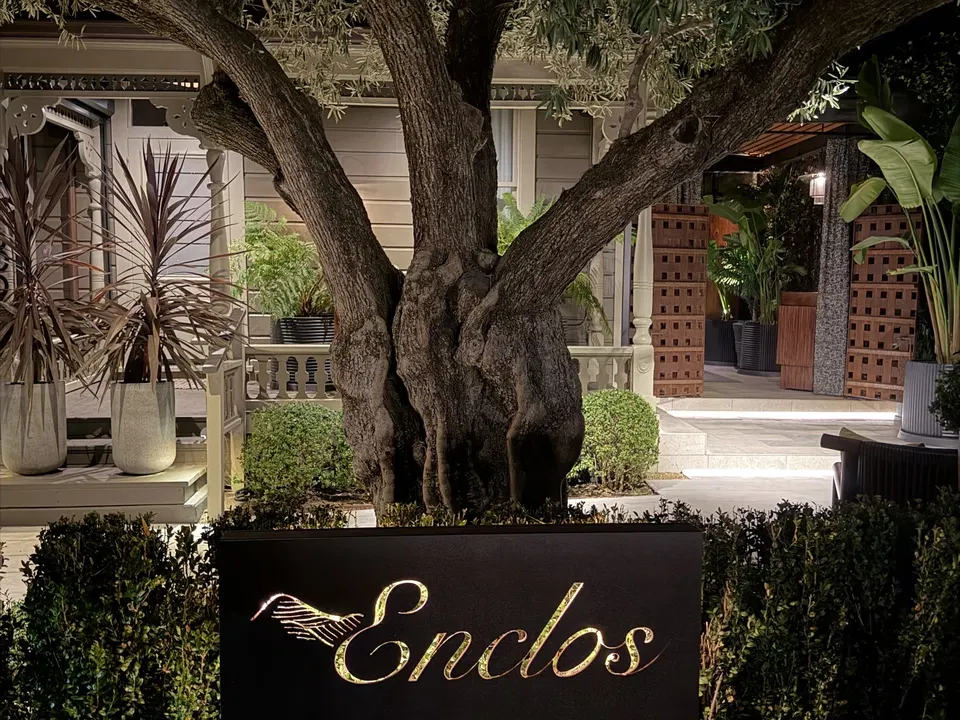
One geographic correction matters at the start: Enclos is in the city of Sonoma, not Napa. The confusion is understandable because the address is 139 East Napa Street, but the restaurant sits just off Sonoma Plaza in Sonoma County. It is about a 25-mile drive from Yountville and The French Laundry, depending on route, and it should be planned as a Sonoma dinner rather than a casual addition to a Napa Valley day.
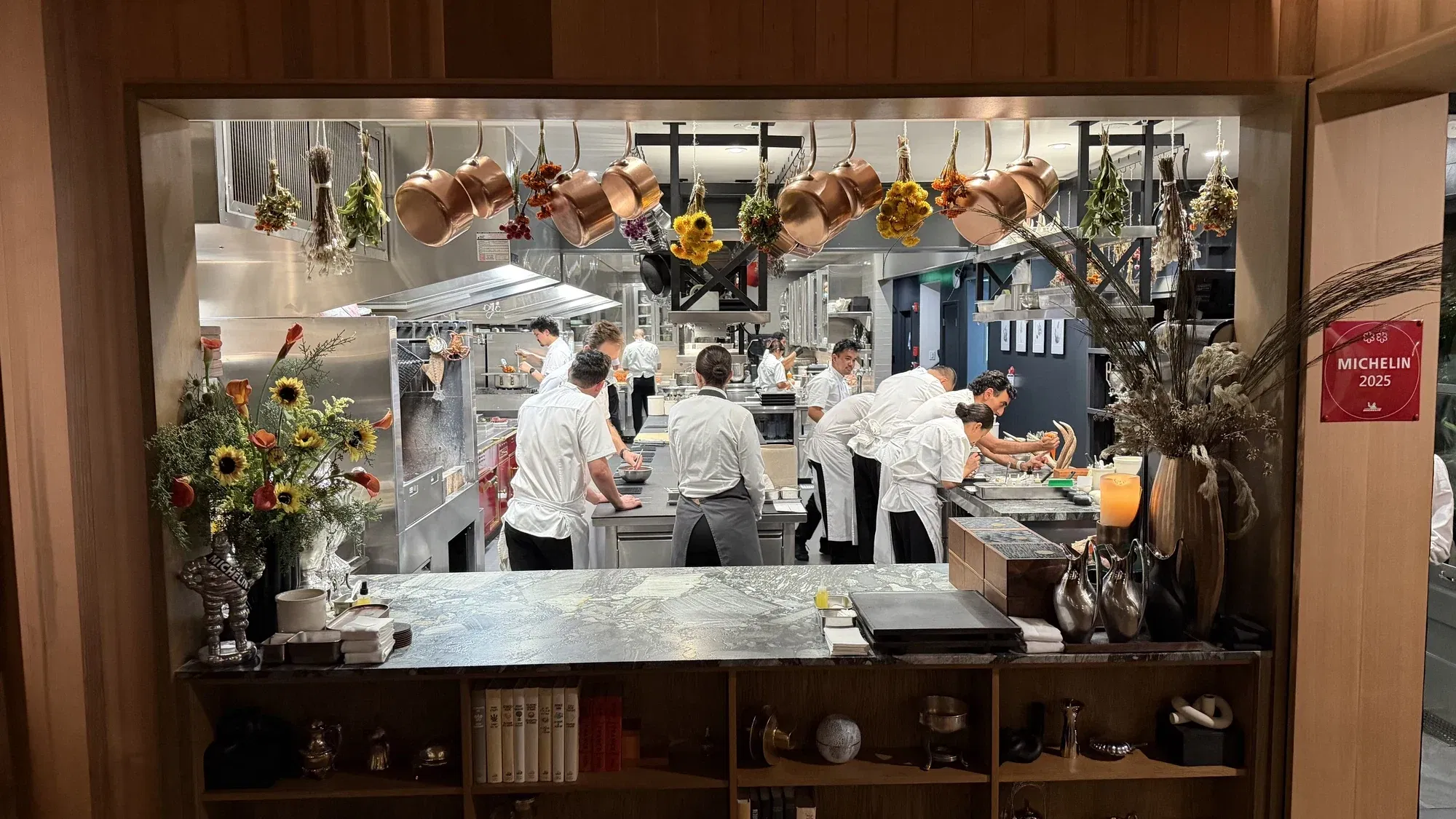
The setting helps explain why the room works. Enclos occupies a restored 1880 Victorian, but the dining room does not lean on period nostalgia. Warm wood runs up the walls and into the steep ceiling. The kitchen is fully visible through a wide opening at the far end, and the line of copper pans above it makes the cooks part of the room without turning them into a performance. Thirty seats are enough to create energy, but few enough that the team can remember what each table is drinking and where each conversation paused.
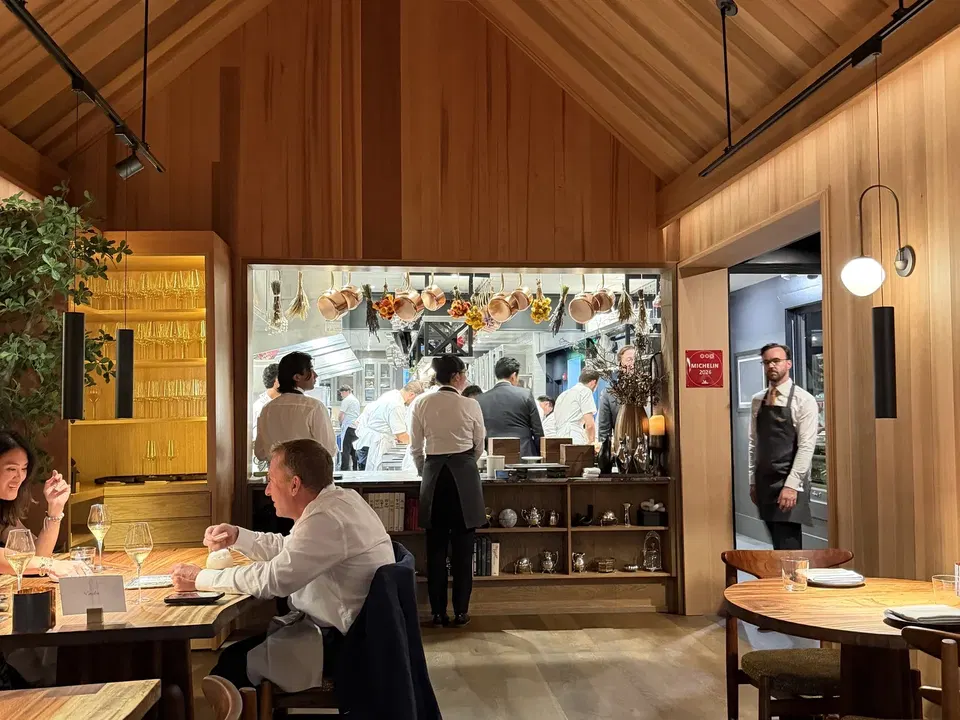
The design feels closer to a beautifully resolved Sonoma home than a hotel dining room. That distinction matters over a long tasting menu. We could watch the kitchen, talk with the team, and settle into the table without feeling that every movement had been choreographed for us. The meal had formality where formality helps: glassware, pacing, temperature, sauce work, and synchronization. It had ease everywhere else.
Two visits captured Enclos at two different Michelin moments
The timing of these meals gives this review a useful before-and-after structure. Michelin awarded Enclos two stars and a Green Star in June 2025. My first dinner came five months later, while the restaurant was still one of the fastest new two-star arrivals in California. Michelin then promoted Enclos to three stars in June 2026, only about eighteen months after opening. I returned the following month.
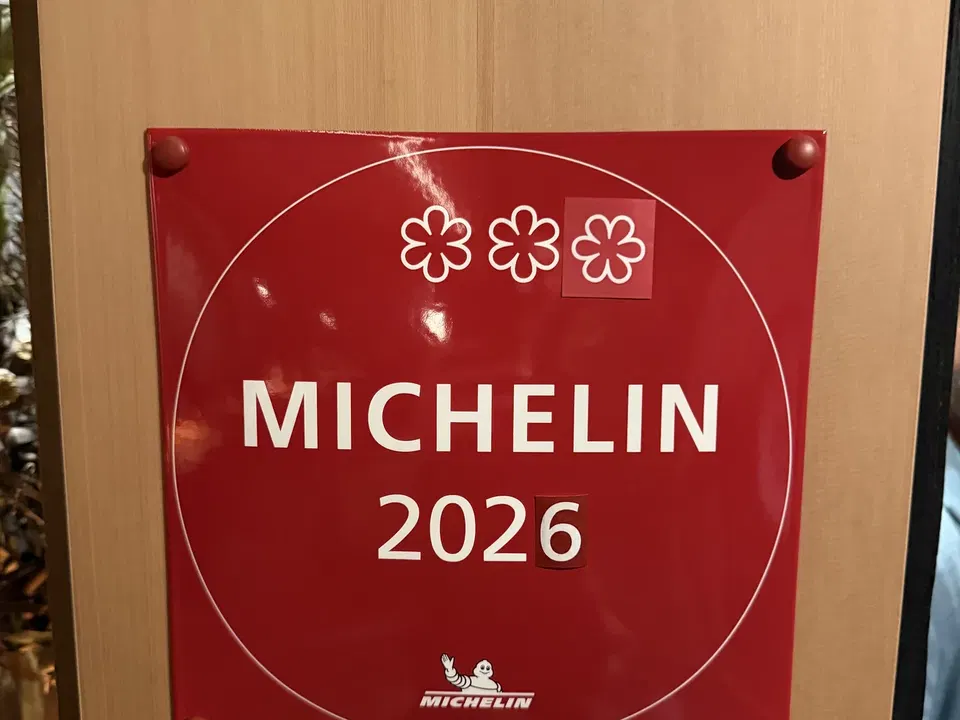
That rise sounds almost too fast until you look at the résumés and infrastructure behind the room. Enclos did not begin as a small independent project improvising its supply chain. It is connected to Stone Edge Farm Estate Vineyards & Winery, with dedicated gardens, an established cellar, and owners Leslie and the late Mac McQuown’s long relationship with farming and Bordeaux-style wine. Limoges arrived with years in restaurants that already understood Michelin-level systems. The dining-room leaders had the experience to make those systems feel human.
Still, stars can only explain why demand increased. They cannot explain why I wanted a second meal so quickly. I returned because the first menu was fun to eat, because the wine service encouraged curiosity, and because the people remembered how to make the table feel seen. After the third star, none of that warmth had been traded for stiffness.
Brian Limoges gives the menu a voice that belongs to him
Chef Brian Limoges grew up in rural New Hampshire and graduated from the New England Culinary Institute. He moved to San Francisco in 2013 to work as a sous chef at Atelier Crenn, then joined Quince and was part of the restaurant during the period in which it earned three Michelin stars. He helped open Birdsong, where the kitchen earned a star in its first year, assisted Simon Rogan with the launch of Henrock in northern England, and later oversaw Angler and Saison for the Saison Restaurant Group.
That history is visible at Enclos, but it never reads like a list of borrowed techniques. The French training appears in sauces, custards, pastry, and the discipline of the progression. The Pacific influence appears in chawanmushi, koshihikari rice, kombu, wakame, sake, and dry-aged tuna. New England supplies the emotional references: lobster roll, clam chowder, brown bread, and the coastal memory behind them. Sonoma supplies the season, produce, meat, dairy, olive oil, honey, and wine.
The smartest dishes operate in several of those places at once. The 60-day dry-aged tuna belly is paired with rice and passion fruit, but its depth and comfort are closer to a composed main course than a conventional crudo. The chawanmushi is Japanese in form and New England clam chowder in flavor memory. A lobster-roll croustade arrives in a single ring of pastry, filled with Maine lobster and a rich emulsion made from the lobster’s innards. None of those combinations need a lecture to land.
Limoges also knows when to let an ingredient list do the talking. Both visits included a sheet devoted to a seasonal farm course. In November, it listed ten squash varieties. In July, “Early Summer in Sonoma” named finger lime, green strawberry, kohlrabi, cucamelon, radish, pine shoots, wasabi root, borage, fermented daikon, purple peas, sea beans, and more. The sheet was not a claim about seasonality. It was evidence.
The dining-room team is a major reason to return
Enclos’s hospitality team is not a secondary feature. Ian Cobb, the general manager, gives the room its calm center. Beverage director Jason Chin can move from Champagne to sake, Burgundy, Stone Edge Farm Cabernet, and old Madeira without turning the conversation into a test. Service director Jaclyn Bisantz-Chin brings the same combination of accuracy and ease to the floor.
Sam was part of the hospitality team I remembered too. The attention he and the rest of the room delivered felt personal rather than scripted.
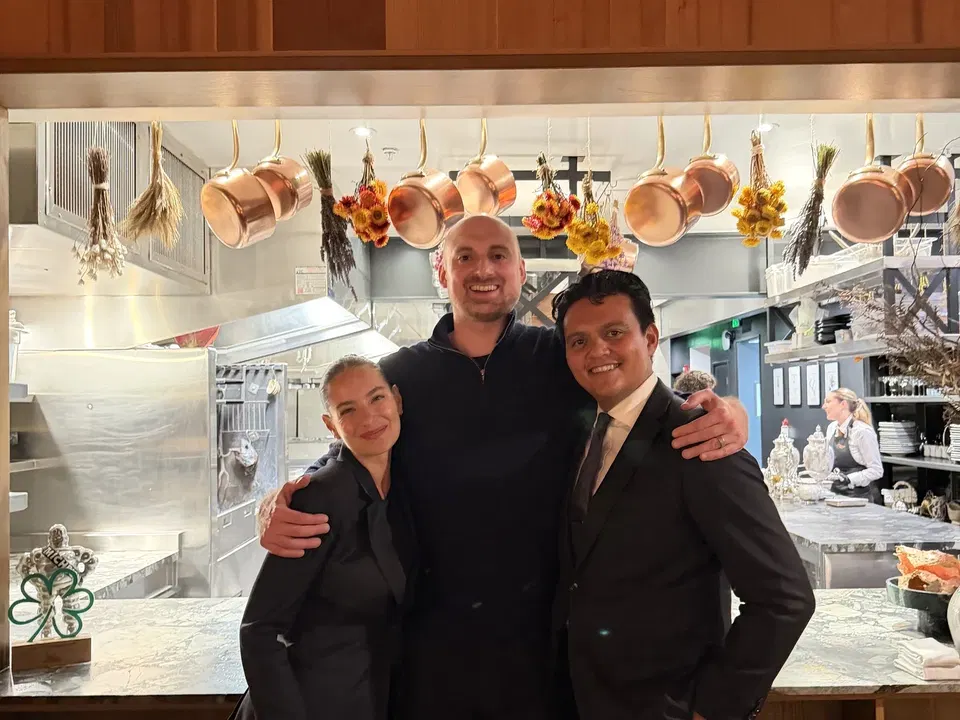
The post-dinner photograph from our second visit captures Jaclyn, Ian, and Jason in front of the open kitchen. It also captures something the formal job titles miss. They look like a team that enjoys being in the room together. That translates to the table. Course descriptions were detailed without becoming speeches, wine discussions could run as deep as we wanted, and the team knew when the table wanted another question answered and when it wanted to keep talking among itself.
For me, that is the difference between a technically strong tasting menu and a restaurant I want in my regular rotation. A long dinner should not require the guest to perform seriousness for the room. Enclos respects the cooking and still allows people to have fun.
The meal begins with Champagne, then moves fast
Both visits began with the Champagne cart, and it is one of the clearest signals that Enclos understands celebration. The cart is not filled with interchangeable labels. The rotation changes, and our photographs show bottles with enough range to make the first choice part of the evening rather than a default pour.
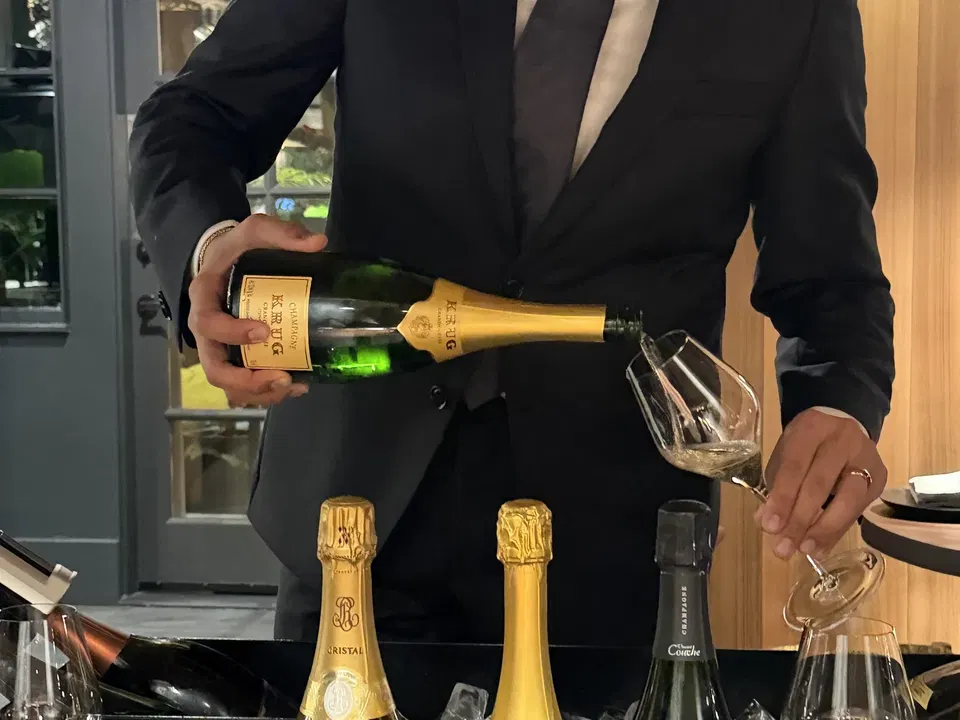
Jason’s larger wine program starts with California and France, then reaches outward when another bottle, sake, beer, or cider serves the course better. The official list also holds Stone Edge Farm library vintages. If you enjoy wine, tell the team what you normally drink and how adventurous you want the progression to be. If you do not want a full pairing, the Champagne cart, bottles by the glass, and a carefully chosen bottle can still create a complete evening.
The food starts with a sequence of canapés that makes Limoges’s biography edible. The Maine lobster “roll” croustade compresses the reference into one crisp ring. Sweet lobster fills the shell, and the brain emulsion adds the intensity that mayonnaise would supply in a conventional roll without making the bite heavy.
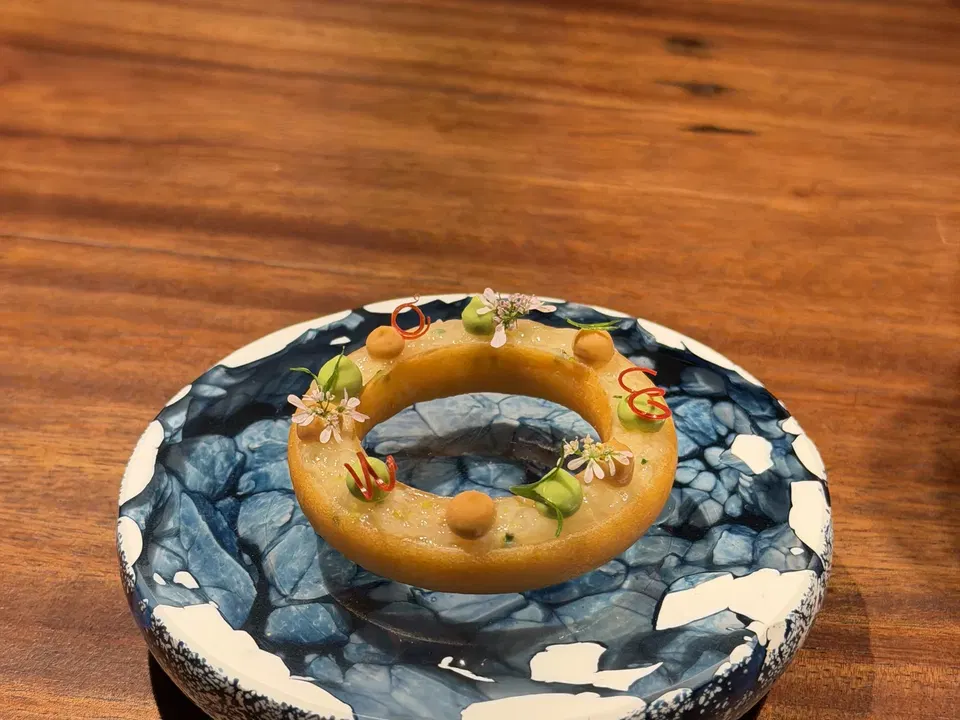
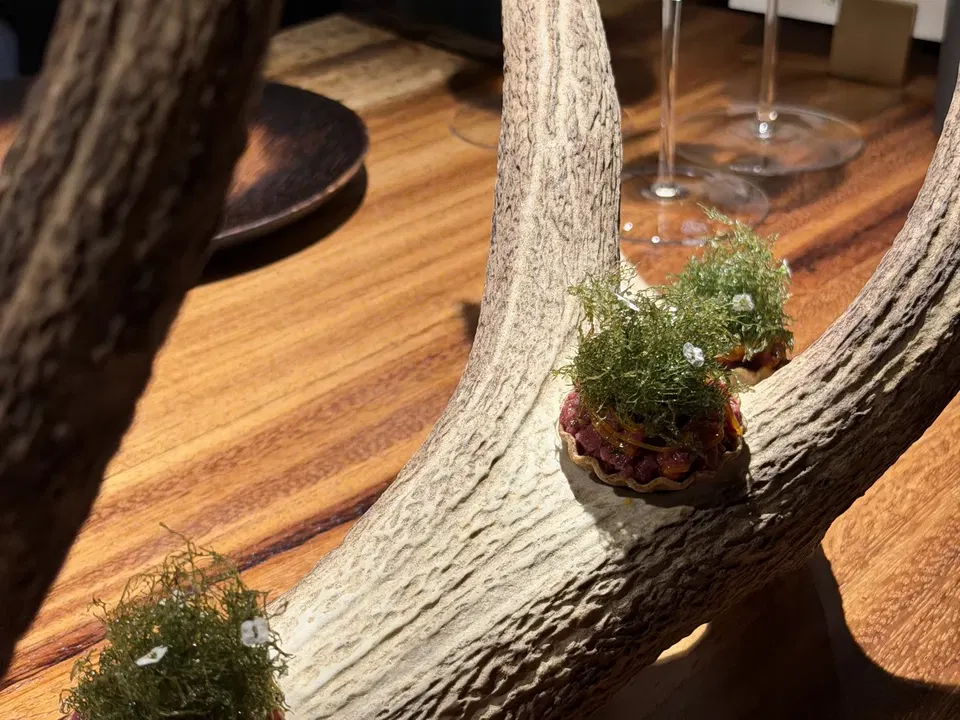
The venison tart goes in the opposite direction. It arrives on antlers, topped with fried lichen, and connects the bite to the deer and oak-covered trails Limoges encountered while walking around Sonoma. It could have been pure visual drama. Instead, the smoked oat shell, venison, onion, and lichen build a compact, savory bite that tastes as purposeful as it looks.
The other opening bites deepen that range. The July menu listed Neapolitan duck liver pie and fermented rutabaga bread pudding with 100-year balsamic. The bread pudding is rich, sweet, fermented, and savory in a few bites. It also shows why Enclos’s opening sequence is more than a prelude. At some restaurants, canapés buy time while the kitchen prepares the first plated course. Here they establish the menu’s main ideas before the first bowl arrives.
First visit: autumn in Sonoma at two Michelin stars
The November 2025 meal began at 5:47 p.m. and our last photograph was taken shortly after 9:13. The autumn menu is reconstructed here from the course cards, photographs, and matching November menu coverage rather than a complete printed takeaway menu. That distinction matters because Enclos changes small components with the farm and market.
After the canapés, the most literal expression of autumn was the Stone Edge Farm squash course. The card named Candy Roaster, Honeynut, Butternut, Roughnut “Autumn Frost,” Kabocha “Green Buttercup,” Lunga di Napoli, Spaghetti Squash, Musquée de Provence, Red Kuri, Delicata, and Sugar Loaf. It was an unusually persuasive way to treat squash as a category rather than one sweet orange purée.
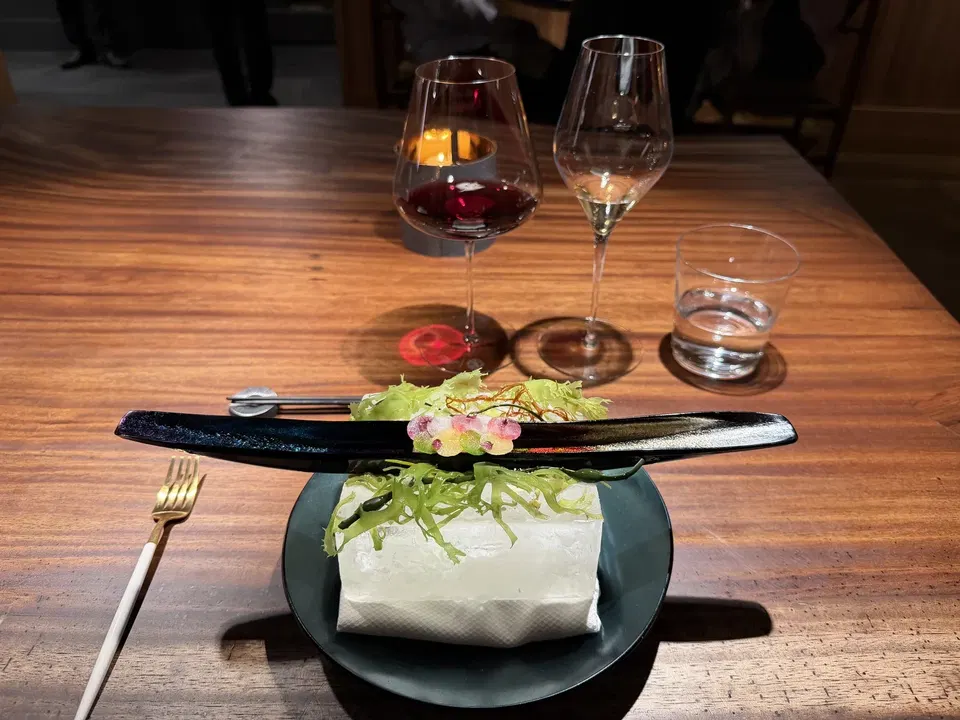
The course moved through different densities, temperatures, and levels of sweetness. More important, it gave the first meal a date and place. You could not move that plate unchanged to July. That is the kind of seasonality I care about: not a garnish changed for the calendar, but a course whose reason for existing disappears with the crop.
The chawanmushi followed the same logic as the version Michelin singled out in its 2025 announcement. A steamed custard carries the flavor memory of clam chowder, with caviar and seasonal vegetables bringing salinity and structure. Limoges does not turn chowder into foam and call it progress. He preserves the comfort and depth, then gives it a texture and portion that fit the larger menu.
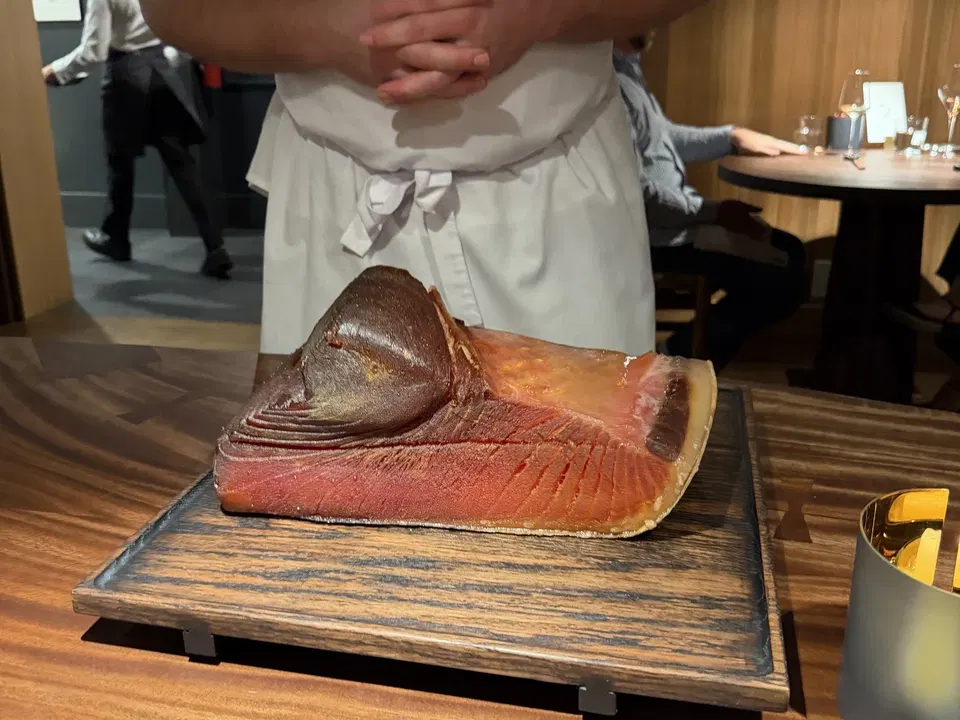
The dry-aged tuna course was already central to the menu. On the first visit, the team brought the whole aged fish to the table before serving it with koshihikari rice, passion fruit, and succulents. Aging intensifies the tuna’s savoriness and softens the line between seafood course and meat course. Passion fruit is not decoration here. Its acidity is what lets the dish carry that much richness without slowing the meal.
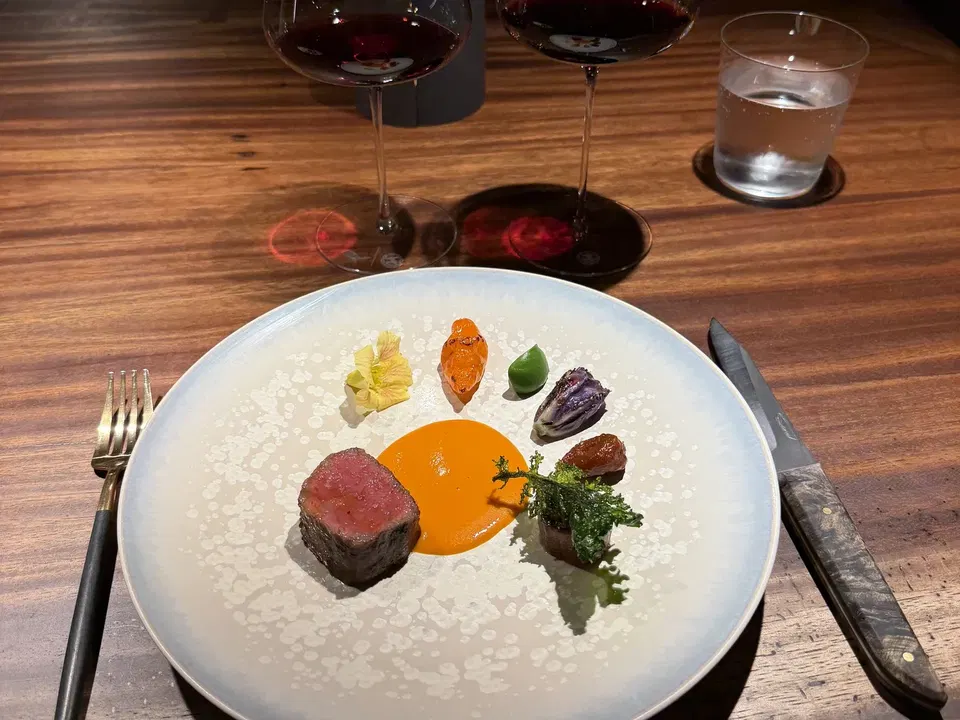
The final savory sequence moved through quail and beef, supported by the farm’s vegetables and sauces with enough acidity to keep the progression moving. The beef plate was arranged with the main cut, several vegetable preparations, and concentrated sauces placed separately. That structure gave each bite a choice rather than covering the meat with one dominant jus.
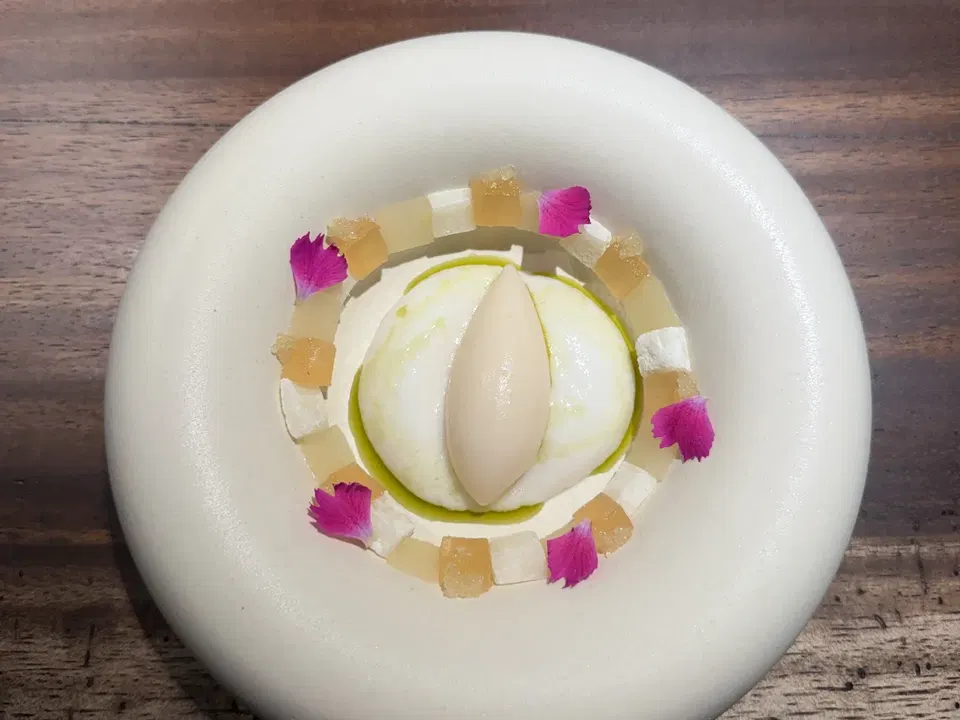
Dessert did not abandon the menu’s restraint. A pear, mochi, ice cream, and olive oil course used cool fruit, chew, cream, and a direct grassy note from the oil. It refreshed rather than simply adding more sugar after the savory courses.
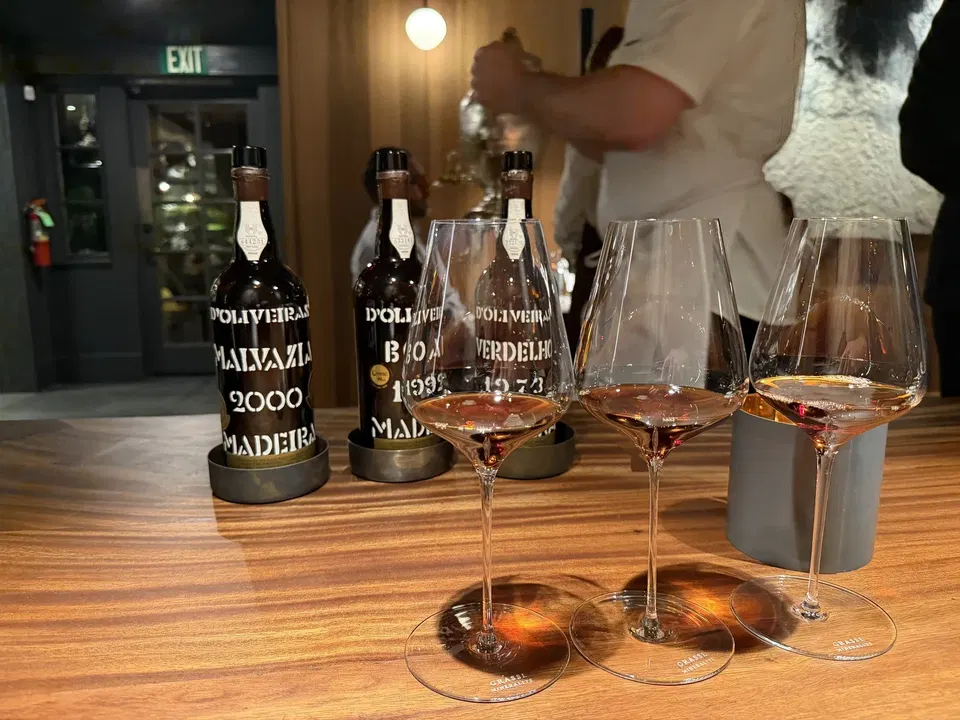
The beverage team then opened another chapter with old Madeira. Bottles from 1973, 1980, 1992, and 2000 turned the end of dinner into a compact lesson in oxidation, age, sweetness, and acidity. It was generous service, but it was also smart sequencing. Madeira can meet caramelized fruit, chocolate, coffee, and small pastries without fading.
By the time the honeycomb presentation and tea arrived, the meal had covered New England, Japan, the Pacific Coast, and a Sonoma farm without feeling like a tasting-menu world tour. The through line was Limoges’s own set of memories and the ingredients available within a few miles of the dining room.
What changed after the third star, and what did not
On the July return, Summer changed the ingredients, the menu devoted more space to multi-part meat courses, and the beverage lineup reached across Champagne, Burgundy, sake, and California. The meal also ran closer to four hours, from our 7:19 p.m. arrival photographs to the nighttime exterior at 11:16.
What did not change was more important. The room remained warm. The Champagne cart still made the opening feel celebratory. The signatures were recognizable but not frozen. Lobster, venison, chawanmushi, dry-aged tuna, farm vegetables, and honey returned in different forms, with enough continuity to feel like Enclos and enough change to justify the second visit.
That is a hard balance for a young restaurant. Remove every recognizable dish and repeat guests lose the pleasure of return. Preserve every signature forever and the farm becomes a branding device. Enclos keeps the ideas and lets the season rewrite their details.
The complete July 24, 2026 tasting menu
The second album includes the printed takeaway menu, so this rotation can be documented in full. Multi-part courses are grouped as the restaurant presented them.
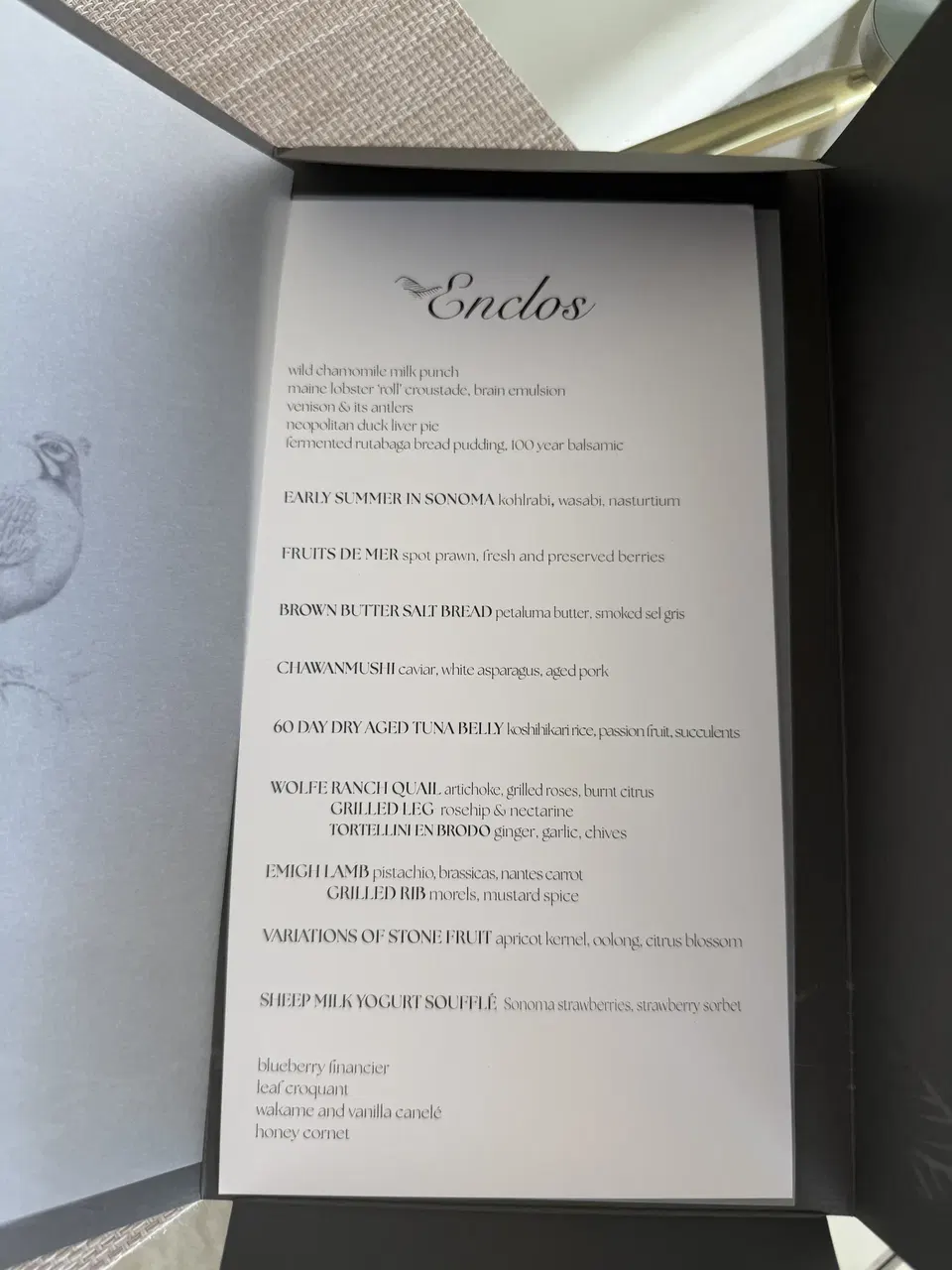
- Wild chamomile milk punch
- Maine lobster “roll” croustade with brain emulsion
- Venison and its antlers
- Neapolitan duck liver pie
- Fermented rutabaga bread pudding with 100-year balsamic
- Early Summer in Sonoma with kohlrabi, wasabi, and nasturtium
- Fruits de Mer with spot prawn and fresh and preserved berries
- Brown Butter Salt Bread with Petaluma butter and smoked sel gris
- Chawanmushi with caviar, white asparagus, and aged pork
- 60-Day Dry-Aged Tuna Belly with koshihikari rice, passion fruit, and succulents
- Wolfe Ranch Quail with artichoke, grilled roses, and burnt citrus; grilled leg with rosehip and nectarine; tortellini en brodo with ginger, garlic, and chives
- Emigh Lamb with pistachio, brassicas, and Nantes carrot; grilled rib with morels and mustard spice
- Variations of Stone Fruit with apricot kernel, oolong, and citrus blossom
- Sheep Milk Yogurt Soufflé with Sonoma strawberries and strawberry sorbet
- Mignardises: blueberry financier, leaf croquant, wakame-and-vanilla canelé, and honey cornet
The printed list makes the dinner sound even larger than the official eight-to-ten-course description because canapés, side preparations, and mignardises are counted individually here. Plan for a progression, not fifteen full plates.
Second visit: the summer menu course by course
“Early Summer in Sonoma” arrived in a clear frozen vessel that looked like a cross-section of the garden. At the center sat a cold green element surrounded by leaves, flowers, shoots, fruit, roots, and fermented pieces. The accompanying card listed more than two dozen components, from cucamelon and pine oil to green almond and sea beans.
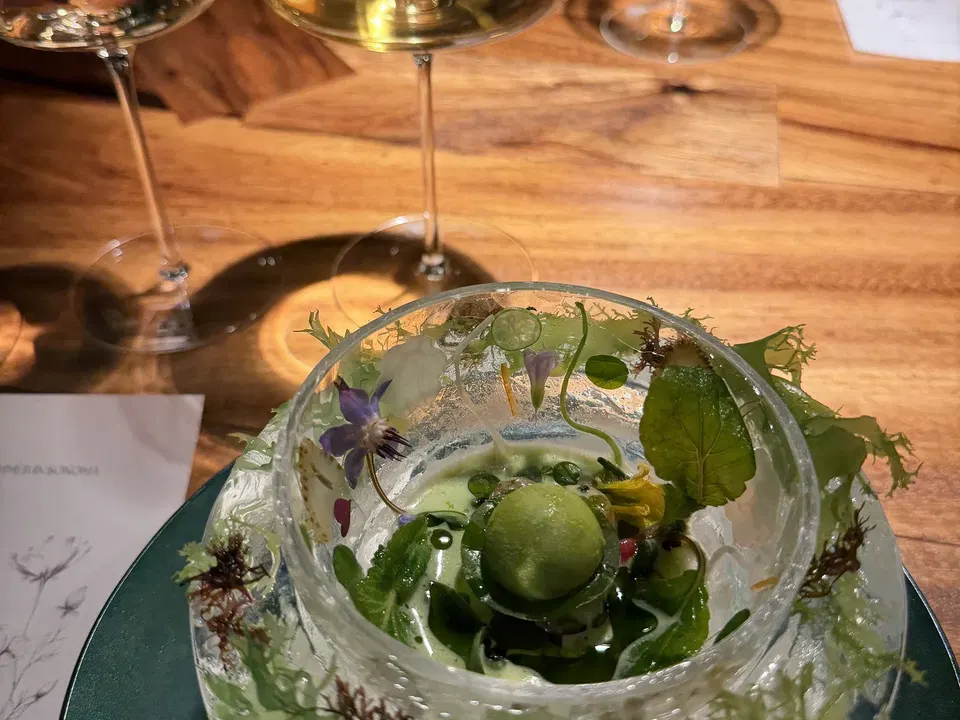
The pleasure of the dish came from changing the next bite. One spoon could be cool and herbal; another could bring acid from green strawberry or finger lime; another could lean into wasabi or fermentation. It was a course with enough contrast to stay interesting through the full bowl.
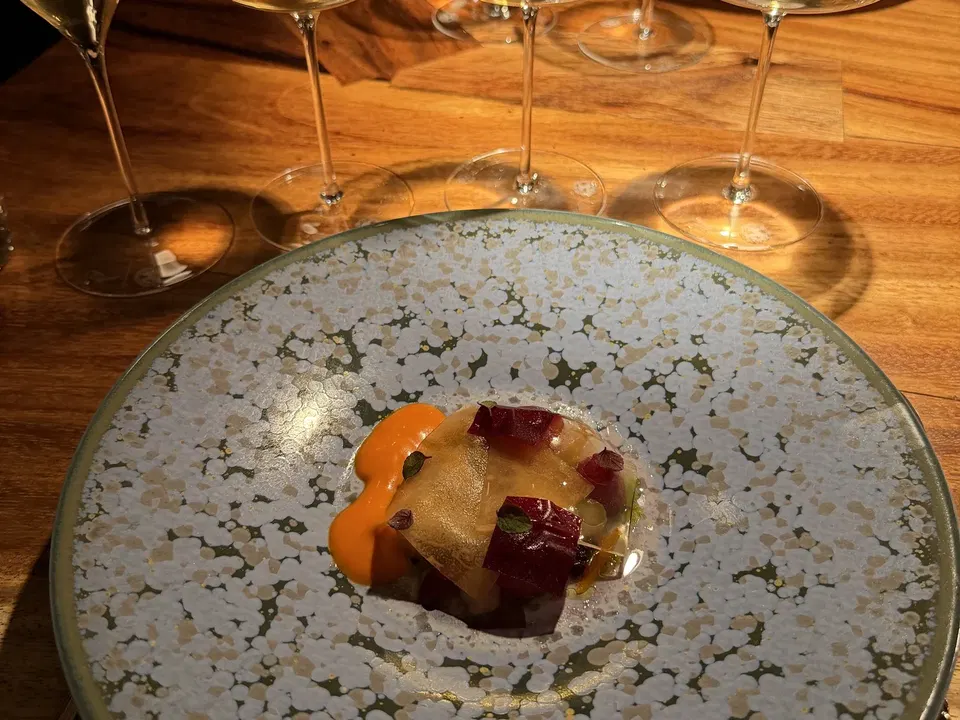
Fruits de Mer narrowed the focus. Spot prawn, fresh and preserved berries, and a clean sauce moved the menu from the many textures of the garden to the sweetness of shellfish. The berries made sense because they met the prawn at its sweet edge while adding the acidity raw shellfish needs.
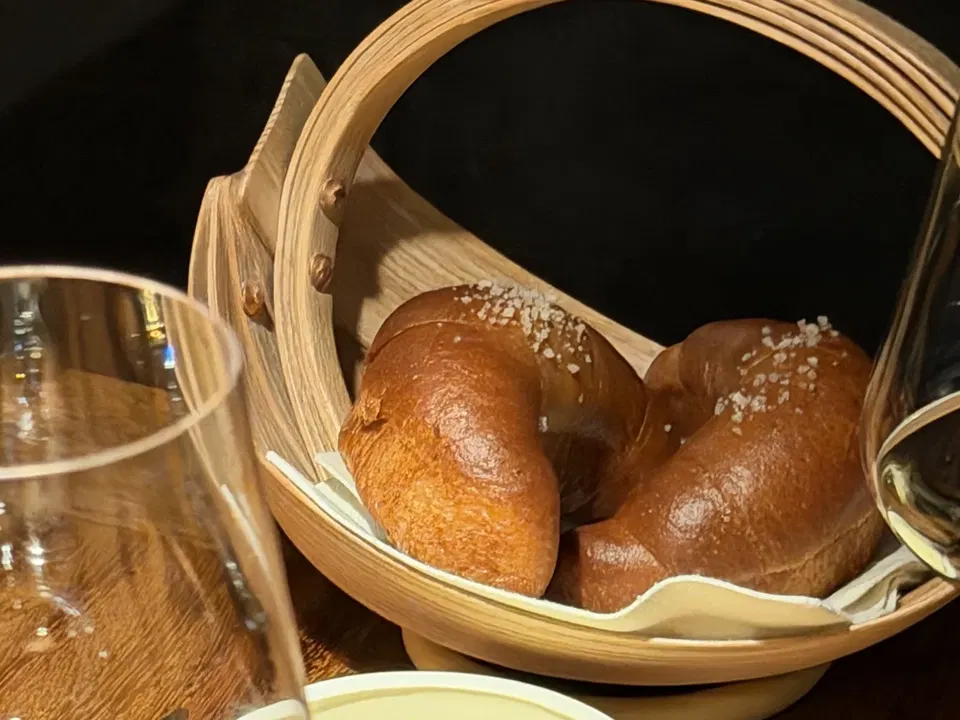
Then came the brown butter salt bread, glossy small loaves served with Petaluma butter and smoked sel gris. Bread is often where a tasting menu accidentally exhausts the guest. Enclos’s version is rich, but its size and smoke make it feel like a course with a specific role rather than an unlimited basket placed beside the meal.
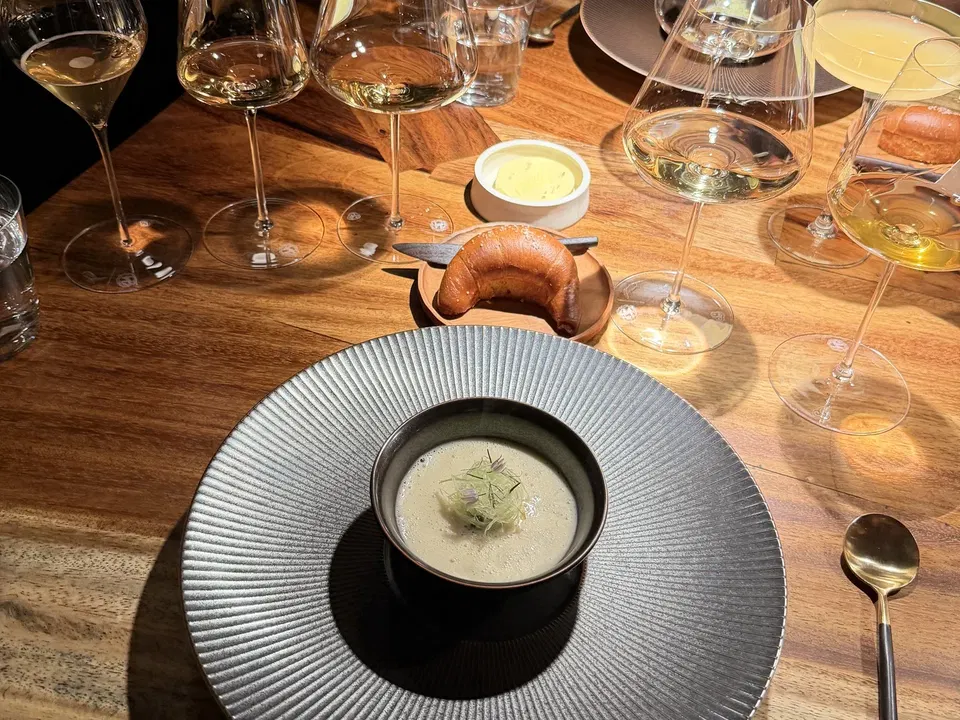
The chawanmushi brought the menu inward. White asparagus and aged pork built depth around the steamed custard, while caviar added a clean saline finish. The clam-chowder idea remained recognizable even as the seasonal components changed. This is one of the dishes that most clearly belongs to Limoges: Japanese structure, New England memory, California sourcing.
The 60-day dry-aged tuna belly was the bridge into the richer half of the meal. Koshihikari rice made it comforting; passion fruit cut through the tuna; succulents added a crisp, saline interruption. The yellow sauce at the center looked almost like an egg yolk, and mixing it into the fish and rice changed the bowl from separate components into something closer to an intensely savory rice course.
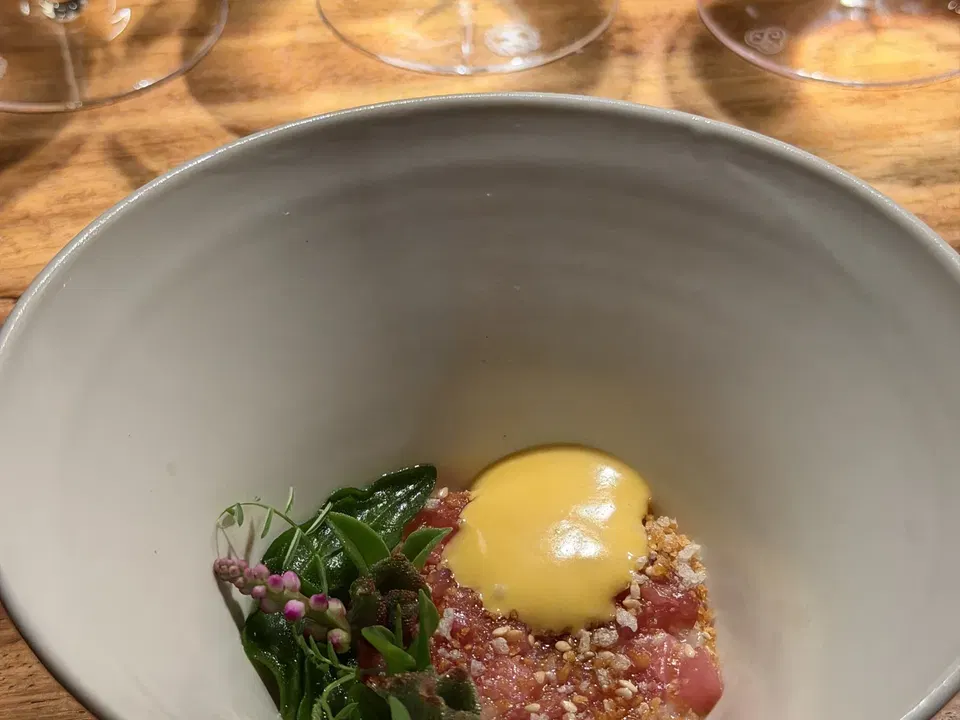
I photographed the whole fish presentation on the first visit and the finished bowl on the second. Together, the images explain why this deserves to remain an Enclos signature. The aging process is visible before the plate arrives, and the finished dish proves the technique has a culinary reason. It is not dry aging for the sake of a talking point.
Wolfe Ranch quail came in three expressions. The breast was paired with artichoke, grilled roses, and burnt citrus. The grilled leg brought rosehip and nectarine. Tortellini en brodo carried ginger, garlic, and chives. Serving the bird across those preparations showed the kitchen’s range, but each part still belonged to the same flavor family of fruit, smoke, broth, and warm spice.
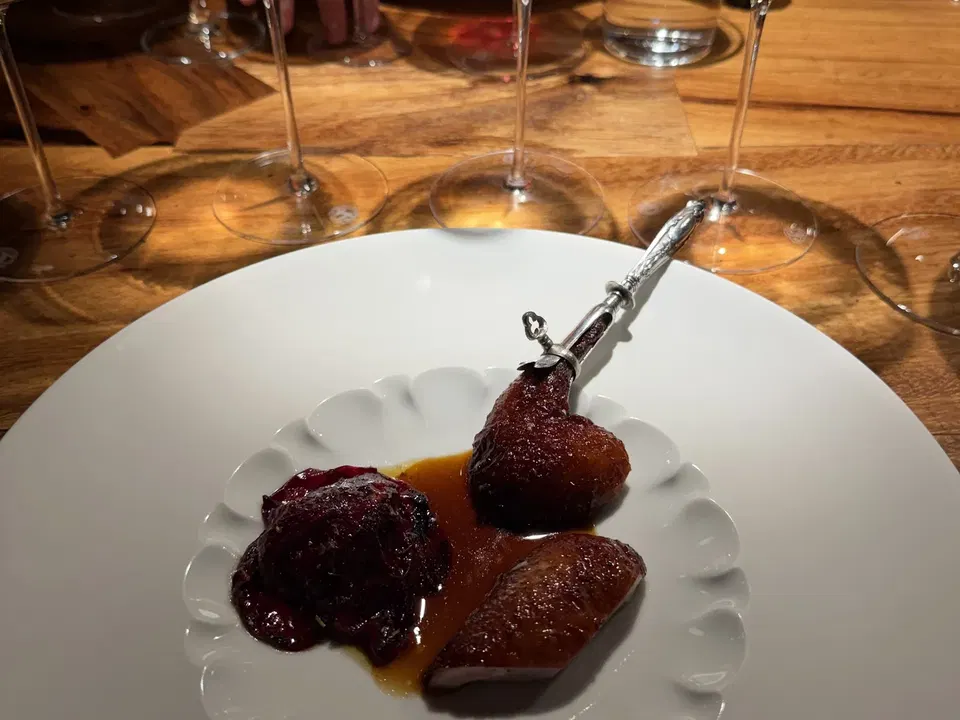
The Emigh lamb followed with pistachio, brassicas, and Nantes carrot, plus a grilled rib with morels and mustard spice. This was the point at which the meal could have become too heavy. Instead, bitter greens and mustard kept the lamb in balance, and the smaller rib preparation made the course feel generous without turning it into a steakhouse portion.
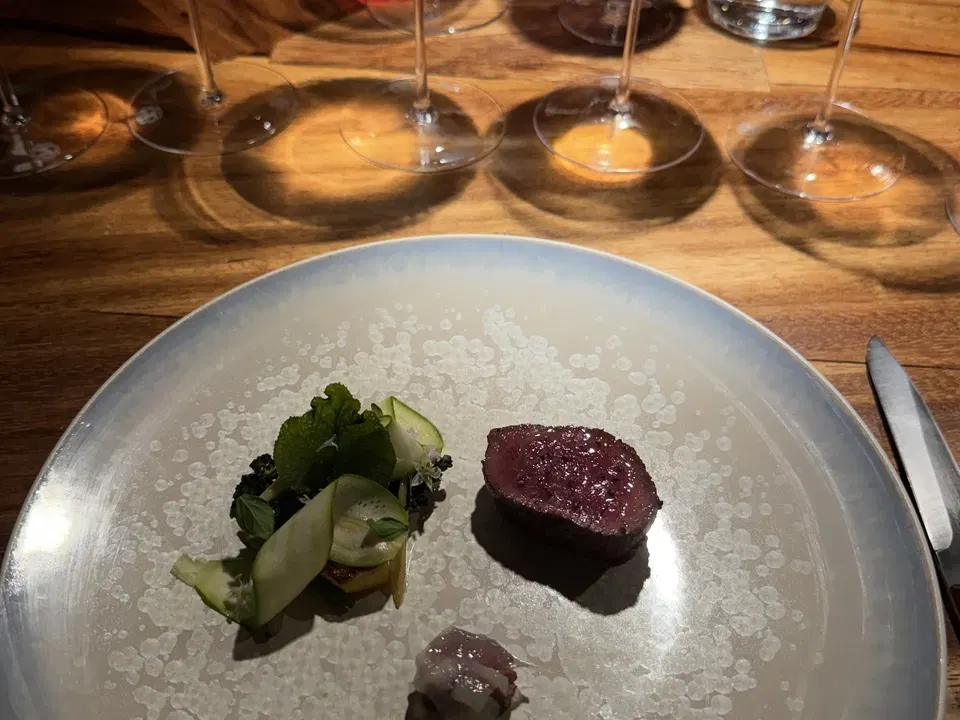
Dessert moved back toward fruit and tea. Variations of stone fruit paired apricot kernel with oolong and citrus blossom. The presentation used a flower-like vessel and a small spoon, focusing the course around aroma, acidity, and the slight bitterness of kernel and tea.
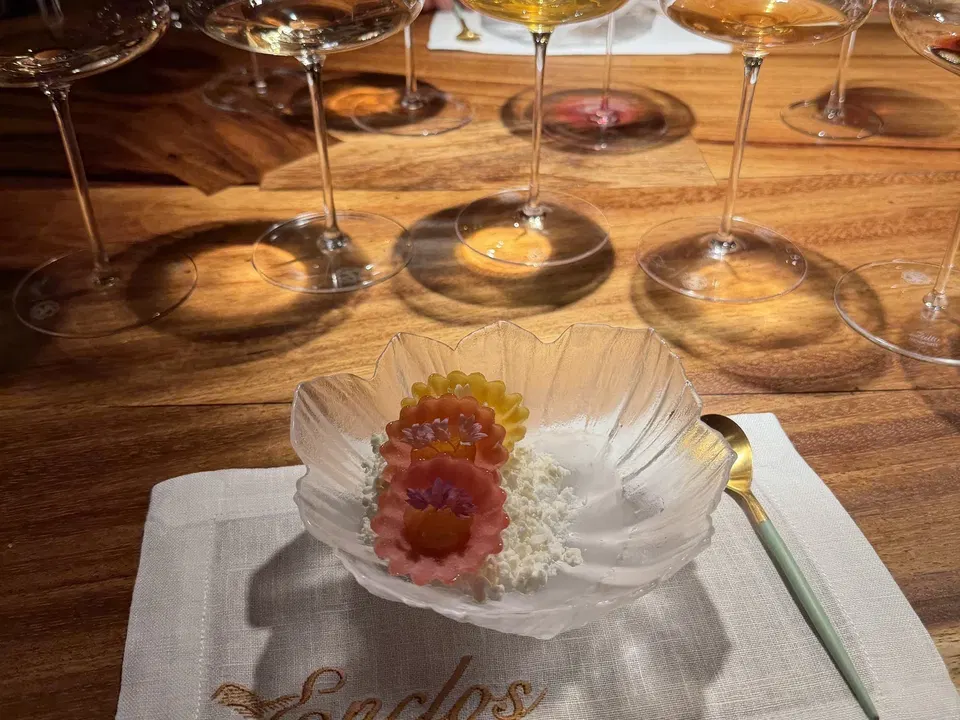
The sheep milk yogurt soufflé was the warmer, more comforting finish. Sonoma strawberries and strawberry sorbet gave it a direct summer flavor, while the yogurt kept the soufflé from reading as only sweet. The table at this point was full of wine glasses from the progression, a useful visual record of how much range Jason’s pairings had covered.
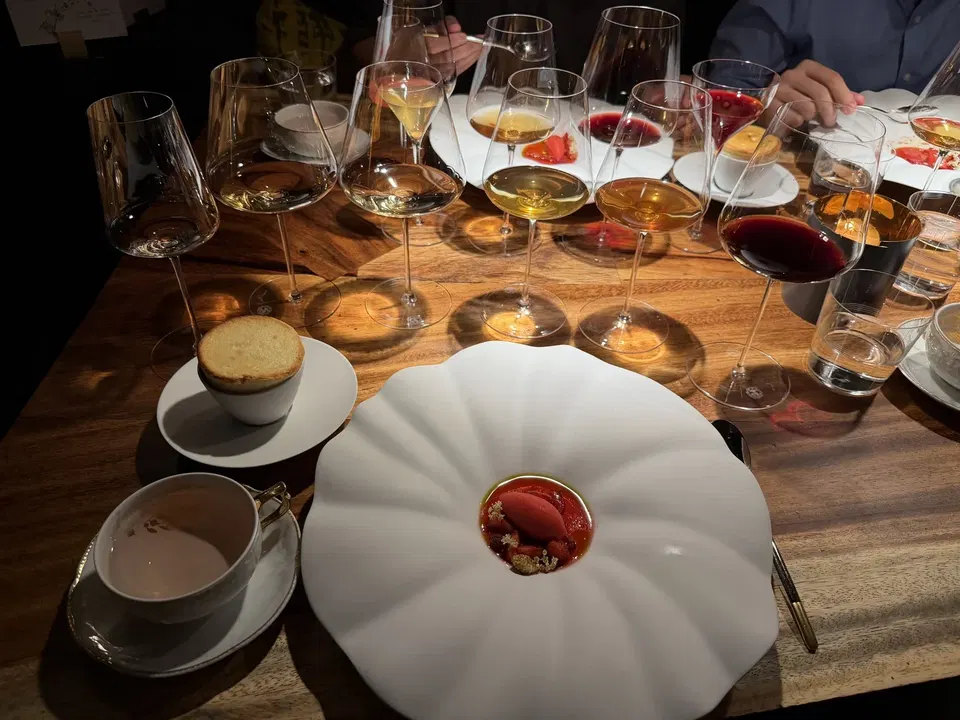
Mignardises closed the meal with a blueberry financier, leaf croquant, wakame-and-vanilla canelé, and honey cornet. The wakame canelé was a final reminder of the menu’s Pacific vocabulary; the honey cornet connected back to Stone Edge Farm. Small gifts and the printed menu came home with us, giving the second visit a satisfying last chapter after nearly four hours.
Jason Chin’s beverage program can support a second visit on its own
The wine program deserves time in the booking decision. Enclos begins with California and France, holds an extensive Stone Edge Farm library, and uses the rest of the world when a course calls for it. Pairings may include sake, beer, or cider rather than forcing every plate into a conventional wine sequence. There is also a nonalcoholic option, though guests should contact the restaurant for the current format.
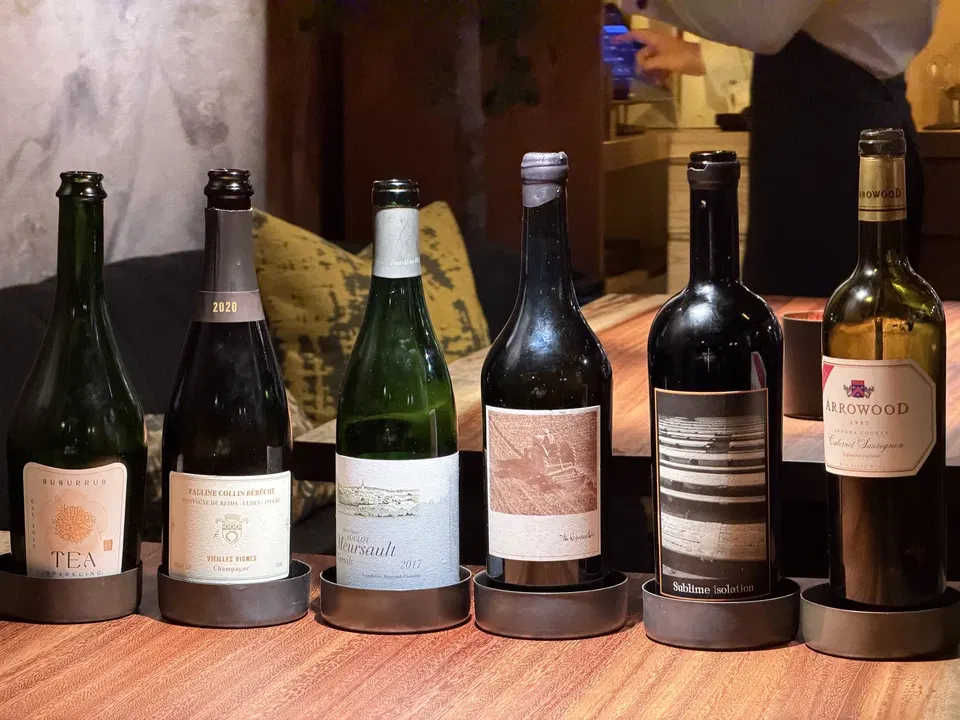
Across the two dinners, the photographs show grower Champagne, Burgundy, sake, Stone Edge Farm, and old Madeira. That is not breadth for display. Dry-aged tuna with rice and passion fruit asks something different from a lamb rib with morels. A service built only around Sonoma Cabernet would miss half the menu.
If you collect wine, ask for the current list before your visit and contact the restaurant if you are seeking a particular vintage. If you want to bring your own bottle, the $125 corkage fee and two-bottle limit make sense only for something personally meaningful or difficult to replace. Otherwise, Jason’s list and the Stone Edge Farm library are part of what you are paying to access.
Stone Edge Farm makes the Green Star tangible
Enclos’s Green Star and Stone Edge Farm connection are not based on a few herbs in planters behind the kitchen. Stone Edge Farm operates a secluded Moon Mountain estate and a culinary garden about three miles west of the restaurant. Together they produce more than 100 varieties of organic heirloom vegetables and fruit, plus herbs, eggs, honey, grapes, olives, and olive oil.
The farm and restaurant preserve and ferment excess produce, turn vegetable trimmings into miso, make “capers” from bay laurel buds, and produce more than 100 cubic yards of compost each year. Cover crops, chickens under olive trees, and owl and bat boxes support the larger system. A microgrid makes the property energy independent and carbon negative, with more than 30 sensors monitoring water use.
Those facts matter because the menu makes them visible. The ten-squash card in November and long summer produce list in July are snapshots of two different harvests. The honeycomb dessert, olive oil, vegetables beside the beef and lamb, and fruit in the final courses keep the farm present from the opening bites through mignardises.
Enclos versus The French Laundry, SingleThread, and Quince
Enclos belongs in California’s destination-restaurant conversation, but the choice among its peers depends on the trip you want.
Choose The French Laundry if Thomas Keller’s history, Yountville, and the institution itself are the objective. Choose Enclos if you want a newer restaurant whose signatures are still taking shape, a 30-seat room close to Sonoma Plaza, and a menu that moves openly between New England, Japan, the Pacific, and Wine Country.
Choose SingleThread if you want the Healdsburg farm, restaurant, and inn to operate as one overnight experience. Choose Enclos if you already have lodging, want dinner to stand on its own, and prefer a Victorian dining room in town. Both connect a three-star menu to dedicated farm production, but the emotional references are different.
Choose Quince if the San Francisco setting and Michael and Lindsay Tusk’s long-established California-Italian vocabulary are central to the night. Brian Limoges worked at Quince, and Enclos carries some of that discipline, but Sonoma changes the result. At Enclos, his New Hampshire childhood and Stone Edge Farm are in the foreground.
My own answer is simpler. I admire all three peers, but after these two meals I would book Enclos first. It gives me the combination I care about most: food with a clear author, a cellar that rewards questions, seasonal change substantial enough to justify returning, and people I was happy to see again.
How to book Enclos and plan the evening
Reservations release on the last Friday of every month at 12 p.m. Pacific, two months in advance, only through Tock. Set a reminder and decide on date flexibility before the release. With 30 seats and four dinner services per week, desirable Friday and Saturday times do not have much inventory.
The cancellation rule is strict enough to read before paying. A reservation can be cancelled for a full refund until 72 hours before the booking. Inside that window it becomes nonrefundable, although it is transferable to another guest. Parties above six need a full buyout.
Send dietary restrictions at least 72 hours ahead. Enclos’s current policy page says it can prepare a vegetarian menu with advance notice, but it cannot offer a fully vegan menu. Eggs, dairy, gelatin, seaweed, gluten, and soy play structural roles in many dishes. The restaurant cannot guarantee celiac-safe, gluten-free, or soy-free service. Ask before booking if an allergy could determine whether the menu works.
Arrive hungry, but do not schedule another commitment afterward. Our dinners ran roughly three and a half and four hours. The second reservation began later, which put us outside after 11 p.m. Street parking is available, but a car service is the better choice if you plan to explore the pairing or order from the Champagne cart and cellar.
The dress code asks guests to avoid shorts, sandals, athleisure, and hats. Guests must be at least 12. Neither rule makes the room stiff. Think dinner-ready rather than black tie.
Who should book Enclos?
Book it for a milestone, but do not wait for one if food and wine are already the reason you travel. The menu gives repeat guests enough seasonal change to come back within a year, and the service has enough personality to make that return feel different from starting over at another tasting counter.
It is an especially strong choice for couples and groups of four who want to talk through a long meal, collectors who want access to an unusual cellar, and diners interested in how a chef turns biography into flavor without making the menu autobiographical theater. I would book it again tomorrow. Set the release reminder, give the restaurant four hours, and let the team lead the night.
Enclos Sonoma FAQ
Is Enclos in Napa or Sonoma?
Enclos is in the city of Sonoma at 139 East Napa Street, near Sonoma Plaza. East Napa is the street name; the restaurant is not in Napa or Napa Valley.
How many Michelin stars does Enclos have?
Enclos has three Michelin stars in the 2026 California Guide. It earned two stars and a Green Star in 2025, about six months after opening, then received the third star in June 2026.
Is Enclos worth booking?
Yes. After two visits, it is my favorite restaurant in California. Book it for a four-hour, dinner-only destination experience built around Brian Limoges’s tasting menu, Stone Edge Farm produce, Jason Chin’s beverage program, and unusually warm service.
How much does Enclos cost?
The tasting menu was $295 per person when this article was fact-checked in August 2026, before beverages and any current service charge. Check Tock for the current total because menu pricing can change.
When do Enclos reservations open?
Reservations open on the last Friday of every month at noon Pacific, two months in advance, exclusively through Tock.
How long does dinner at Enclos take?
Plan for approximately four hours. Our November 2025 dinner lasted about three and a half hours, while the July 2026 return lasted nearly four.
Does Enclos offer a wine pairing?
Yes. The optional pairing can include wine, sake, beer, or other selections. The restaurant also offers a changing Champagne cart, Stone Edge Farm flights and library bottles, and nonalcoholic choices.
Can Enclos accommodate dietary restrictions?
Some, with at least 72 hours’ notice. A vegetarian menu is possible, but a fully vegan menu is not. Enclos cannot guarantee a celiac-safe, gluten-free, or soy-free meal, and it lists additional limits for severe egg, dairy, gelatin, allium, and seaweed restrictions.
What is the dress code at Enclos?
Guests should not wear shorts, sandals, athleisure, or hats. The room feels relaxed within that standard; black tie is not required.
Are children allowed at Enclos?
Guests must be 12 years of age or older.
What is the corkage fee?
Enclos charges $125 per 750 ml bottle and allows up to two bottles per reservation.
Where should I stay for an Enclos dinner?
Stay in or near the city of Sonoma if Enclos anchors the night. The restaurant is close to Sonoma Plaza, so a Sonoma hotel avoids turning a late four-hour dinner into a long drive back to Napa Valley or San Francisco.
Final verdict after two visits
The first visit proved that Enclos’s fast arrival at two stars was not hype. The second proved that the third star had not changed the personality of the restaurant. Brian Limoges’s cooking became broader with the season, the wine program gave us new reasons to linger, and Ian, Sam, Jason, Jaclyn, and the larger team kept the experience generous and personal.
My answer is an enthusiastic yes. Enclos is my favorite restaurant in California, and the return visit made that opinion stronger. Book it for the tuna, chawanmushi, farm courses, quail, lamb, desserts, Champagne cart, and cellar. Go back because the menu will change and the people are worth seeing again.