
Restaurant in Tokyo, Japan
Sushi M
345Pearl PointsBook early. Format rewards the adventurous.


About Sushi M
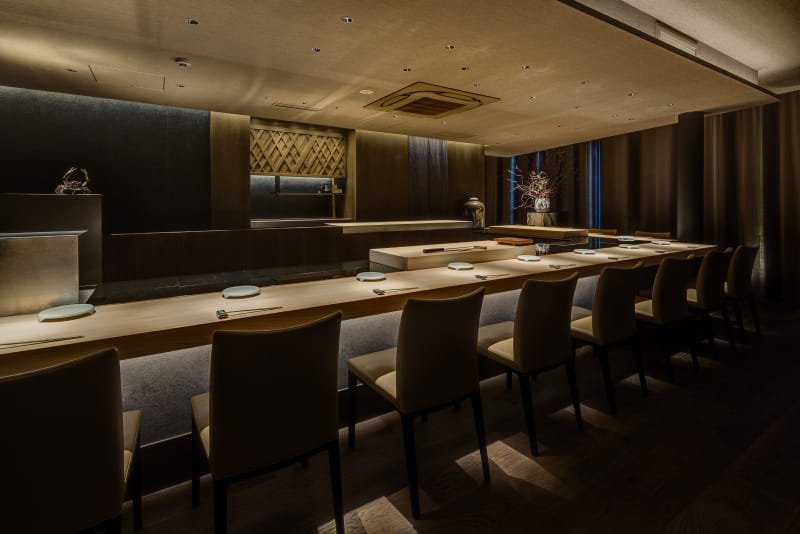
A 12-seat dinner-only counter in Minamiaoyama where Chef Shinichiro Ogata merges French technique with edomae sushi in a single nightly omakase session. Ranked among Japan's top restaurants by Opinionated About Dining in both 2023 and 2025, it suits returning guests ready to engage with the beverage pairing programme. Book ahead — walk-ins are not the format here.
Should You Book Sushi M?
Sushi M operates dinner-only — Tuesday through Sunday, 5 to 11 pm — and with just 12 seats, every service runs close to capacity. There is no pricing listed publicly, which places it in the category of omakase-format restaurants where the menu dictates the cost rather than the other way around. Book on that basis.
What Sushi M Actually Is
The format here is not direct kaiseki or sushi in isolation. Chef Shinichiro Ogata runs a 12-seat counter on the second floor of a Minamiaoyama address where French technique and edomae sushi coexist in the same progression. The beverage pairings are designed to bridge that cultural crossover, not simply sake alongside rice and fish, but a programme that matches the Franco-Japanese register of the food itself. For a returning guest, this is the detail worth paying attention to on a second visit: the pairing programme is where the concept either clicks or doesn't, and it rewards engagement rather than passive ordering.
Minamiaoyama is one of Tokyo's more composed neighbourhoods for a dinner of this type, quiet enough for a long evening, with Aoyama-itchome station within walking distance. For other Aoyama-area options worth knowing, Aoyama Jin is close by and operates in a different register entirely, which is useful context if you are building a longer trip around this part of the city.
Lunch vs. Dinner: The Structural Reality
Sushi M is dinner-only. There is no lunch service listed in the venue record. This matters practically: it means the 12-seat counter runs a single session per evening with no daytime alternative, and there is no lower-priced lunch format to use as a first-visit entry point. For first-timers who want to gauge fit before committing to a full omakase dinner spend, that option does not exist here. The model is one format, one price tier, one session. If you prefer to road-test a restaurant at lunch before a larger evening commitment, a reasonable approach at this price bracket in Tokyo, you will need to look elsewhere. Hirosaku and Ajihiro both offer formats worth considering for a daytime slot in the same culinary tier. For kaiseki in particular, Kikunoi Tokyo runs lunch services that give you a grounded point of comparison before committing to a single-session format like Sushi M's.
Practical Details
Reservations: Book in advance, with 12 seats and a single nightly session, last-minute availability is unlikely on any weekend. Booking difficulty is rated Easy by Pearl, which likely reflects the absence of a high-profile waitlist system rather than surplus seats. Hours: Tuesday to Sunday, 5–11 pm; closed Monday. Dress: No dress code is listed, but the Minamiaoyama location and format suggest smart casual as the floor, not the ceiling. Budget: Pricing is not published; expect omakase-level spend in line with the restaurant's OAD ranking and format. Contact the venue directly to confirm current pricing before booking. Location: 2F, 4 Chome-24-8 Minamiaoyama, Minato City, Tokyo 107-0062.
Context Within Tokyo's Wider Dining Picture
If Sushi M is one stop on a broader Japan trip, it fits naturally into a circuit that includes HAJIME in Osaka, Gion Sasaki in Kyoto, or akordu in Nara for anyone building a multi-city itinerary around Japanese fine dining with French influence. For kaiseki specifically, Ifuki and Ankyu in Kyoto offer strong reference points against which to calibrate Sushi M's Franco-Japanese positioning. Akasaka Ogino is worth knowing as a Tokyo-based kaiseki alternative if your dates don't align with Sushi M's schedule.
For broader Tokyo planning, Pearl's guides cover restaurants, hotels, bars, wineries, and experiences. If you are extending the trip beyond Tokyo, Goh in Fukuoka, 1000 in Yokohama, and 6 in Okinawa each deserve consideration in their respective cities.
Frequently Asked Questions
Does Sushi M handle dietary restrictions?
check the venue's official channels before booking. With only 12 seats and a single nightly session, Chef Shinichiro Ogata's counter runs a set format built around edomae sushi and French technique, which leaves limited room for major substitutions. Flag any restrictions at the time of reservation — not on the night.
Can Sushi M accommodate groups?
The entire restaurant seats 12, so a group of six would occupy half the counter. That makes Sushi M workable for small groups, but larger parties should think carefully: you are not booking a private room, you are sharing a counter with other diners. If full-room buyouts matter to you, confirm availability when reserving.
Can I eat at the bar at Sushi M?
Sushi M is a counter-only format — the 12 seats are the bar. There is no separate dining room or table service. That structure is core to the experience, placing every guest directly in front of the chef. If you prefer table seating, this is the wrong venue; if you are comfortable at a counter, it is the right one.
What are alternatives to Sushi M in Tokyo?
For traditional high-end edomae sushi, Harutaka is the sharper comparison — purist technique, similar intimacy. If the French-Japanese creative angle is what draws you, L'Effervescence offers a comparable fusion sensibility in a full-service restaurant format. RyuGin is the better choice if you want progressive Japanese cuisine with a longer track record and stronger award credentials.
Is Sushi M good for a special occasion?
Yes, with caveats. The 12-seat counter, dinner-only format, and OAD-ranked standing (Top Restaurants in Japan, 2025) give it the right weight for a significant meal. The hybrid edomae-French format also makes it a more interesting choice than a conventional omakase counter for guests who have already covered Tokyo's standard circuit. Book well ahead — single nightly sessions at this size sell out.
Location
2F, 4 Chome-24-8 Minamiaoyama, Minato City, Tokyo 107-0062, Japan
Tokyo, Japan
Compare Sushi M
| Venue | Cuisine | Price | Awards | Booking Difficulty |
|---|---|---|---|---|
| Sushi M | Kaiseki | Easy | ||
| Harutaka | Sushi | ¥¥¥¥ | Michelin 3 Star, World's 50 Best | Unknown |
| L'Effervescence | French | ¥¥¥¥ | Michelin 3 Star, World's 50 Best | Unknown |
| RyuGin | Kaiseki, Japanese | ¥¥¥¥ | Michelin 3 Star, World's 50 Best | Unknown |
| HOMMAGE | Innovtive French, French | ¥¥¥¥ | Michelin 2 Star, World's 50 Best | Unknown |
| Crony | Innovative, French | ¥¥¥¥ | Michelin 2 Star, World's 50 Best | Unknown |
Key differences to consider before you reserve.
Also Consider
- Harutaka, Sushi, ¥¥¥¥
- L'Effervescence, French, ¥¥¥¥
- RyuGin, Kaiseki, Japanese, ¥¥¥¥
- HOMMAGE, Innovtive French, French, ¥¥¥¥
- Crony, Innovative, French, ¥¥¥¥
How Sushi M Compares
The closest direct comparison for Sushi M's format is Harutaka, which operates at ¥¥¥¥ and sits at the serious end of Tokyo's edomae sushi scene. Harutaka is harder to book and more technically conservative, there is no French influence, and the focus is pure rice-and-fish precision. If you are drawn to Sushi M specifically because of the Franco-Japanese crossover, Harutaka is not a substitute; it is a different proposition entirely. If you want the best available edomae sushi without the fusion layer, Harutaka wins on that narrow brief. For guests who want the cultural crossover, Sushi M is the more distinctive choice at this price tier.
Within Tokyo's French-influenced creative dining category, HOMMAGE and Crony operate in overlapping territory at ¥¥¥¥. Both lean more heavily into the French side than Sushi M does, the sushi component is what separates Sushi M's identity from either of them. L'Effervescence is the reference point for pure French fine dining in Tokyo at this price level and draws a different type of diner. For kaiseki with Japanese classical grounding rather than fusion, RyuGin is the peer benchmark, OAD-ranked, technically deep, and a useful calibration point before or after a Sushi M visit.
On booking difficulty, Sushi M is rated Easy by Pearl, which gives it a practical edge over Harutaka and RyuGin for guests planning on shorter timelines. The trade-off is that with only 12 seats in a single nightly session, easy to book does not mean easy to walk into, it means the process is accessible, not that availability is wide. For a special occasion dinner where the format matters as much as the food, Sushi M offers a combination of concept, scale, and OAD recognition that none of its immediate peers replicate in quite the same way.
Hours
- Monday
- Closed
- Tuesday
- 5–11 pm
- Wednesday
- 5–11 pm
- Thursday
- 5–11 pm
- Friday
- 5–11 pm
- Saturday
- 5–11 pm
- Sunday
- 5–11 pm
Recognized By


Explore Tokyo
Save or rate Sushi M on Pearl
Keep this venue in your Pearl passport, rate it after you visit, and track it alongside every other place you collect.