
Restaurant in Osaka, Japan
Aozora blue
440Pearl PointsSoba technique applied to udon. Book it.


About Aozora blue
A Michelin Bib Gourmand udon restaurant in Osaka's Hiranomachi district where Swiss chef Richard Stöckli applies soba-craft techniques — stone-milling unpolished wheat, rolling and boiling to order — to produce noodles that reward close attention. The Arabiki Zaru Udon with salt and wasabi is the dish to order. At the ¥ price point, it is one of the most considered eating experiences in Osaka for the cost.
Verdict
Most visitors to Osaka expect udon to be a casual, low-effort eat. Aozora blue corrects that assumption fast. This is a Michelin Bib Gourmand-recognised restaurant in Hiranomachi where a Swiss-born chef named Richard Stöckli has rebuilt udon from the ground up using soba-making techniques, including stone-milling unpolished wheat on a millstone and applying the soba craftsman's principle of freshly ground, freshly rolled, freshly boiled. The result is a bowl of noodles that earns close attention rather than fast consumption. At the ¥ price point, there is almost no reason not to go.
The Space
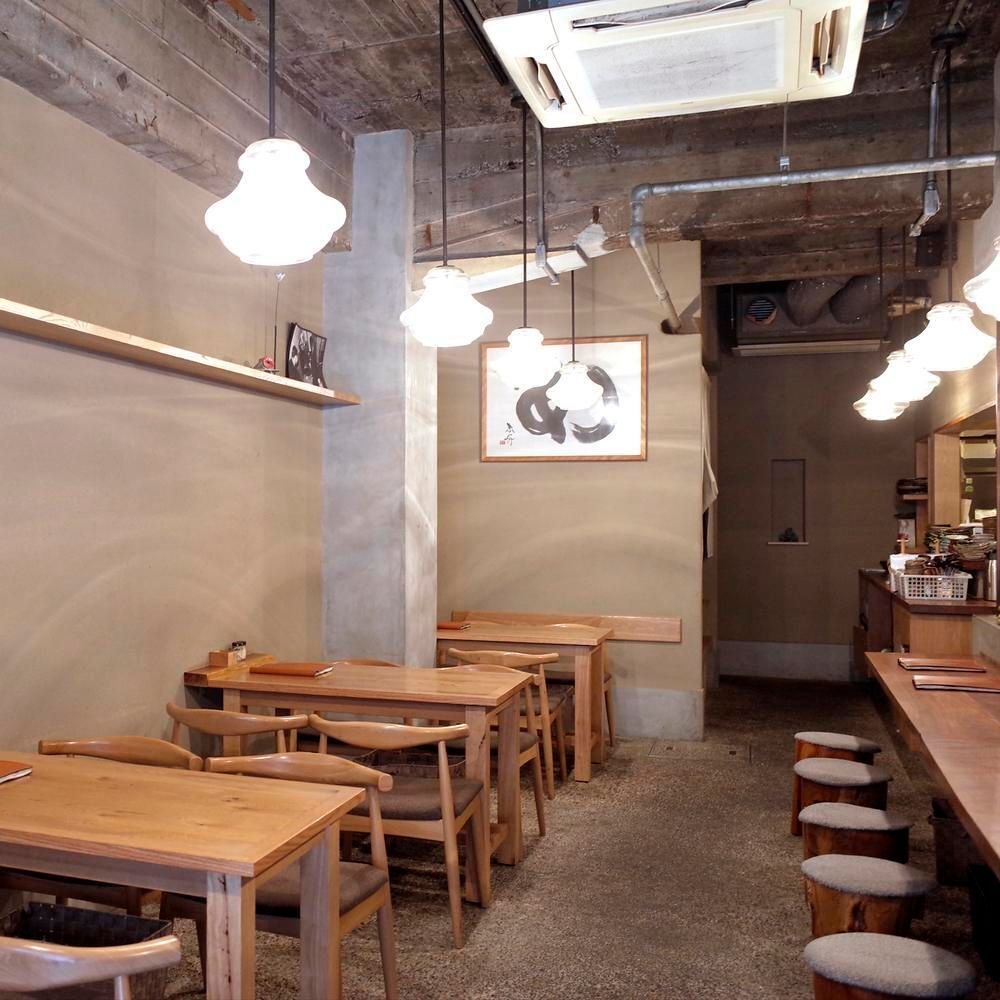
Aozora blue occupies the ground floor of the Inoue Building in Hiranomachi, a district in Osaka's Chuo Ward more associated with financial offices than destination dining. The address — 4 Chome-5-8 — sits in a part of Osaka that rewards deliberate navigation rather than casual wandering. This is not a neighbourhood that pulls you in on atmosphere alone, which means the restaurant functions as a genuine anchor for the area: the reason to come to this particular block is specifically Aozora blue. The ground-floor location, typical of many serious single-subject Japanese dining rooms, keeps the focus tightly on the counter and the bowl in front of you rather than on room design as spectacle. For the food-focused traveller, that compression of purpose is a feature, not a limitation.
What Makes This Different
The displacement of technique is the story here. Stöckli trained as a soba craftsman before switching his focus to udon. The methods he developed, stone-grinding unpolished wheat, then rolling and boiling to order, are applied to a grain and a noodle that almost nobody was treating this way in Osaka. Where most udon operations prioritise throughput, Aozora blue prioritises the interval between grinding and serving. The philosophy is the same one that drives serious soba-ya in Kyoto and Tokyo: time between mill and bowl degrades the product, so the interval must be minimal.
The recommended starting point is the Arabiki Zaru Udon, coarse-ground udon served on a wicker basket, accompanied by salt and wasabi rather than the dipping broth you might expect. This matters practically: the salt-and-wasabi pairing asks you to taste the noodle itself rather than lean on the sauce for flavour. The meal closes with udon water, the cooking liquid from the noodles, served in the same way a soba-ya would offer soba-yu at the end of a tasting. The parallel is intentional; it signals that Aozora blue is positioning this experience within the lineage of Japan's serious noodle-craft traditions rather than within everyday udon culture.
Drinks and snack selection is curated to complement udon rather than distract from it. This is a minor but telling detail: the beverage programme reflects the same specificity of purpose that drives the noodle-making. You are not walking into a menu designed to maximise covers per hour.
The Chef and the Neighbourhood
Richard Stöckli is Swiss, which is relevant context without being the point. The point is that his background in soba gave him a technical framework that most udon specialists in Japan were not applying when he opened in Hiranomachi. Stöckli has described his discovery of wheat as transformative, and while that framing belongs to the personal narrative rather than the plate, the practical output, a Bib Gourmand in consecutive years (2024 and 2025), confirms that the technique lands. Hiranomachi itself is not a dining district in the way that Shinsaibashi or Namba are. Aozora blue's presence here is less about riding a neighbourhood wave and more about the kind of low-profile, address-specific draw that serious eaters in Osaka track by word of mouth and recommendation. If you are exploring Osaka beyond the standard circuit, this address fits that brief well. Cross-reference it with our full Osaka restaurants guide to build a coherent itinerary around it.
How It Compares Among Osaka Udon Options
For udon specifically in Osaka, Ogimachi Udonya Asuro, Oudon Yomogi, and Udondokoro Shigemi are the other addresses worth knowing. Aozora blue's differentiation is the soba-craft crossover and the stone-milling process, which none of the others replicate in the same way. If you want udon as a quick, filling meal, any of those alternatives will serve you well. If you want udon as a focused tasting experience with a clear technical thesis, Aozora blue is the address. For udon beyond Osaka, Gion Yorozuya in Kyoto and Hyun Udon in Seoul are worth adding to your regional comparison set.
Know Before You Go
- Price range: ¥, among the lowest price tiers in Osaka's serious dining scene
- Cuisine: Udon, prepared with stone-milled unpolished wheat using soba-craft techniques
- Location: Ground floor, Inoue Building, 4 Chome-5-8 Hiranomachi, Chuo Ward, Osaka
- Awards: Michelin Bib Gourmand 2024 and 2025
- Booking difficulty: Easy
- Recommended dish: Arabiki Zaru Udon (coarse-ground udon on a wicker basket, with salt and wasabi)
- Hours: Not publicly confirmed, check before travelling
- Phone/website: Not listed, approach via walk-in or local reservation platforms
- Good for: Solo diners, pairs, food-focused travellers; less suited to large groups given the focused format
Explore More in Osaka and Beyond
For the full picture of what to eat, drink, and do in Osaka, use our guides: Osaka restaurants, Osaka hotels, Osaka bars, Osaka wineries, and Osaka experiences. For serious dining elsewhere in Japan, Harutaka in Tokyo, Gion Sasaki in Kyoto, akordu in Nara, Goh in Fukuoka, 1000 in Yokohama, and 6 in Okinawa are all worth your time depending on the itinerary. On the innovative French side of Osaka's dining scene, HAJIME and La Cime are the two addresses that matter most.
Frequently Asked Questions
Can Aozora blue accommodate groups?
The venue is a ground-floor space in a modest Osaka office building, which suggests limited seating rather than a large-group setup. For parties of four or more, contact ahead to confirm capacity — no booking policy or phone number is listed publicly, so showing up early is the safer approach. Solo diners and small groups of two are clearly the intended format here.
What should a first-timer know about Aozora blue?
This is not a typical Osaka noodle canteen. Aozora blue earns its Michelin Bib Gourmand (2024 and 2025) through a specific technique: the chef trained in soba before switching to udon, grinding unpolished wheat on a millstone and following the soba principle of freshly ground, freshly rolled, freshly boiled. Expect a focused, deliberate meal rather than a quick bowl. The price range sits at ¥, so value is high relative to the precision involved.
What should I order at Aozora blue?
Order the Arabiki Zaru Udon — coarse-ground udon served on a wicker basket, accompanied by salt and wasabi. This is the dish the venue explicitly recommends, and it reflects the core technique: millstone-ground unpolished wheat, soba-derived rolling methods, and freshly boiled noodles. The meal closes with udon water rather than soba water, which is the house custom. Alcoholic drinks and snacks are also curated to complement the udon format.
What are alternatives to Aozora blue in Osaka?
For udon in Osaka, Ogimachi Udonya Asuro, Oudon Yomogi, and Udondokoro Shigemi are the main comparisons. Aozora blue differentiates itself through its soba-trained chef and millstone-grinding process, which none of the others replicate. If you want a more traditional Osaka udon experience without the craft-technique angle, those alternatives are worth considering.
Can I eat at the bar at Aozora blue?
No seating configuration is documented in the available venue data. Given the ground-floor format in a compact Osaka building and the curated pairing of drinks with the udon meal, there may be counter seating, but this can change. Arriving early and checking on arrival is the practical approach. Check the venue's official channels for the latest details.
Is Aozora blue good for solo dining?
Yes. The focused menu, ¥ price point, and craft-driven format make Aozora blue a practical solo choice — similar to how premium soba counters in Japan typically work. The Michelin Bib Gourmand recognition signals strong value without a high financial commitment, so solo diners get full access to what the kitchen does well without needing to share dishes or justify a group booking.
Location
Japan, 〒541-0046 Osaka, Chuo Ward, Hiranomachi, 4 Chome−5−8 Inoue Bldg., 1F
Osaka, Japan
Compare Aozora blue
| Venue | Cuisine | Awards | Booking Difficulty |
|---|---|---|---|
| Aozora blue | Udon | Easy | |
| HAJIME | French, Innovative | Michelin 3 Star, World's 50 Best | Unknown |
| La Cime | French | Michelin 2 Star, World's 50 Best | Unknown |
| Kashiwaya Osaka Senriyama | Japanese | Michelin 3 Star | Unknown |
| Taian | Kaiseki, Japanese | Michelin 3 Star | Unknown |
| Fujiya 1935 | Innovative | Michelin 2 Star | Unknown |
How Aozora blue stacks up against the competition.
Also Consider
- HAJIME, French, Innovative, ¥¥¥¥
- La Cime, French, ¥¥¥¥
- Kashiwaya Osaka Senriyama, Japanese, ¥¥¥
- Taian, Kaiseki, Japanese, ¥¥¥
- Fujiya 1935, Innovative, ¥¥¥¥
Aozora blue operates at the ¥ tier, which puts it in a different spending bracket from most of Osaka's recognised dining. HAJIME, La Cime, and Fujiya 1935 are all ¥¥¥¥ operations in the French and innovative categories. If your priority is a single technically focused meal at the lowest possible price with Michelin recognition attached, Aozora blue has no direct competition in that space in Osaka. The comparison with ¥¥¥¥ venues is not really a comparison at all, they serve different purposes on the same trip.
At the ¥¥¥ level, Kashiwaya Osaka Senriyama and Taian represent Osaka's serious Japanese dining in kaiseki format. Both are longer, more ceremonial experiences that require advance booking and a considerably higher budget. If you are deciding between spending your one serious meal in Osaka at a kaiseki counter or at Aozora blue, the question is format preference: do you want a multi-course progression or a single, deeply focused bowl? Both carry Michelin recognition; neither is the wrong answer.
For food-focused travellers building an Osaka itinerary across multiple days, the practical case is to include Aozora blue regardless of what else you book. At ¥, the cost of getting it wrong is low; the cost of missing it if the stone-milled udon thesis lands is harder to recover from. Book the kaiseki counter for one evening, use Aozora blue for a lunch that does not compete with your dinner plans, and approach the ¥¥¥¥ French venues, HAJIME, La Cime, Fujiya 1935, on a separate visit or when the itinerary specifically calls for that register.
Recognized By


Explore Osaka
Save or rate Aozora blue on Pearl
Keep this venue in your Pearl passport, rate it after you visit, and track it alongside every other place you collect.