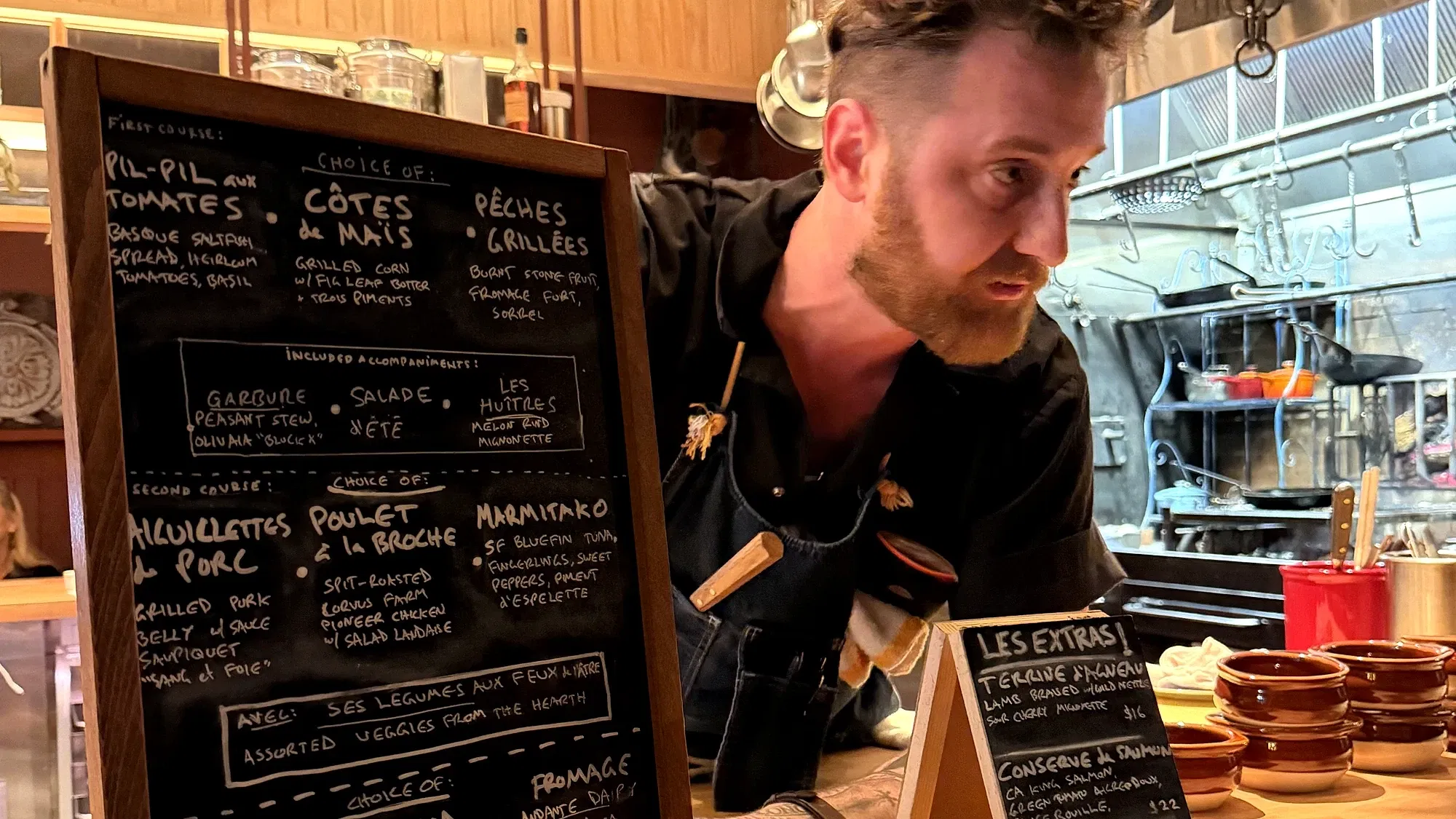
Joseph Magidow was close enough to reach across the cypress counter when he leaned in with the evening’s handwritten chalkboard. Behind him, pans hung from the open kitchen, herbs dried overhead, and the live-fire hearth that powers every hot dish was already burning. In a city full of highly choreographed tasting counters, the first minutes at La Cigale felt refreshingly personal: the chef was not disappearing behind a pass, and the menu was not arriving as a fixed procession whose details would only be revealed later. Joseph stood in front of us, explained the choices, and invited the counter into the meal.
That scene is the best way to understand this La Cigale San Francisco review. The small Glen Park restaurant is intimate, but not hushed; ambitious, but never stiff; French, but far more specific than the familiar bistro shorthand. Joseph and co-owner Daisy Linden have built the restaurant around Occitania and neighboring southwestern traditions. The menu moves through the Mediterranean south, Gascony and Languedoc and can borrow from nearby Basque cooking without flattening them into a generic idea of “French.” The result is one of the most distinctive live-fire dinners in San Francisco.
My August 5, 2026 visit unfolded as La Cigale intends: seated at the counter, able to watch nearly every movement, with choices that encouraged sharing and a menu that gradually occupied more and more of the space between us. The cooking was excellent, but what stayed with me most was how naturally the room turned technique into hospitality. You could see the work, ask about it and then eat the result a few feet from the hearth.
See La Cigale’s Pearl venue profile for the restaurant’s practical details and location.
Why La Cigale feels different from a conventional French tasting menu
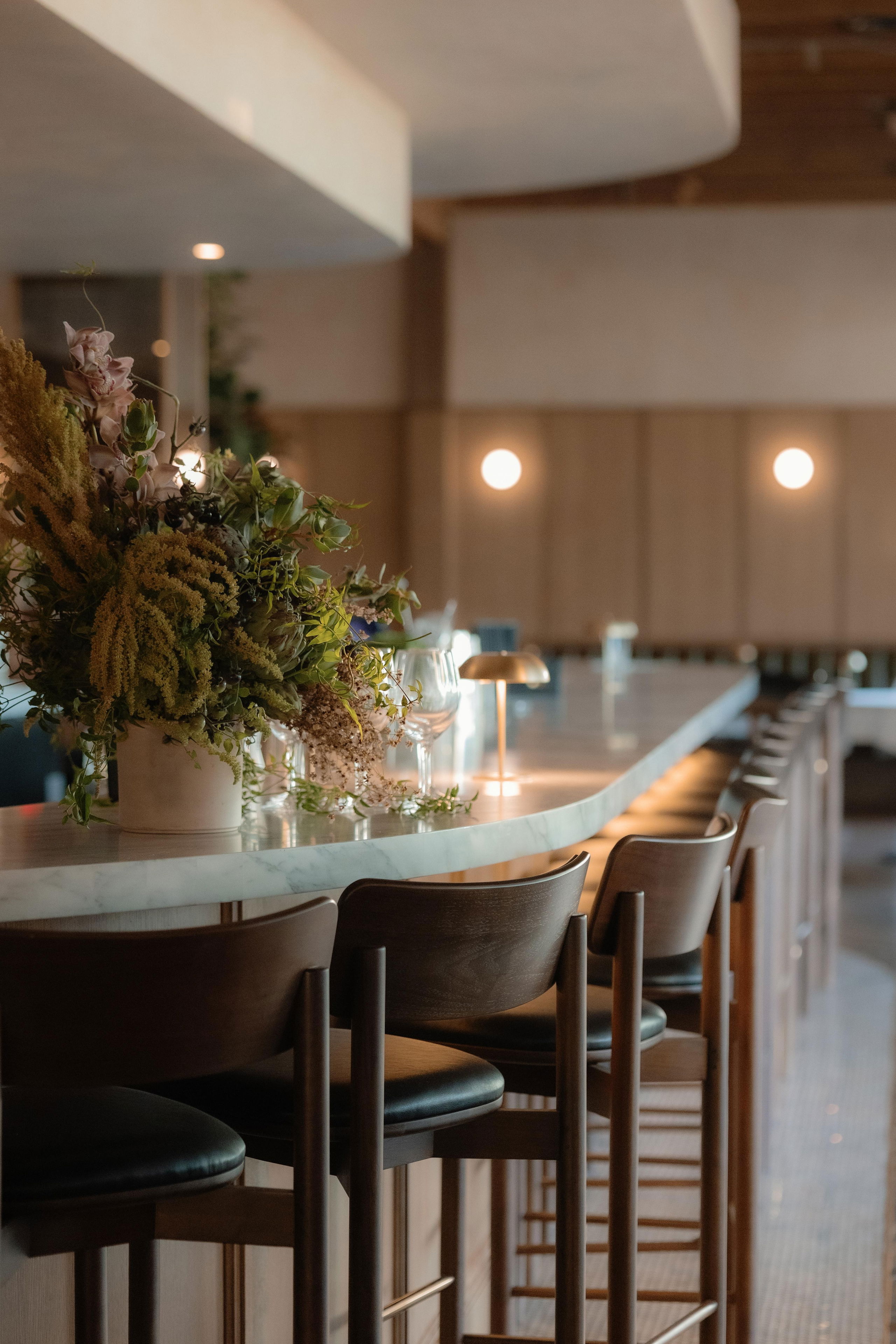
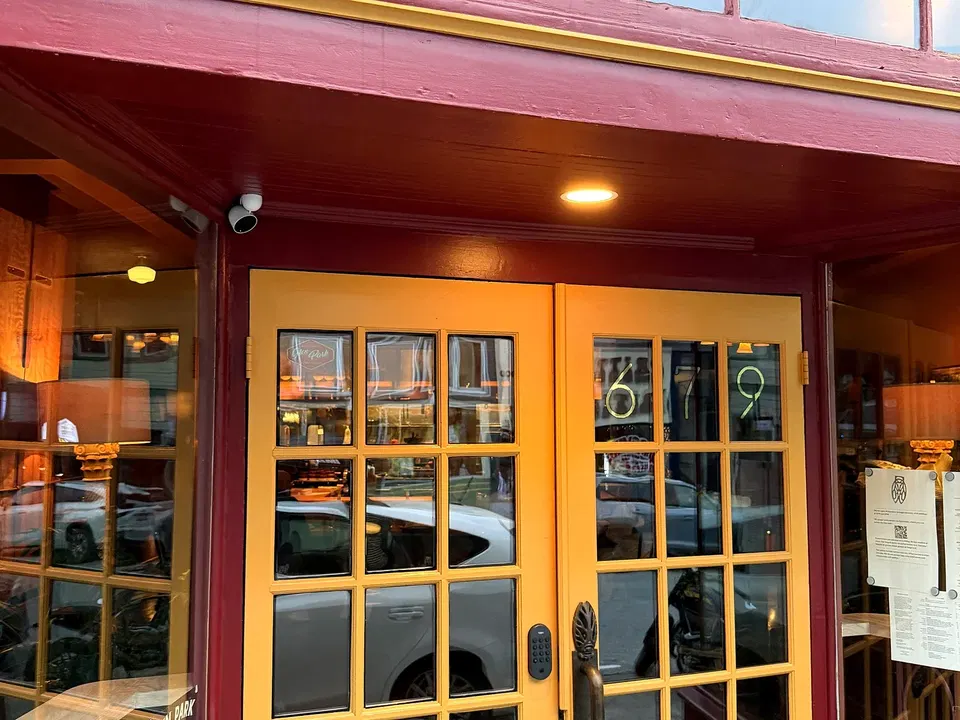
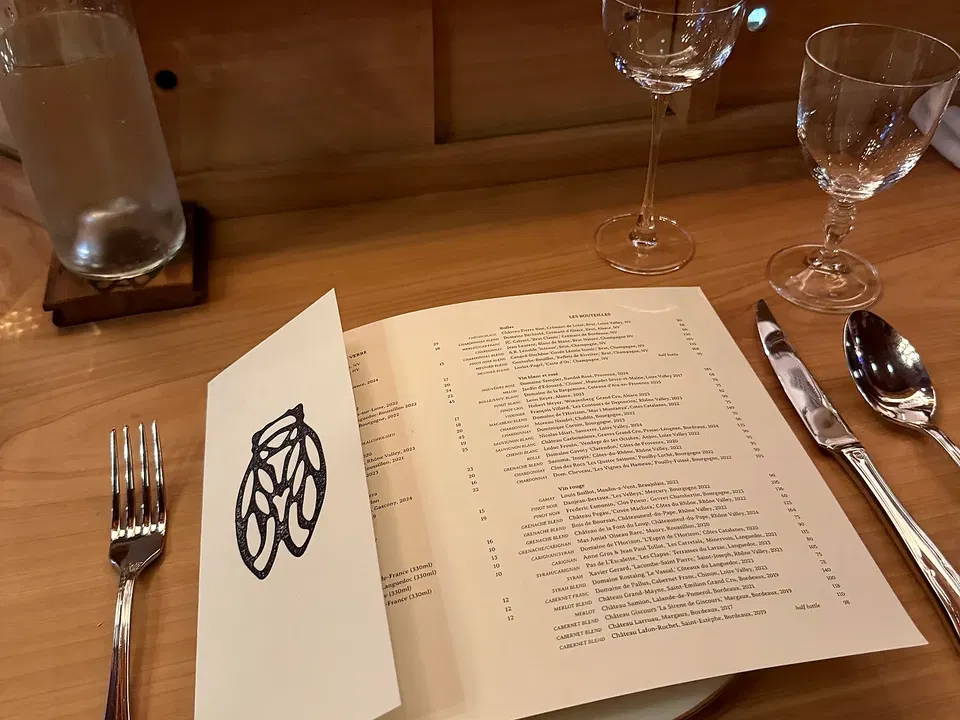
La Cigale means “the cicada,” a reference that makes more sense once you open the small booklet waiting at the counter. It evokes southern French summers: long evenings, pétanque, cold rosé and the persistent sound of cicadas. That mood carries into the restaurant without becoming a theme. The deep red Chenery Street storefront is compact, the interior is warm and tactile, and every stool faces the working kitchen.
Joseph’s path to this cooking is unusually direct. After formative stints at Delfina and Tawla, time in France, including Montpellier, convinced him to pursue the Occitan traditions that now anchor La Cigale. Rather than treating “French” as one national style, he focuses on a region with its own ingredients, dialects and culinary border crossings. Basque salt cod can appear beside Gascon garbure; piment d’Espelette can sharpen a tuna stew; California peaches can become the center of a dessert that still feels rooted in the south of France.
The format supports that point of view. This is not a parade of tiny, isolated plates. The prix-fixe offers three choices in each of three courses, then surrounds them with shared accompaniments and small surprises. Going with friends lets the table cover more of the chalkboard, but even a smaller party receives a meal with a communal rhythm. Bowls and platters arrive for passing, the staff continues the conversation started by the menu explanation, and the counter gradually feels less like a row of separate reservations.
The daily-changing nature of the menu matters, too. What follows is the dinner served on August 5, not a promise that the same dishes will be there next week. La Cigale’s identity is consistent even when the ingredients change: direct sourcing, whole-animal cooking, regional French ideas and a hearth used as a complete cooking system rather than a decorative flourish.
The live-fire kitchen is the center of the experience
There is no gas cooking line hidden behind the visible action. La Cigale’s custom hearth is the kitchen. It incorporates a manual turnspit driven by weights and ropes and supports a collection of tools designed to move heat, smoke and rendered fat with precision. One of the most dramatic is the flambadou, a cone-shaped iron tool heated in the fire and used to ignite dripping fat over food. Even when that particular tool is not in play, the kitchen’s logic remains visible: flame, coals, distance and time replace knobs and burners.
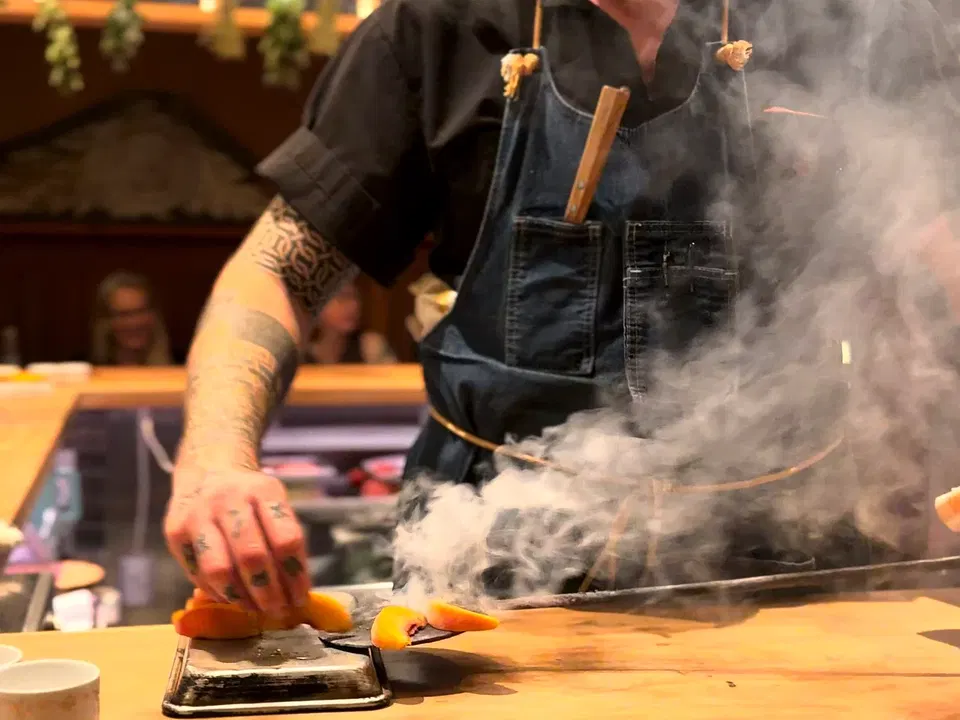
That setup could easily turn dinner into theater for its own sake. Here, the spectacle remains subordinate to the food. Joseph moved between the hearth, cutting boards and counter service with the economy of someone who designed the room around the way he actually cooks. The open kitchen also changes the social contract. Guests see how much work goes into a bowl that appears simple, while the chef sees reactions immediately. Questions do not have to travel through several layers of service.
The room benefits from that feedback loop. Fifteen seats are enough to create energy, yet few enough that the group can follow the same action. Smoke rising from the counter, the rotisserie turning and a pot being portioned into earthenware become shared moments. By the middle of dinner, the distinction between “kitchen” and “dining room” feels almost arbitrary.
Our August menu, from salt cod and corn to chicken and marmitako
The chalkboard began with three first-course choices. Pip-pil aux tomates paired a Basque salt-cod spread with heirloom tomatoes and basil. Côtes de maïs brought grilled corn together with fig-leaf butter and three piments. Pêches grillées moved stone fruit into savory territory with fromage fort and sorrel. It was a concise set of options, but the range was wide: oceanic and creamy, smoky and sweet, or tangy and fruit-driven.
The language on the board was French, yet Joseph’s explanation made the menu easy to navigate. More importantly, the cooking did not rely on translation alone. California produce supplied the immediacy. Tomatoes and corn tasted like August; stone fruit belonged to the same local moment. The French framework gave those ingredients a direction rather than masking where they came from.
Several accompaniments expanded the first half of the meal. Oysters arrived with melon and mignonette. Salade d’été brought a fresh, bitter and acidic counterpoint. Garbure, described simply as “peasant stew” on the board, provided the deepest regional anchor.
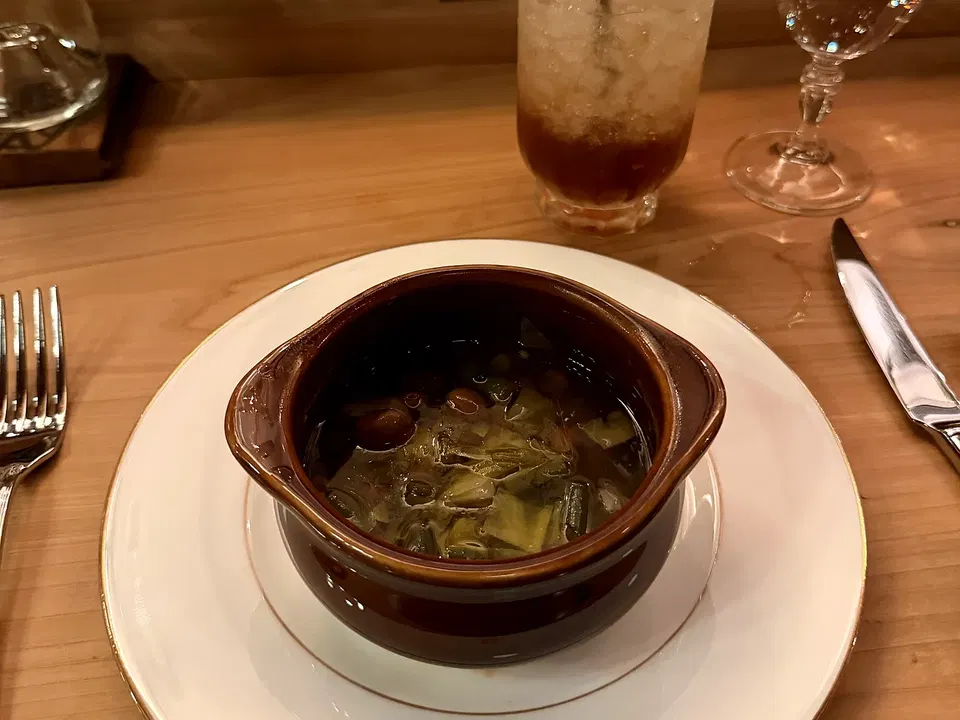
Garbure is the kind of dish that explains La Cigale better than a long manifesto could. It is a Gascon country soup, traditionally built from vegetables, beans and preserved or fresh meat according to what is available. Served here in a ceramic bowl, it felt nourishing and direct, but the broth and greens showed the attention of a fine-dining kitchen. It did not need to be deconstructed to feel precise. The appeal was exactly the opposite: a humble regional form treated with complete seriousness.
The second-course choices continued the same balance between hearth cooking and southern French reference points. A pork preparation came from the grill with garlic saupiquet. Poulet à la broche paired spit-roasted chicken with salade landaise. Marmitako combined bluefin tuna, fingerling potatoes, sweet peppers and piment d’Espelette. Vegetables from the hearth accompanied the larger plates.
The chicken is perhaps the purest expression of the room’s equipment. Rotisserie cooking gives the fire time to render fat, crisp skin and baste the bird continuously. Marmitako tells a different story. The Basque fishermen’s stew traditionally brings tuna and potatoes together; the version on our menu used bluefin, peppers and Espelette chile to keep the flavors vivid rather than heavy. The pork and garlic saupiquet made a strong case for ordering across the options with a group.
What made the sequence satisfying was not excess for its own sake. Each choice had a regional reason to exist, and the shared vegetables and salad kept the larger proteins from dominating the table. By the end of the savory courses, dishes covered the counter in front of us. That abundance felt generous rather than chaotic because the meal had been building toward it all night.
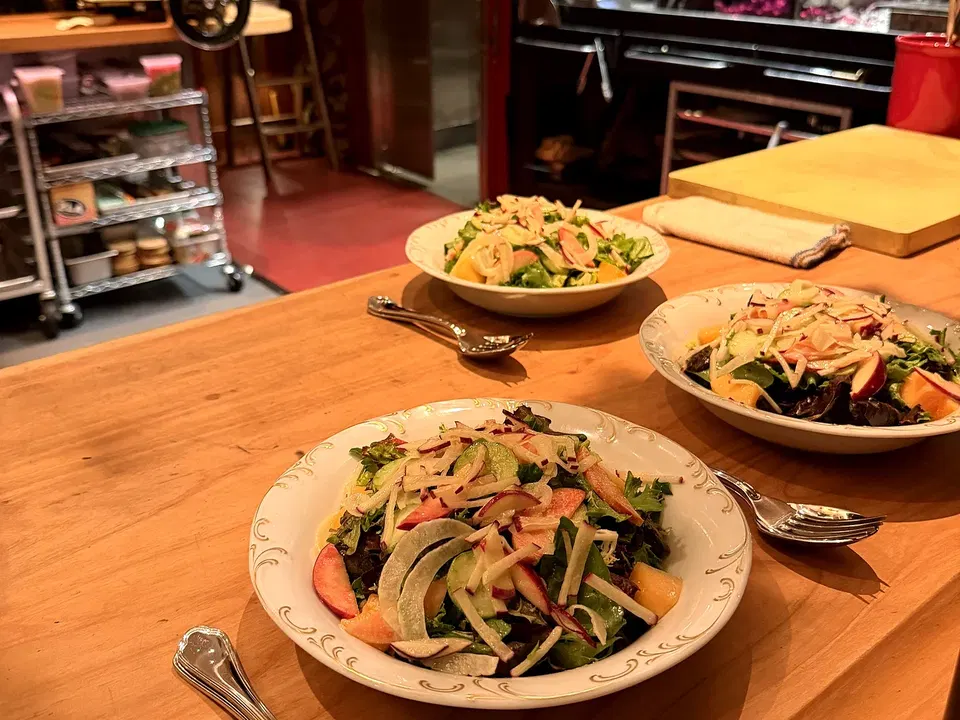
Service at arm’s length
At La Cigale, the best service moments are inseparable from the kitchen. Joseph introduced the menu, cooked in full view and portioned food into bowls across the counter. Other members of the team moved with the same informality and command. Nothing felt rehearsed into anonymity.
That does not mean the experience is casual about detail. The pacing held together a menu with individual choices and shared dishes. New plates arrived as the previous idea had reached its natural conclusion. Staff could explain an unfamiliar regional term without turning it into a lecture. Water, wine and clearing happened smoothly despite the counter’s compact geometry.
The intimacy also rewards curiosity. If you like knowing why a dish belongs on the menu, how the fire changed it or what a particular southern French reference means, this is a room where those questions feel welcome. The conversation can become part of dinner without interrupting the work.
Wine and nonalcoholic drinks at La Cigale
Matt Montrose’s beverage program follows the kitchen toward France, with particular strength in the south. The list has the personality of a restaurant that knows exactly what it wants to pour, but it does not force every guest into a prescribed pairing. You can choose a bottle, ask the team to guide you toward a region or style, or explore the nonalcoholic options.
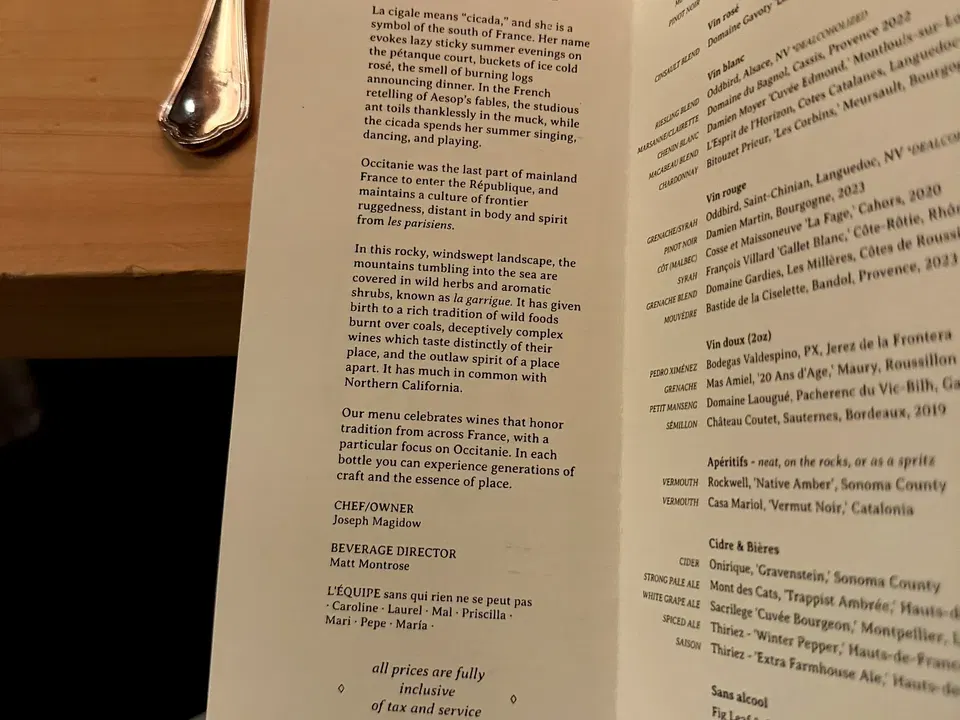
That flexibility suits the food. A single bottle can move through salt cod, grilled vegetables, poultry and a rich stew if it has enough acidity and savory character. Southern French whites, rosés and lighter reds have obvious affinities, but the staff can navigate beyond the most literal match. The current corkage fee is $60 per bottle, so bringing a special wine is possible, though the house list is a meaningful part of the restaurant’s point of view.
One of the photographed drinks arrived cold over crushed ice, a small but telling detail in a room inspired by long southern summers. The nonalcoholic program receives real attention rather than functioning as a consolation prize, which makes the dinner easier to recommend to mixed-drinking groups.
Dessert keeps the menu in California summer
The August dessert choices stayed with peak-season fruit. Galette aux pêches paired Masumoto peaches with rhubarb and basil ice cream. Pavlova aux fraises combined baked meringue, yogurt, strawberries and vanilla cream. A cheese course offered a savory finish.
The peach galette was the most natural conclusion to the menu’s argument. The fruit carried the unmistakable generosity of a California summer, while rhubarb and basil prevented the plate from becoming simply sweet. The pavlova offered the lighter, brighter route, using yogurt and strawberries to refresh after the hearth-driven main courses. Both choices extended the meal’s regional conversation without pretending the ingredients came from somewhere else.
Price, reservations and how to plan your dinner
La Cigale currently charges $140 per person, inclusive of tax and service. That clarity is welcome. The total reflects a complete dinner in a 15-seat room where the chef and a small team handle a labor-intensive, daily-changing menu over live fire. Drinks, supplements and corkage are additional.
The restaurant currently serves Wednesday through Saturday at 5 p.m. and 8 p.m. Because there are only 15 seats, reservations are worth planning. The counter format is central to the experience, so arrive ready to sit beside other guests and watch the kitchen rather than expecting a private table. Glen Park BART is nearby, making the restaurant unusually convenient for a destination meal outside the city’s most obvious dining corridors.
The menu changes daily. La Cigale says it can always provide pescatarian, vegetarian, dairy-free and gluten-free versions, though it does not recommend the restaurant for vegans. Contact the team before booking for other restrictions.
For the latest seatings, policies and menu information, use La Cigale’s official website.
Should you book La Cigale?
Yes. La Cigale is an enthusiastic recommendation for diners who want the cooking, room and people behind a restaurant to feel connected. It is especially compelling if you love open kitchens, live fire, regional French food, thoughtful wine and the energy of a very small counter.
The meal has enough technical ambition to reward serious food lovers, but its greatest strength is warmth. Joseph’s chalkboard explanation, the fire visible behind him, the bowls passed across the counter and the growing conversation among guests all belong to the same experience. La Cigale does not make intimacy synonymous with ceremony. It uses intimacy to make an ambitious dinner feel human.
I would return with friends, order across the choices and let the counter fill up again.
La Cigale San Francisco FAQ
How much does dinner at La Cigale cost?
The current set dinner is $140 per person, inclusive of tax and service. Wine, nonalcoholic drinks, supplements and the $60 corkage fee are additional.
How many seats does La Cigale have?
La Cigale’s current FAQ lists 15 seats. Every seat faces the open kitchen and live-fire hearth.
What kind of food does La Cigale serve?
La Cigale serves live-fire cooking inspired by Occitania and the broader south of France. The daily-changing menu can draw from Basque, Gascon, Languedoc and Mediterranean traditions while using Northern California ingredients.
When are La Cigale’s seatings?
The current schedule is Wednesday through Saturday, with seatings at 5 p.m. and 8 p.m. Confirm the latest availability when booking because hours and menus can change.
Is La Cigale a tasting menu?
It is best described as a set, multi-course dinner with choices and shared accompaniments. The format is more communal than a conventional sequence of individually plated tasting portions.
Can La Cigale accommodate dietary restrictions?
La Cigale says it can always provide pescatarian, vegetarian, dairy-free and gluten-free versions, though it does not recommend the restaurant for vegans. Contact the team before booking for other restrictions.