
Bar in New York City, United States
East Village Organic
100ptsFirst Avenue Organic Retail
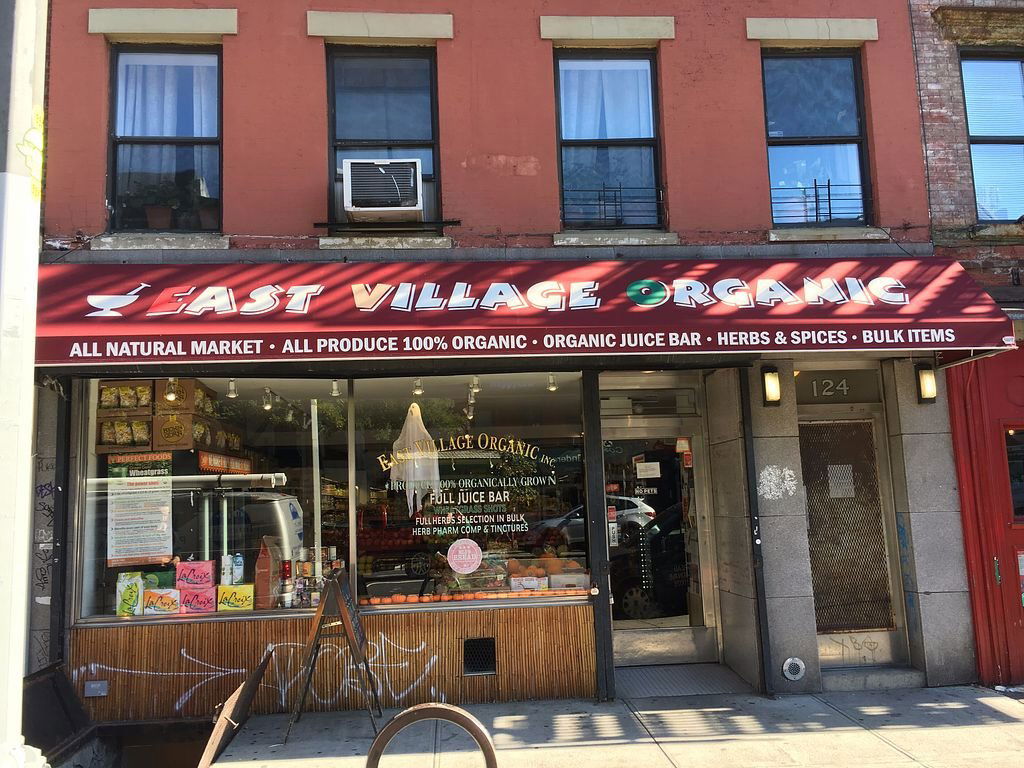
About East Village Organic
A neighborhood grocery and café on First Avenue, East Village Organic has carved out a consistent place in the Lower East Side's organic and natural food scene. Located at 124 1st Ave, the shop occupies a corner of one of New York's most historically layered food neighborhoods, where independent operators have long held ground against chain encroachment. For residents and visitors who prioritize sourcing transparency, it remains a practical daily stop.
First Avenue's Organic Anchor in a Neighborhood Built on Independent Food Culture
First Avenue between 6th and 14th Streets has functioned as one of Manhattan's more durable corridors for independent food retail. The East Village accumulated its food identity through decades of Ukrainian delis, Eastern European bakeries, and a subsequent generation of natural food shops that took root as the neighborhood shifted demographically in the 1980s and 1990s. East Village Organic, at 124 1st Ave, sits within that longer arc: a neighborhood grocery operating in a city where organic retail has split sharply between large-format chains and small independent operators who trade on accessibility and curation over square footage.
That split matters when assessing where a shop like this fits. Whole Foods and its contemporaries occupy the high-volume, brand-heavy end of the New York organic market. At the other end, smaller independents serve a more localized function: they stock what their immediate neighborhood actually buys, they keep lower overhead, and they tend to attract regulars who value proximity and a less curated, less theatrical shopping experience. East Village Organic occupies that second tier, on a block that still reads as genuinely residential rather than retail-polished.
What the East Village Format Looks Like in Practice
The East Village has historically rewarded shops that operate without pretension. The neighborhood's food culture runs toward the functional: corner grocery stores, late-night bodegas, the kind of ramen or falafel spot that doesn't require a reservation. Organic retail in this context means something different than it does on the Upper West Side or in Carroll Gardens. Here, it tends to mean a tighter selection, competitive pricing relative to the immediate area, and a clientele that includes longtime residents who have watched the neighborhood change around them.
Independent natural food retailers in dense urban neighborhoods have faced consistent pressure over the past decade. Rising rents on Manhattan's avenues have pushed out operators with thinner margins, making the ones that remain a reasonable indicator of sustained local demand. A shop at this address, in this neighborhood, signals something about its relationship with the immediate community more than it signals anything about culinary ambition or chef-driven programming.
The Neighborhood Frame: Why the East Village Still Supports Independent Operators
The East Village retains a density of independent food and drink operators that few Manhattan neighborhoods can match at this point. Alphabet City and the surrounding blocks have historically attracted operators willing to accept smaller footprints and less foot traffic in exchange for lower rents and a loyal residential base. That dynamic has compressed over time, but it hasn't disappeared. The result is a neighborhood where a natural food grocery can still function as a genuine neighborhood anchor rather than a boutique concept or a loss-leader for a larger brand.
For context, the bar and cocktail scene immediately around First Avenue reflects the same pattern. Spots like Amor y Amargo and Attaboy NYC have built substantial reputations in the East Village precisely because the neighborhood tolerates a format that doesn't require spectacle. The same logic applies to food retail: proximity, consistency, and a legible value proposition tend to outperform concept-heavy formats in this part of the city. Across the wider New York drinking scene, venues like Angel's Share and Superbueno each built their followings through specificity rather than scale, a pattern that holds across independent food and beverage operators citywide.
Organic Retail in New York: A Wider Frame
New York's organic and natural food retail market has consolidated significantly since the early 2000s. National chains now account for a substantial share of what was once a fragmented independent sector. Independents that have survived this consolidation typically did so through one of two strategies: either they moved upmarket into specialty and prepared foods, adding café elements and high-margin perishables, or they stayed close to their neighborhood base, kept their range tight, and competed on accessibility. The latter strategy is less visible in food media but more durable in practice.
The same forces that reshaped New York's organic retail have played out in other cities, where independent operators have had to find their own angles for survival. The craft-focused independent model has analogues across American food and drink: Kumiko in Chicago, ABV in San Francisco, and Jewel of the South in New Orleans each built their identities on specificity and depth rather than volume. Julep in Houston, Allegory in Washington, D.C., and Bar Leather Apron in Honolulu follow a similar logic: independent operators in competitive markets tend to thrive when they do one thing with enough consistency that the neighborhood organizes itself around them. The Parlour in Frankfurt on the Main is a European example of the same dynamic playing out across a different food culture entirely. The pattern is consistent: specialization and neighborhood roots matter more than scale for long-run viability.
Planning Your Visit
East Village Organic is located at 124 1st Ave, in the heart of the East Village on Manhattan's Lower East Side. The address sits within easy walking distance of the L train at First Avenue and the F/M trains at Second Avenue. The immediate block is residential, so foot traffic is neighborhood-driven rather than tourist-led. For anyone building a broader itinerary around New York's independent food and drink scene, see our full New York City restaurants guide for context on how the East Village fits into the city's wider map.
Hours, pricing, and contact details are not available in our current database. Visiting in person or checking directly is the reliable approach for current operating information.
Quick reference: 124 1st Ave, New York, NY 10009. Independent neighborhood organic grocery, East Village, Manhattan.
Frequently Asked Questions
- What should I expect atmosphere-wise at East Village Organic?
- The East Village format tends toward the functional and unpretentious. First Avenue independents in this stretch of the neighborhood serve a primarily residential clientele, so the atmosphere is closer to neighborhood grocery than curated food boutique. If you are arriving from outside the city or from a more polished retail environment, calibrate expectations accordingly: the draw here is access and locality, not design or theater.
- What do regulars order at East Village Organic?
- Without confirmed menu or inventory data in our records, we are not able to specify what regulars reach for. What the format suggests is a focus on daily-use organic staples rather than specialty or prepared foods, consistent with how small independent natural grocers operate in dense urban neighborhoods. For verified current stock, contact the shop directly.
- What's the main draw of East Village Organic?
- The draw is direct: an independent organic option on First Avenue in a neighborhood that has seen significant independent retail contraction over the past decade. In a city where the organic grocery market has consolidated toward large-format chains, a smaller independent at this address serves a specific function for the immediate residential community. There are no awards or price data in our records to reference as additional proof points.
- Do they take walk-ins at East Village Organic?
- As a neighborhood grocery, walk-in access is the expected format. No reservation or booking infrastructure applies to a retail grocery operation of this kind. Phone and website details are not confirmed in our database, so for current hours or any operational queries, visiting the address directly is the most reliable method.
- Is East Village Organic worth the prices?
- Price data is not available in our records, so a direct comparison against peers is not possible here. The value case for any small independent organic grocery in Manhattan rests primarily on proximity and the cost differential versus larger chains, which varies by product category. For a neighborhood resident on First Avenue, the case is largely one of convenience; for a visitor making a deliberate trip, the calculus depends on what you are looking for.
- How does East Village Organic fit into the broader East Village food and drink scene?
- The East Village sustains a density of independent food and drink operators that is relatively unusual for Manhattan at this point in the city's retail evolution. East Village Organic, as a neighborhood organic grocery on First Avenue, occupies the food retail layer of that ecosystem rather than the restaurant or bar layer. For visitors building a fuller picture of the area's food character, pairing a visit here with stops at some of the East Village's recognized bar programs gives a more complete read on what makes the neighborhood's independent food culture distinctive.
More bars in New York City
- (SUB)MERCER(SUB)MERCER occupies a basement address on Mercer Street in SoHo, positioning it as a deliberate destination rather than a drop-in. The subterranean format tends to keep ambient noise lower than street-level alternatives, making it a reasonable call for groups of four or more. Book ahead for weekends and confirm group capacity directly with the venue.
- 1 OR 81 OR 8 on DeKalb Avenue is a low-key Fort Greene bar that works best for two people on a weeknight when the room is quiet enough for conversation. Walk-ins are easy, no advance planning required. If a specialist cocktail program is your priority, Attaboy or Amor y Amargo offer more defined experiences — but for a neighbourhood drink without the fuss, this delivers.
- 230 Fifth Rooftop Bar230 Fifth is the easiest rooftop bar in Midtown to walk into, and the Empire State Building views justify the trip. The crowd skews groups and tourists, and the drinks are solid rather than craft-focused. Go early on a weekday for the best version of the experience; after 9 PM on weekends it tips firmly into party-group territory.
- 4 Charles Prime Rib4 Charles Prime Rib is a compact, reservation-required West Village dining room built around a focused prime rib format. It works well for dates and pairs but is too small for groups of four or more. Booking is easy relative to Manhattan peers, and the narrow menu signals a kitchen that executes one thing consistently well.
- 44 & X Hell's KitchenA low-key Hell's Kitchen neighborhood bar-restaurant that earns its place for easy weeknight dates and pre-theatre dinners. Booking is simple, the room is intimate enough for conversation, and there's no dress pressure. Not a cocktail destination, but a reliable, pressure-free option in Midtown West when you want comfort over spectacle.
- 58-22 Myrtle Ave58-22 Myrtle Ave is a low-key Ridgewood neighborhood spot that rewards return visits more than first impressions. Easy to get into, with no reservation headaches, it suits regulars looking for an unpretentious room rather than a structured cocktail program. If a strong drinks list or kitchen ambition matters to you, look to Attaboy or Amor y Amargo instead.
Related editorial
- Asia's 50 Best Restaurants 2026: The Chairman and Wing Go 1-2 from the Same BuildingThe Chairman takes No. 1 and Wing climbs to No. 2 at Asia's 50 Best Restaurants 2026. Both operate from the same Hong Kong building. Here's what it means.
- Four Seasons Yachts Debut: 95 Suites, 11 Restaurants, and a March 2026 Maiden VoyageFour Seasons I launches March 20, 2026, with 95 suites, a one-to-one staff ratio, and 11 onboard restaurants. Worth tracking if you want hotel-grade service at sea.
- LA Michelin Guide 2026: Seven New Restaurants from Tlayudas to Uzbek DumplingsMichelin's March 2026 California Guide update adds six LA restaurants and one Montecito newcomer, spanning Oaxacan tlayudas, Uzbek manti, and Korean-Italian pasta.
Save or rate East Village Organic on Pearl
Keep this venue in your Pearl passport, rate it after you visit, and track it alongside every other place you collect.