
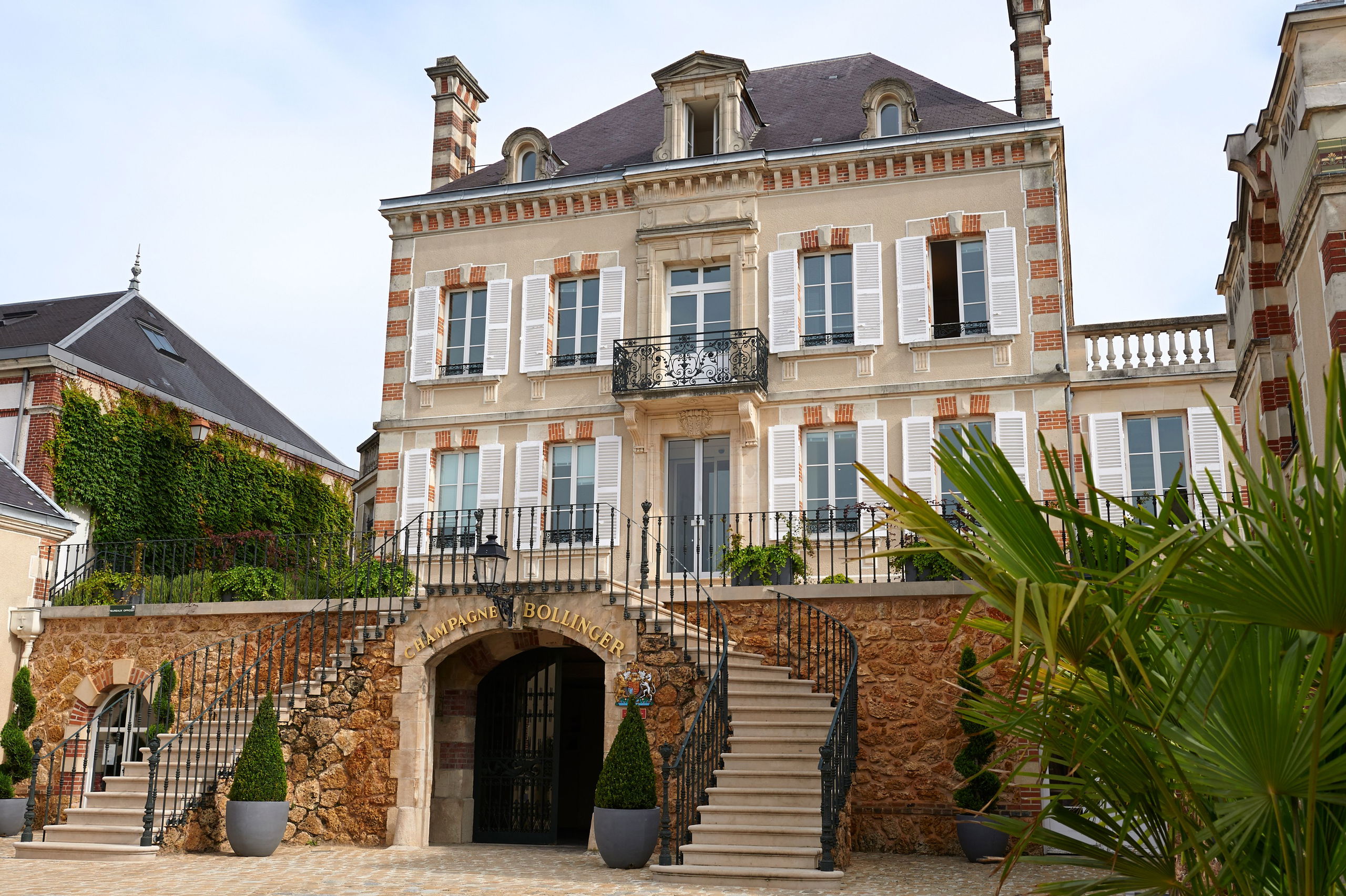



Winery in Aÿ, France
Bollinger
1,825ptsOak-Fermented Grand Marque

About Bollinger
Founded in 1829 and based in Aÿ-Champagne, Bollinger is one of the Marne Valley's few remaining independent Grand Marques, holding a Pearl 4 Star Prestige rating from EP Club in 2025. Winemaker Gilles Descôtes oversees a house known for its commitment to reserve wines, oak fermentation, and vineyard ownership across some of Champagne's most prized classified plots.
Aÿ and the Independent Grand Marque
The village of Aÿ sits at the heart of the Marne Valley's premier cru and grand cru belt, a few kilometres east of Épernay on the northern slope of the Montagne de Reims. The town has been synonymous with prestige Champagne production for centuries, and the concentration of significant houses along its main boulevards reflects that history directly. Lallier, Philipponnat, Ayala, and Deutz all maintain addresses in or immediately around Aÿ, placing Bollinger in a peer group defined less by marketing category than by physical proximity and shared terroir access.
Within that group, Bollinger occupies a specific position: a family-controlled, independent house with origins in 1829, operating a cellar network beneath the town's streets and owning a comparatively large portfolio of classified vineyard parcels. This ownership model distinguishes it from négociant-heavy competitors and has practical consequences for how the wines are made, how they age, and how they are priced against the broader Grand Marque tier. For visitors arriving from Épernay, the Bollinger address on the Boulevard Maréchal de Lattre de Tassigny is a short drive into Aÿ-Champagne proper, making it a natural stop on any serious producer itinerary through this stretch of the valley. Check our full Aÿ restaurants guide for planning the broader visit.
Viticulture First: What Vineyard Ownership Actually Means Here
Champagne has long operated on a split between grower-producers, who farm their own fruit, and large houses, which blend across hundreds of sourced parcels. Bollinger occupies an unusual middle position: a large house with genuine vineyard depth. The estate controls plots across several of the appellation's most classified sites, including parcels in Aÿ itself, where grand cru-rated Pinot Noir defines the local identity.
This matters for the sustainability conversation because vineyard ownership creates accountability that pure sourcing relationships do not. When a house farms its own land, decisions about canopy management, soil health, harvest timing, and pest control sit entirely within the production team's authority. Winemaker Gilles Descôtes and the viticulture team have worked over recent decades to extend organic and low-intervention practices across the estate's holdings, reflecting a broader shift in Champagne toward sustainable certification and away from the heavy agrochemical use that dominated mid-twentieth-century viticulture in the region.
Champagne's official sustainable viticulture framework, Viticulture Durable en Champagne, covers a majority of the appellation's vineyard area now, but houses with significant owned-parcel portfolios are better positioned to implement coherent, long-term soil programmes than those dependent on contracted growers with separate economic incentives. Bollinger's scale of ownership gives the estate a tighter feedback loop between cellar decisions and field practice. That loop is visible in the wine style: the preference for low-dosage cuvées and extended lees ageing reflects a confidence in fruit quality that comes from controlled farming rather than heavy correction in the cellar.
For context on how this approach compares elsewhere in France's fine wine regions, similar vineyard-first philosophies govern producers like Albert Boxler in Niedermorschwihr and Château Bélair-Monange in Saint-Émilion, where estate control over farming decisions is treated as foundational to the wine's character rather than incidental to it.
The Winemaking Logic: Oak, Reserves, and Time
Bollinger's technical signature is its continued use of small oak barrels for fermenting the base wines, a practice that has become rare among large houses, most of which converted to stainless steel during the 1970s and 1980s. Oak fermentation introduces micro-oxygenation and textural complexity at an early stage, and it requires a winery to maintain a substantial cooperage programme alongside the cellar itself. The commitment is not decorative: it adds cost, labour, and variability that stainless steel eliminates. The decision to maintain it is a deliberate production philosophy, one that distinguishes Bollinger's non-vintage profile from houses using reductive, tank-based methods.
The reserve wine library compounds this distinction. Bollinger holds perpetual reserve wines in a solera-style system that draws from multiple decades of production, adding oxidative complexity and depth to the non-vintage blend. This is an expensive asset to maintain, requiring significant cellar space and long-term capital commitment, but it gives the winemaking team ingredients that no single harvest can supply. For Gilles Descôtes, the reserve programme is both a technical resource and a consistency tool: in difficult vintages, deep reserves allow the house style to hold without compromise.
Extended cellar ageing on lees, beyond appellation minimums, characterises both the non-vintage and prestige lines. The practical effect is that wines arrive in market with more post-disgorgement freshness in reserve and a finer, more integrated mousse than earlier-disgorged competitors. For the trade and for collectors, this translates to longer drinking windows and more predictable development in the bottle. Houses at a comparable prestige tier, including Billecart-Salmon, share the philosophy of cellar patience as a quality signal.
EP Club Assessment: Pearl 4 Star Prestige (2025)
EP Club awarded Bollinger a Pearl 4 Star Prestige rating in 2025, placing it in the upper tier of the EP Club Champagne assessments. The Pearl designation signals a house with consistent quality across its range, demonstrable ageing credentials, and a production philosophy that goes beyond brand management. In the context of Aÿ producers specifically, that rating positions Bollinger alongside the village's most serious operators and reflects the combination of vineyard ownership, technical conservatism, and reserve depth described above.
For collectors and trade buyers, the rating functions as a reference point within a crowded Grand Marque category where brand visibility does not always correlate with cellar seriousness. Bollinger's position in the Pearl tier is evidence-based: it reflects the house's track record across vintages, the depth of its reserve programme, and the consistency Descôtes has maintained across recent production cycles.
Planning a Visit to Bollinger in Aÿ
Bollinger's cellars and visitor facilities are based at 20 Boulevard Maréchal de Lattre de Tassigny in Aÿ-Champagne. Visits to houses of this tier typically require advance booking through the producer's official channels; walk-in access to the winery is not standard practice. Visitors travelling from Paris should allow approximately one hour and twenty minutes by TGV to Reims, with a connecting regional service or road transfer to Aÿ. From Épernay, Aÿ is less than ten minutes by road, making it practical to combine a Bollinger visit with calls on neighbouring producers including Philipponnat, Ayala, and Deutz. Autumn, during and just after harvest, offers the most operationally active atmosphere in the cellar district, though spring visits, when the vines are breaking dormancy and the cellar teams are completing disgorgement cycles, give a different window into the production calendar.
Frequently Asked Questions
What is the defining thing about Bollinger?
Bollinger's defining characteristic is the combination of significant owned-vineyard holdings in Aÿ and the surrounding grand cru zone, a technical commitment to oak fermentation and deep reserve wine stocks, and independence from the major Champagne conglomerates. Founded in 1829 and awarded a Pearl 4 Star Prestige rating by EP Club in 2025, it operates at a tier where production decisions are driven by cellar philosophy rather than volume targets. In the context of Aÿ specifically, it is the most prominent independent Grand Marque with its primary address in the village.
What is the leading wine to try at Bollinger?
For a first encounter, the non-vintage Spécial Cuvée is the clearest expression of what oak fermentation and deep reserves produce at the house's baseline level: more textural weight and oxidative complexity than most non-vintage Champagnes at its price tier. For those with access to the vintage range, the prestige Grande Année represents the house's approach to single-harvest expression across its classified parcel portfolio. Winemaker Gilles Descôtes oversees both, and the vintage wines carry the extended lees-ageing programme that places them in a small peer group with Billecart-Salmon and a handful of other houses committed to cellar patience over commercial release schedules. The EP Club Pearl 4 Star Prestige (2025) assessment covers the house's overall range rather than a single cuvée, so both the entry and prestige tiers sit within that validated framework.
For further reference across French fine wine production, EP Club also covers producers including Chartreuse in Voiron, Château Bastor-Lamontagne in Preignac, Château Batailley in Pauillac, Château Branaire Ducru in St-Julien, and Château Boyd-Cantenac in Cantenac, alongside international producers such as Aberlour in Aberlour and Accendo Cellars in St. Helena.
Recognized By
Related editorial
- Best Fine Dining Restaurants in ParisFrom three-Michelin-star icons to the next generation of Parisian chefs pushing boundaries, these are the restaurants that define fine dining in the world's culinary capital.
- Best Luxury Hotels in RomeFrom rooftop terraces overlooking ancient ruins to Michelin-starred hotel dining, these are the luxury hotels that make Rome unforgettable.
- Best Cocktail Bars in KyotoFrom sleek lounges to hidden speakeasies, Kyoto's cocktail scene blends Japanese precision with global influence in ways you won't find anywhere else.
Save or rate Bollinger on Pearl
Keep this venue in your Pearl passport, rate it after you visit, and track it alongside every other place you collect.



