
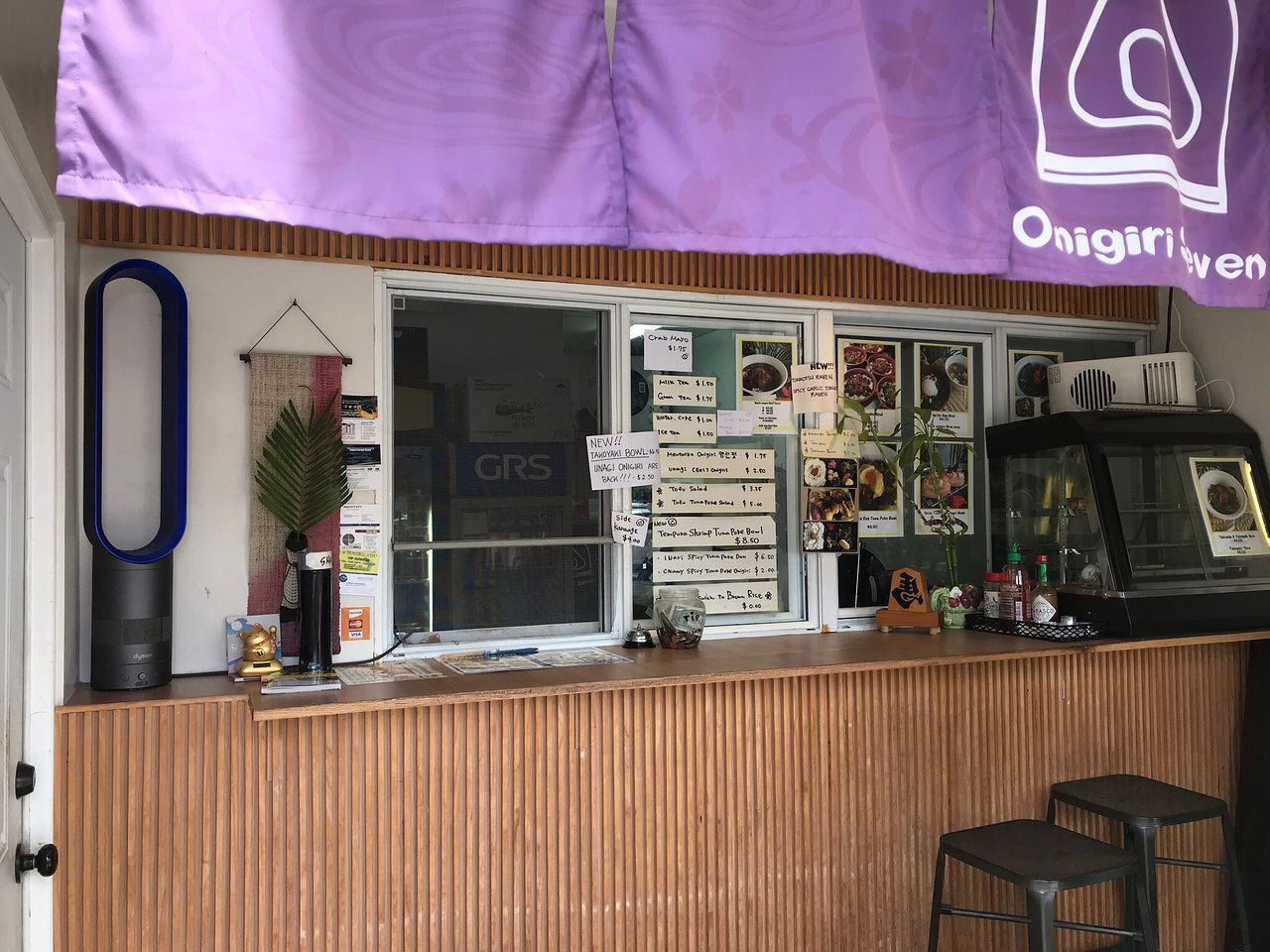
    Restaurant in Tumon, Guam

    Onigiri Seven

    100pts

    Precision Rice Format

    Onigiri Seven, Restaurant in Tumon

    About Onigiri Seven

    Onigiri Seven sits in Tumon's Tamuning district, where Japanese rice-ball culture meets Guam's layered Pacific pantry. The format is compact and ingredient-forward, placing it in a category that prioritises simplicity of form over elaboration of technique. For visitors moving between the resort strip and the island's quieter eating spots, it reads as a useful counterpoint to the broader Korean and Japanese dining options nearby.

    Rice, Form, and the Pacific Pantry

    Onigiri as a format occupies a specific position in Japanese food culture: it is not street food in the improvised sense, nor is it restaurant dining in the formal sense. It sits in a middle register defined by precision of rice preparation, the quality of the filling, and the integrity of the nori wrap. In Tumon, where the dining offer runs heavily toward Korean barbecue, Japanese teppanyaki, and all-day resort buffets, a venue built around this format represents a deliberate narrowing of focus. That narrowing is the editorial point. The question worth asking is not what Onigiri Seven offers on its menu, but what the onigiri format itself demands of its ingredients, and whether a Pacific island setting changes those demands in interesting ways.

    Guam's position in the western Pacific places it at a genuine crossroads of ingredient supply. Japan is close enough that Japanese rice varieties, nori sourced from domestic producers, and imported umeboshi are viable inputs for any operation serious about the format. At the same time, the island's own pantry, shaped by Chamorro tradition, Spanish colonial history, and American military presence, introduces local proteins, tropical produce, and flavour affinities that don't appear on an equivalent counter in Osaka or Fukuoka. The most interesting onigiri operations in Asia-Pacific tend to be the ones that hold the form constant while allowing the filling to reflect genuine local sourcing. Whether Onigiri Seven pursues that approach is a question worth investigating on the ground.

    Tumon's Eating Context

    Tumon is Guam's primary tourist corridor, concentrated along the beachfront strip that runs through Tamuning. The dining offer here skews toward Japanese and Korean travellers, who make up the largest share of inbound visitors to the island. That demographic pressure shapes what restaurants open, what ingredients get imported, and what price points survive. Japanese-format venues in Tumon are not novelties; they are infrastructure for a visitor base that expects to find familiar eating formats even at distance from home. Onigiri Seven sits within that context, offering a format that functions as both comfort eating for Japanese visitors and an accessible entry point for other travellers curious about the cuisine.

    For a broader sense of the island's eating options, our full Tumon restaurants guide maps the range from casual to considered. Nearby, Jin Mi in Harmon and L.A. Tofu & Galbi in Tamuning represent the Korean end of the spectrum, while Pepper Lunch in Dededo and Coffee Club Guam in Barrigada extend the casual dining map further across the island's northern municipalities.

    The Ingredient Argument for Onigiri

    The case for taking onigiri seriously as a food form rests almost entirely on ingredient quality. Rice variety matters: short-grain Japanese cultivars like Koshihikari have a starch profile that produces the cohesion and slight stickiness essential to the form. Undercook or over-season the rice and the structure collapses; get the seasoning balance wrong and the filling is overwhelmed. Nori quality is similarly non-negotiable. First-harvest nori from Japan's Ariake Sea or Ise Bay has a clean oceanic flavour and a snap on biting that lower-grade sheets don't replicate. These are not premium flourishes; they are structural requirements of the format done correctly.

    Fillings tell a different story. Traditional Japanese onigiri fillings, including salted salmon, tuna with mayonnaise, pickled plum, and seasoned cod roe, have well-documented flavour logic built around salt, fat, and acidity as counterpoints to the neutral rice base. A Pacific-located operation has the option of working with those same poles using local inputs: fresh-caught tuna from Guam's surrounding waters, local pickles, or Chamorro-inflected seasonings. Whether any given venue takes that option is a matter of sourcing commitment and menu ambition. It is worth asking directly when you visit.

    Format and Scale in Context

    Onigiri counters exist on a wide spectrum globally. At one end are convenience-store formats, where the product is industrially produced and priced for daily commuter consumption. At the other end are specialist counters in Tokyo and Osaka where rice is sourced from named farms, fillings are made in-house, and the operation is intentionally small-scale. Most venues sit somewhere between those poles. A venue in Tumon's tourist district is probably not positioning against the specialist Tokyo counter model, but it is not a convenience store either. The format's accessibility is part of its appeal: onigiri is fast to eat, easy to carry, and priced well below the sit-down dining options that dominate Tumon's restaurant strip.

    That accessibility also makes it genuinely family-friendly in a way that many of Tumon's dining options are not. There is no complex ordering process, no need to coordinate a multi-course meal across different ages and preferences, and no minimum spend that makes a casual stop feel like a commitment. For travelling families moving between beach time and the resort strip, a quick stop for rice balls reads as a practical solution rather than a dining occasion.

    Placing Onigiri Seven in a Wider Frame

    For EP Club readers accustomed to tracking the precision ingredient work at venues like Arpège in Paris or the sourcing rigour behind Aponiente in El Puerto de Santa María, the onigiri format might read as a minor key. But the ingredient logic is not so different: both traditions are built on the argument that the quality of the raw material, handled with discipline and minimal intervention, produces a result that elaboration cannot improve. The scale and the price point are different; the underlying philosophy is recognisably related.

    Closer to home in terms of register, the comparison set includes the Korean and Japanese casual dining operations across Guam's northern municipalities. Jin Mi and L.A. Tofu & Galbi occupy the sit-down end of that casual bracket, with proteins and formats that require more time and table space. Onigiri Seven operates in a faster, more portable register, which gives it a different utility in a visitor's day rather than a lesser one.

    Planning a Visit

    Onigiri Seven is located in the Tumon Tamuning area, placing it within the main tourist zone of Guam's northern coast. Specific hours, contact details, and booking requirements are leading confirmed directly on arrival or through current local listings, as these details were not available at time of writing. The format itself requires no reservation; onigiri counters operate on a walk-in basis almost universally. Visitors exploring the wider dining range on the island might use stops like this as a low-friction way to punctuate longer days that include more formal meals at the Korean and Japanese sit-down options nearby.

    Frequently Asked Questions

    Is Onigiri Seven a family-friendly restaurant?

    In Tumon's tourist corridor, where many dining options carry minimum spends or require coordinating multi-course orders, the onigiri format sits at the more accessible end of the spectrum. There is no complex service sequence, portions are individual and portable, and the format appeals across age groups without the friction of a full restaurant meal. For families visiting Guam and moving between beach time and the resort strip, a casual rice-ball stop involves less logistical overhead than most sit-down alternatives in the area.

    How would you describe the vibe at Onigiri Seven?

    Tumon's dining scene is weighted toward Japanese and Korean visitors, and the venues that serve them tend to fall into two registers: formal sit-down operations running teppanyaki or barbecue formats, and fast, high-turnover counters built for convenience. Onigiri Seven sits in the second register. Without specific awards or a named chef anchoring it to the premium end of the local market, it reads as a neighbourhood-facing operation rather than a destination restaurant, with a pace and informality that suits a quick stop rather than a considered evening out.

    What should I order at Onigiri Seven?

    Specific menu details and current filling options were not available at time of writing, so recommending individual items would involve speculation rather than evidence. As a general principle for onigiri counters, the most revealing order is usually the simplest: a classic filling like salted salmon or pickled plum tests the quality of the rice preparation and the sourcing of the nori more directly than a heavily flavoured variant. If local or Guam-sourced fillings appear on the menu, those are worth prioritising, as they reflect the most direct engagement with the Pacific ingredient context. Ask staff at the counter for current recommendations.

    Does Onigiri Seven use Japanese rice varieties, and does that affect the texture of the onigiri?

    Rice variety is structural to the onigiri format rather than a finishing detail: short-grain Japanese cultivars produce the starch cohesion that holds the rice ball together and gives it the slight stickiness expected from the form. Operations that use long-grain or mixed-grain rice produce a noticeably different result in both texture and structural integrity. Whether Onigiri Seven sources named Japanese cultivars is something to ask directly at the counter, as supply chain specifics were not available for this listing. In a Pacific island context, importing Japanese-variety rice is logistically feasible given Guam's proximity to Japan, though confirmation from the venue is the only reliable way to verify current practice.

    Keep this place

    Save or rate Onigiri Seven on Pearl

    Keep this venue in your Pearl passport, rate it after you visit, and track it alongside every other place you collect.