
Restaurant in Paris, France
Le Chateaubriand
680Pearl PointsSet menu format, serious pedigree, book ahead.


.png?width=144&height=144&quality=80)

About Le Chateaubriand
Le Chateaubriand is the defining address of Paris's bistronomy movement and one of the hardest tables to secure in the 11th arrondissement. Chef Iñaki Aizpitarte's single set menu, sourced from independent producers, has held a World's 50 Best ranking and a current Opinionated About Dining top-500 position. At €€€ per head, the value is clear — if you can get a reservation.
Verdict
Le Chateaubriand is one of the most important neo-bistro addresses in Paris, and its track record supports that claim: a World's 50 Best ranking of #21 in 2015, a Michelin Plate in 2024, and a current #326 position in Opinionated About Dining's Europe list. If you want to understand what the bistronomy movement actually means in practice, this is the place to book. At €€€ pricing — significantly below the €€€€ tier of its fine-dining peers — it delivers a single set menu that has earned an international following. The catch: reservations are near impossible to secure, and the format is non-negotiable. If you want à la carte flexibility, book Septime or Le Servan instead.
Portrait
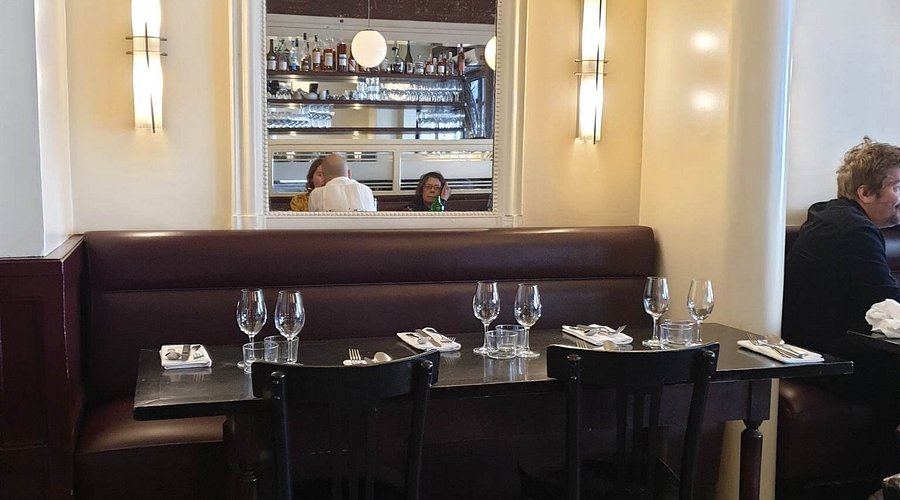
Le Chateaubriand sits on Avenue Parmentier in the 11th arrondissement, a neighbourhood that has been central to Paris's bistronomy scene for over two decades. The room itself does the work before any food arrives: 1930s bistro bones , zinc bar, high ceilings, slate surfaces, narrow tables , create a spatial intimacy that feels genuinely earned rather than designed. The seating is close, the room is long and narrow, and there is no private dining room. This is a communal dining experience, and the layout reinforces it. If you are booking for a celebration or a business meal where a degree of privacy matters, understand that upfront: the main room is the only room, and your neighbours will be within earshot.
For a special occasion, this framing is either an asset or a liability depending on what you want. The room has real atmosphere , the kind that comes from a space that has not been renovated for trend rather than function , and the single set menu means the kitchen is firing on a fixed programme all evening. There are no awkward ordering decisions, no menu anxiety, and no risk of one person at the table eating significantly better than another. For a birthday dinner or an anniversary where you want the meal to carry the occasion rather than the setting, that format works well. For a business meal where the conversation needs to hold the floor, the noise level and proximity of neighbouring tables may work against you.
Chef Iñaki Aizpitarte, a Basque-born cook who is credited as one of the initiators of the bistronomy movement, built this restaurant's reputation on the combination of market-driven sourcing, independent producers, and flavour pairings that sit slightly outside French tradition without abandoning its foundations. The menu changes, but the format does not: a single set menu, no alternatives, with wine from carefully selected independent producers. This is a kitchen with a defined point of view, and it does not hedge. That directness is part of what makes a meal here feel meaningful rather than merely competent.
The bistronomy movement Le Chateaubriand helped define has since produced a generation of Paris restaurants , Septime, Elmer, Gare au Gorille, Le Pantruche , and the category is now well-stocked with strong alternatives. What distinguishes Le Chateaubriand is that it preceded most of them and still holds its position in Opinionated About Dining's top 500 European restaurants. That kind of durability is worth noting when you are weighing whether to spend the effort securing a table here versus booking something easier.
On the broader French dining map, Le Chateaubriand occupies a specific tier: more adventurous and considerably less expensive than the grand maisons like L'Ambroisie or Le Cinq, but more focused and harder to get into than most of its 11th arrondissement peers. If you are building a Paris trip around dining and also want to explore outside the city, the country has strong regional anchors worth adding: Mirazur in Menton, Flocons de Sel in Megève, and Troisgros in Ouches each represent different aspects of what French cooking does at its most considered. For European neo-bistro context beyond France, Bruut in Bruges operates in a similar register. Across the Atlantic, Le Bernardin in New York City shows how French technique translates at the leading of the American market.
The 4.4 Google rating across 882 reviews is a useful signal: this is not a restaurant that divides opinion sharply. The set menu format and the room's particular energy do require commitment, but guests who arrive knowing what they are getting into consistently rate the experience well.
Practical Details
Address: 129 Ave Parmentier, 75011 Paris, France. Hours: Wednesday to Friday 19:00–23:00; Saturday 12:15–13:30 and 19:00–23:00; closed Sunday, Monday, and Tuesday. Reservations: Near impossible , book as far in advance as possible; walk-ins are not a realistic strategy here. Format: Single set menu only, no à la carte. Budget: €€€ per head; meaningfully below Paris's €€€€ fine-dining tier. Dress: No stated dress code, but the room and the restaurant's standing suggest smart casual as a minimum for a special occasion visit. Group dining: There is no private dining room , the main room is communal and narrow, which limits suitability for large or private group celebrations. Pairs and small groups of four work leading. Accessibility: 129 Ave Parmentier is served by the 11th arrondissement's transport links; Goncourt and Oberkampf metro stations are both nearby.
For more Paris dining, see our full Paris restaurants guide. For where to stay, our full Paris hotels guide covers the city's leading properties. If you want to explore further, our Paris bars guide, Paris wineries guide, and Paris experiences guide are worth bookmarking. For classic French regional cooking, Auberge de l'Ill in Illhaeusern, Bras in Laguiole, and Paul Bocuse in Collonges-au-Mont-d'Or each represent the country's broader culinary canon.
Frequently Asked Questions
What should I order at Le Chateaubriand?
There is no ordering decision to make: Le Chateaubriand runs a single set menu, and the kitchen decides what you eat. Iñaki Aizpitarte built the restaurant's reputation, including a World's 50 Best ranking, on this format. Ingredients are sourced from independent producers, and the wine list follows the same philosophy. If you want à la carte flexibility, this is not the right address.
Can I eat at the bar at Le Chateaubriand?
Bar seating is not documented in the venue record, and the format here is a fixed set menu served at the main dining room. The restaurant runs a tight operation across four evenings and Saturday lunch, with reservations described as essential. Do not count on walking in and finding a counter spot — book the room or don't come.
What should I wear to Le Chateaubriand?
Le Chateaubriand is a bistro in the 11th arrondissement, not a grand Parisian dining room — the interior is zinc, slate, and narrow tables in a 1930s shell. Dress as you would for a serious neighbourhood restaurant: put-together but not formal. Overdressing would be as out of place as underdressing.
Is Le Chateaubriand worth the price?
At €€€, it sits above everyday bistro pricing but well below the grand Parisian institutions. For what you get — a chef-driven set menu from one of the founders of the bistronomy movement, with a World's 50 Best pedigree (ranked #21 in 2015) and a Michelin Plate — the price-to-credential ratio is strong. If you want à la carte control over your spend, it will frustrate you; if the set menu format suits you, the value case is solid.
Is Le Chateaubriand good for a special occasion?
Yes, with caveats on format. The single set menu and narrow tables create an intimate but communal atmosphere — this is not the place for a private celebratory dinner with a lot of space or noise tolerance. It works for a food-focused occasion with a partner or a small group who genuinely wants to eat well. For a milestone that calls for ceremony and polish, L'Ambroisie or Le Cinq would fit better.
Is lunch or dinner better at Le Chateaubriand?
Saturday lunch (12:15–13:30) is the only midday service, making it the harder reservation to plan around but potentially a quieter entry point than the Wednesday-to-Friday dinner run. Dinner across the week gives you more date flexibility. The menu format is the same either way, so the choice is mostly about your schedule — though Saturday lunch bookings can move faster given the single weekly slot.
Location
129 Ave Parmentier, 75011 Paris, France
Compare Le Chateaubriand
| Venue | Price |
|---|---|
| Le Chateaubriand | €€€ |
| Alléno Paris au Pavillon Ledoyen | €€€€ |
| Kei | €€€€ |
| L'Ambroisie | €€€€ |
| Le Cinq - Four Seasons Hôtel George V | €€€€ |
| Pierre Gagnaire | €€€€ |
How Le Chateaubriand stacks up against the competition.
Also Consider
- Alléno Paris au Pavillon Ledoyen, Creative, €€€€
- Kei, Contemporary French, Modern Cuisine, €€€€
- L'Ambroisie, French, Classic Cuisine, €€€€
- Le Cinq - Four Seasons Hôtel George V, French, Modern Cuisine, €€€€
- Pierre Gagnaire, French, Creative, €€€€
How It Compares
Le Chateaubriand sits in a different tier from most of its obvious Paris comparisons. Alléno Paris au Pavillon Ledoyen, Kei, L'Ambroisie, Le Cinq, and Pierre Gagnaire all sit at €€€€ and operate in the grand fine-dining register: formal rooms, extensive service brigades, à la carte or multi-course tasting menus with a premium on polish and ceremony. Le Chateaubriand at €€€ delivers a meal that has earned equivalent critical recognition, including a higher World's 50 Best peak than most of those properties, at a lower price point, in a room that prioritises cooking over theatre.
If your priority is the most technically precise or formally presented meal in Paris, L'Ambroisie on the Place des Vosges or Le Cinq inside the Four Seasons George V will serve you better: both offer the full formal experience with private dining availability and the kind of service depth that Le Chateaubriand's bistro format does not attempt to provide. If you want creative cooking at the highest French level with a more contemporary edge, Alléno and Pierre Gagnaire both operate in that space, again at higher price points. Kei is worth considering if Japanese-French fusion is the draw.
Within the bistronomy category specifically, Le Chateaubriand's closest competition is Septime, comparable in ambition, similar booking difficulty, and operating in the same price range. Septime is marginally easier to book and has a broader format that may suit groups or diners who want more flexibility. Le Chateaubriand's edge is its longer track record and the specific character of Aizpitarte's cooking. For diners choosing between the two, both are worth attempting; book whichever table opens first.
Hours
- Monday
- Closed
- Tuesday
- Closed
- Wednesday
- 19:00-23:00
- Thursday
- 19:00-23:00
- Friday
- 19:00-23:00
- Saturday
- 12:15-13:30 19:00-23:00
- Sunday
- Closed
Recognized By


Explore Paris
Save or rate Le Chateaubriand on Pearl
Keep this venue in your Pearl passport, rate it after you visit, and track it alongside every other place you collect.