
Hotel in Yakushima, Japan
Sankara Hotel \u0026 Spa Yakushima
200ptsForest-Immersive Restraint

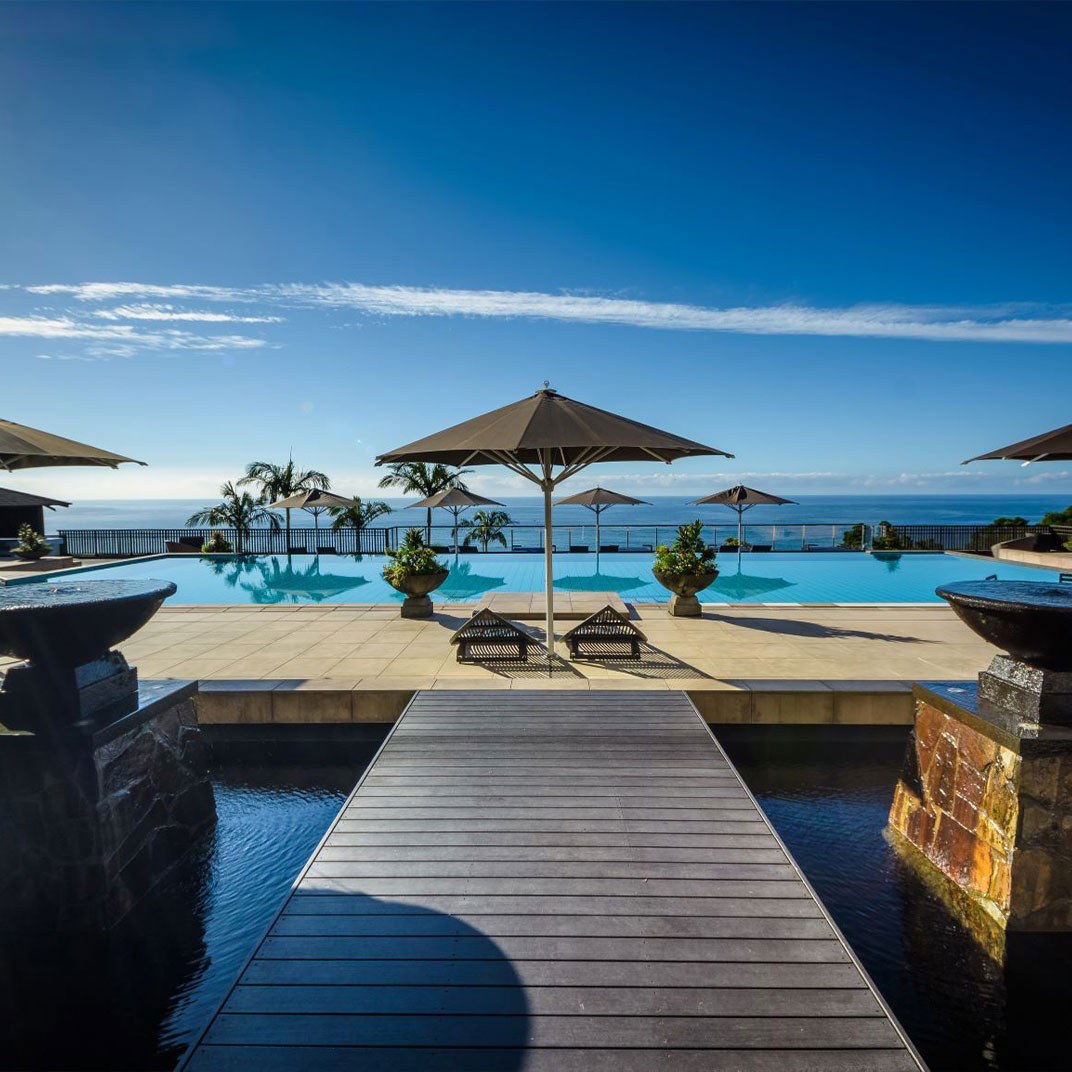
About Sankara Hotel \u0026 Spa Yakushima
Sankara Hotel & Spa Yakushima holds a Michelin One Key recognition for 2025, placing it among Japan's most considered resort properties. Set on Yakushima island, a UNESCO World Heritage site defined by ancient cedar forest and near-constant mist, the hotel positions itself within the small tier of Japanese luxury properties where design, landscape integration, and spatial restraint carry more weight than brand scale.
Where the Forest Sets the Architectural Terms
Approaching Sankara Hotel & Spa Yakushima, the landscape makes its conditions clear before any building comes into view. Yakushima island sits roughly 60 kilometres south of the Kyushu coast, and its interior is covered by ancient cedar forest, some of it over a thousand years old, now protected as a UNESCO World Heritage site. Rain falls here on more than 200 days a year. The air carries moisture even in dry spells. Any structure that attempts to dominate this environment will simply lose the argument. The architecture at Sankara does not attempt to dominate. It concedes to the forest on nearly every front, which is precisely what earns it a place in serious conversation about Japan's premium resort tier.
Japan's luxury resort category has split over the past decade into two broad camps. One is the large-format international brand hotel, often city-adjacent, heavy on imported materials, and aligned with a global aesthetic readable from Singapore to Milan. The other is a smaller, more location-specific category, where the physical environment dictates material choices, building scale, and spatial rhythm. Sankara belongs firmly to the second group. In this, it sits alongside properties like Amanemu in Mie and Zaborin in Kutchan, both of which treat their natural settings as the primary design brief. The difference at Yakushima is the particular intensity of the landscape: this is not a polished national park, but a genuinely wild island where the cedar canopy, moss, and elevation changes create conditions that few resort designers in Japan have had to work with at this scale.
Low-Profile Architecture as a Design Position
The architectural approach at Sankara reflects the logic of restraint that a site like Yakushima demands. Low-profile structures, natural material palettes, and the deliberate minimisation of hard contrast against the treeline are not decorative choices here — they are responses to an environment that would make any other approach look absurd. This positions the hotel in a specific design tradition within Japanese luxury hospitality, one that draws more from the ryokan sensibility of spatial humility than from the resort language of spectacle and vista-framing. Where a property like Bvlgari Hotel Tokyo announces itself through materials and vertical ambition, Sankara signals quality through what it withholds: height, noise, visual competition with the surrounding forest.
This is not a widespread approach in Japanese premium hospitality. Most high-end rural retreats in Japan achieve landscape integration through traditional architectural references, heavy timber framing, and tatami-centered interior rhythms. Sankara operates in a different register, one that is more contemporary and less explicitly referential to classical Japanese form. Among island or coastal properties in Japan, this positions it close to Jusandi in Ishigaki and Halekulani Okinawa in terms of design ambition, though Yakushima's forest environment creates a distinctly different sensory context from either of those subtropical coastal settings.
Michelin Recognition and What It Implies
The Michelin One Key designation for 2025 places Sankara in the lower tier of the Michelin hotel selection, which in Japan now spans from One Key properties up through Two and Three Key designations. Within the One Key category in Japan, the range is wide, covering well-positioned urban business hotels on one end and genuinely compelling destination properties on the other. Sankara's inclusion signals that Michelin's inspectors read it as the latter: a property where location specificity, design coherence, and the quality of the guest experience justify recommendation to a traveller making a deliberate choice rather than a convenient one. For context on what higher-tier Michelin hotel recognition looks like within Japan, properties like HOTEL THE MITSUI KYOTO and Gora Kadan in Hakone occupy higher brackets of the selection, each with deeper institutional histories and more documented critical track records.
The One Key recognition also locates Sankara within a broader pattern of Michelin's expanding engagement with Japanese resort and rural hospitality. Properties like Fufu Nikko, Asaba in Izu, and Nishimuraya Honkan in Kinosaki-cho all appear in the Michelin selection, pointing to a sustained editorial interest in Japan's destination inn and resort category beyond the traditional urban focus. Sankara sits within this acknowledged cohort, differentiated primarily by its island location and the unusual ecological status of Yakushima itself.
Getting There and Planning the Stay
Reaching Yakushima requires either a ferry from Kagoshima on Kyushu or a short flight via Yakushima Airport, which receives connections from Kagoshima and Osaka. Neither option is as frictionless as arriving at a bullet-train-accessible resort like Fufu Kawaguchiko or Fufu Kyu-Karuizawa. That access complexity is part of the proposition. Yakushima draws travellers who have specifically committed to the island experience, which filters the guest profile toward those genuinely interested in the natural environment rather than those seeking a convenient weekend retreat from a major city.
The island's trekking routes, particularly those leading into the old-growth cedar zones designated under the UNESCO listing, represent the primary activity draw. Sankara sits in a position to serve as a base for this, though guests should be aware that the mist and rainfall that define Yakushima's atmosphere are not occasional atmospheric effects but structural features of the climate. Packing and scheduling accordingly is practical advice, not a caveat. For those who prefer more accessible island luxury in Japan's southern arc, The Hiramatsu Hotels & Resorts Ginoza in Ginoza offers a different register entirely, with Okinawa's infrastructure and clearer weather patterns. For a remote island context closer in spirit to Yakushima's commitment to natural immersion, GOTO RETREAT by Onko Chishin in Goto provides useful comparison.
Bookings for Sankara should be made well in advance for the spring and autumn seasons, when Yakushima's trekking conditions are most consistent and demand from Japanese domestic travellers is highest. The island's relative inaccessibility means that last-minute availability is rare during peak periods. For travellers building a broader Japan itinerary around resort properties, our full Yakushima guide covers the island's dining and accommodation options in more depth. Those comparing Sankara against other design-led rural retreats in Japan should also look at Benesse House in Naoshima, Sekitei in Hatsukaichi-shi, Satoyama-Jujo in Niigata, Nasu Mukunone in Nasu, Kamenoi Besso in Yufu, and Atami Izusan Karaku in Atami. For those interested in international comparisons of destination resort properties with strong design credentials, Higashiyama Niseko Village, a Ritz-Carlton Reserve offers a northern Japanese contrast, while The Fifth Avenue Hotel in New York City, Badrutt's Palace Hotel in St. Moritz, and Hôtel de Paris Monte-Carlo show how differently premium hospitality reads when the natural environment is not the defining variable.
Frequently Asked Questions
- What is the general atmosphere at Sankara Hotel & Spa Yakushima?
- The atmosphere is defined almost entirely by the island rather than the hotel. Yakushima's UNESCO-listed cedar forest, consistent mist, and high rainfall create a sensory environment that few luxury properties in Japan match. Sankara holds a Michelin One Key for 2025, placing it in the recognised tier of Japan's destination resort category. Rates position it at the premium end of what is a small island market, with the guest experience oriented around the natural setting rather than resort amenities in the conventional sense.
- Which room types do guests tend to prefer at Sankara Hotel & Spa Yakushima?
- Specific room category data is not available in our current records. Given the property's design approach and the One Key Michelin recognition, rooms that maximise direct visual and acoustic connection to the surrounding forest are likely to represent the most considered choice. On properties of this type, the differential between room categories is typically a function of proximity to the landscape and the degree of spatial privacy, rather than differences in fit-out quality. Guests should confirm current availability and room configurations directly with the hotel before booking.
Recognized By

Related editorial
- Asia's 50 Best Restaurants 2026: The Chairman and Wing Go 1-2 from the Same BuildingThe Chairman takes No. 1 and Wing climbs to No. 2 at Asia's 50 Best Restaurants 2026. Both operate from the same Hong Kong building. Here's what it means.
- Four Seasons Yachts Debut: 95 Suites, 11 Restaurants, and a March 2026 Maiden VoyageFour Seasons I launches March 20, 2026, with 95 suites, a one-to-one staff ratio, and 11 onboard restaurants. Worth tracking if you want hotel-grade service at sea.
- LA Michelin Guide 2026: Seven New Restaurants from Tlayudas to Uzbek DumplingsMichelin's March 2026 California Guide update adds six LA restaurants and one Montecito newcomer, spanning Oaxacan tlayudas, Uzbek manti, and Korean-Italian pasta.
Save or rate Sankara Hotel \u0026 Spa Yakushima on Pearl
Keep this venue in your Pearl passport, rate it after you visit, and track it alongside every other place you collect.