
Hotel in Viterbo, Italy
Terme di Vulci Glamping \u0026 Spa
150ptsThermal Glamping, Etruscan Plain

About Terme di Vulci Glamping \u0026 Spa
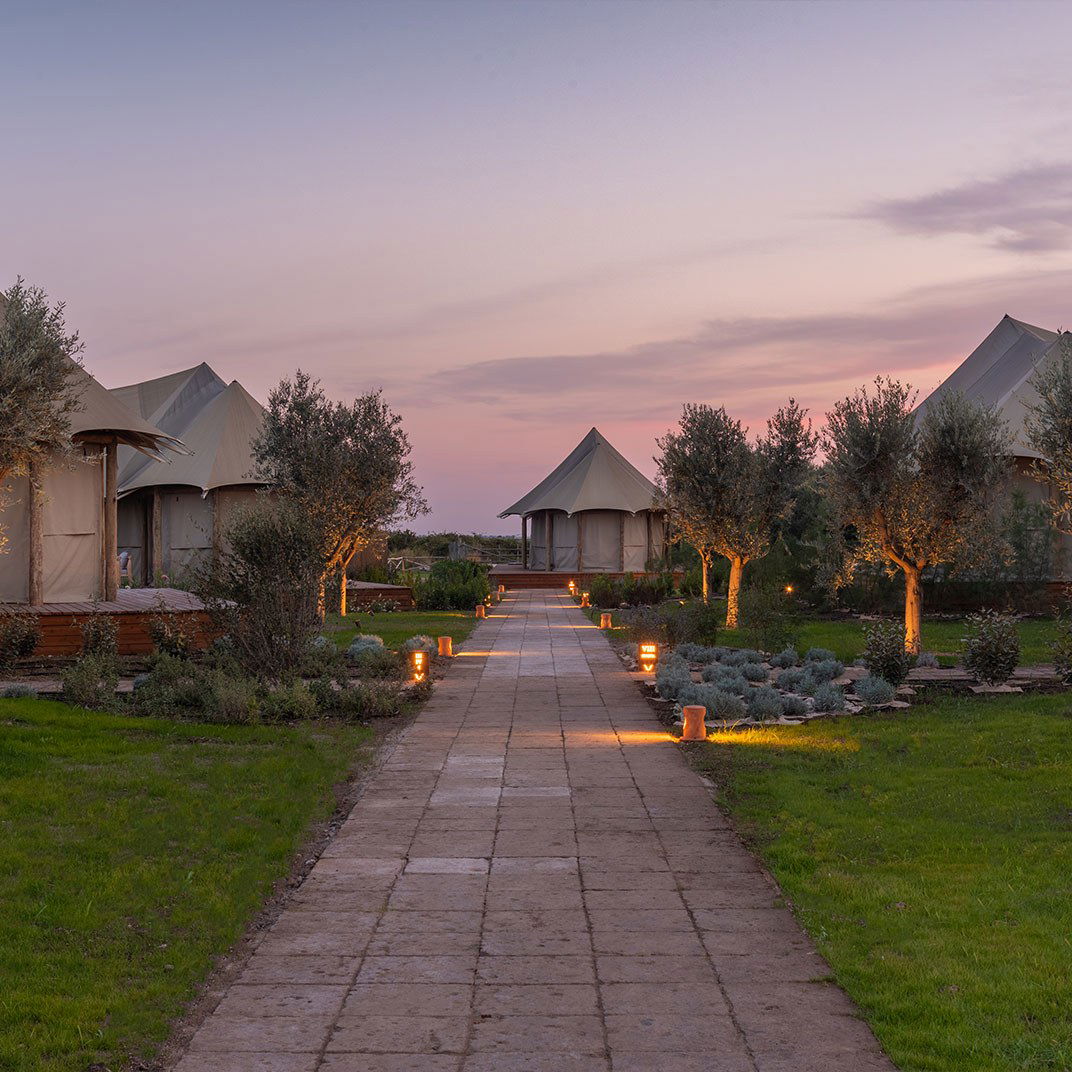
A Michelin Selected glamping and spa property set within the thermal landscape of the Vulci archaeological zone near Canino, Viterbo. Terme di Vulci occupies a rare position in northern Lazio's premium accommodation tier, combining open-air lodging with thermal bathing in one of Italy's least-trafficked heritage corridors. It offers a deliberate alternative to the region's more conventional agriturismo and historic-building conversions.
Where the Etruscan Plain Meets the Canvas Ceiling
Northern Lazio's thermal belt runs from the sulfurous springs of Saturnia north through the volcanic plateau of the Maremma, and most of it remains conspicuously under-served by accommodation that matches the landscape's ambition. The area around Canino, in the province of Viterbo, sits inside this corridor with the added weight of the Vulci archaeological park at its edge, one of the most significant Etruscan necropolis sites in Italy. Against that backdrop, Terme di Vulci Glamping & Spa operates in a format that the Italian premium accommodation market has been slow to adopt at any serious level: purpose-designed glamping that treats the physical environment as both setting and structural argument.
Glamping in Italy has tended to arrive as either low-investment camping with upgraded mattresses or as agriturismo overflow dressed in canvas. The more considered end of the format, where the open-air structure is a deliberate design choice rather than a budget concession, remains genuinely rare outside a handful of properties in Tuscany and the Dolomites. Terme di Vulci's Michelin Selected designation for 2025 places it in a documented tier of properties the guide considers worth tracking, a signal that the format here has been executed with enough discipline to register against Italy's broader hospitality field. See our full Viterbo restaurants guide for how the wider area sits within the region's travel circuit.
The Architecture of Open Air
The editorial angle at Terme di Vulci is, before anything else, spatial. Glamping as a lodging category asks a specific architectural question: how much of the boundary between interior and exterior do you dissolve before the guest experience loses coherence? Properties that answer well, like Borgo San Felice Resort in Castelnuovo Berardenga or Rosewood Castiglion Del Bosco in Montalcino, tend to anchor the guest within landscape features rather than simply placing structures inside them. The thermal springs at Vulci provide exactly that kind of anchor. The water element does the spatial work that stone walls perform in a conventional hotel: it fixes the property to its site and gives the guest a sensory reason to be precisely here.
The wider glamping and spa pairing reflects a broader shift in Italian wellness hospitality. Properties like Bellevue Hotel & Spa in Cogne and Castel Fragsburg in Merano have built their reputations on landscape-integrated wellness, but both operate within solid-wall architecture. The open-structure version of that proposition requires the design to work harder, since there is no building envelope to carry the weight of luxury signaling. Material choices, ground treatment, light management, and the relationship between individual lodging units and communal bathing spaces become the entire vocabulary.
Northern Lazio's Accommodation Position
Viterbo province has historically attracted far less premium accommodation investment than Tuscany's southern corridor or the Amalfi Coast, despite holding comparable archaeological and thermal assets. The city of Viterbo itself contains a medieval papal quarter that would anchor a boutique hotel scene in almost any northern European country. Instead, the area's premium accommodation options cluster around agriturismo conversions and, increasingly, smaller-scale properties that identify a specific asset, thermal water, archaeological adjacency, vineyard land, and build a single-proposition stay around it.
Terme di Vulci sits in this second group. Nearby, Corte della Maestà in Civita di Bagnoregio represents the historic-building conversion model in the same province. Further afield in the Italian center, Borgo Santandrea on the Amalfi Coast and Il San Pietro di Positano demonstrate how landscape integration can command a distinct premium tier when executed with rigor. The gap in northern Lazio between asset quality and hospitality investment is real, and properties that close it with credible design and recognized quality signals occupy an increasingly valuable position in a market where informed travelers are actively seeking non-Tuscan alternatives.
The Michelin Selected classification, which covers hotels rather than restaurants and reflects criteria around quality, comfort, and character rather than cuisine, puts Terme di Vulci in a documented conversation with properties across the Italian peninsula, from Aman Venice to Casa Maria Luigia in Modena, even if the formats and price tiers differ substantially. For the glamping category specifically, that kind of external validation matters more than in established formats, because the guest is being asked to accept a degree of structural unconventionality on faith.
The Thermal Proposition
Italy's thermal bathing tradition is deep and regionally specific. Saturnia's free cascades attract a mass market that has little to do with premium hospitality. Terme di Saturnia the resort operates at a different register. The volcanic springs of the Viterbo area, including those at Bagnoregio and Terme dei Papi in Viterbo itself, historically served papal and aristocratic clients and retain a character distinct from the more commercialized Tuscan thermal circuit. Terme di Vulci draws on this same subterranean geology, which means the spa component here is not decorative: the water is the reason the site exists where it does.
For travelers building an itinerary around thermal wellness, the northern Lazio circuit offers a less-trafficked alternative to the Saturnia corridor. The archaeological dimension, with the Vulci necropolis accessible from the property's address at Via delle Terme, Canino, adds a cultural layer that pure wellness properties in the region cannot match. The combination of thermal bathing, Etruscan heritage, and open-air lodging is specific enough to constitute a distinct travel proposition rather than a generic rural retreat.
Planning Your Stay
Terme di Vulci is located on Via delle Terme in Canino, in the province of Viterbo, in the northern Lazio Maremma. The nearest major road access runs through Canino, which sits approximately midway between the Via Aurelia coast road and the A1 Autostrada. Viterbo city, the provincial capital, is roughly 40 kilometers northeast and provides the nearest concentration of rail connections for travelers arriving without a car. A car is, in practical terms, necessary for exploring the archaeological sites and surrounding countryside that give the location its full context. The thermal and glamping format suggests spring and autumn as the more considered visiting windows: summer heat on the open volcanic plain can be intense, while winter access to outdoor thermal waters is the draw for a smaller subset of guests who specifically seek that contrast. Given the Michelin Selected recognition and the relative scarcity of this format in the region, advance booking is advisable, particularly for shoulder-season weekends when the combination of archaeological tourism and wellness travel creates genuine demand.
For travelers comparing this kind of landscape-embedded property against the grander scale of, say, Four Seasons Hotel Firenze or Bulgari Hotel Roma, the calculation is different: those properties trade on urban cultural density and institutional prestige. Terme di Vulci trades on irreplaceable site specificity and a format that neither of those properties can replicate. The comparison set is closer to properties like Therasia Resort in Lipari or Il Pellicano in Porto Ercole: places where the landscape does the primary work and the accommodation exists in considered relationship to it. Other landmark Italian properties worth benchmarking against the wider premium tier include Passalacqua in Moltrasio, Borgo Egnazia in Savelletri di Fasano, Portrait Milano, Il Sereno in Torno, Grand Hotel Tremezzo, Castello di Reschio in Lisciano Niccone, JK Place Capri, and Savoia Excelsior Palace Trieste. International reference points for the broader conversation include The Fifth Avenue Hotel in New York City, Badrutt's Palace Hotel in St. Moritz, and Hôtel de Paris Monte-Carlo.
Frequently Asked Questions
What should I expect atmosphere-wise at Terme di Vulci Glamping & Spa?
The atmosphere is defined by two things that rarely coincide in Italian hospitality: an active archaeological landscape and functioning thermal water. The Vulci necropolis is one of the most significant Etruscan sites in the country, and the property sits at the edge of that zone. The open-air glamping format means the surrounding Maremma plain, volcanic in geology and largely unpopulated, is a constant presence rather than a backdrop viewed through windows. The Michelin Selected recognition signals that the execution meets a documented quality threshold, so the atmosphere is not that of an improvised outdoor escape. Guests should expect structured comfort within a genuinely remote-feeling natural setting. The thermal component adds a specific sensory register that conventional hotels in the area cannot offer.
Which room category should I book at Terme di Vulci Glamping & Spa?
Specific room category data is not published in available sources, which is itself informative: properties at this scale in the glamping format typically offer a small number of lodging configurations, and direct contact with the property before booking is the appropriate route for understanding which unit type leading suits your priorities, whether that is proximity to the thermal facilities, privacy from other guests, or a particular orientation within the landscape. Given the Michelin Selected classification, the property has demonstrated a sufficient level of quality to warrant that direct engagement rather than a default booking-platform selection.
What's the defining thing about Terme di Vulci Glamping & Spa?
The combination of thermal bathing and Etruscan archaeological adjacency in an open-air lodging format is specific to this site in a way that no designed amenity list can reproduce elsewhere. The Vulci necropolis is not a generic heritage backdrop: it represents one of the primary sites through which Etruscan civilization has been documented, and its proximity to a thermal source follows the same logic that drew Etruscan and later Roman settlement to volcanic spring sites across central Italy. For travelers based in or passing through the Viterbo province, that convergence of geology, archaeology, and contemporary hospitality is the reason the property has earned its Michelin Selected status rather than the accommodation format alone.
Recognized By

Similar venues by awards
Related editorial
- Asia's 50 Best Restaurants 2026: The Chairman and Wing Go 1-2 from the Same BuildingThe Chairman takes No. 1 and Wing climbs to No. 2 at Asia's 50 Best Restaurants 2026. Both operate from the same Hong Kong building. Here's what it means.
- Four Seasons Yachts Debut: 95 Suites, 11 Restaurants, and a March 2026 Maiden VoyageFour Seasons I launches March 20, 2026, with 95 suites, a one-to-one staff ratio, and 11 onboard restaurants. Worth tracking if you want hotel-grade service at sea.
- LA Michelin Guide 2026: Seven New Restaurants from Tlayudas to Uzbek DumplingsMichelin's March 2026 California Guide update adds six LA restaurants and one Montecito newcomer, spanning Oaxacan tlayudas, Uzbek manti, and Korean-Italian pasta.
Save or rate Terme di Vulci Glamping \u0026 Spa on Pearl
Keep this venue in your Pearl passport, rate it after you visit, and track it alongside every other place you collect.