
Hotel in Vernon, Canada
Sparkling Hill Resort
150ptsWellness Architecture Above Kalamalka

About Sparkling Hill Resort
Most Pacific Northwest hoteliers play it safe, perhaps to let the spectacular landscapes and seascapes have the last word. Sparkling Hill Resort, in British Columbia’s Okanagan Valley, is another story — it’s an impressive piece of contemporary architecture, and and an unapologetically luxe one at that. It’s a Swarovski project — hence the abundance of crystals — but it’s focused more on wellness than on glamour. The rooms are large and luxurious, with vast windows overlooking the mountains or the lake, and the spa offerings are encyclopedic, ranging from a massage or manicure to vitamin infusions an even nutrition counseling. Take their advice to the PeakFine restaurant with its locally sourced cuisine and its expansive views.
Crystal and Stone Above Kalamalka Lake
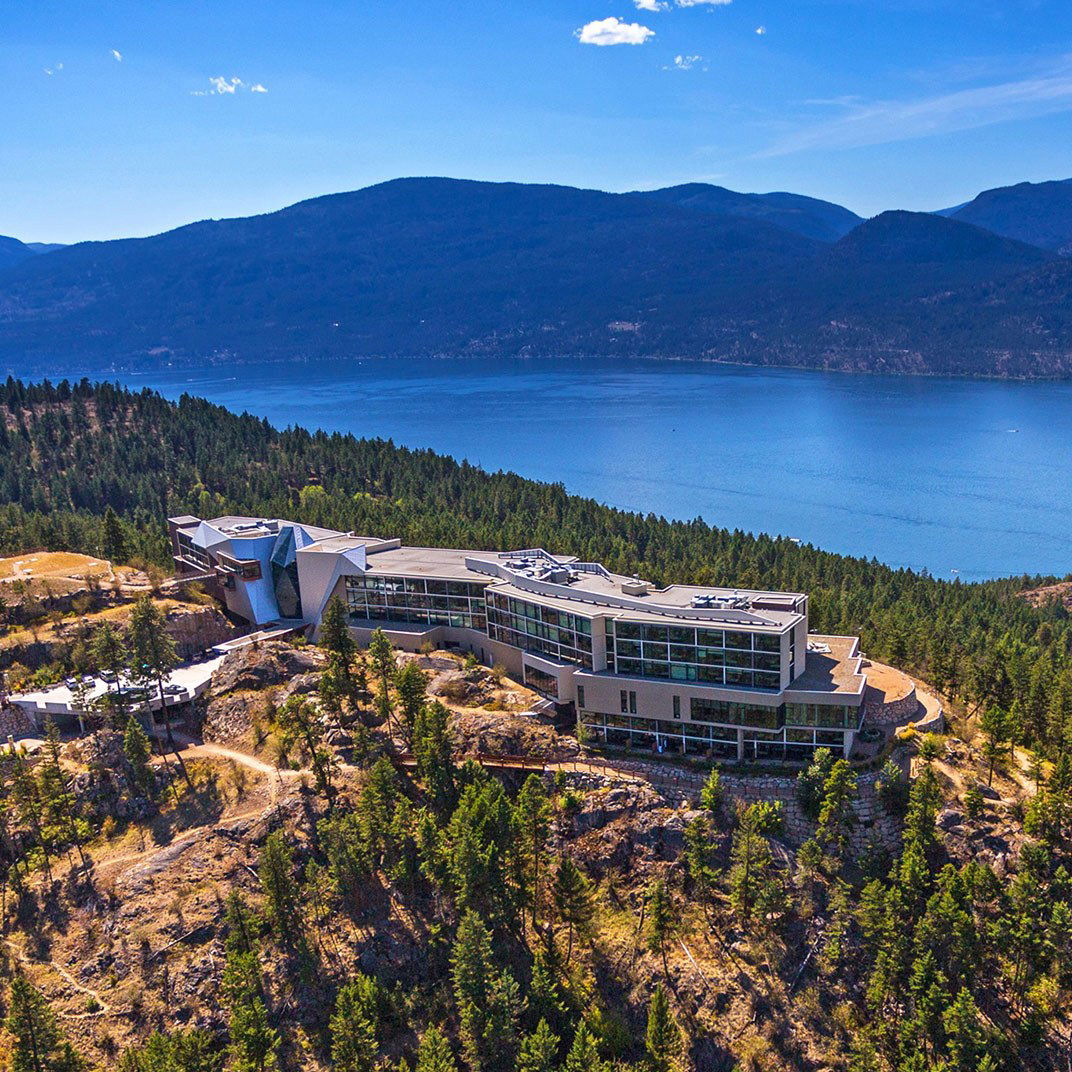
The Okanagan interior has developed a distinct category of resort property over the past two decades: places that use the region's dramatic topography not as backdrop but as structural argument. Sparkling Hill Resort, set on a hillside above Vernon at 888 Sparkling Place, belongs to that category decisively. The approach road already signals the register. You climb away from the valley floor, and the lake below shifts from a detail into a panorama. By the time the building resolves through the windshield, it has positioned itself as something closer to an Alpine observation platform than a conventional Canadian lodge.
The architecture is the defining fact here. The resort is built around a commitment to Swarovski crystal as both material and motif, with roughly 3.5 million crystals integrated into the structure and interior surfaces. This is not decorative overlay applied after the fact. The crystal work is load-bearing conceptually, determining how the building catches and distributes light at different hours. In the morning, east-facing corridors and public spaces handle the Okanagan sun the way a prism handles a beam: selectively, with refraction rather than reflection. By late afternoon the effect inverts. The Michelin Selected designation the property holds for 2025 brings it into the same evaluation framework as properties with far larger staffs and urban locations, which says something about how the physical plant is perceived at a credentialing level.
What the Building Is Actually Doing
Resort trades in a specific architectural idea: that wellness and spatial design are the same discipline. The spa complex, which anchors the lower levels, runs to approximately 40,000 square feet and is one of the larger dedicated spa footprints in western Canada for a single property. The treatment rooms, pools, and thermal facilities are not arranged as amenities appended to a hotel corridor. They form the structural core, and the guest rooms orbit around them. This is an inversion of the conventional resort hierarchy, where rooms generate revenue and spa is a supplementary line. At Sparkling Hill, the spa complex is closer to the product itself, and the rooms are the accommodation format that allows guests to access it across multiple days.
Building material palette extends beyond crystal. The exterior and primary structural surfaces lean toward stone, glass, and materials that age with the climate rather than against it. The Okanagan sees genuine winters, and the resort's architectural posture treats that as a feature rather than a problem to be mitigated with heated walkways and enclosed corridors alone. The refined siting, roughly 1,000 feet above the valley, means the snow coverage differs from the lakeside hotels in Vernon proper, and the views of Kalamalka Lake in winter carry a different quality than the summer postcard version.
Placing It in the Canadian Resort Set
Canada's premium resort category now splits along a clear axis. On one side sit the grand railway-era flagships: properties like Fairmont Chateau Lake Louise in Lake Louise, Fairmont Banff Springs in Banff, and Fairmont Chateau Whistler in Whistler, where the brand heritage and sheer scale carry much of the identity. On the other side sit smaller, design-specific properties where the physical concept does the competitive work. Fogo Island Inn in Joe Batt's Arm sits in that second group through architectural specificity and geographic isolation. Clayoquot Wilderness Lodge in Tofino holds a similar position through format and access. Sparkling Hill occupies the wellness-architecture niche within that second cohort, where the building's design program is inseparable from the core offer.
The comparison also clarifies what Sparkling Hill is not. It is not a city hotel with a spa wing, in the manner of Rosewood Hotel Georgia in Vancouver or Four Seasons Hotel Toronto in Toronto. It is not a heritage property where the building's age and architectural pedigree provide the main credential. And it is not a wilderness camp where accommodation is deliberately minimal. It sits in a small, specific tier: destination wellness resorts where the architecture itself is the program and where multiple nights are the intended unit of stay.
For context on how this tier operates elsewhere in Canada, Manoir Hovey in North Hatley and Hôtel Quintessence in Mont-Tremblant occupy structurally similar positions in the Quebec market: design-forward, smaller-footprint, non-urban properties where the physical environment does significant programmatic work. The mechanisms differ by region, but the guest decision logic is comparable.
Vernon and the Okanagan Context
Vernon sits at the northern end of the Okanagan Valley, a geography that gets discussed primarily through its wine production and lake culture in summer. The city itself is not a major tourism draw in the way Kelowna or Penticton are, which means Sparkling Hill effectively functions as a self-contained destination rather than a base for urban exploration. Guests arriving here are arriving for the property. The surrounding landscape, Kalamalka Lake in particular, is frequently cited in regional travel writing for its colour, which shifts between turquoise and green depending on light conditions. That context matters architecturally because the resort's siting maximizes exposure to it rather than framing it through occasional picture windows. For a broader orientation to what the area offers, see our full Vernon restaurants guide.
Within Canada's wider Michelin Selected hotel cohort for 2025, Sparkling Hill shares recognition with properties across a range of formats and regions. The selection signals a standard of physical quality and guest experience consistency rather than a narrowly defined category, which is part of why the same list can include urban flagships and remote wellness resorts without contradiction.
Planning a Stay
The resort is a drive destination: Vernon is approximately 4.5 hours from Vancouver by road, or accessible via Kelowna Airport roughly 60 kilometres south, which handles connections from Vancouver, Calgary, and Toronto. The refined siting and spa-centered format mean the property functions across seasons, but spring shoulder periods (April and May) and autumn (September through October) combine Okanagan lake views at their sharpest with lighter booking pressure than summer. Given the resort's positioning as a multi-night wellness destination, planning at least two or three months ahead for peak periods is advisable, particularly if specific room configurations or treatment bookings matter. For comparable properties at different points in Canada, Le Germain Charlevoix Hotel and Spa in Baie-St-Paul and Hastings House Country House Hotel on Vancouver Island offer design-led alternatives in different regional settings.
Frequently Asked Questions
- What kind of setting is Sparkling Hill Resort?
- Sparkling Hill sits on a hillside above Vernon in British Columbia's Okanagan Valley, approximately 1,000 feet above Kalamalka Lake. It is a destination resort rather than a city property, which means the surrounding natural environment and the building's relationship to it are central to the stay rather than incidental. The property holds a Michelin Selected designation for 2025, placing it within the same credentialing framework as Canada's other recognized hotel properties across a range of price points and formats.
- What's the leading room type at Sparkling Hill Resort?
- Given the resort's architectural emphasis on views and natural light, rooms and suites with refined lake-facing orientations deliver the most direct return on the property's design logic. The spa facilities form the structural core of the building, so proximity to that complex is worth factoring into room selection. As a Michelin Selected property for 2025, Sparkling Hill's room quality is assessed against a cross-category standard that rewards physical environment and consistency of experience.
- What's the defining thing about Sparkling Hill Resort?
- The defining feature is the integration of approximately 3.5 million Swarovski crystals into the architecture and interiors, combined with a 40,000-square-foot spa complex that functions as the property's programmatic center rather than an add-on. This places Sparkling Hill in a small category of Canadian resorts where the building's design concept is the primary product. The Michelin Selected recognition for 2025 is the most current external credential from a named publication framework.
- How far ahead should I plan for Sparkling Hill Resort?
- For summer stays, two to three months of lead time is a practical baseline given Okanagan peak season demand. Autumn bookings, particularly September, benefit from early planning as the combination of post-summer availability and lake colour makes it a preferred window. The resort does not publish phone or web booking details through EP Club's records, so confirming current availability and rates through the property directly or through recognized hotel booking channels is the appropriate step. As a Michelin Selected property, it typically appears on the major booking platforms used for recognized Canadian hotels.
- Is Sparkling Hill Resort primarily a spa retreat or a conventional hotel stay?
- The property is structured as a wellness destination where the spa complex, at approximately 40,000 square feet, forms the architectural and programmatic core. Guests who book for a single night without engaging the spa facilities are using a fraction of what the property is designed to deliver. Two or three nights is the format that aligns with the resort's design logic, consistent with how similar properties in the Michelin Selected cohort, including regional comparisons like Hôtel Quintessence in Mont-Tremblant, position multi-night stays as the intended unit of experience.
Recognized By

Similar venues by awards
Related editorial
- Asia's 50 Best Restaurants 2026: The Chairman and Wing Go 1-2 from the Same BuildingThe Chairman takes No. 1 and Wing climbs to No. 2 at Asia's 50 Best Restaurants 2026. Both operate from the same Hong Kong building. Here's what it means.
- Four Seasons Yachts Debut: 95 Suites, 11 Restaurants, and a March 2026 Maiden VoyageFour Seasons I launches March 20, 2026, with 95 suites, a one-to-one staff ratio, and 11 onboard restaurants. Worth tracking if you want hotel-grade service at sea.
- LA Michelin Guide 2026: Seven New Restaurants from Tlayudas to Uzbek DumplingsMichelin's March 2026 California Guide update adds six LA restaurants and one Montecito newcomer, spanning Oaxacan tlayudas, Uzbek manti, and Korean-Italian pasta.
Save or rate Sparkling Hill Resort on Pearl
Keep this venue in your Pearl passport, rate it after you visit, and track it alongside every other place you collect.