
Hotel in Tulum, Mexico
Wakax Hacienda - Cenote \u0026 Boutique Hotel
350ptsCenote-Integrated Lodging

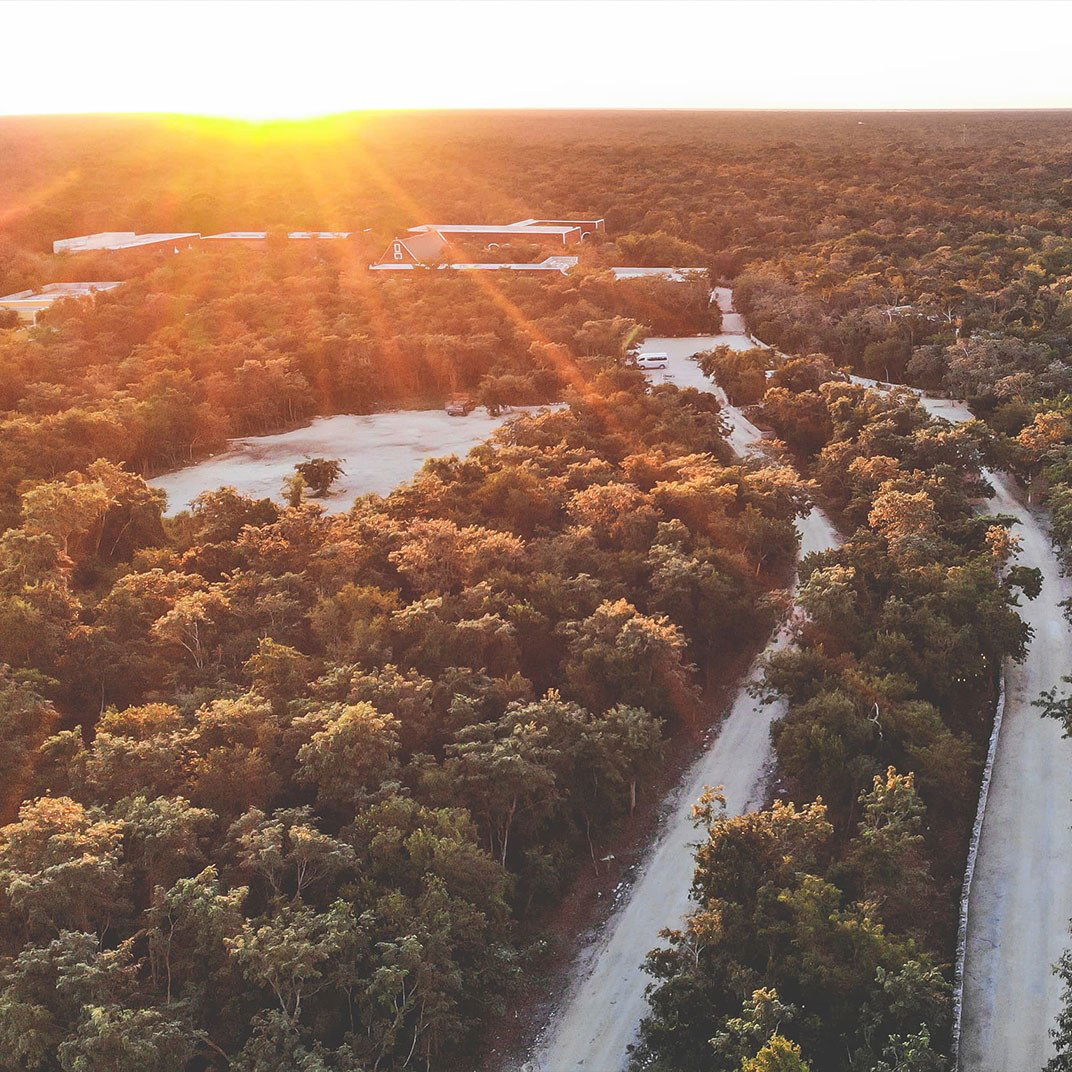
About Wakax Hacienda - Cenote \u0026 Boutique Hotel
Wakax Hacienda earned Two MICHELIN Keys in 2025, placing it among a small tier of boutique hotels in Tulum recognized for both setting and standards. Built around a private cenote on the Cancún-Tulum corridor, it offers an experience rooted in the Yucatán Peninsula's limestone karst geography and the Maya concept of sacred water. For travelers weighing design-led properties against larger resort formats, Wakax occupies a distinct position.
Where the Cenote Is the Architecture
Along the Cancún-Tulum highway corridor, the dominant hospitality model has long been beach-facing: palapa roofs over white sand, Caribbean views, and a formula repeated at scale. Wakax Hacienda takes a different organizing principle. Here, the cenote, a natural sinkhole fed by the Yucatán's vast underground river system, is not an amenity or a day-trip excursion. It is the structural heart of the property. That shift in orientation separates Wakax from the coastal strip and places it in conversation with a smaller set of inland properties that treat the peninsula's geological character as the primary draw rather than a supplement to sea views.
Cenotes carry cultural weight that predates any hotel category system. For the ancient Maya, these formations were understood as entrances to the underworld, sources of fresh water in a region with no surface rivers, and sites of ritual significance. That history doesn't disappear when a property is built around one; it either gets acknowledged or it gets aestheticized into irrelevance. The more considered boutique properties in the Yucatán have found ways to hold both — to offer access and comfort while letting the place speak to something older. Where Wakax lands on that axis is part of what the Two MICHELIN Keys designation, awarded in 2025, implicitly evaluates.
The Michelin Keys Standard in a Boutique Context
Michelin's hotel keys program, expanded significantly in recent years, applies a framework that weights setting, service calibration, and overall guest experience rather than room count or brand affiliation. Two Keys, within that framework, indicates a property that delivers consistently at a level above its immediate peer tier — not merely comfortable, but considered. For Tulum specifically, where the range of accommodation runs from design-forward eco-cabañas to high-capacity resort complexes, a Two Keys distinction in 2025 positions Wakax within a small cohort of properties where the physical environment and the guest experience have been brought into alignment with each other.
Properties like Hotel Esencia and Azulik have long defined the upper register of Tulum's boutique accommodation. Ahau Tulum and Ana y Jose Hotel & Spa Tulum occupy adjacent territory. What distinguishes Wakax within this cohort is the cenote-centered proposition, which is genuinely scarce. Private or semi-private cenote access at a boutique property, on the corridor between Cancún and Tulum at km 239, is not something that can be replicated by adding a pool or repositioning a beachfront. The geology either exists or it does not.
Yucatán's Cenote Geography as Context
The Yucatán Peninsula sits atop one of the world's largest underground freshwater systems, the Sistema Sac Actun, a flooded cave network that stretches for hundreds of kilometers. Where the ceiling of these caves has collapsed over millennia, cenotes form , some open to the sky, some partially sheltered, some entirely subterranean. The region holds thousands of them, ranging from heavily touristed open pools near Chichen Itza to remote, near-inaccessible caverns in the jungle interior.
For travelers oriented around natural environments rather than built amenities, this geography matters. A stay that gives close, unhurried access to a cenote offers something fundamentally different from a day tour to a shared site. The experience of swimming in limestone-filtered water in the early morning, before the light shifts or crowds arrive, belongs to a category of travel that resists easy comparison to beach hotel experiences. Wakax Hacienda's positioning on the Cancún-Tulum corridor (km 239) places it within reach of both Tulum town's restaurant scene and the broader Riviera Maya's transport infrastructure, while retaining the spatial separation that makes the setting coherent.
Where Wakax Sits in Mexico's Premium Boutique Tier
Across Mexico, the premium independent hotel category has grown in depth and geographic spread. Chablé Yucatán near Mérida has established a benchmark for cenote-adjacent wellness hospitality in the interior. Maroma in Riviera Maya represents the older strand of refined beach-facing luxury on the same coastline. Further afield, One&Only Mandarina in Riviera Nayarit and Zadun, A Ritz-Carlton Reserve in Los Cabos define what large-scale branded luxury looks like on Mexico's coasts. Las Ventanas al Paraíso, A Rosewood Resort sits in the same branded upper tier in San José del Cabo.
Wakax operates in a different register from all of these: smaller in scale, defined by a specific natural feature, and recognized now by Michelin's evaluation framework rather than a brand affiliation. That combination, boutique size plus credentialed recognition plus an irreproducible natural asset, places it in a peer set that also includes properties like Etéreo, Auberge Resorts Collection in Punta Maroma and, further afield in terms of geography and character, Xinalani in Quimixto and Playa Viva in Juluchuca. These are properties where the natural setting is load-bearing, not decorative.
For travelers comparing properties across the Tulum corridor specifically, Aldea Canzul, Amansala Resort, BE Destination Tulum, and Bespoke Tulum each represent distinct positions within the same market. Wakax's Two MICHELIN Keys places it at the formally recognized end of that local spectrum.
Planning a Stay
Wakax Hacienda sits at km 239 on the Carretera Cancún-Tulum, the federal highway that runs the length of the Riviera Maya. That position puts it roughly equidistant from the Cancún international airport to the north and Tulum town to the south, both accessible by taxi or private transfer. Given the boutique scale of the property and the specificity of the cenote-access proposition, advance booking is advisable, particularly for peak season travel between December and March, when Tulum's broader accommodation market tightens significantly. Contact and reservation details are leading sourced directly through current listings, as phone and digital booking channels were not confirmed at time of writing. For a broader orientation to what the area offers across dining, drinking, and accommodation, the EP Club Tulum guide covers the full range.
Frequently Asked Questions
- What is the defining characteristic of Wakax Hacienda?
- The property is organized around a private cenote, a natural freshwater sinkhole formed by the collapse of Yucatán's underground limestone cave system. In 2025, Michelin awarded it Two Keys, recognizing the coherence of setting, service, and experience. That combination of geological specificity and formal recognition distinguishes it within Tulum's boutique accommodation tier.
- What is the signature room or space at Wakax Hacienda?
- Based on the property's Two MICHELIN Keys recognition and its cenote-centered design, the cenote itself functions as the defining space rather than any conventional signature suite. The accommodation category is boutique, and the property's style positions natural immersion ahead of conventional hotel amenities as the primary draw.
- Does Wakax Hacienda take walk-ins?
- Given its boutique scale and Two MICHELIN Keys status, which signals a level of demand and operational specificity that typically requires planning ahead, walk-in availability is unlikely to be reliable, particularly during Tulum's high season from December through March. No confirmed phone or website was available at time of writing; contacting the property through current booking channels before arrival is strongly advised.
- How does Wakax Hacienda connect to the cultural heritage of the Yucatán?
- Cenotes were considered sacred by the ancient Maya, functioning as water sources, ritual sites, and symbolic gateways in cosmological belief. A property built around one exists in direct relationship with that heritage, whether or not it explicitly frames its offering in those terms. For travelers interested in the cultural and geological layers of the Yucatán Peninsula, this positioning gives a stay at Wakax Hacienda a dimension that a conventional beachfront property in the same corridor would not provide.
Recognized By

More hotels in Tulum
- Encantada TulumEncantada Tulum sits at KM 8.7 on the southern hotel zone strip, a solid choice for couples wanting beachfront access without the design-hotel price premium of Azulik or Bespoke Tulum. Booking is easy, and the location suits guests who plan to explore cenotes and beach clubs rather than stay anchored on property. Book two to three weeks ahead in peak season.
- NEST TulumNEST Tulum sits at Km 9.5 on the Boca Paila road, giving it a quieter position than most of Tulum's hotel zone. Booking is easy and the southern location suits first-timers who want distance from the busier northern beach clubs. Not a fit for conventional business travel, but worth considering for creative retreats or small team offsites seeking genuine separation from city noise.
- Olas TulumOlas Tulum sits at KM 10.6 on Boca Paila Road in the quieter southern stretch of the hotel zone, closer to Sian Ka'an than the crowded north. Booking is easy compared to competitors like Azulik and Hotel Esencia. The location is the primary draw — return visitors should book 4–6 weeks out in high season (December–March) to secure availability.
- Aloft TulumAloft Tulum is the practical, low-friction pick on the town side of Tulum — easy to book, covered by Marriott Bonvoy points, and priced below the boutique beach-zone competition. It works well for business travellers or loyalty program users, but it is not the property for a design-led or beach-first stay. For that, look elsewhere in the hotel zone.
- Amansala Resort |Beachclub | SpaAmansala combines beachclub, spa, and resort in one property at KM 5.5 on the Tulum Hotel Zone — a format that works well for guests who want beach access, wellness, and social energy in one location. Best booked November through April. Not the right call if service consistency or amenity depth is your priority.
Related editorial
- Asia's 50 Best Restaurants 2026: The Chairman and Wing Go 1-2 from the Same BuildingThe Chairman takes No. 1 and Wing climbs to No. 2 at Asia's 50 Best Restaurants 2026. Both operate from the same Hong Kong building. Here's what it means.
- Four Seasons Yachts Debut: 95 Suites, 11 Restaurants, and a March 2026 Maiden VoyageFour Seasons I launches March 20, 2026, with 95 suites, a one-to-one staff ratio, and 11 onboard restaurants. Worth tracking if you want hotel-grade service at sea.
- LA Michelin Guide 2026: Seven New Restaurants from Tlayudas to Uzbek DumplingsMichelin's March 2026 California Guide update adds six LA restaurants and one Montecito newcomer, spanning Oaxacan tlayudas, Uzbek manti, and Korean-Italian pasta.
Save or rate Wakax Hacienda - Cenote \u0026 Boutique Hotel on Pearl
Keep this venue in your Pearl passport, rate it after you visit, and track it alongside every other place you collect.