
Hotel in Pinakatai, Greece
Peliva Nature \u0026 Suites\u002c Pelion
150ptsForest-Edge Village Suites

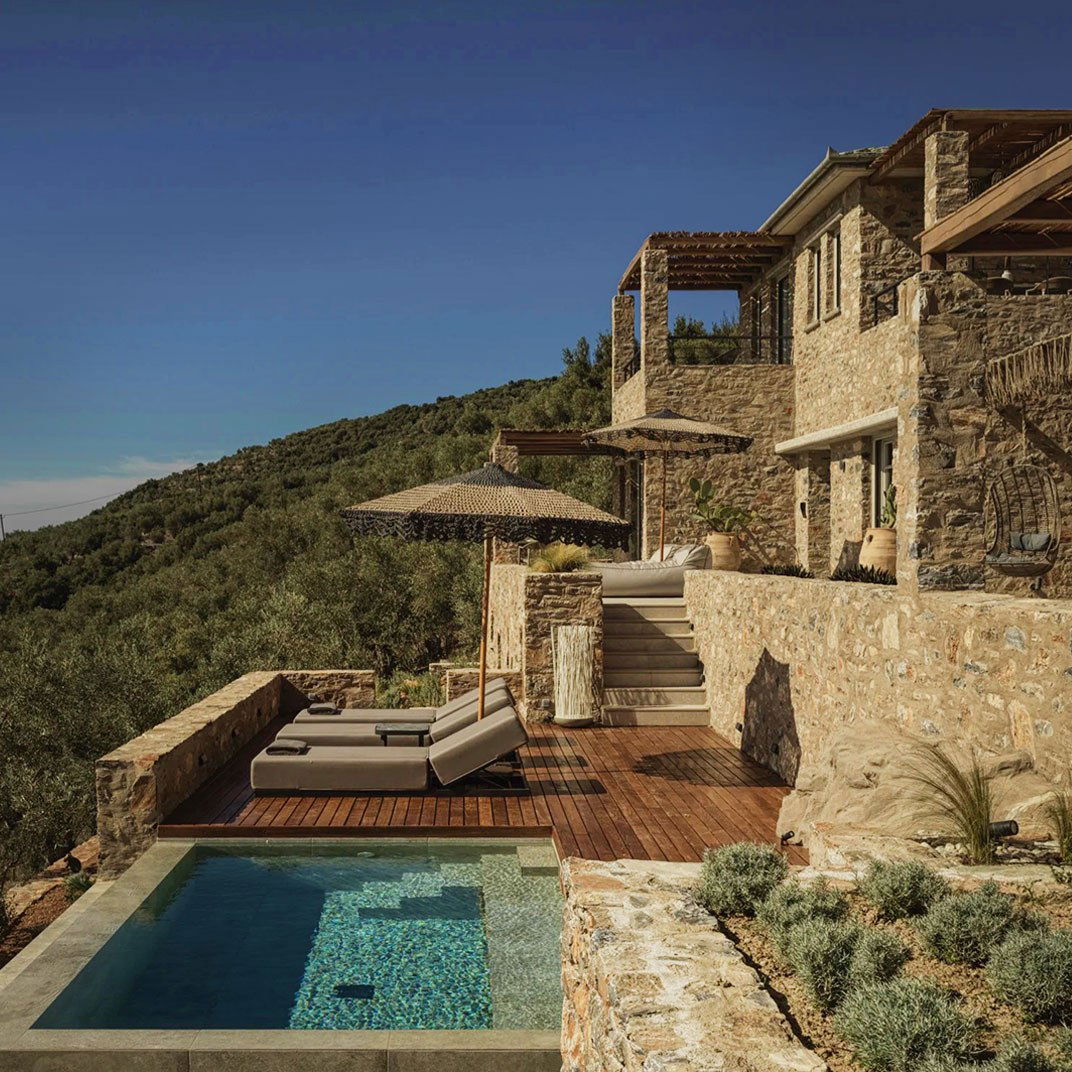
About Peliva Nature \u0026 Suites\u002c Pelion
Peliva Nature & Suites sits in the village of Pinakates on the Pelion peninsula, earning Michelin Selected recognition in the 2025 hotel guide. The property occupies a category defined by small-scale, vernacular architecture and direct access to the forested, sea-facing terrain that distinguishes Pelion from the Aegean island circuit. For travellers calibrating between Pelion's quieter inland villages and Greece's more established luxury destinations, Peliva represents the peninsula's design-conscious, nature-rooted end of the market.
Where Pelion's Village Architecture Meets the Forest Edge
The Pelion peninsula has long operated outside the gravitational pull of Greece's Aegean island circuit. Where properties like Astra Suites in Santorini or the Grace Hotel, Auberge Resorts Collection in Imerovigli trade in caldera panoramas and volcanic drama, Pelion's identity is built on something more textured: chestnut forests descending toward the Aegean, cobblestone paths threading between Ottoman-era mansions, and villages that have remained small enough to avoid the infrastructure pressures of the island tourism economy. Pinakates sits near the leading of that village hierarchy, a settlement of stone-built archontika (manor houses) that the Greek government has classified as a traditional settlement worthy of preservation. Peliva Nature & Suites operates inside that architectural framework.
The property holds Michelin Selected status in the 2025 hotel guide, a designation that places it in a peer set defined not by scale or brand infrastructure but by character, quality of experience, and design coherence. Across Greece's premium accommodation offer, Michelin Selected hotels span a wide range of formats, from urban properties like The Met Hotel in Thessaloniki to island retreats such as Myconian Ambassador in Mykonos. Peliva's placement in that cohort signals a property that meets the guide's threshold for considered hospitality, distinguishing it from Pelion's broader accommodation offer, which ranges from informal guesthouses to self-catering village homes.
Vernacular Form, Contemporary Restraint
Pelion's architectural identity is unusually codified for a Greek region. The peninsula's stone buildings, slate roofs, and overhanging wooden balconies (a form called the sahnisi) reflect centuries of prosperous trade and Ottoman administrative oversight. The village of Pinakates preserves this language particularly well, with facades that have changed little since the 18th and 19th centuries. Properties working within this context face a specific design challenge: how to provide the comfort expectations of a contemporary guest while respecting a built environment that planning regulation and cultural sentiment both protect.
The approach taken by design-conscious small hotels in this part of Greece tends toward material continuity: local stone, timber joinery, hand-plastered walls in muted tones that reference the regional palette without replicating it literally. This is a different design discipline from the stripped-back minimalism that defines island properties like Acro Suites in Agia Pelagia or the Olea All Suite Hotel in Zakynthos, where whitewashed surfaces and Cycladic geometry set the reference points. In Pelion, the design brief is warmer, more forested, more rooted in a specific historical moment rather than a generalised Mediterranean abstraction.
Peliva's name itself signals the orientation: the combination of nature and suites in both the property name and the category it occupies speaks to a format where the surrounding landscape is understood as part of the offer, not merely the backdrop. Suite formats in this tier typically mean distinct accommodation units with a higher degree of privacy and spatial separation than hotel-block rooms, a structure that suits the village setting and the kind of travel Pelion attracts.
Pelion's Position in Greece's Premium Accommodation Map
Greece's premium accommodation geography has historically concentrated in three zones: Athens, the Cyclades (particularly Santorini and Mykonos), and the Ionian islands. The Peloponnese has gained traction through large-scale integrated resorts, with properties like Amanzoe in Porto Heli and Mandarin Oriental Costa Navarino in Pylos anchoring a different model: resort compounds with extensive amenity infrastructure. Pelion sits outside all of these gravitational centres, which is precisely what defines its appeal to a certain traveller profile.
The peninsula attracts visitors who are deliberately calibrating away from high-density island tourism, toward a Greece that feels more continuous with its landscape and village history. Properties in this context compete not primarily on amenity count but on the quality of their integration with the place. That is a position Peliva shares with comparable smaller-scale properties elsewhere on the Greek mainland and the less-trafficked islands, including Kinsterna Hotel in Monemvasía, which similarly anchors its offer in historical built fabric, and Palazzo Santa Maria in Syros, where neoclassical architecture sets the design register.
Among the Sporades and northern Aegean islands, ALERÓ Seaside Skyros Resort in Skyros operates in a broadly analogous format, combining a less-travelled island setting with a design-led approach that positions it outside the mainstream island luxury circuit. For travellers building a Greek itinerary that reaches beyond the established island loop, these properties form a coherent secondary tier.
Reaching Pinakates and Planning the Stay
Pelion's geography shapes the logistics of any stay here. The peninsula extends southeast from Volos, the region's main city, with mountain roads that wind through apple and chestnut orchards before reaching the higher villages on the eastern face. Pinakates sits on that eastern slope, among the most traditionally preserved of Pelion's settlements. Volos is the practical arrival hub, reachable by road from Athens (roughly three hours) or by train from Thessaloniki. From Volos, the drive to Pinakates takes approximately 40 minutes on roads that become progressively narrower as you climb, which is worth accounting for when arriving after dark or in winter conditions.
The Pelion peninsula has a defined tourism season that concentrates between late spring and early autumn. The eastern villages, facing the Aegean, combine beach access in summer with the cooler forested interior throughout the year. Winter in Pelion is a secondary draw, with the ski area above Chania functioning as a rare Greek winter destination, though properties in the premium segment tend to time their closures and peak periods around the warmer months. Checking directly with Peliva on seasonal availability is the reliable approach, given that village properties of this scale often manage their calendars more fluidly than larger hotel groups.
For travellers calibrating between Pelion and Greece's other design-conscious smaller properties, the comparison set is worth considering carefully. Elix by Mar-Bella Collection in Perdika, Acron Villas in Paros, and Pegasus Suites in Fira each represent the suite-format model applied to different Greek geographies. Peliva's distinction within that set is the specific weight it places on the natural and architectural environment of Pelion itself, a peninsula that rewards travellers willing to organise their own arrival rather than slot into an established island transfer infrastructure. See our full Pinakatai restaurants guide for context on eating and drinking in the area.
Frequently Asked Questions
- What is the atmosphere like at Peliva Nature & Suites, Pelion?
- The atmosphere is shaped by Pinakates itself, one of the Pelion peninsula's most intact traditional settlements, where stone-built architecture and forest surroundings set a quieter register than Greece's island resorts. Peliva holds Michelin Selected recognition in the 2025 guide, which places it in a cohort defined by character and setting rather than amenity volume. The price positioning is consistent with small-scale premium properties in the Greek countryside rather than with large resort compounds like those found in the Peloponnese or on Mykonos.
- What room category do guests tend to prefer at Peliva Nature & Suites, Pelion?
- Specific room-category data is not available in our current records. The suite format indicated by the property name aligns with a wider trend in Michelin Selected Greek properties toward distinct, higher-privacy accommodation units over standard hotel rooms. Properties operating in comparable style categories, such as Poseidonion Grand Hotel Spetses in Spetses or Kivotos Mykonos in Mykonos Island, tend to see guests prioritise units with the strongest connection to the natural or architectural setting. At a village property in Pelion, that would logically point toward suites with direct views of the forest or the surrounding stone village fabric, though confirmation should come directly from the property.
Recognized By

Similar venues by awards
Related editorial
- Asia's 50 Best Restaurants 2026: The Chairman and Wing Go 1-2 from the Same BuildingThe Chairman takes No. 1 and Wing climbs to No. 2 at Asia's 50 Best Restaurants 2026. Both operate from the same Hong Kong building. Here's what it means.
- Four Seasons Yachts Debut: 95 Suites, 11 Restaurants, and a March 2026 Maiden VoyageFour Seasons I launches March 20, 2026, with 95 suites, a one-to-one staff ratio, and 11 onboard restaurants. Worth tracking if you want hotel-grade service at sea.
- LA Michelin Guide 2026: Seven New Restaurants from Tlayudas to Uzbek DumplingsMichelin's March 2026 California Guide update adds six LA restaurants and one Montecito newcomer, spanning Oaxacan tlayudas, Uzbek manti, and Korean-Italian pasta.
Save or rate Peliva Nature \u0026 Suites\u002c Pelion on Pearl
Keep this venue in your Pearl passport, rate it after you visit, and track it alongside every other place you collect.