
Hotel in Palm Jumeirah, United Arab Emirates
Atlantis The Royal\u002c Dubai
600ptsMega-Resort Maximalism

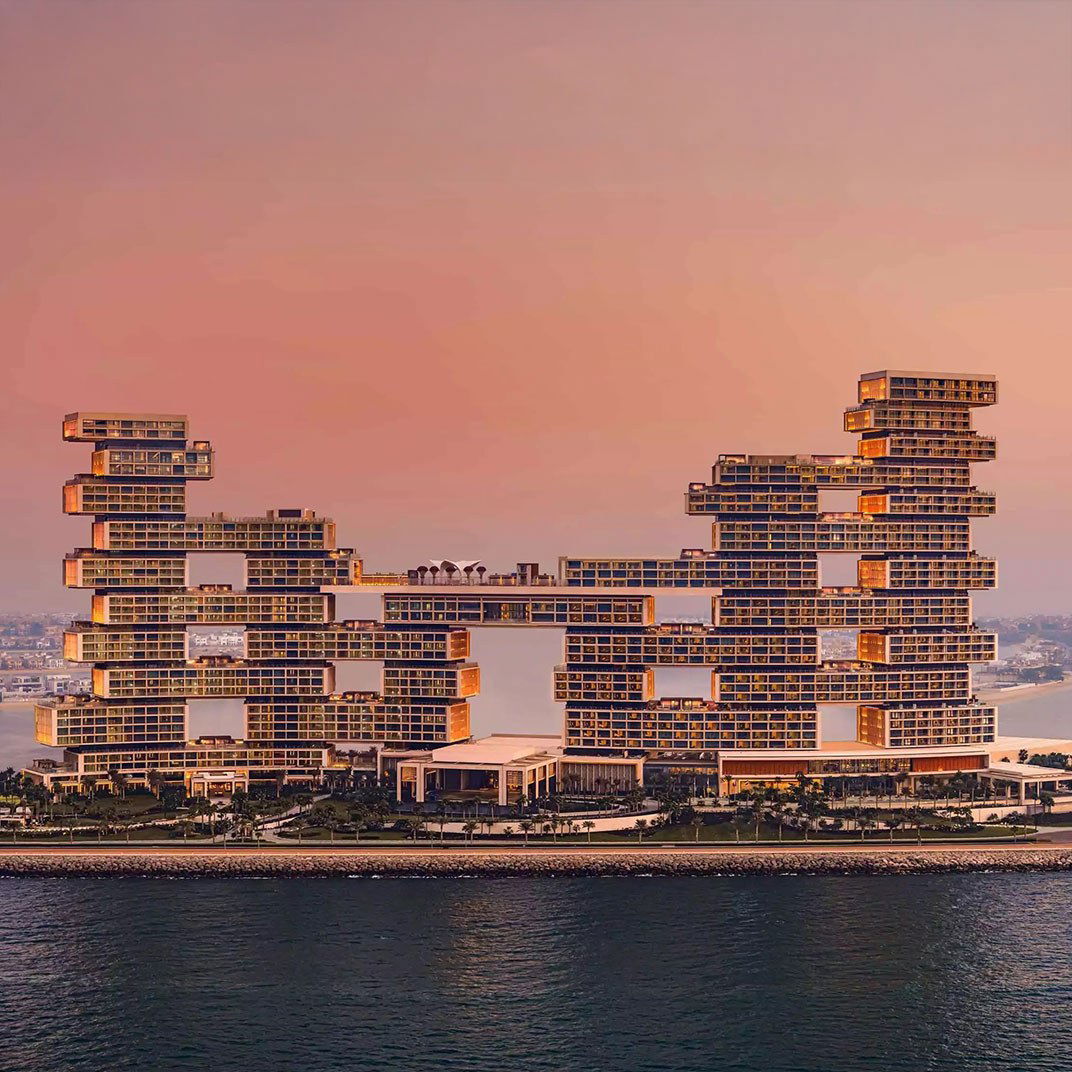
About Atlantis The Royal\u002c Dubai
Atlantis The Royal holds Three MICHELIN Keys in the 2025 guide, placing it among a small cohort of UAE hotels recognised at that level. The property sits on the outer crescent of Palm Jumeirah, where scale and architectural spectacle define the competitive set. For travellers calibrating between Dubai's mega-resort tier and more intimate luxury alternatives, this is the reference point against which the others are measured.
Architecture as the Product
Dubai's hospitality market has long used architecture as its primary differentiator, and nowhere is that logic more fully realised than on Palm Jumeirah's outer crescent. The resort tier here operates on a different register from the city's older downtown hotels: rooms are not just places to sleep but components of a designed spectacle, and the physical structure of the building is as much the offering as the services inside it. Atlantis The Royal sits squarely within that tradition, representing the most recent and most expensive iteration of the mega-resort format that the Palm has come to define globally.
The building's profile, visible from several kilometres along the Dubai coastline, functions less like a hotel and more like a piece of civic infrastructure. Its sculpted towers, cantilever forms, and sky bridge belong to a school of architecture-as-statement that connects Dubai's ambitions with the broader genre of landmark resort construction seen in Singapore, Las Vegas, and the Maldives. What distinguishes the Palm Jumeirah execution is the density of programming packed into a single address: pools, restaurants, bars, beach access, and event spaces stacked across a footprint that would constitute an entire neighbourhood in a more constrained city.
That scale creates an internal logic of its own. Guests at properties of this type rarely need to leave the building, and the resort's designers appear to have engineered it with that in mind. The interior language moves between maximalism and considered material choices, with water features, art installations, and ceiling heights calibrated to register as genuinely impressive rather than merely large. For travellers accustomed to the restraint-led design of properties like Aman Venice or Cheval Blanc Paris, this is a different aesthetic proposition entirely: abundance as a design principle, executed at the highest budget tier the market supports.
Three MICHELIN Keys and What That Signal Means
The 2025 MICHELIN Keys list for hotels represents the guide's most significant expansion into accommodation assessment, and Atlantis The Royal's Three Keys distinction places it in the smallest, most selective cohort on that list. In the UAE context, Three Keys recognition carries particular weight because the guide's hotel programme applies the same evaluative rigour to amenities, service consistency, and physical environment that its restaurant arm applies to kitchens. Earning the top tier in a market as competitive as Dubai, where the comparison set includes properties backed by some of the world's largest hospitality groups, confirms a level of execution that goes beyond the architectural spectacle alone.
Internationally, Three Keys properties cluster at addresses like Le Bristol Paris, Hotel Sacher Wien, and Badrutt's Palace Hotel in St. Moritz — properties where the physical address, service culture, and historical positioning are inseparable from the guest experience. Atlantis The Royal earns its place in that conversation through a different route: not heritage or restraint, but contemporary ambition executed without compromise. The peer set matters because it clarifies what the rating is actually measuring. MICHELIN Keys across all Three-tier recipients reward consistency and completeness of experience; at Atlantis The Royal, the argument rests on scale of programming, design investment, and F&B depth rather than intimacy or historical patina.
For comparison within the UAE, Andaz by Hyatt on Palm Jumeirah offers a counterpoint: a property on the same island operating at smaller scale, with a design-led but less monumental approach. The choice between them maps directly onto the choice between the mega-resort and boutique-luxury philosophies that define the Palm's upper tier.
Palm Jumeirah in the UAE Hotel Context
Palm Jumeirah occupies a specific position in the UAE's hospitality geography. It is neither the heritage-adjacent territory of Abu Dhabi's waterfront, where properties like Anantara Sir Bani Yas Island offer wildlife access and seclusion, nor the raw landscape drama of Anantara Qasr Al Sarab in the Liwa Desert. The Palm is a constructed island whose entire identity is the product of engineering ambition, and the hotels that perform leading on it are those that match the island's own ethos: scale, visibility, and a determination to make the infrastructure itself the spectacle.
The broader UAE circuit offers meaningful alternatives for travellers whose priorities shift. Fairmont Ajman and Fairmont Fujairah Beach Resort represent the northern emirate beach resort option, with lower density and different coastal character. Al Badayer Retreat by Sharjah Collection sits at the opposite end of the scale philosophy: a desert-facing property whose value lies precisely in what it withholds. Telal Resort Al Ain offers the inland garden city as an alternative base. None of these are direct competitors to Atlantis The Royal; they serve a different traveller decision entirely. Desert Islands Resort by Anantara in Al Dhafra and Anantara Santorini Abu Dhabi Retreat in Ghantoot extend the regional comparison further, each carving a niche that the Palm's mega-resort format cannot replicate. For a comprehensive look at what the island itself offers across categories, our full Palm Jumeirah restaurants and hotels guide maps the full range.
Within the global mega-resort conversation, the comparison set broadens further. Properties like Bvlgari Hotel Tokyo or Mandarin Oriental Ritz Madrid operate at smaller scale with deeper historical positioning, while Aman New York and Hôtel de Paris Monte-Carlo represent the institution-building approach. Atlantis The Royal argues that contemporary ambition, executed at sufficient scale and with MICHELIN-level service consistency, constitutes its own category of legitimacy.
Planning a Stay
Atlantis The Royal sits on Crescent Road on Palm Jumeirah's outer ring, accessible via the Palm Monorail from the Gateway station or by taxi from Dubai International Airport, which typically runs 35 to 45 minutes depending on traffic. The property's size means advance planning within the resort itself pays dividends: restaurant reservations and pool access at specific areas can require booking ahead, particularly during the October to April peak season when temperatures make outdoor programming genuinely comfortable. Dubai's summer months, from June through September, see lower occupancy and adjusted rates across the Palm tier, which creates a viable entry point for travellers whose schedules allow flexibility. The full Atlantis The Royal listing on EP Club covers the latest availability and category guidance. For travellers building a wider UAE itinerary, Mövenpick Resort Al Marjan Island in Ras Al Khaimah offers a lower-density coastal option at the northern end of the country's resort circuit.
Frequently Asked Questions
What's the vibe at Atlantis The Royal, Dubai?
The property operates at the leading of Dubai's mega-resort format, which means the atmosphere is deliberately large, social, and visually saturated. It holds Three MICHELIN Keys in the 2025 guide, the highest tier in the hotel programme, which confirms that the scale is matched by service and operational consistency. The guest profile skews toward travellers for whom the resort's programming, pool culture, and F&B breadth are the primary draw rather than the quieter, more residential atmosphere you find at smaller-key properties elsewhere on the Palm or in Abu Dhabi. It is a property that rewards engagement with its infrastructure; guests who prefer a low-stimulus environment will find the format demanding.
Which room category should I book at Atlantis The Royal, Dubai?
The property's Three MICHELIN Keys status applies across the full guest experience rather than to any specific room tier, so the question of category comes down to how much of the resort's architecture you want to be inside versus looking at. Higher-floor rooms and sky-facing categories place guests within the building's more theatrical spaces, while lower categories still benefit from the full amenity programming. Given the property's price positioning at the leading of the Palm Jumeirah market, the uplift to a sky-facing or sea-view category is proportionally smaller relative to the base rate than at comparably priced but smaller properties like Cipriani Venice or The Fifth Avenue Hotel in New York. Style data for specific categories is not confirmed in EP Club's current database; check the full listing for current category options.
Recognized By

Related editorial
- Asia's 50 Best Restaurants 2026: The Chairman and Wing Go 1-2 from the Same BuildingThe Chairman takes No. 1 and Wing climbs to No. 2 at Asia's 50 Best Restaurants 2026. Both operate from the same Hong Kong building. Here's what it means.
- Four Seasons Yachts Debut: 95 Suites, 11 Restaurants, and a March 2026 Maiden VoyageFour Seasons I launches March 20, 2026, with 95 suites, a one-to-one staff ratio, and 11 onboard restaurants. Worth tracking if you want hotel-grade service at sea.
- LA Michelin Guide 2026: Seven New Restaurants from Tlayudas to Uzbek DumplingsMichelin's March 2026 California Guide update adds six LA restaurants and one Montecito newcomer, spanning Oaxacan tlayudas, Uzbek manti, and Korean-Italian pasta.
Save or rate Atlantis The Royal\u002c Dubai on Pearl
Keep this venue in your Pearl passport, rate it after you visit, and track it alongside every other place you collect.