
Hotel in Nakijin U002c Kunigami Gun, Japan
ALMIS NAKIJIN
150ptsYanbaru Coast Retreat

About ALMIS NAKIJIN
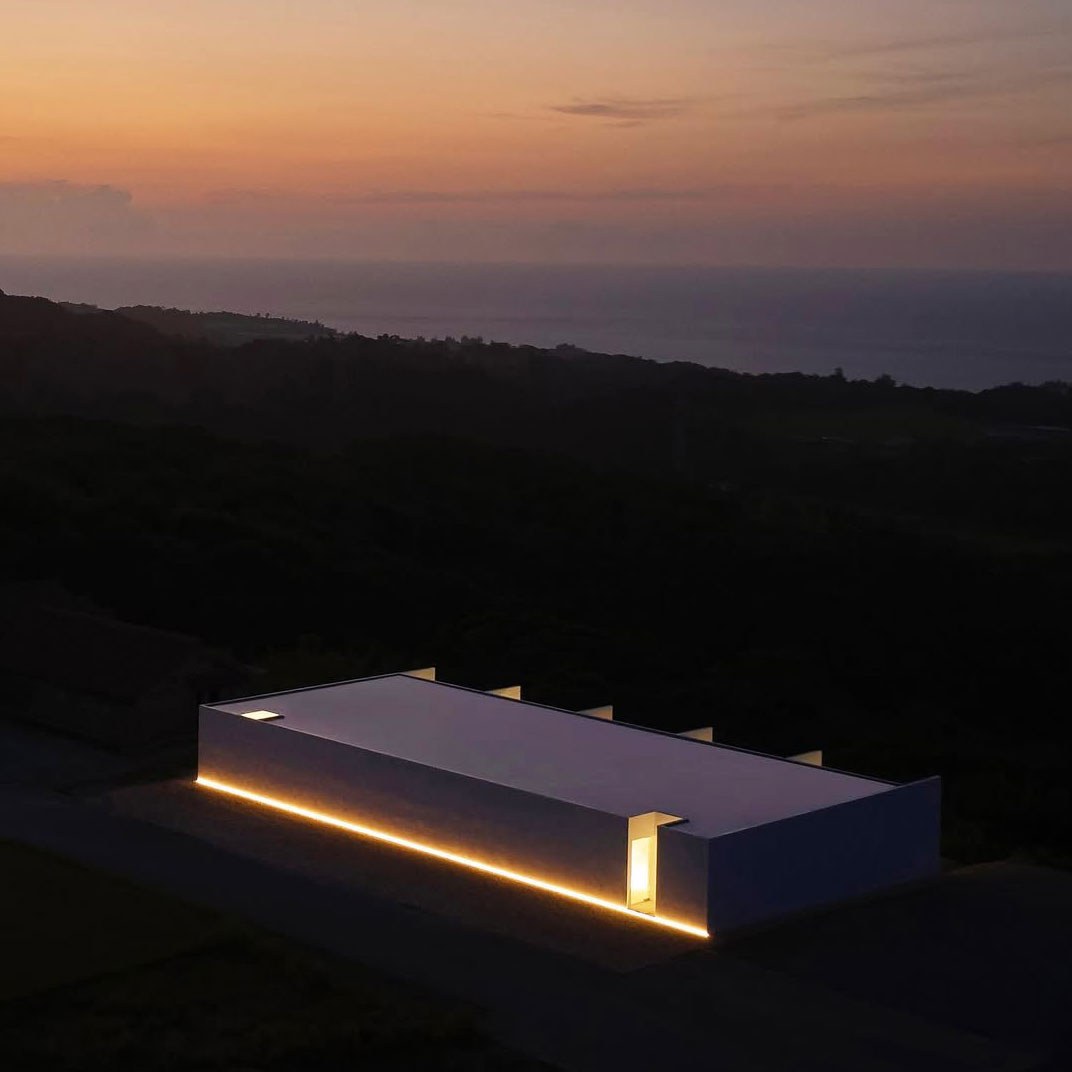
Perched on a cliff overlooking the East China Sea, its rectangular white façade standing out in stark relief against the blue sky, Emil Nakijin is an ultra-modern boutique hotel with just five suites. They’re lined up in a row facing the ocean, each with oversized stainless steel sliding glass doors opening onto private terraces with open-air baths and infinity pools. The linear layout is a hallmark of the Hiroshima-based design firm Shinichi Ogawa & Associates, and the bright interiors are nearly identical — minimalist and all-white — with nothing to distract from the spectacular surrounding landscape. There’s no restaurant, spa, or conventional hotel services, but suites are well-outfitted for doing absolutely nothing, which is exactly the point of this sleek and silent escape.
Where the Okinawan Coast Shapes a Different Kind of Stay
The northern reaches of Okinawa's main island, Kunigami-gun, operate on a different register from the resort corridor further south. The highway thins, the coast grows rougher, and the villages sit closer to coral forest than convenience. Nakijin, a municipality defined by its UNESCO-listed castle ruins and its position inside the Yanbaru subtropical zone, has not drawn the same density of international hotel investment as Naha or Onna. That relative quiet is, for the properties that have earned Michelin recognition here, the entire point.
ALMIS NAKIJIN, addressed at 2031-139 Shoshi in the Nakijin district of Kunigami-gun, holds a MICHELIN Selected distinction in the Michelin Hotels and Stays 2025 guide. Within the northern Okinawa accommodation tier, that recognition matters: Michelin's hotel selection process evaluates physical environment, service consistency, and character alongside practical delivery, and being selected in a region this sparse puts the property in a small cohort. For context, the denser peer set of MICHELIN Selected and starred hotels in Japan's premium archipelago runs from the ryokan traditions of Hakone and the Kii Peninsula through to design-led properties in Okinawa's central resort zone, places like Halekulani Okinawa and Jusandi in Ishigaki. ALMIS NAKIJIN earns its place in that conversation from a different geography entirely.
The Architecture of Northern Okinawa's Design Moment
Japan's specialist accommodation sector has spent the better part of two decades fragmenting into tighter niches. Large international brands occupy one end; at the other, a cohort of smaller, site-specific properties have pursued a design philosophy grounded in local material culture and topographic response. The Michelin hotel guide's expansion into Japan's regional prefectures has drawn attention to properties operating outside the traditional luxury corridors, and Nakijin represents one of the more compelling arguments for looking north on the island.
The broader design logic at work in properties like ALMIS NAKIJIN aligns with what has become a recognisable tendency in high-quality Okinawan lodging: the building does not attempt to import a generic resort aesthetic, but instead reads its physical context. In Kunigami-gun, that context includes Yanbaru's dense subtropical canopy, the castle ruins at Nakijin-jo, and a coastline that alternates between sheltered coves and exposed limestone cliff. Architectural responses in this register tend to prioritise sightlines, material connection to the site, and a reduction of the boundary between interior and exterior. Where a city property like the Bvlgari Hotel Tokyo draws from vertical urban density and fashion-world material precision, or HOTEL THE MITSUI KYOTO from centuries of Kyoto spatial convention, a northern Okinawa property like ALMIS NAKIJIN operates through a different logic entirely: landscape legibility over decorative statement.
That distinction places it in a peer set that includes site-responsive properties elsewhere in Japan's premium regional tier: Amanemu in Mie, which reads the Ago Bay environment through restrained architecture, Zaborin in Hokkaido with its forest-embedded geometry, or Benesse House in Naoshima, where the building and its art program are inseparable from the island's identity. These properties are held together not by brand affiliation or price bracket alone, but by the seriousness with which each engages its specific geography.
The Nakijin Setting as Context
Arriving in Nakijin requires a deliberate decision. The area sits roughly 60 to 70 kilometres north of Naha Airport by road, making it a genuine destination rather than an incidental stop. That journey has a clarifying effect: the traffic and density of the southern prefectural capital drop away, and the Yanbaru landscape asserts itself. Nakijin Castle, one of the Ryukyu Kingdom's most significant fortifications and now a UNESCO World Heritage Site, frames the municipality's cultural weight. The structure's curved stone walls date back to the 13th century and remain among the more evocative archaeological presences in Okinawa's built landscape.
That combination of physical distance, cultural depth, and relative low tourism density shapes the character of any stay in this part of Kunigami-gun. It is not the Okinawa of mass beach resorts or marina complexes. The expectation, and the appeal, is something quieter and more specific. Properties earning Michelin recognition in this context are being evaluated against a different set of benchmarks than they would be in Naha or Onna, where competition density is higher and the traveller profile more diverse. For a comparative sense of what Michelin-selected properties in quieter Japanese regional settings offer, Gora Kadan in Hakone, Asaba in Izu, and Nishimuraya Honkan in Kinosaki-cho each illustrate the model: deep localisation, smaller capacity, and a format that requires the guest to come to the property rather than the property coming to the traveller.
Placing ALMIS NAKIJIN in Japan's Wider Specialist Hotel Tier
Japan's specialist accommodation market has a visible grammar at this level. Properties tend to operate with limited keys, which keeps the ratio of staff to guest high and allows the physical environment to absorb the full attention of the experience. That format is well-established in the ryokan tradition but has extended into properties that work across hybrid models, neither strictly ryokan nor Western resort hotel. Within Okinawa specifically, this is a smaller and more recent phenomenon than in, say, the Izu Peninsula or the Hakone hot spring corridor, where multi-generation properties have refined their format over decades.
Across the prefecture, the Michelin-selected tier spans distinct geographic zones. The Hiramatsu Hotels and Resorts Ginoza sits in the central coastal zone. Jusandi in Ishigaki operates on the Yaeyama Islands, where the culture and climate diverge sharply from the main island. ALMIS NAKIJIN in Kunigami-gun represents the northern main island's entry into that recognised tier, a geography that remains comparatively uncharted for international visitors. Other parts of Japan's premium regional accommodation network, from Fufu Nikko and Fufu Kawaguchiko to Satoyama-Jujo in Niigata and Nasu Mukunone, reinforce the pattern: quality in Japan's non-urban accommodation tier consistently tends toward intimacy, environmental specificity, and a guest experience built around place rather than amenity accumulation.
Planning a Stay
ALMIS NAKIJIN is located at 2031-139 Shoshi, Nakijin, Kunigami-gun. Given the property's northern position relative to Naha, guests travelling from the prefectural capital should plan for road travel of approximately one hour or more, and a rental car is the practical choice for independent movement in this part of the island. The Nakijin Castle ruins are within the municipality and make a natural companion for any stay in the area. Given limited availability data on specific room categories, pricing, and direct booking channels at time of writing, prospective guests should verify current availability through standard hotel booking platforms. For a broader view of what the Okinawa and northern island region offers across the accommodation and dining spectrum, our full Nakijin, Kunigami-gun guide covers the key options.
For those building a wider Japan itinerary that moves between urban and regional properties at the Michelin-recognised tier, the progression from cities like Tokyo (see Bvlgari Hotel Tokyo) through Kyoto, Hakone, and then south to Okinawa's northern coast follows a logic of increasing quietude and geographic specificity. Other remote or specialist properties worth considering in the same register include Kamenoi Besso in Yufu, Sekitei in Hatsukaichi-shi, Atami Izusan Karaku, GOTO RETREAT by Onko Chishin, Fufu Kyu-Karuizawa Restful Forest, and Higashiyama Niseko Village, a Ritz-Carlton Reserve. For those whose travel extends beyond Japan entirely, the same discipline of place-first luxury is represented at properties like The Fifth Avenue Hotel in New York City, Badrutt's Palace Hotel in St. Moritz, and Hotel de Paris Monte-Carlo.
FAQs
What's the vibe at ALMIS NAKIJIN?
The surrounding area sets the tone before the property does. Nakijin sits in Kunigami-gun, in Okinawa's northern Yanbaru region, which is characterised by subtropical forest, a quieter coastline, and the cultural gravity of Nakijin Castle, a UNESCO-listed Ryukyu Kingdom site. The municipality sits well north of the main resort corridor. Properties at this latitude in Okinawa, including ALMIS NAKIJIN, carry a MICHELIN Selected recognition in the 2025 guide, which tends to accompany a focused, environment-led format rather than a large-scale amenity offering. Pricing and capacity specifics are not available in current data; guests should verify directly through booking platforms before travel.
Which room offers the leading experience at ALMIS NAKIJIN?
Specific room category data, including names, configurations, pricing tiers, and associated design details, is not available from current verified sources. What the MICHELIN Selected 2025 distinction does signal is that the property meets Michelin's threshold for character and quality at the property level. In Japan's specialist accommodation sector, the most consequential room distinctions tend to be view orientation and proximity to outdoor elements, particularly in coastal or forested settings like Nakijin. Direct enquiry with the property, or a booking platform with room-level detail, will give the clearest current picture of what is available.
Recognized By

Similar venues by awards
Related editorial
- Asia's 50 Best Restaurants 2026: The Chairman and Wing Go 1-2 from the Same BuildingThe Chairman takes No. 1 and Wing climbs to No. 2 at Asia's 50 Best Restaurants 2026. Both operate from the same Hong Kong building. Here's what it means.
- Four Seasons Yachts Debut: 95 Suites, 11 Restaurants, and a March 2026 Maiden VoyageFour Seasons I launches March 20, 2026, with 95 suites, a one-to-one staff ratio, and 11 onboard restaurants. Worth tracking if you want hotel-grade service at sea.
- LA Michelin Guide 2026: Seven New Restaurants from Tlayudas to Uzbek DumplingsMichelin's March 2026 California Guide update adds six LA restaurants and one Montecito newcomer, spanning Oaxacan tlayudas, Uzbek manti, and Korean-Italian pasta.
Save or rate ALMIS NAKIJIN on Pearl
Keep this venue in your Pearl passport, rate it after you visit, and track it alongside every other place you collect.