
Hotel in Monticchiello, Italy
L\u0027Olmo
150ptsVal d'Orcia Farmstead Immersion

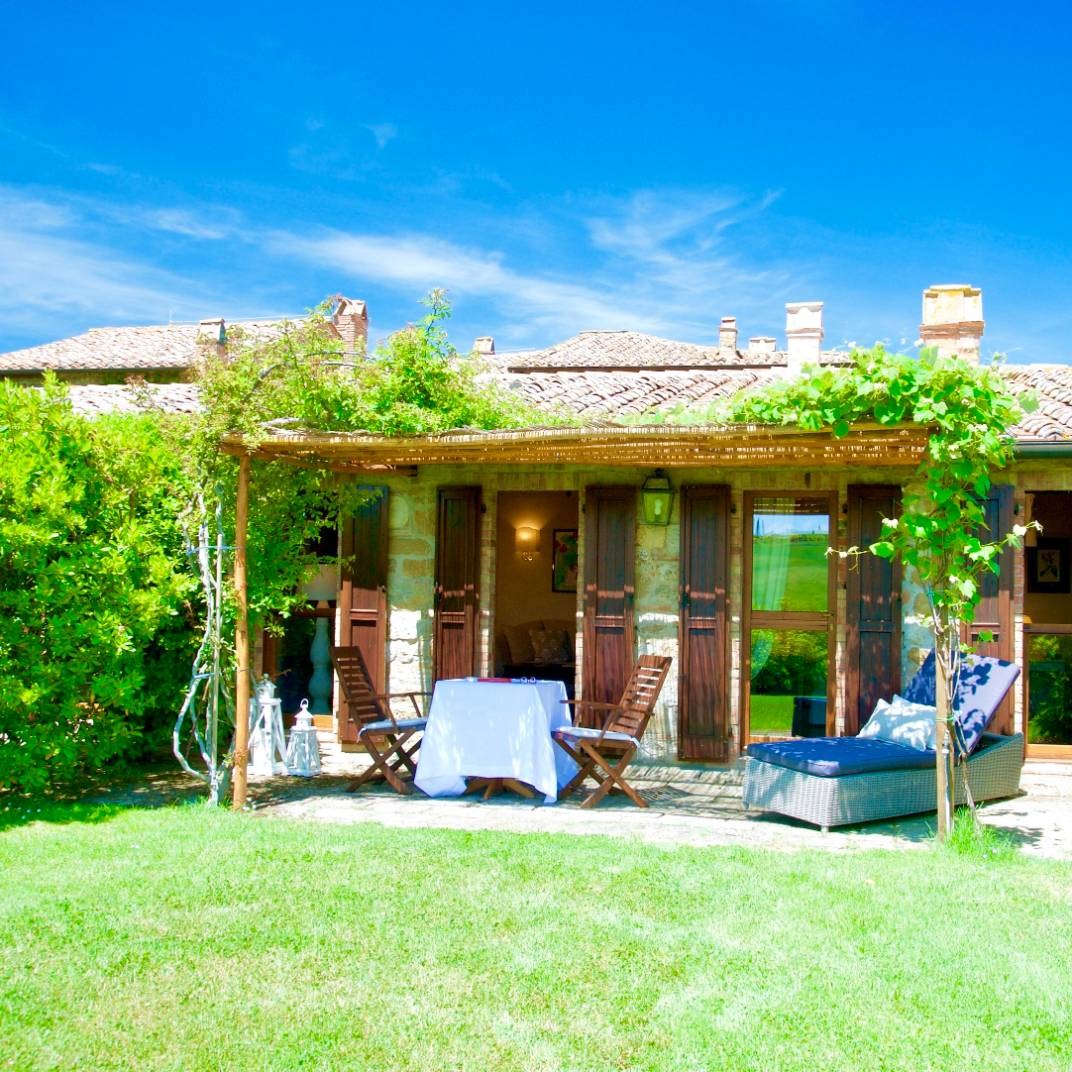
About L\u0027Olmo
A Michelin Selected agriturismo on the edge of the Val d'Orcia, L'Olmo sits within the ancient walls of Monticchiello at the intersection of Tuscan agricultural tradition and considered rural hospitality. The property occupies a farmstead on the SP 88, surrounded by the cypress-lined terrain that defines southern Tuscany's most photographed country. For travellers who find the larger Val d'Orcia resort circuit too managed, this is a quieter, more grounded alternative.
Stone, Cypress, and the Val d'Orcia Way of Building
The road that leads to L'Olmo — the SP 88, Strada Provinciale Orcia delle Macchie — tells you what kind of property this is before you arrive. It runs through the open agricultural countryside south of Monticchiello, past the dry-stone walls and cypress windbreaks that have defined this corner of southern Tuscany for centuries. The Val d'Orcia is a UNESCO World Heritage landscape, and the designation matters here not as a branding tool but as a literal description of what you see: a working agricultural territory whose visual character has been shaped by centuries of land management and vernacular building. Properties that sit well in this environment do so by respecting its grammar. L'Olmo, at Podere Ommio 27, is a farmstead that reads as part of that grammar rather than an interruption of it.
This matters architecturally. The agriturismo format that dominates the Val d'Orcia and the broader Tuscan countryside is, at its core, a hospitality model built around working farm buildings , stone-walled, thick-roofed, low-profile structures that were never designed for spectacle. The leading of them derive their character from exactly this restraint. Where some of the larger resort conversions in the region, such as Rosewood Castiglion Del Bosco in Montalcino, operate at a scale that blurs the line between private estate and managed resort, smaller podere properties hold closer to the original proportions and material palette. L'Olmo sits in this smaller, more structurally honest tier.
Monticchiello and the Question of Scale
Monticchiello itself is one of the least trafficked medieval villages in a region that has, in places, been overtaken by its own reputation. It sits on a ridge above the Val d'Orcia floor, close enough to Pienza and Montepulciano to benefit from their gravitational pull without absorbing their visitor density. The village has maintained a working community character , its Teatro Povero, an annual participatory theatre event performed by local residents since 1967, has become one of the more cited examples of authentic rural cultural continuity in Italy. The surrounding countryside functions as both agricultural land and visual backdrop, with the Orcia valley floor visible across a terrain of wheat, sunflowers, and the famous cypress rows that anchor every landscape photograph taken within twenty kilometres.
For the hospitality properties that operate in this zone, position relative to Monticchiello's ridge matters. Properties on the valley approaches, like L'Olmo on the SP 88, sit in the agricultural lowland rather than within the hilltop village perimeter , a distinction that shifts the experience from medieval-village enclosure to open-country farmstead. Neither is better; they address different preferences. The farmstead position delivers the working landscape directly: morning light across open fields, proximity to the cypress lines, and a sense of physical connection to the Val d'Orcia that the hilltop village, for all its beauty, filters through stone walls and narrow lanes.
Michelin Selection in the Agriturismo Context
L'Olmo holds a Michelin Selected designation in the 2025 Michelin Hotels guide. In Italy's accommodation sector, Michelin Selected functions as a quality filter rather than a ranking , it identifies properties that meet a threshold of character, setting, and hospitality standard without placing them in a tiered hierarchy. For a farmstead property in the Val d'Orcia, the designation signals that the experience delivers on the promise of its setting rather than trading on it. The Val d'Orcia attracts a volume of hospitality investment precisely because its landscape sells itself; Michelin's hotel selection process is, in part, a corrective to this, distinguishing properties where the hospitality substance is proportionate to the scenery. In this peer set, L'Olmo sits alongside properties like Borgo San Felice Resort in Castelnuovo Berardenga in the broader Sienese countryside conversation, though at a considerably different scale and register.
For context on how Italian rural hospitality positions itself across the country's regions, the contrast with coastal properties is instructive. The cliff-side architecture of Borgo Santandrea on the Amalfi Coast or the island geometry of JK Place Capri represents a fundamentally different design vocabulary , one defined by verticality and drama. The Val d'Orcia farmstead operates in the opposite register: horizontal, earthbound, defined by its relationship to agricultural land rather than to sea and sky. Both approaches are legitimate. They serve different kinds of travellers and different travel purposes.
The Practical Shape of a Stay
L'Olmo addresses the SP 88 at Podere Ommio 27, outside Monticchiello. The address structure , a podere number on a provincial road , is the standard locator format for working farmsteads in this part of Tuscany, and it signals something about how arrival works: this is not a village hotel with a piazza entrance, but a rural property accessed by driving into the agricultural landscape. That process is itself part of the experience. In the Val d'Orcia, travel time between properties, villages, and towns is measured in minutes rather than hours; Pienza is within easy reach, Montepulciano slightly further, and Siena accessible as a day destination. The region's road network, while occasionally narrow, is well-marked and manageable for self-driving visitors, which remains the practical standard for stays of this type.
For travellers building a longer Italian itinerary, the Val d'Orcia sits naturally between Florence and Rome as a mid-trip pause. Properties like Four Seasons Hotel Firenze in Florence and Bulgari Hotel Roma in Rome represent the urban anchors of that route, with the Val d'Orcia offering a deliberate change of pace and texture between them. The contrast is the point: arriving at a farmstead after the density of Florence, or departing for Rome having spent several days in open agricultural countryside, structures a trip around meaningful environmental shifts rather than consecutive city stays.
Lake Como alternatives for a similar shift in register include Il Sereno in Torno and Grand Hotel Tremezzo, though the landscape logic is entirely different. For those specifically drawn to the agriturismo and Tuscan hill-country model, Corte della Maestà in Civita di Bagnoregio offers a parallel but distinct Lazio-facing variation on the same rural tradition. See also our full Monticchiello restaurants guide for dining context around the area.
Phone and direct booking details are not publicly listed for L'Olmo; approach through third-party accommodation platforms or the Michelin Hotels guide entry, which confirmed the property's current selection status for 2025.
Who This Property Is For
The Val d'Orcia farmstead model suits a specific travel disposition: guests who want to be in landscape rather than looking at it from a terrace, who find value in agricultural quietness, and who are building an itinerary around regional exploration rather than a single fixed base. L'Olmo, with its Michelin Selected standing and its SP 88 farmstead address, addresses that disposition directly. It is not a design hotel with a countryside backdrop, nor a resort that happens to be rural. It is a property whose identity is determined by its site, its material honesty, and its position within one of the most carefully preserved agricultural landscapes in Europe.
Travellers for whom that framing resonates will find few comparable alternatives in immediate proximity. The larger branded properties in the Sienese countryside, from Rosewood Castiglion Del Bosco to Borgo Egnazia further south, operate at a different scale of infrastructure and service expectation. Castello di Reschio in Lisciano Niccone occupies a third register , the private estate conversion , that sits between the farmstead and the resort in terms of both size and managed intimacy. L'Olmo's position is the most grounded of these, in both the literal and architectural sense.
Frequently Asked Questions
What's the atmosphere like at L'Olmo?
L'Olmo operates in the agriturismo tradition: a farmstead property set in open Val d'Orcia countryside on the SP 88 outside Monticchiello. The atmosphere is defined by agricultural landscape rather than village enclosure , open terrain, cypress lines, and the horizontal quiet that characterises this UNESCO-listed valley. It holds a Michelin Selected designation for 2025, which signals hospitality quality proportionate to the setting rather than simply trading on the scenery. It is not a resort in the conventional sense; it is a rural property whose character comes from its site.
What room should I choose at L'Olmo?
Specific room categories and configurations are not publicly detailed in available sources. Given the farmstead format and the Michelin Selected designation, the property is likely to offer a limited number of rooms or suites within converted agricultural buildings. For a Val d'Orcia farmstead, rooms facing the open countryside rather than internal courtyard positions will typically deliver the landscape orientation that defines the stay. Confirm room specifics and any seasonal availability directly when booking.
What's L'Olmo leading at?
Based on its Michelin Selected status and its location on the agricultural approach to Monticchiello, L'Olmo delivers most clearly on landscape immersion in the Val d'Orcia. The property's position on the SP 88 farmstead road, rather than within a hilltop village, means the working agricultural environment is the immediate context. For travellers whose priority is proximity to the valley's open countryside, the cypress terrain, and quiet rural character, this address is better positioned than the village-centre alternatives nearby.
Do I need a reservation for L'Olmo?
The Val d'Orcia is one of Tuscany's most sought-after rural destinations, and Michelin Selected properties in the region typically require advance booking, particularly across the spring-to-autumn season from April through October when demand peaks. A direct phone listing and website are not currently available in public records for L'Olmo; approach through the Michelin Hotels guide or established accommodation platforms. Given the limited-room format typical of farmstead properties of this type, booking several weeks in advance is the practical standard for the peak season window.
Recognized By

Similar venues by awards
Related editorial
- Asia's 50 Best Restaurants 2026: The Chairman and Wing Go 1-2 from the Same BuildingThe Chairman takes No. 1 and Wing climbs to No. 2 at Asia's 50 Best Restaurants 2026. Both operate from the same Hong Kong building. Here's what it means.
- Four Seasons Yachts Debut: 95 Suites, 11 Restaurants, and a March 2026 Maiden VoyageFour Seasons I launches March 20, 2026, with 95 suites, a one-to-one staff ratio, and 11 onboard restaurants. Worth tracking if you want hotel-grade service at sea.
- LA Michelin Guide 2026: Seven New Restaurants from Tlayudas to Uzbek DumplingsMichelin's March 2026 California Guide update adds six LA restaurants and one Montecito newcomer, spanning Oaxacan tlayudas, Uzbek manti, and Korean-Italian pasta.
Save or rate L\u0027Olmo on Pearl
Keep this venue in your Pearl passport, rate it after you visit, and track it alongside every other place you collect.