
Hotel in Miyakojima, Japan
IRAPH SUI\u002c a Luxury Collection Hotel\u002c Miyako Okinawa
150ptsIrabu Island Seclusion

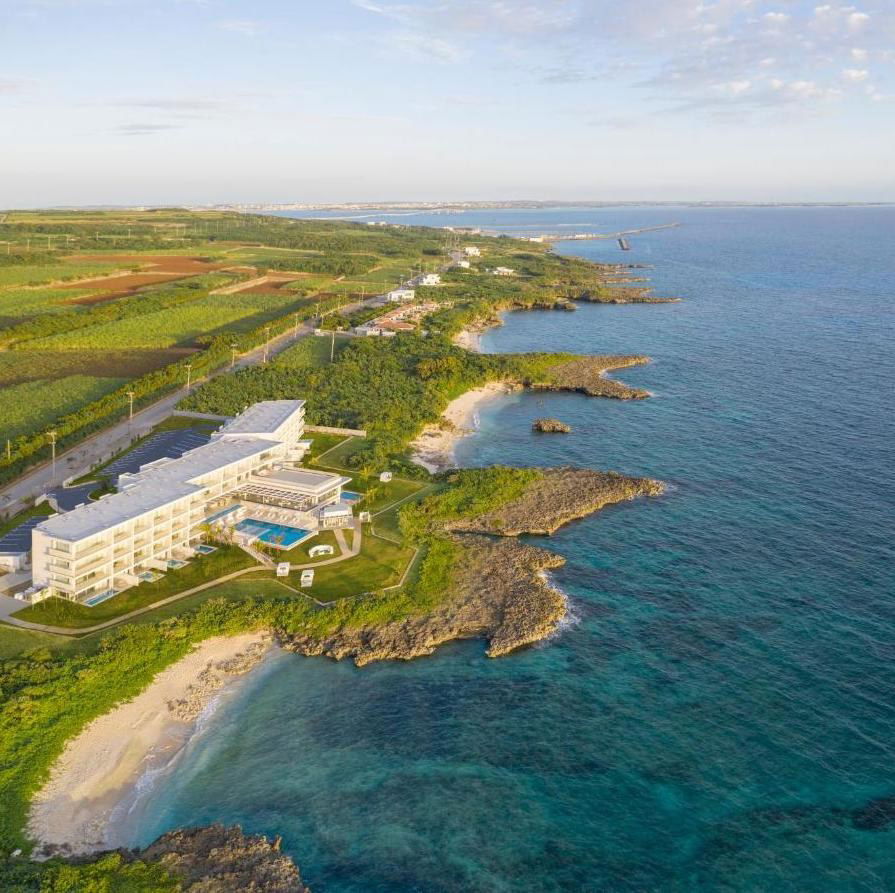
About IRAPH SUI\u002c a Luxury Collection Hotel\u002c Miyako Okinawa
IRAPH SUI, a Luxury Collection Hotel on Miyakojima's Irabu Island, holds Michelin Selected status in the 2025 Michelin Hotels guide, positioning it among Japan's recognized luxury properties. The hotel sits on Irabu Island, connected to Miyakojima by a toll-free bridge, and draws guests seeking the quieter, less-developed side of the Miyako archipelago's coral-edged coast.
Where the Coral Sea Meets Irabu Island
The approach to Irabu Island from Miyakojima proper crosses the Irabu Bridge, at 3.5 kilometres one of the longer toll-free bridges in Japan, and the transition in character is immediate. Miyakojima's main island carries infrastructure, agriculture, and the low-rise density of a working town; Irabu runs quieter, with fishing settlements and coastline that still reads as genuinely remote. IRAPH SUI sits on this island, and its position is architectural before it is anything else: the building orients toward the East China Sea, and the light that arrives here is softer and more westward-angled than anything you'd encounter on the main island's eastern shore.
In Japan, the relationship between building and landscape is rarely incidental. The tradition running from Ryokan architecture through to contemporary resort design consistently treats the view as a structural element, not a decorative one. IRAPH SUI operates in that register: the address at 818-5 Irabu places it within reach of Irabu's limestone-edged coastline, and the Luxury Collection branding signals a property calibrated against an international competitive set while remaining grounded in a specific geography.
Design Discipline in the Miyako Archipelago
Miyakojima's premium accommodation market has developed along two distinct lines. The Shigira resort complex, anchored by properties including Hotel Shigira Mirage, Shigira Bayside Suite Allamanda, and The Shigira, concentrates multiple properties within a managed resort zone on the main island's northern coast. IRAPH SUI takes a different position: a single property, international branding, and deliberate island separation. The distinction matters for guests choosing between immersive resort-compound logic and a more contained, place-specific experience.
The Luxury Collection's positioning within the Marriott portfolio places it alongside design-led properties that are expected to express local identity rather than a globally homogenized luxury template. In practice, this means a property in the Ryukyu island chain should carry material and spatial references to Okinawan culture, not default to the resort vernacular common to Southeast Asian beach properties or Maldivian water-villa formats. Whether IRAPH SUI achieves this with consistency is the question worth asking; that it operates within a framework designed to demand it is at least a structural advantage over international flags with fewer curatorial expectations.
Across Japan's recognized luxury hotel tier, the design-led properties that hold Michelin Selected status tend to share a commitment to considered materiality. Properties like Zaborin in Kutchan work with Hokkaido's forest textures; Benesse House in Naoshima is built around contemporary art; Gora Kadan in Hakone layers ryokan tradition over villa-style accommodation. IRAPH SUI's Michelin Selected status in the 2025 guide places it in this company, even as its architectural language responds to a subtropical rather than temperate context.
Michelin Selection and What It Signals
The Michelin Hotels guide, which incorporated IRAPH SUI in its 2025 edition, operates on criteria distinct from the restaurant star system. Michelin Selected represents inclusion in the curated tier below the key categories, recognising properties that meet a quality threshold across service, atmosphere, and physical environment without necessarily competing at the absolute leading of the scale. For Miyakojima, which sits at the outer edge of Japan's domestic tourism circuit and receives less international recognition than Kyoto, Tokyo, or even mainland Okinawa, the inclusion is a meaningful signal that the archipelago has entered the frame for discerning travellers making Japan-wide itinerary decisions.
Comparison with other Michelin-recognised properties in the Japan luxury tier is instructive. Properties like Halekulani Okinawa address the main Okinawan island with an American heritage brand reconstituted for Japanese luxury expectations. Amanemu in Mie anchors Aman's onsen-resort format to the Shima Peninsula. Jusandi in Ishigaki brings the Yaeyama islands into the recognised tier. IRAPH SUI's selection adds the Miyako archipelago to a set of remote Japanese island destinations that have cleared the bar for international recognition.
Irabu Island as Context
Understanding IRAPH SUI requires understanding Irabu. The island's economy has historically run on fishing, and Irabu fishermen were known across the Pacific for deep-sea tuna diving, a tradition that extends back centuries. The landscape is flat, low, and coastal, with no significant elevation to interrupt the horizon. In spatial terms, this means the sea is always present, always close, and the light shifts noticeably across the day in ways that become the hotel's primary experiential offering regardless of what happens inside its walls.
Miyakojima as a whole draws travellers seeking what mainstream Okinawa no longer offers: relative quietude, coral-rich water with visibility that runs to 50 metres in good conditions, and a town infrastructure that remains functional rather than tourist-optimised. The comparison set within the island includes Ayanna Miyakojima, Namyu The Place, Private Resort Hotel Renn, and Blue Ocean Hotel & Resort Miyakojima, most of which operate on the main island. IRAPH SUI's Irabu address separates it from this cluster and reduces the ambient noise of tourist infrastructure.
For context on the broader Japan luxury hotel picture, the Bvlgari Hotel Tokyo and HOTEL THE MITSUI KYOTO represent the urban end of Japan's premium tier; properties like Fufu Nikko, Asaba in Izu, Kamenoi Besso in Yufu, Sekitei in Hatsukaichi-shi, and Nishimuraya Honkan in Kinosaki-cho anchor the ryokan-influenced end. IRAPH SUI sits in a third category: subtropical island luxury, where the architectural challenge is heat, humidity, and the primacy of outdoor space. That is a different design problem from both, and the success of the solution is the measure worth applying. For the full picture of where to eat and stay across the island, see our full Miyakojima restaurants guide.
Planning Your Stay
Miyakojima is accessible by direct flight from Tokyo (Haneda), Osaka (Itami and Kansai), and Naha, with flight times from Tokyo running approximately three hours. The Irabu Bridge crossing from Miyakojima city to Irabu Island takes under fifteen minutes by car. The leading visibility for diving and snorkelling in the Miyako reefs runs from late spring through early autumn, with water temperatures in the high twenties Celsius across summer. Typhoon season extends from June through October, and experienced Miyako visitors tend to favour May or early November as months that balance warm conditions with reduced storm risk. For international travellers comparing island luxury at a global scale, The Fifth Avenue Hotel in New York City, Badrutt's Palace Hotel in St. Moritz, and Hôtel de Paris Monte-Carlo mark one end of the international luxury hotel spectrum; IRAPH SUI operates at the opposite geographic extreme, where remoteness is precisely the point. Booking is handled through the Luxury Collection / Marriott platform, and the property's Michelin Selected status means it is likely to appear in curated Japan luxury itinerary searches.
Frequently Asked Questions
- Which room offers the leading experience at IRAPH SUI, a Luxury Collection Hotel, Miyako Okinawa?
- The hotel holds Michelin Selected status in the 2025 Michelin Hotels guide, and properties recognised at this level typically weight ocean-facing rooms heavily in their design rationale. On Irabu Island, where the western coastal orientation governs the light and the view, rooms with direct sea exposure would logically deliver the spatial intention the design is built around. Specific room-category data is not available in our current record; contacting the property through the Luxury Collection booking channel is the surest way to confirm which configurations face the water.
- What is IRAPH SUI leading at?
- IRAPH SUI sits at the intersection of a recognised luxury hotel framework (Michelin Selected, 2025) and a genuinely remote island location on Irabu, separated from Miyakojima's main island by the Irabu Bridge. For travellers whose priority is coastal Japan at a remove from both mainland infrastructure and the more resort-dense parts of Okinawa, that combination is the property's core offering. The Miyako archipelago's coral reefs and clear water add an outdoor dimension that few Michelin-recognised Japan properties can match.
- What is the leading way to book IRAPH SUI, a Luxury Collection Hotel, Miyako Okinawa?
- Book through the Luxury Collection or Marriott Bonvoy platform, which provides the most direct access to room availability and rate structures for the property. IRAPH SUI's Michelin Selected recognition in 2025 means it draws attention from Japan-focused travel planners; booking well in advance is advisable for the May and October-November shoulder windows that avoid typhoon season while maintaining warm conditions.
- What is IRAPH SUI a strong choice for?
- If you are building a Japan itinerary that combines urban luxury with a remote coastal conclusion, IRAPH SUI provides a credible endpoint: Michelin Selected status (2025), Irabu Island's separation from the main tourist circuit, and Miyakojima's coral-water diving and snorkelling within reach. It is less suited to travellers seeking a resort-compound format with multiple dining venues and activity programming on a single site; the Shigira complex on the main island addresses that preference more directly.
- How does IRAPH SUI's location on Irabu Island differ from staying on Miyakojima's main island?
- Irabu Island is connected to Miyakojima by the 3.5-kilometre Irabu Bridge but retains a notably quieter character: fewer restaurants, less commercial development, and a fishing-village pace that the main island's central areas no longer offer. For a Michelin Selected property, this separation is part of the proposition rather than an inconvenience. Guests who want easy access to Miyakojima's dining options should factor in the short bridge crossing; those prioritising coastal seclusion will find the island's remove directly aligned with what IRAPH SUI is designed to deliver.
Recognized By

Similar venues by awards
Related editorial
- Asia's 50 Best Restaurants 2026: The Chairman and Wing Go 1-2 from the Same BuildingThe Chairman takes No. 1 and Wing climbs to No. 2 at Asia's 50 Best Restaurants 2026. Both operate from the same Hong Kong building. Here's what it means.
- Four Seasons Yachts Debut: 95 Suites, 11 Restaurants, and a March 2026 Maiden VoyageFour Seasons I launches March 20, 2026, with 95 suites, a one-to-one staff ratio, and 11 onboard restaurants. Worth tracking if you want hotel-grade service at sea.
- LA Michelin Guide 2026: Seven New Restaurants from Tlayudas to Uzbek DumplingsMichelin's March 2026 California Guide update adds six LA restaurants and one Montecito newcomer, spanning Oaxacan tlayudas, Uzbek manti, and Korean-Italian pasta.
Save or rate IRAPH SUI\u002c a Luxury Collection Hotel\u002c Miyako Okinawa on Pearl
Keep this venue in your Pearl passport, rate it after you visit, and track it alongside every other place you collect.