
Hotel in Marrakesh, Morocco
Amanjena
1,150ptsPisé-Wall Seclusion



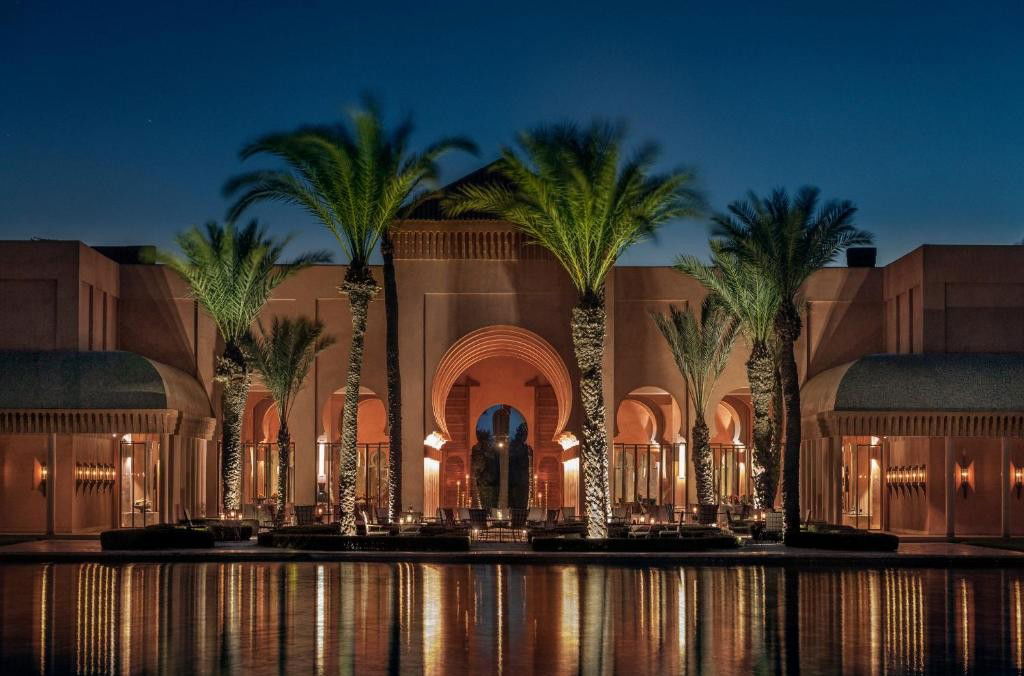
About Amanjena
Aman's first African property, open since 2000 on the Route de Ouarzazate, translates Marrakesh's rose-city architecture into 40 rose-toned pavilions and maisons arranged around a central bassin. The design references rammed-earth pisé construction and Berber village forms, while dining spans Japanese and Mediterranean menus. Rates from $1,569 per night position it at the top of the city's resort tier, where it holds the 2025 World Travel Award for Morocco's Leading Villa Resort.
Where Marrakesh's Architecture Becomes the Design Brief
Approaching Amanjena along the Route de Ouarzazate, roughly 12 kilometres from the city's medina, the first thing that registers is how deliberately the property recedes into its surroundings. The walls are the same dusty rose as the city's old pisé structures, the material itself referencing the rammed-earth construction technique that defines Marrakesh's historic fabric. American architect Ed Tuttle, who has shaped much of Aman's visual identity across Asia, turned his attention here to the forms of Islamic architecture and Berber vernacular building rather than the dense geometric ornament those traditions sometimes produce. The result is more restrained: clean arched entrances, stucco Venetian domes, vaulted ceilings that cool the interior air through passive geometry rather than conditioning alone.
This was Aman's debut on the African continent when it opened in 2000, and it represented a studied departure from the group's better-known tropical island idiom. Where properties like Aman Venice work with inherited palazzo fabric, Amanjena constructed its own vocabulary from scratch, borrowing from the Berber villages that climb the High Atlas Mountains and from the sultan's palace typology that defines Marrakesh's grandest domestic architecture. The 40 pavilions and maisons are organised around a central bassin, an ancient irrigation pool that gives the property its spatial logic the way a courtyard mosque is organised around its ablution fountain.
The Spatial Hierarchy: Pavilions, Bassins, and Maisons
Within the Aman category, Amanjena occupies a position between the pure villa format and the conventional hotel room model. Its 40 accommodation units divide into distinct tiers, each with a different relationship to outdoor space and privacy. The 18 standard Pavilions at 1,883 square feet each include a private courtyard with a lounging gazebo. Six Pavilions Bassin add direct pool proximity. Eight Pavilions Piscine include their own private pools. The six two-storey Maisons, along with the Maison Jardin and Al-Hamra Maison, scale up to 3,875 square feet with two bedrooms, a private pool, gardens, butler service, and fireplaces for cooler Atlas winters.
At Marrakesh's luxury tier, where comparisons run against Royal Mansour's medina riads, La Mamounia's palatial gardens, and the international footprint of Four Seasons Resort Marrakech, Amanjena differentiates through spatial scale and architectural coherence rather than room count or amenity density. With 40 units total, it operates closer to the small-keys design philosophy that defines Aman's global positioning. Rates from $1,569 per night confirm the upper bracket; the 2025 World Travel Award for Morocco's Leading Villa Resort substantiates the categorisation.
Interior materiality runs to zellij-tiled floors layered with Berber carpets, Ouarzazate green marble in the bathrooms, deep soaking tubs, twin vanities, and platform beds that sit low beneath domed ceilings. The ornamental restraint is purposeful: Tuttle's design avoids the dense optical pattern-work that characterises some Moorish revival hotels in favour of surface calm that registers the quality of individual materials more clearly.
Dining as a Cross-Mediterranean Argument
The two restaurants at Amanjena make a quietly ambitious geographic claim. The Mediterranean Restaurant, housed in the reception pavilion, traces culinary territory from Morocco westward to the Iberian peninsula's Al-Andalus traditions and eastward to Sicily and the south of France. This is not arbitrary range: Morocco's cuisine carries Andalusian influences absorbed over centuries of movement across the Strait of Gibraltar, so the menu's geographic sweep reflects a historical argument as much as a marketing one.
The second restaurant, Nama, overlooks the property's 33-metre heated pool and operates as a Japanese dining counter, with sushi and sashimi as its focus. The combination of Japanese and Maghrebi dining under one roof is characteristic of how major Aman properties handle food programming: the expectation is that guests travelling the group's global circuit bring tastes formed across multiple cuisines, and the kitchen responds accordingly. A third option, El Caidal, functions as a tent among the olive groves with live Moroccan music along a lantern-lit path, suited to evening dining that leans into the property's theatrical landscape setting. Two lounges flank the reception pavilion: one for afternoon tea, served with local pastries and Morocco's gunpowder green and mint preparation, the other for post-dinner cigars and shisha.
Beyond the Property: Atlas Villages and the Atlantic Coast
Route de Ouarzazate address positions Amanjena at the foot of the High Atlas Mountains, which concentrates its excursion offering on two distinct territories. The Berber villages of the High Atlas are the closer option, accessible as day trips that include valley routes largely inaccessible to independent travellers without local knowledge. The medina of Marrakesh itself, a UNESCO-protected historic centre, is roughly a 20-minute drive; the property's guided excursion threads through the tanneries, the Musée de Marrakech, surviving bakeries, and the former stork hospital in the old quarter.
Further option is Essaouira, the Atlantic coast city approximately two hours west, where the Portuguese-era ramparts and wind-stripped medina offer a counterpoint to Marrakesh's dense, inland character. Guests travelling from Casablanca-Mohammed V International Airport should allow approximately 2.5 hours; Marrakesh-Menara Airport reduces that to 20 minutes, and the property arranges transfers from both at an additional fee.
For those extending a Morocco itinerary, properties at other points on the circuit include Dar Ahlam in Ouarzazate, closer to the pre-Saharan landscape south of the Atlas, Dar Maya in Essaouira for the Atlantic coast, and Hotel Sahrai in Fes for the country's oldest imperial city. The Fairmont Tazi Palace Tangier covers the northern tip. Within Marrakesh itself, alternatives at different price points or formats include El Fenn, Ksar Char-Bagh, La Sultana Marrakech, Jnane Tamsna, IZZA Marrakech, and Fairmont Royal Palm Marrakech on the golf corridor. See our full Marrakesh guide for the wider picture.
For Aman loyalists building a longer international programme, the group's other city properties, including Aman New York, show how consistently the group applies its spatial restraint across very different architectural contexts.
Planning
Amanjena sits at km 12, Route de Ouarzazate, Marrakech 40000. With 40 rooms across its pavilion and maison categories, the property operates at low capacity by design; rates from $1,569 per night reflect the villa-tier positioning and the butler-included Maison formats at the upper end. The property is family-accessible, with a children's library and babysitting arrangements available. The spa runs separate hammam suites for men and women, with a signature Moroccan Bloom treatment using black olive oil soap, kessa scrub, and rhassoul clay. The adjacent 27-hole Amelkis Championship Golf Course provides an additional anchor for guests who integrate golf into extended stays. Google review average sits at 4.7 from 489 reviews as of current data.
Frequently Asked Questions
What is the leading suite at Amanjena?
The Al-Hamra Maison sits at the apex of the accommodation hierarchy. As a two-bedroom, two-storey dwelling with a private pool, gardens, and butler service across approximately 3,875 square feet, it is the largest and most private unit on the property. Amanjena holds the 2025 World Travel Award for Morocco's Leading Villa Resort, and the Maison format is the tier that earns that classification.
What is the standout feature of Amanjena?
The architectural coherence sets it apart at the Marrakesh luxury tier. Ed Tuttle's design translates the city's rose-city pisé tradition and Berber village building forms into a 40-unit property organised around a central bassin, producing an environment that reads as an extension of the surrounding built landscape rather than a departure from it. At rates from $1,569 and with a Google rating of 4.7 from 489 reviews, it positions at the leading of the market on both price and reception.
Do I need a reservation for Amanjena?
Given that Amanjena operates 40 units total, availability is constrained by design. If you are travelling during Marrakesh's peak seasons, which run roughly October through early December and February through April when temperatures sit in a comfortable range and international travel volumes peak, securing a booking well in advance is advisable. The Maison categories are fewer in number and tend to attract guests planning longer stays; for those specifically, early booking is the only reliable approach.
What kind of traveller fits Amanjena well?
The property suits guests who travel the Aman circuit globally and expect spatial privacy, low guest density, and design that references local architectural tradition without foregrounding resort amenity. At $1,569 per night as a baseline, it addresses the upper end of Marrakesh's visitor market. Families are accommodated, and the golf and excursion programme extends appeal to guests who want structured activity alongside low-stimulus base accommodation.
How does Amanjena's dining compare to what you find in Marrakesh's medina?
The dining at Amanjena is deliberately contained within the property rather than referencing the medina's street-level food culture. The Mediterranean Restaurant draws on the historical culinary connections between Morocco, Andalusia, Sicily, and southern France, while Nama runs a Japanese menu alongside the main pool. El Caidal, the olive-grove tent with live Moroccan music, is the property's closest approach to a traditional Moroccan dining atmosphere. For guests wanting direct engagement with medina food culture, the property arranges guided excursions into the old quarter, where the distinction between what Amanjena offers and what the city itself offers becomes immediately apparent.
Recognized By


Related editorial
- Best Fine Dining Restaurants in ParisFrom three-Michelin-star icons to the next generation of Parisian chefs pushing boundaries, these are the restaurants that define fine dining in the world's culinary capital.
- Best Luxury Hotels in RomeFrom rooftop terraces overlooking ancient ruins to Michelin-starred hotel dining, these are the luxury hotels that make Rome unforgettable.
- Best Cocktail Bars in KyotoFrom sleek lounges to hidden speakeasies, Kyoto's cocktail scene blends Japanese precision with global influence in ways you won't find anywhere else.
Save or rate Amanjena on Pearl
Keep this venue in your Pearl passport, rate it after you visit, and track it alongside every other place you collect.