
Hotel in Hoi An, Vietnam
Four Seasons Resort\u002c The Nam Hai
350ptsVietnamese Coastal Villa Seclusion

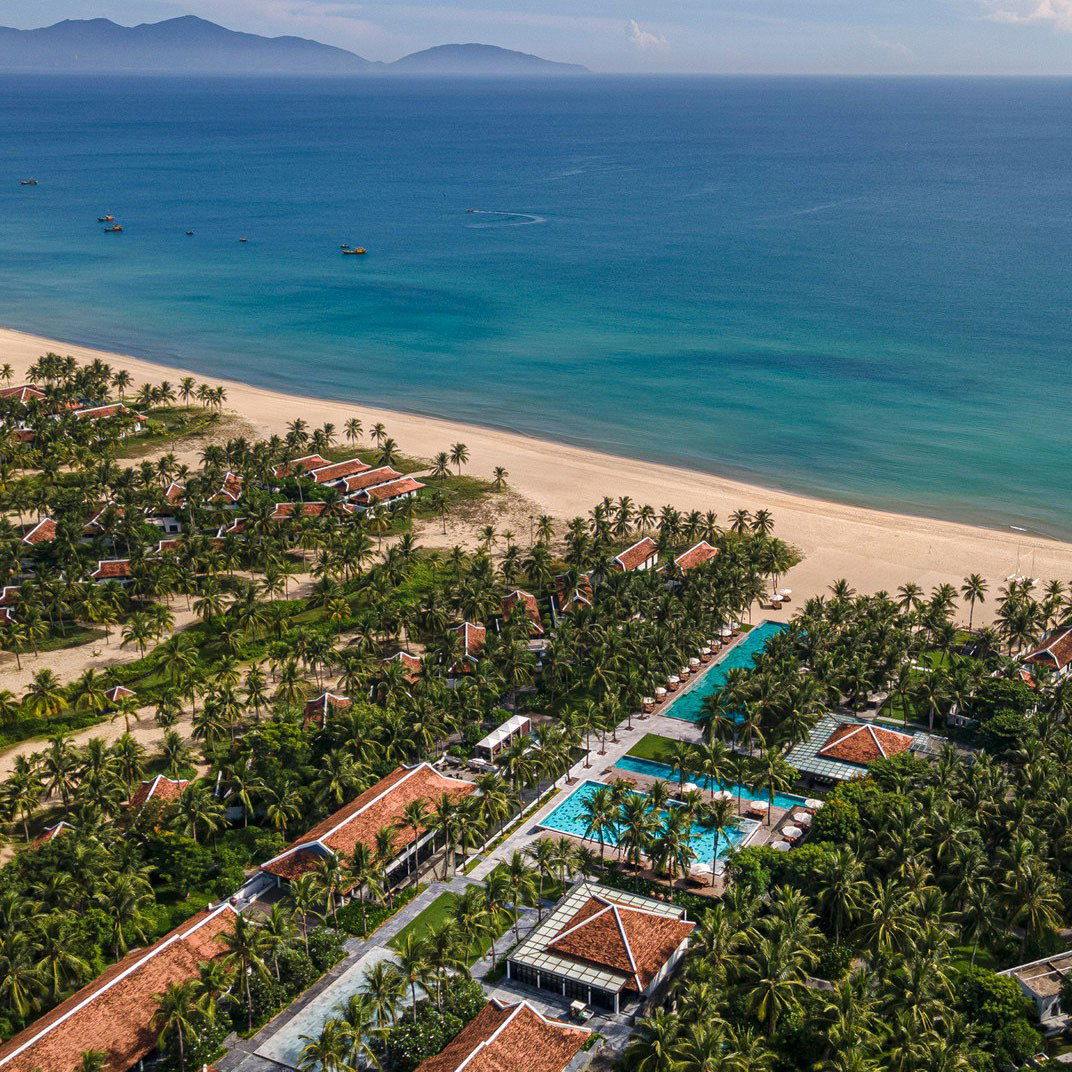
About Four Seasons Resort\u002c The Nam Hai
Awarded Two MICHELIN Keys in 2025, Four Seasons Resort The Nam Hai occupies a stretch of Ha My Beach in Dien Ban District, placing it outside Hoi An's busier hotel corridor. The resort's pavilion-and-pool architecture draws from central Vietnamese vernacular traditions, and its position within the Four Seasons portfolio signals a peer set defined by design discipline and operational consistency rather than urban convenience.
Ha My Beach and the Architecture of Arrival
The drive from Hoi An's Ancient Town to Ha My Beach takes roughly twenty minutes, passing through Dien Ban District's flat coastal plain before the road narrows toward Dien Duong Village. That distance is not a drawback — it is part of the resort's structural logic. Four Seasons Resort The Nam Hai was built on the premise that genuine removal from the city requires physical separation, and the approach road, lined with low vegetation rather than commercial signage, begins the transition before the gates come into view.
What greets arriving guests is a compound organized around water, pavilions, and open-sided corridors that channel sea breezes rather than block them. The design vocabulary draws from central Vietnamese architecture: steeply pitched roofs, dark timber framing, and materials sourced to echo the region's craft traditions. This is not the anonymous international resort aesthetic that dominates stretches of Vietnamese coastline further south. The spatial sequence from arrival court to pool terrace to beach is deliberate and unhurried, with each threshold offering a shift in light and sound rather than a sudden reveal.
Design Philosophy in the Context of Vietnamese Coastal Hospitality
Vietnam's premium coastal hotel market has developed along two distinct lines in recent decades. The first is the large-footprint international resort, often on a branded stretch of Da Nang beach, trading on proximity to the airport and convention infrastructure. The second is the design-led enclave that prioritizes low density, local material palettes, and site-specific spatial planning. Four Seasons The Nam Hai belongs firmly to the second category, and its 2025 Two MICHELIN Keys recognition places it in a verified peer set that includes some of Vietnam's most considered hospitality properties.
The MICHELIN Keys distinction, introduced in 2024 and now covering Vietnam's leading accommodation, evaluates architecture, design, service quality, and the coherence of the guest experience as a whole. Two Keys at the resort level signals a property that has moved beyond comfort into a considered spatial and sensory proposition. In that sense, the award functions as design criticism as much as hospitality endorsement.
For context within Hoi An specifically: the city's hotel supply spans everything from mid-range riverfront properties in the old town to wellness-focused retreats and international brand outposts. The Almanity Hoi An Wellness Resort and the Anantara Hoi An Resort anchor the wellness and boutique ends of the in-town market, while properties like Hoi An Memories Resort & Spa and the Silk Sense Hoi An River Resort compete in the mid-to-upper tier along the river. The Nam Hai sits apart from all of them, physically and categorically, on its own beach frontage.
The Pool and Pavilion Structure
The resort's layout centers on a tiered infinity pool system that steps down toward Ha My Beach, one of the quieter stretches of sand on the central Vietnamese coast. Individual pool villas — the property's signature accommodation format , follow a consistent spatial grammar: a walled garden, a private plunge pool, interior volumes that open fully to outdoor areas, and a material palette that keeps manufactured surfaces to a minimum. Dark wood, natural stone, and locally woven textiles recur across the property without tipping into folkloric pastiche.
This approach to villa architecture reflects a broader shift in Southeast Asian luxury hospitality. As the Amanoi in Vinh Hy demonstrates further south, the most considered Vietnamese resort design tends to privilege site topography and local craft over imported finish materials, using the landscape as a primary design element rather than a backdrop. The Nam Hai applies a version of this logic to a flat coastal site, where the absence of dramatic terrain is compensated for by spatial sequencing and planting density.
Central Vietnam as a Design Context
Hoi An's broader architectural heritage , the UNESCO-listed Ancient Town, the influence of Japanese merchant building forms, the French colonial streetscapes , creates a design-conscious context that relatively few resort markets can match. Hotels that engage with this heritage substantively, rather than applying surface-level Vietnamese motifs to generic floor plans, occupy a different critical register. The Nam Hai's architectural language reads as an extension of that local design conversation rather than an import.
Travelers approaching central Vietnam with design as a primary interest have a reasonable set of comparison points: Banyan Tree Lăng Cô in Lăng Cô sits between Da Nang and Hue on a lagoon site with its own strong spatial identity, while the LANGCO BAY RETREAT in Hue City represents the smaller-scale end of the regional design-led spectrum. Further afield, Pullman Danang Beach Resort anchors the larger urban-adjacent bracket. Each property answers a different version of the question about what premium coastal hospitality should feel like in this part of the country.
For those cross-referencing against Vietnam's broader luxury tier, Amanaki Saigon Boutique Hotel in Ho Chi Minh City and Garrya Mu Cang Chai in Lao Cai Province show how design-led hospitality in Vietnam operates across very different geographic and cultural registers. The Nam Hai is the coastal expression of that same impulse. Our full Hoi An restaurants and hotels guide maps the wider options across the city's neighbourhoods.
Planning a Stay
The resort's location in Dien Ban District, roughly 25 kilometers from Da Nang International Airport, makes it accessible as either an in-and-out destination or a base for day trips into Hoi An's Ancient Town and the surrounding countryside. The distance from the old town is short enough to visit by car or bicycle without committing the full day, and most guests treat Ha My Beach as the primary orientation point, using the town as an excursion rather than a daily commute.
Given its Two MICHELIN Keys standing and Four Seasons operational standards, the property sits at the upper end of Vietnam's resort pricing, consistent with comparably positioned properties internationally. Those calibrating expectations against global Four Seasons benchmarks , say, Badrutt's Palace Hotel in St. Moritz or Hôtel de Paris Monte-Carlo in Monte Carlo , should note that the Nam Hai's rate structure reflects the Southeast Asian luxury tier rather than European city-hotel pricing, making it a relatively accessible entry point into the brand's top-tier design properties. Advance booking is advisable during the dry season months of February through August, when central Vietnam's coastal conditions are at their most favorable and demand at its most consistent.
Other Hoi An properties worth comparing at the planning stage include the Hotel Royal Gallery Hoi An, the Namia River Retreat, and the Namia River Retreat Wellness Inclusive Resort, each of which offers a different spatial and pricing proposition within the same destination. Those extending into southern Vietnam might also consider The Anam Mui Ne or L'Azure Resort & Spa in Phu Quoc as part of a longer coastal itinerary.
Frequently Asked Questions
What is the leading room type at Four Seasons Resort The Nam Hai?
The property's pool villas are the format the resort is built around, and they represent the clearest expression of its design intent. Each villa operates as a self-contained spatial sequence , walled garden, plunge pool, open-plan interior , that makes the most of the resort's low-density layout and Ha My Beach setting. Suite and villa categories within the Four Seasons portfolio at this property tier are priced accordingly, and the Two MICHELIN Keys recognition reflects the guest experience across those higher accommodation categories specifically.
Why do people choose Four Seasons Resort The Nam Hai over other Hoi An hotels?
The combination of beach frontage on Ha My, the Two MICHELIN Keys distinction awarded in 2025, and the Four Seasons operational standard places this property in a tier with no direct in-market competition. Guests who prioritize private beach access, design coherence, and consistent international-brand service over proximity to the Ancient Town tend to find the tradeoff direct. For those who want to be walking distance from Hoi An's old town restaurants and streets, properties like Anantara Hoi An Resort or Hotel Royal Hoi An Danang offer a different calculation.
Do I need to book in advance for Four Seasons Resort The Nam Hai?
At the Four Seasons tier, advance booking is standard practice regardless of destination. For the Nam Hai specifically, the dry season window from February through August is when availability tightens most sharply, as central Vietnam's weather conditions align with peak international travel demand. If your dates fall within the Lunar New Year or major European holiday windows, booking three to six months ahead is prudent. The resort's website is the primary booking channel for direct rates and villa-category availability.
Recognized By

Explore Hoi An
Related editorial
- Asia's 50 Best Restaurants 2026: The Chairman and Wing Go 1-2 from the Same BuildingThe Chairman takes No. 1 and Wing climbs to No. 2 at Asia's 50 Best Restaurants 2026. Both operate from the same Hong Kong building. Here's what it means.
- Four Seasons Yachts Debut: 95 Suites, 11 Restaurants, and a March 2026 Maiden VoyageFour Seasons I launches March 20, 2026, with 95 suites, a one-to-one staff ratio, and 11 onboard restaurants. Worth tracking if you want hotel-grade service at sea.
- LA Michelin Guide 2026: Seven New Restaurants from Tlayudas to Uzbek DumplingsMichelin's March 2026 California Guide update adds six LA restaurants and one Montecito newcomer, spanning Oaxacan tlayudas, Uzbek manti, and Korean-Italian pasta.
Save or rate Four Seasons Resort\u002c The Nam Hai on Pearl
Keep this venue in your Pearl passport, rate it after you visit, and track it alongside every other place you collect.