
Hotel in Gardiner, United States
Wildflower Farms, Auberge Resorts Collection
670ptsWorking-Farm Cabin Retreat


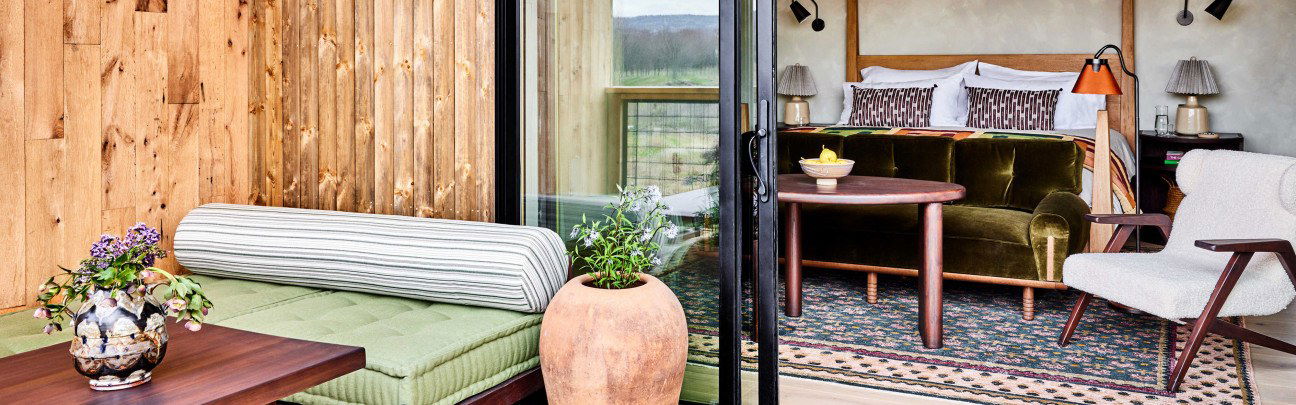
About Wildflower Farms, Auberge Resorts Collection
Wildflower Farms earned a Michelin Key in 2024, placing it among a select tier of rural retreats where the physical setting is as deliberate as the hospitality program. Set on 140 acres in Gardiner, New York, with freestanding cabins framing the Shawangunk Ridge, it represents Auberge Resorts Collection's most farm-integrated property to date, with an on-site restaurant, working farmland, and the Thistle Spa operating as a coherent whole.
Where the Shawangunk Ridge Meets a Working Farm
Approaching Wildflower Farms along the western edge of the Hudson Valley, the first thing that registers is not a building but a ridgeline. The Shawangunk Ridge rises sharply to the east, its pale conglomerate cliffs catching morning light in a way that hotel photography rarely conveys. The 140-acre property in Gardiner, New York sits in that shadow, and the design decision to orient the freestanding cabins outward toward that view rather than inward toward a central lodge defines the entire spatial logic of the property. It is a landscape-first approach to resort architecture, and it separates Wildflower Farms from most of its Hudson Valley competitors before a guest even reaches the front desk.
The property opened in fall 2022, joining a Hudson Valley accommodation market that had already been deepening for a decade. The region had attracted a wave of design-forward retreats and farmhouse conversions, but Wildflower Farms arrived at a larger scale than most, with 65 cabins distributed across meadows of native plantings and woodland paths. The Auberge Resorts Collection, a brand that began with Auberge du Soleil in Napa and built its reputation around rural luxury in wine country, was translating that template into a working-farm context. The result is a property where the agricultural setting is not decorative but operational: produce from the farm feeds the kitchen, and the rhythm of the seasons governs the guest experience more directly than at properties where the landscape is a backdrop.
Cabin Architecture and the Logic of Dispersal
The freestanding cabin format, common at properties like Amangiri in Canyon Point and Post Ranch Inn in Big Sur, carries a specific design argument: that privacy and immersion in a natural setting require physical separation from other guests. At Wildflower Farms, the 65 cabins are positioned to frame clear views of the Shawangunk Ridge, with a slow-moving river threading through the property. The architectural language draws from regional vernacular without replicating it literally. These are not converted farm buildings; they are purpose-built structures that use natural materials and a low-profile footprint to read as objects that belong in a meadow rather than objects placed on one.
Dispersal of accommodation across 140 acres means that density, a problem at many rural resorts that cluster rooms to reduce construction costs, is kept low. Forested footpaths connect the cabins to shared amenities, and the Thistle Spa operates as a destination within the property rather than an afterthought tucked beside a car park. This internal geography matters to how the property feels: movement between spaces is itself part of the experience, with guests passing through working farmland and woodland rather than along hotel corridors.
For comparison, Troutbeck in Amenia occupies a different tier in the same regional market, with a historic manor-house format and a stronger emphasis on communal indoor gathering. Wildflower Farms positions itself at the outdoor-immersion end of the Hudson Valley spectrum. The Michelin Key awarded in 2024, part of the guide's inaugural hotel recognition program, signals that the hospitality industry's most recognized credentialing body reads the property as operating in the upper tier of experiential rural accommodation.
Clay Restaurant and the Farm-to-Table Argument
Farm-to-table as a marketing phrase has been so widely applied across American hospitality that it has nearly lost descriptive value. What distinguishes Clay, the on-site restaurant at Wildflower Farms, is that the supply chain is the property itself. When guests hand-pick eggs from the farm's chickens and those eggs appear scrambled in their breakfast omelet that morning, the phrase closes a loop that most farm-to-table restaurants only gesture toward. The kitchen draws from the surrounding acreage rather than from a network of regional suppliers, which places Clay closer to the model seen at SingleThread Farm Inn in Healdsburg or Blackberry Farm in Walland than to the broader category of hotel restaurants with locally sourced menus.
The restaurant's stated focus on Hudson Valley flavors is paired with a wine list described as global in scope, which is a common hospitality positioning for properties that want the kitchen to read as regional and the cellar to read as sophisticated. The Hudson Valley itself has a growing wine scene, though it remains smaller and less internationally recognized than the Finger Lakes. The decision to reach beyond local producers for the wine program reflects a realistic assessment of where the regional list currently stands.
The Thistle Spa and the Wellness Infrastructure
The wellness programming at Wildflower Farms follows a pattern seen at the higher end of the nature-immersion resort category. Properties like Canyon Ranch Tucson built their entire identity around wellness as the primary offering, with accommodation secondary. Wildflower Farms positions the Thistle Spa as a significant component of the guest experience without subordinating the broader rural-retreat program to it. The forested footpaths and cliffs that the property references in its programming are not spa amenities in a formal sense, but they function as the kind of low-intensity outdoor access that wellness-oriented guests increasingly expect as a baseline at this price tier.
Broader category of rural luxury wellness retreats has been drawing significant investment. The Hudson Valley market in particular has attracted interest from international brands, with a One&Only; property expected in the region in the coming years. That kind of institutional attention to a market typically follows demonstrated demand, and Wildflower Farms, as the Auberge brand's first significant move into the northeast, has contributed to establishing that the market exists at the premium level.
Where Wildflower Farms Sits in the Rural Luxury Field
Auberge Resorts Collection operates properties across a range of geographic contexts, from the wine-country setting of its founding Napa property to urban addresses like Bowie House in Fort Worth. Wildflower Farms represents the brand in its most naturalistic register, closer in spirit to properties like Sage Lodge in Pray or Amangani in Jackson Hole than to its urban or wine-country counterparts. The 65-cabin count puts it at a scale that allows for genuine seclusion without the operational limitations of a very small property.
Guests traveling from New York City have a clear day-trip or weekend-trip corridor into the Hudson Valley, and Gardiner sits at the southern edge of the Catskills, adjacent to the Shawangunk Ridge climbing area and within range of several other regional draws. The property's Google rating of 4.6 from 211 reviews reflects a guest satisfaction picture that holds across a meaningful sample size, not just a handful of enthusiastic early adopters.
For those considering how Wildflower Farms compares to urban alternatives in the broader Auberge portfolio or to other luxury rural properties accessible from the northeast, the relevant peer set includes Little Palm Island Resort and Spa in Little Torch Key, Ambiente in Sedona, and Alpine Falls Ranch in Superior. Each trades on landscape immersion as a primary value proposition; Wildflower Farms distinguishes itself within that cohort through the working-farm integration and its northeastern positioning relative to a large metropolitan feeder market.
For further context on dining and lodging in the region, see our full Gardiner restaurants guide. Guests planning a broader New York City arrival or departure may also want to reference properties like The Fifth Avenue Hotel or Aman New York for the city-side portion of a trip.
Planning Your Stay
Wildflower Farms operates on 140 acres at 2702 Main St, Gardiner, NY 12525, with 65 freestanding cabins distributed across the property. The property sits at the base of the Shawangunk Ridge, adjacent to climbing, hiking, and cycling infrastructure that makes it viable as a base for outdoor activity as well as a retreat-format stay. The Michelin Key recognition from 2024 places it in a credentialed tier of American experiential hotels. The Google rating of 4.6 from 211 reviews supports that positioning with guest-sourced feedback. Booking is handled through the Auberge Resorts Collection platform; given the property's profile and the Hudson Valley's strong weekend demand from the New York City market, advance reservations are advisable, particularly for autumn foliage season and spring bloom periods when meadow and woodland conditions are at their most photogenic.
Frequently Asked Questions
What's the vibe at Wildflower Farms, Auberge Resorts Collection?
The property reads as a working-farm retreat rather than a conventional luxury hotel. Freestanding cabins face the Shawangunk Ridge across native meadows, the on-site restaurant Clay draws from the farm's own produce, and the programming emphasizes outdoor movement and seasonal rhythm over amenity density. It earned a Michelin Key in 2024, which places it in the recognized upper tier of American experiential hotels. For guests arriving from New York City, it occupies a distinct position in the Hudson Valley market: more secluded and more farm-integrated than most alternatives at the same price tier.
What's the most popular room type at Wildflower Farms, Auberge Resorts Collection?
The property's 65 accommodations are all freestanding cabins, which is the defining architectural choice rather than one option among several. The cabin format, oriented toward views of the Shawangunk Ridge, is the product itself. Specific cabin categories are not detailed in available data, but the dispersal across 140 acres means that positioning relative to the river, the meadows, or the woodland footpaths likely differentiates individual units. The Michelin Key recognition covers the property as a whole, not a specific room type.
What's the standout thing about Wildflower Farms, Auberge Resorts Collection?
Working-farm integration is what separates Wildflower Farms from most properties in the Hudson Valley luxury tier. Guests can collect eggs from the farm's chickens, which the kitchen then uses in breakfast service. Clay restaurant draws from on-site produce for a menu focused on Hudson Valley ingredients. That closed loop between agricultural land and kitchen is rare at the scale of a 65-room property. The Michelin Key awarded in 2024 and a Google rating of 4.6 from 211 reviews both suggest the execution holds up against the concept.
Recognized By


Related editorial
- Asia's 50 Best Restaurants 2026: The Chairman and Wing Go 1-2 from the Same BuildingThe Chairman takes No. 1 and Wing climbs to No. 2 at Asia's 50 Best Restaurants 2026. Both operate from the same Hong Kong building. Here's what it means.
- Four Seasons Yachts Debut: 95 Suites, 11 Restaurants, and a March 2026 Maiden VoyageFour Seasons I launches March 20, 2026, with 95 suites, a one-to-one staff ratio, and 11 onboard restaurants. Worth tracking if you want hotel-grade service at sea.
- LA Michelin Guide 2026: Seven New Restaurants from Tlayudas to Uzbek DumplingsMichelin's March 2026 California Guide update adds six LA restaurants and one Montecito newcomer, spanning Oaxacan tlayudas, Uzbek manti, and Korean-Italian pasta.
Save or rate Wildflower Farms, Auberge Resorts Collection on Pearl
Keep this venue in your Pearl passport, rate it after you visit, and track it alongside every other place you collect.