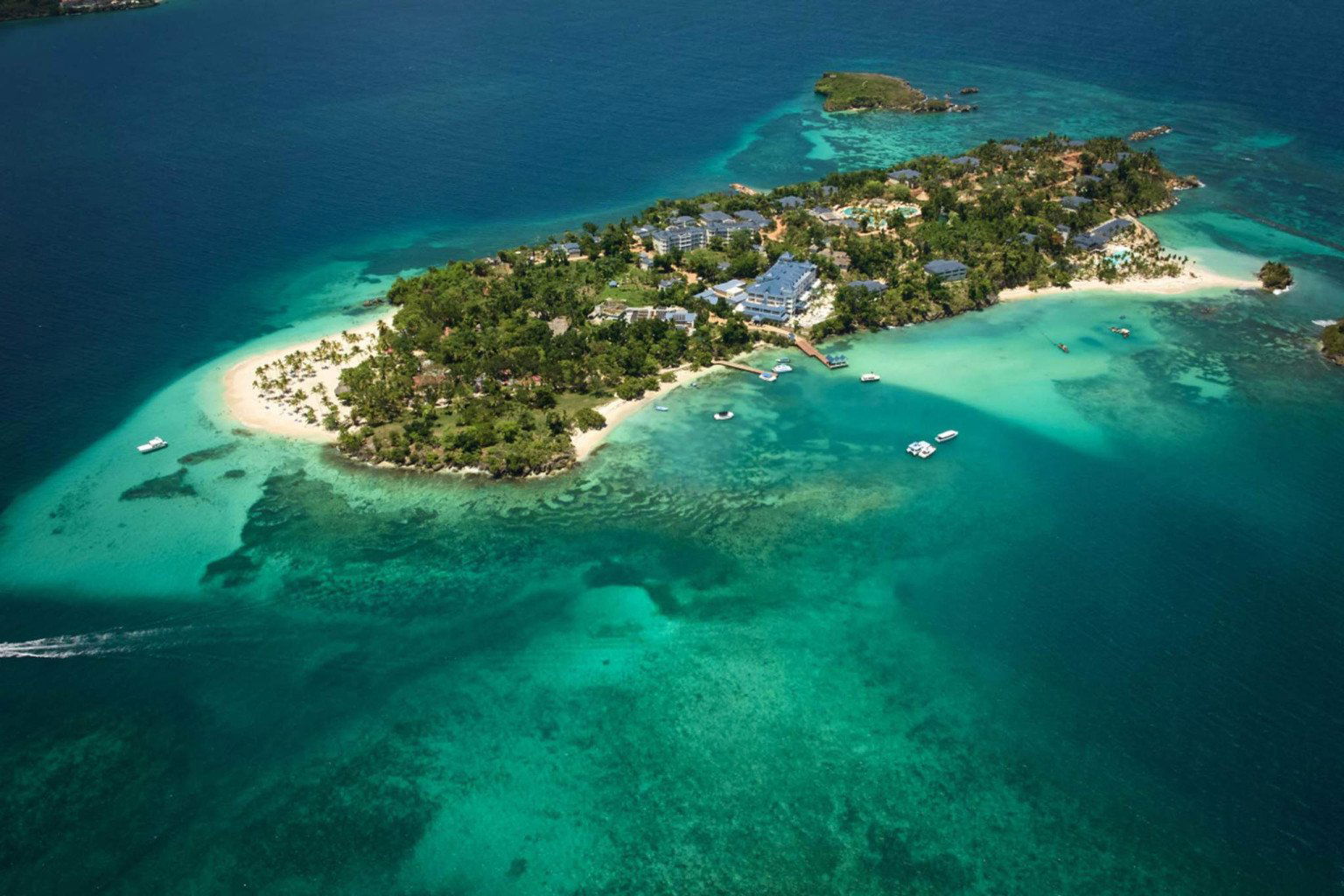
Hotel in Cayo Levantado, Dominican Republic

    Cayo Levantado Resort

    150pts

    Island-Access Isolation

    Cayo Levantado Resort, Hotel in Cayo Levantado

    About Cayo Levantado Resort

    Cayo Levantado Resort occupies its own private island in the Samaná Bay, a setting that removes the usual resort compromise between seclusion and scenery. The surrounding bay is one of the Dominican Republic's most geographically distinctive stretches of coastline, drawing humpback whale migrations between January and March. For travellers comparing island-access properties across the Caribbean, this is a meaningful differentiator.

    An Island to Itself: The Geography That Defines the Stay

    There is a particular logic to island-only resorts that mainland Caribbean properties cannot replicate. When the boat docks and the only structures in sight belong to the property you are staying in, the relationship between guest and landscape shifts entirely. Cayo Levantado Resort sits on Cayo Levantado, a small island in the Samaná Bay on the northeastern coast of the Dominican Republic, and the island format is the foundational fact of the experience. Access requires a short boat transfer from the town of Samaná, which means arrival is itself a kind of threshold crossing, a moment of deliberate separation from the mainland that all-inclusive beachfront properties on the Punta Cana strip cannot manufacture.

    The Samaná Peninsula has long occupied a different register in Dominican tourism than the high-volume resort corridors of the southeast. The bay is one of the Atlantic's most ecologically significant migratory zones, with humpback whales arriving to breed between January and March each year. That seasonal natural event gives the region a temporal dimension rare in Caribbean resort travel, and it places stays during those months in a different category of experience than peak-summer bookings at comparable properties.

    Architecture in Context: What the Physical Setting Demands

    Island resort architecture in the Caribbean splits broadly between two approaches. The first imposes a standardised international aesthetic regardless of site, the kind of travertine-and-glass language that reads identically in Cancún, Maldives, or Mauritius. The second takes the specific topography, vegetation, and light conditions of a location as the starting brief. Cayo Levantado's dense tropical canopy, irregular coastline, and relatively compact footprint make the second approach the more defensible one, and properties that work with site conditions rather than against them tend to age more coherently.

    The island's relatively modest scale means that the resort's built environment is in close conversation with its natural surroundings at almost every point. This is architecturally consequential: sight lines, material choices, and the placement of common spaces all operate differently when dense vegetation begins at the edge of a terrace rather than beyond a maintained perimeter. For travellers who have stayed at design-forward island properties elsewhere, such as Amanera in Playa Grande or ANI Private Resorts in Cabrera, the comparative question is how well the built fabric holds up against the landscape rather than competing with it.

    The Dominican Republic's premium hotel category has diversified considerably over the past decade. Properties like Casa Colonial Beach & Spa in Puerto Plata and Eden Roc Cap Cana have established that there is a market for design-led alternatives to the traditional all-inclusive format. Cayo Levantado operates within that broader shift, where location specificity and physical setting carry as much weight in a booking decision as room count or amenity lists.

    The Samaná Bay Peer Set

    Positioning Cayo Levantado within Dominican Republic accommodation requires acknowledging the range of the country's hotel offer. At the larger-scale end, Casa de Campo Resort & Villas in La Romana operates across a vastly different footprint, with polo fields and a marina. At the boutique end, Sublime Samaná Hotel & Residences in Las Terrenas offers a peninsula-based alternative for travellers drawn to the same general region. The island format of Cayo Levantado places it in a distinct sub-category: not urban, not villa-compound, not beachfront-strip, but genuinely water-separated.

    Internationally, the island-access resort format is well-established in markets like the Maldives and French Polynesia, where boat or seaplane transfer is the baseline expectation. In the Caribbean, that format is less common and tends to command a premium positioning relative to shore-based competitors. Travellers who have experienced properties like Amangiri in Canyon Point or Castello di Reschio in Lisciano Niccone will recognise the shared logic: geographic separateness is itself a design decision, and it sets the terms for everything that follows.

    When to Go and How to Approach the Booking

    The whale-watching window from January through March represents the highest-demand seasonal argument for the Samaná Bay region. Boats depart from the town of Samaná for organised whale-watching excursions during these months, and the combination of island accommodation with daily wildlife access creates a specific travel itinerary that the summer months cannot replicate. Travellers targeting this window should treat accommodation availability in the bay as a planning constraint rather than an afterthought.

    Outside the whale season, the Samaná Peninsula operates at a lower intensity than the southeast resorts, which suits travellers looking to avoid the higher-volume dynamics of Punta Cana-corridor properties. The bay's protected geography tends to produce calmer water conditions than Atlantic-facing coastlines, relevant for guests prioritising swimming or snorkelling over surf.

    For context on how Cayo Levantado fits within the wider Dominican hotel offer, our full Cayo Levantado restaurants and hotels guide maps the local options. Travellers considering alternatives in other parts of the peninsula might also look at Dominican Tree House Village in Samaná, which takes a different approach to the same regional setting. Further afield, Natura Cabana Boutique Hotel & Spa in Sosúa and El Morro Eco Adventure Hotel in Monte Cristi serve travellers interested in the north coast's quieter edge.

    Planning Your Stay

    Reaching Cayo Levantado from outside the Dominican Republic typically routes through El Catey International Airport (AZS), which serves the Samaná region, or through Santo Domingo or Santiago with onward ground transfer. From El Catey, road access to the Samaná town ferry point takes roughly 30 to 40 minutes. The boat crossing to the island itself is short, operating on a schedule tied to the resort. Visitors flying into the country's main hubs and combining a Samaná stay with time in the capital might consider Hodelpa Nicolás de Ovando in Santo Domingo, which occupies a historic colonial building in the Zona Colonial and offers a markedly different register from resort travel. Casa Bonita Tropical Lodge in La Cienaga is another point of reference for travellers drawn to smaller-scale, landscape-integrated properties across the country.


    Frequently Asked Questions

    Is Cayo Levantado Resort more low-key or high-energy?

    The Samaná Bay region sits outside the high-volume resort corridors of the Dominican Republic's southeast, and the island-access format reinforces that separation. The property draws a different traveller profile than the Punta Cana strip: the emphasis is on the natural setting and the bay's ecology rather than organised entertainment programming. Compared to Live Aqua Beach Resort Punta Cana, the energy is considerably quieter.

    What's the most popular room type at Cayo Levantado Resort?

    Specific room category data is not publicly available in confirmed form, so this is worth verifying directly with the property before booking. In island-format resorts generally, rooms with direct water or canopy views tend to command the highest demand and the widest price differential, making early booking advisable for those with strong preferences on outlook.

    What should I know about Cayo Levantado Resort before I go?

    The island-access format means all arrivals and departures depend on boat transfers coordinated with the resort. The Samaná Bay's humpback whale season runs January through March, which is the most ecologically significant window for the region. The nearest international airport with direct regional service is El Catey (AZS). For broader regional context, Sublime Samaná in Las Terrenas provides a useful point of comparison for understanding the peninsula's accommodation range.

    How hard is it to get a reservation at Cayo Levantado Resort?

    If you are targeting the January-to-March whale-watching window, availability in the Samaná Bay tightens considerably, and this applies to the island's limited inventory in particular. Outside of that seasonal peak, the peninsula operates at lower occupancy than the southeast resorts. Direct booking through the property or a specialist agent is the most reliable path; wait times are not publicly documented but the island's finite capacity makes advance planning advisable during peak season.

    What's a smart way to approach Cayo Levantado Resort?

    Treat the whale-watching season as a planning anchor if it aligns with your travel dates: January through March offers a specific natural event that cannot be replicated later in the year. If you are combining the stay with time elsewhere in the country, consider pairing it with a contrasting property type, such as Hodelpa Nicolás de Ovando in Santo Domingo for colonial city context, to build a more varied itinerary across the Dominican Republic's different registers.

    Is a stay at Cayo Levantado Resort worth the investment?

    The island format carries an inherent premium over shore-based alternatives in the same region, and that premium is justified primarily by geographic separateness and the bay access it provides. If your priorities are seclusion, proximity to the whale season, and a natural setting that mainland properties cannot match, then the positioning makes sense. If the priority is amenity volume or proximity to town, a peninsula-based property would likely deliver better value for money.

    Does Cayo Levantado's island setting affect dining and activity options?

    Island-format resorts by definition operate with a more contained set of on-site options than mainland properties with easy access to a town's restaurant or excursion market. The Samaná Bay and the surrounding peninsula offer whale-watching, waterfall excursions at El Limón, and beach access as the primary activity anchors. For dining variety beyond the resort, the transfer to the mainland town of Samaná is a logistical consideration worth factoring into the stay. Travellers who prefer walking out to a range of independent restaurants each evening may find the format more constraining than those content with a self-contained island experience. See our Cayo Levantado guide for broader local context.

    Keep this place

    Save or rate Cayo Levantado Resort on Pearl

    Keep this venue in your Pearl passport, rate it after you visit, and track it alongside every other place you collect.