
Hotel in Casole D U0027elsa, Italy
Castello di Casole\u002c A Belmond Hotel\u002c Tuscany
350ptsEstate-Scale Tuscan Seclusion

About Castello di Casole\u002c A Belmond Hotel\u002c Tuscany
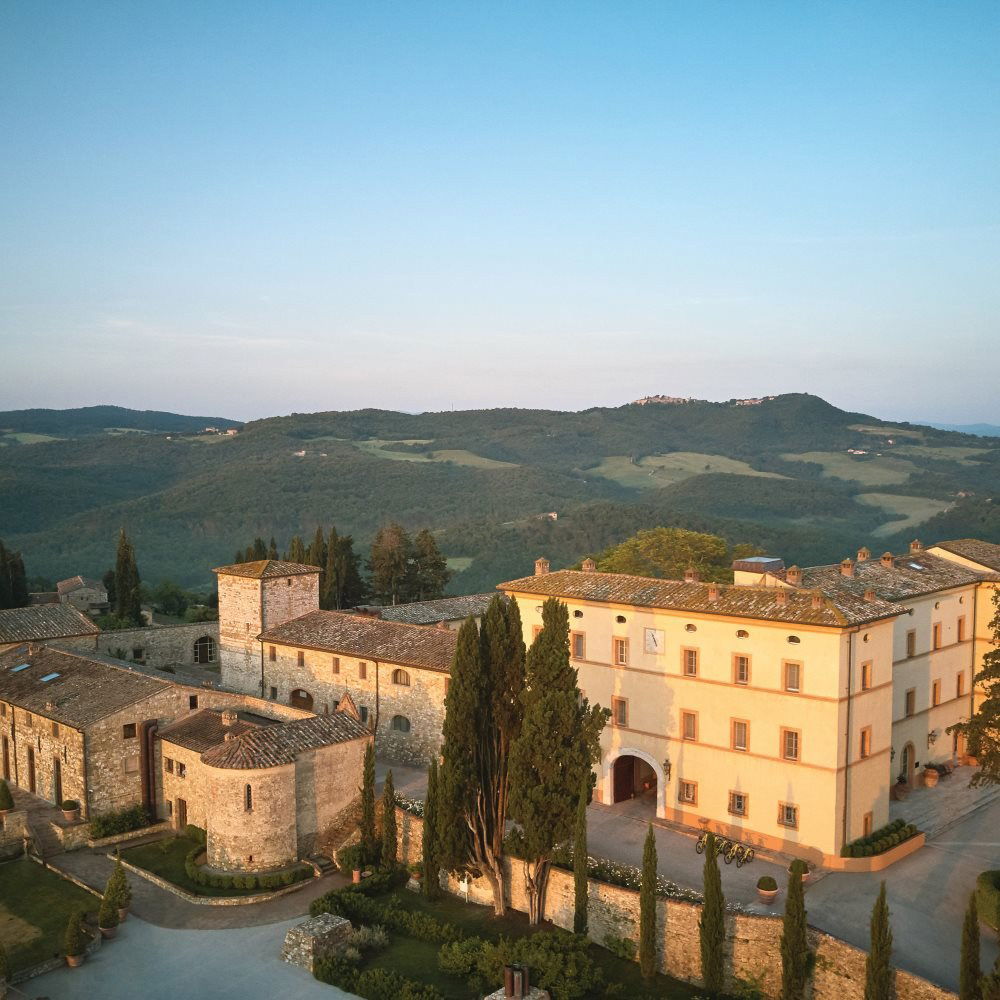
A medieval Sienese castle transformed into a Belmond property, Castello di Casole holds Two MICHELIN Keys for 2025, placing it among Italy's most recognized rural retreats. Set across a 4,200-acre estate in the Sienese hills, it occupies a tier of Tuscan hospitality where architectural heritage and landscape scale define the offer as much as service or amenity.
Stone, Scale, and the Sienese Hills
The approach to Castello di Casole sets the register before you reach the front door. A long cypress-lined drive across open estate land — some 4,200 acres of Sienese countryside — establishes a sense of remove that most Tuscan properties can only approximate. This is not a hotel that has grafted itself onto a historic shell; the castle and its surrounding borgo have been a continuous presence on this hillside since the tenth century, and the architecture carries that weight without theatrics. Thick travertine walls, Romanesque proportions, and views across the Val d'Elsa that have changed little in centuries give the property a physical authority that no amount of interior design investment could manufacture.
Within the broader category of Italian rural luxury, the castle-hotel format occupies a specific and increasingly competitive tier. Properties like Castello di Reschio in Lisciano Niccone and Rosewood Castiglion Del Bosco in Montalcino pursue a similar logic: historic Tuscan or Umbrian fabric, significant land holdings, and a self-contained estate experience. What separates the strongest examples in this group is whether the architectural identity feels genuinely inhabited or merely preserved. At Castello di Casole, the decision to retain the original masonry, irregular floor plans, and the visual weight of the medieval structure rather than smooth it into a generic luxury finish is what places it closer to the former.
Two MICHELIN Keys: What the Recognition Signals
Michelin's hotel key system, relaunched internationally for 2025, evaluates properties on architecture, interior design, quality of service, and the overall guest experience rather than food alone. Castello di Casole's Two MICHELIN Keys distinction for 2025 places it in a select bracket within Italy's recognized hotel landscape , a credential that carries more weight for design-led rural properties than for urban hotels, where the competitive field is denser. For context, the Two Keys designation sits below Three Keys, which Michelin reserves for properties it considers exceptional at a global level, but above the One Key tier that covers a broader range of quality accommodation. In Tuscany specifically, the rating situates Castello di Casole within a peer group of estates where design coherence, spatial quality, and the relationship between built environment and landscape are taken as seriously as thread counts and turndown service.
Belmond, which manages the property as part of its Italian portfolio alongside the LVMH-owned Cipriani in Venice, brings consistent operational standards to a building that could easily overwhelm a less experienced operator. The group's track record with heritage structures in Italy means guests can expect the physical drama of the setting to be matched by a service framework that functions , a pairing that is less automatic than it might appear when the building itself is ten centuries old.
Architecture as the Primary Experience
The design approach at Castello di Casole is worth reading as an editorial position, not just an aesthetic one. In a category where some operators convert historic Italian buildings into high-gloss international luxury interiors , marble lobbies, contemporary furniture dropped into medieval rooms , the preference here runs toward retention and restraint. Stone walls remain exposed. The geometry of the original rooms, with their irregular volumes and deep-set windows, is not corrected. The result is interiors where the architecture is doing most of the work, and where the leading light in any given space arrives at a specific time of day rather than being engineered to arrive everywhere at once.
This approach carries trade-offs. Guests who travel with expectations calibrated to, say, Four Seasons Hotel Firenze in Florence or Bulgari Hotel Roma in Rome will encounter a different register: quieter, more deliberately paced, less oriented around the spectacle of the hotel as object. The estate's sheer scale , the 4,200 acres mean genuine visual and physical solitude at certain points of the property , functions as an amenity in itself, one that urban luxury properties cannot replicate regardless of their interior investment.
The borgo structure, with accommodation spread across the castle and converted outbuildings, means the property reads as a small village rather than a single building. Walking between sections at different times of day, across open courtyards and through shaded stone passages, is part of the experience in a way that would not be true of a conventional hotel floor plan. The spatial vocabulary is medieval and the orientation is outward , toward the hills, the vineyards, and the changing light of the Val d'Elsa , rather than inward toward a lobby or atrium.
Situating Casole d'Elsa
Casole d'Elsa sits between Siena and Volterra in the Sienese interior, a zone that draws fewer visitors than the Chianti corridor or the Montalcino wine country to the south, but offers comparable landscape quality with noticeably less traffic on the roads. For guests arriving from Florence, the drive southeast takes roughly an hour and a half depending on routing. Siena itself is under an hour, making it a practical base for the city rather than a remote outpost. The surrounding area produces Vernaccia di San Gimignano to the north and sits within reach of Morellino di Scansano and Brunello country further south, which positions the property well for wine-focused itineraries across multiple Tuscan denominations.
For comparison within the Belmond and broader Italian luxury estate category, Borgo San Felice Resort in Castelnuovo Berardenga operates on a similar borgo model in the Chianti Classico zone, while Il Pellicano in Porto Ercole and Borgo Santandrea on the Amalfi Coast represent the coastal end of Italy's design-led rural hospitality spectrum. The Val d'Elsa location is deliberately landlocked , the appeal is the interior Tuscan terrain, not the sea, and guests should arrive expecting hills, olive groves, and stone rather than pools overlooking water.
Our full Casole d'Elsa restaurants guide covers the surrounding area for dining beyond the estate.
Planning Your Stay
Castello di Casole operates on a seasonal model typical of Tuscany's rural luxury tier, with peak occupancy running from late May through September when the landscape and light are at their most persuasive. Shoulder months, particularly April and October, offer similar landscape quality with fewer guests on the estate and generally more availability. Booking through Belmond's central reservations channel is the standard route; as a recognised Two MICHELIN Keys property for 2025, demand from guests tracking the guide's hotel recommendations has added a layer of lead-time to availability planning, particularly for the summer high season. Guests considering this property alongside Casa Maria Luigia in Modena, Aman Venice, or Passalacqua in Moltrasio for an Italian itinerary will find that Casole d'Elsa occupies a distinct register , rural, architecturally heavy, and oriented around the estate rather than a city or lakeside setting.
Frequently Asked Questions
- What kind of setting is Castello di Casole, A Belmond Hotel, Tuscany?
- A medieval hilltop castle and surrounding borgo set across 4,200 acres of Sienese countryside in the Val d'Elsa. The property holds Two MICHELIN Keys for 2025, which recognizes its architectural character and overall guest experience. It suits guests specifically seeking a rural estate with genuine historic fabric rather than a hotel with incidental historic styling.
- Which room category should I book at Castello di Casole, A Belmond Hotel, Tuscany?
- Room data is not published in our current database. Given the Two MICHELIN Keys recognition and the borgo structure, accommodation across the castle and converted outbuildings is likely to vary in character , rooms within the original castle volume will generally offer the most architecturally coherent experience. Confirming room placement and outlook directly with Belmond reservations before booking is advisable.
- Why do people go to Castello di Casole, A Belmond Hotel, Tuscany?
- The combination of historic architectural scale, estate land, and Sienese hill country that the location provides is the primary draw. The Two MICHELIN Keys distinction for 2025 signals that the property performs at a recognized level within Italy's competitive rural luxury tier. Guests arrive for the physical setting as much as any specific amenity or dining program.
- Do I need a reservation for Castello di Casole, A Belmond Hotel, Tuscany?
- Yes. As a Two MICHELIN Keys property with a fixed room count and strong summer demand, the estate books ahead , particularly from June through August. Belmond's reservations system is the direct booking route. Planning at least two to three months ahead for peak Tuscan season is advisable; shoulder season offers more flexibility but still warrants advance planning for this tier of property.
Recognized By

Related editorial
- Asia's 50 Best Restaurants 2026: The Chairman and Wing Go 1-2 from the Same BuildingThe Chairman takes No. 1 and Wing climbs to No. 2 at Asia's 50 Best Restaurants 2026. Both operate from the same Hong Kong building. Here's what it means.
- Four Seasons Yachts Debut: 95 Suites, 11 Restaurants, and a March 2026 Maiden VoyageFour Seasons I launches March 20, 2026, with 95 suites, a one-to-one staff ratio, and 11 onboard restaurants. Worth tracking if you want hotel-grade service at sea.
- LA Michelin Guide 2026: Seven New Restaurants from Tlayudas to Uzbek DumplingsMichelin's March 2026 California Guide update adds six LA restaurants and one Montecito newcomer, spanning Oaxacan tlayudas, Uzbek manti, and Korean-Italian pasta.
Save or rate Castello di Casole\u002c A Belmond Hotel\u002c Tuscany on Pearl
Keep this venue in your Pearl passport, rate it after you visit, and track it alongside every other place you collect.