
Hotel in Beach & Spa, France
Château L’Hospitalet Wine Resort, Beach & Spa
600ptsBiodynamic Estate Hospitality


About Château L’Hospitalet Wine Resort, Beach & Spa
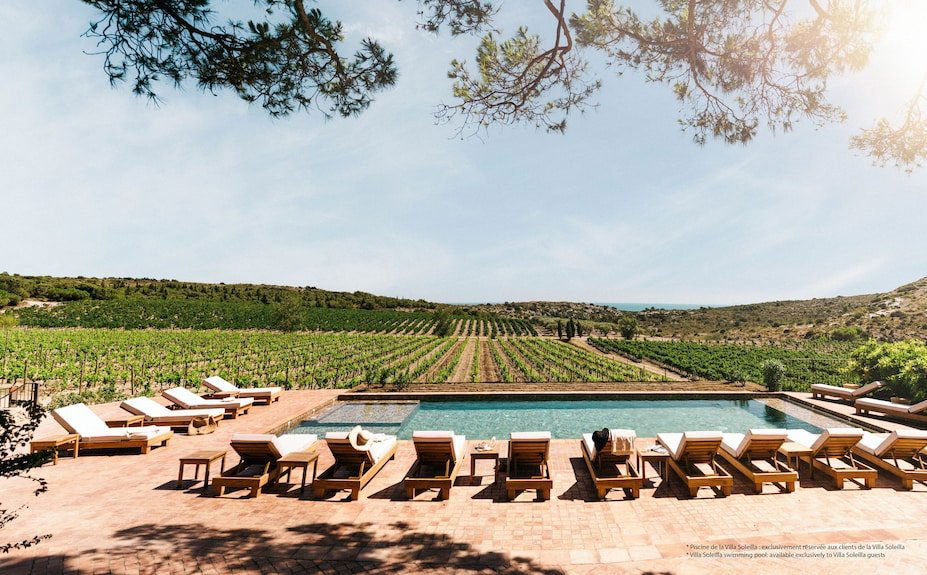
A 1,000-hectare wine estate outside Narbonne where biodynamic vines, Mediterranean scrubland, and the scent of garrigue frame a Gault & Millau Exceptional Hotel (2025). Château L'Hospitalet positions itself where agricultural heritage meets resort-scale hospitality, with the main château and Villa Soleilla sitting deep inside working vineyards rather than adjacent to them. For wine-focused travellers, the distinction matters.
Where the Estate Is the Architecture
In the Languedoc, the land does not quietly surround a property — it announces it. Approaching Château L'Hospitalet along the D168 outside Narbonne, the shift happens gradually: the road narrows, the horizon opens into a sweep of vine rows, and the garrigue — that distinctly Mediterranean mix of wild thyme, rosemary, and sun-baked scrub , starts to assert itself through the air before the buildings come into view. This is not a hotel with a wine programme. It is a working estate of approximately 1,000 hectares, within which hospitality occupies a considered, secondary role. That sequencing shapes everything about the experience.
Among French wine-country properties, this framing places Château L'Hospitalet in a narrow tier alongside estates where the agricultural identity is primary and the hotel infrastructure exists to immerse guests in it rather than distract from it. Les Sources de Caudalie in Bordeaux and Château Lafaurie-Peyraguey in Sauternes operate on a similar logic, though their respective appellations carry different international recognition. The Languedoc's relative undervaluation in the fine wine market means L'Hospitalet sits in a less crowded peer set, which may explain why the Gault & Millau Exceptional Hotel designation for 2025 reads less as confirmation of something well-known and more as a correction to an oversight.
The Physical Logic of the Domaine
The architecture of a wine estate like this is inseparable from its agricultural function. Château L'Hospitalet's principal structure is the traditional mas-style main building , thick limestone walls, shuttered windows, proportions that predate the modern concept of a resort entirely. It was not designed to impress in the contemporary sense. It was built to endure the Languedoc climate: the tramontane wind, the compressed, dry summers, the brightness that operates at a different register than the rest of France. The result is a building with genuine authority rather than borrowed grandeur.
The Villa Soleilla operates as a distinct property within the estate, offering a more intimate configuration for guests who want greater separation from the main hotel's scale. In the French wine estate tradition, this two-tier structure , main domain plus private villa , echoes approaches taken at properties such as Villa La Coste in Le Puy-Sainte-Réparade and La Réserve Ramatuelle, though each arrives at the format from a very different design philosophy. At L'Hospitalet, the driver is the estate itself: the Villa Soleilla is positioned to give guests the sensation of having the vineyards almost entirely to themselves.
Surrounding gardens and vine rows are cultivated biodynamically , a production philosophy that has tangible consequences for the physical character of the estate. Biodynamic farming prohibits synthetic inputs and follows a planting calendar tied to natural cycles, which tends to produce soils that look and feel different from conventionally farmed land: richer in texture, more complex in colour, frequently more alive with insect activity. Walking through these rows is therefore not incidental to the stay. It is the stay's architectural spine.
Position Within the Southern French Resort Tier
Southern France's premium hospitality tier has split along recognisable lines. At one end sit the headline Riviera addresses , Hotel Du Cap-Eden-Roc in Cap d'Antibes, Airelles Saint-Tropez, Château de la Chèvre d'Or in Èze , where the Mediterranean setting is spectacular and the guest profile international but the connection to agricultural production is essentially decorative. At the other end sit the wine estate properties, where that connection is structural. Hôtel & Spa du Castellet and Baumanière Les Baux-de-Provence occupy mid-positions in this spectrum, with strong culinary identities. Château L'Hospitalet sits firmly in the agricultural-primary category, with a scale , 1,000 hectares , that most estate hotels in France cannot match.
For guests arriving from Paris, the most direct rail connection runs Narbonne to Gare de Lyon in under three hours via TGV, making L'Hospitalet practically accessible without the environmental cost of a flight. The estate is driveable from the station in under fifteen minutes. This logistical ease is worth noting: estate properties in the Languedoc generally require more planning than their Provençal counterparts, which benefit from better-served airports and denser road networks. Narbonne is the exception , well-connected enough that the estate's relative remoteness reads as seclusion rather than inconvenience.
What the Gault & Millau Recognition Signals
Gault & Millau's Exceptional Hotel designation for 2025 carries a specific implication beyond general quality recognition. The guide has historically been more attentive to culinary and hospitality craft than to physical infrastructure alone, which means the designation reflects something about the experience of staying here , the quality of service, table, and programming , rather than simply the condition of the rooms. Within the broader French hotel landscape, a five-point Gault & Millau score places L'Hospitalet in a tier that most regional wine country properties do not reach. For context, the guide's scoring in this category is rigorous: properties at Domaine Les Crayères in Reims and Royal Champagne Hotel & Spa in Champillon occupy similar recognition tiers in their own wine regions.
The award also functions as a signal within the Languedoc specifically. The appellation has long suffered from a perception gap relative to Bordeaux, Burgundy, and the Rhône, despite producing wines of genuine complexity and increasing critical attention. A Gault & Millau Exceptional designation for the region's most prominent estate hotel does something useful: it repositions the Languedoc not just as a wine destination worth visiting but as one that can sustain a multi-night premium stay without concessions in quality. That argument benefits every property in the region, not just L'Hospitalet itself.
Planning the Stay
The estate's location on the D168 south of Narbonne, with the Étang de Leucate and the Mediterranean coastline within reach, means the stay can combine vineyard immersion with access to the coast without requiring a car-dependent itinerary. Summer months bring the full garrigue scent profile and long golden evenings across the vines, though this is also peak season regionally. Spring and early autumn , particularly September, when harvest activity is visible across the estate , offer conditions that engage the agricultural character of the property more directly. For guests approaching a stay here as a wine-focused trip rather than a beach-adjacent resort break, the vintage period adds an experiential layer that no other season replicates.
Accommodation options split between the main château hotel and Villa Soleilla, the latter suited to guests seeking a more self-contained configuration. The spa adds a recovery element that longer stays benefit from, particularly if guests are combining L'Hospitalet with touring the broader Languedoc wine circuit.
For those building a broader southern France itinerary, L'Hospitalet pairs naturally with wine-country properties to the east: Château de la Gaude in Aix-en-Provence, Château de Montcaud in Sabran, or La Bastide de Gordes. For those who want to anchor a France trip in Paris before heading south, Cheval Blanc Paris and Aman New York each offer points of departure for travellers arriving from further afield. Further exploration of the southern coast can include Casadelmar in Porto-Vecchio and The Maybourne Riviera. See our full Beach & Spa restaurants and hotels guide for broader regional context.
Frequently Asked Questions
Is Château L'Hospitalet Wine Resort, Beach & Spa more formal or casual in atmosphere?
The estate sits closer to the relaxed end of the premium French hotel register , its identity is rooted in the working agricultural estate rather than the formal palace-hotel tradition. That said, Gault & Millau's 2025 Exceptional Hotel designation indicates a level of service and hospitality craft that places it well above resort-casual. Guests arriving from urban luxury addresses like Cheval Blanc Paris will find the tone considerably more grounded , less ceremony, more landscape. Dress codes, if any, are likely to reflect that positioning: smart-casual for dining, entirely informal for the vineyards and grounds.
What is the leading accommodation option at Château L'Hospitalet?
Villa Soleilla functions as the estate's most self-contained and private offering, set apart from the main château building and surrounded by vines and gardens. In the context of French wine estate hospitality, this kind of separate villa configuration typically represents the property's upper tier, combining proximity to the agricultural setting with a degree of seclusion unavailable in the main hotel. For travellers comparing options, it positions similarly to private villa configurations at Château du Grand-Lucé and Aman Venice in terms of separateness and scale, though in a very different architectural register.
Recognized By


Related editorial
- Asia's 50 Best Restaurants 2026: The Chairman and Wing Go 1-2 from the Same BuildingThe Chairman takes No. 1 and Wing climbs to No. 2 at Asia's 50 Best Restaurants 2026. Both operate from the same Hong Kong building. Here's what it means.
- Four Seasons Yachts Debut: 95 Suites, 11 Restaurants, and a March 2026 Maiden VoyageFour Seasons I launches March 20, 2026, with 95 suites, a one-to-one staff ratio, and 11 onboard restaurants. Worth tracking if you want hotel-grade service at sea.
- LA Michelin Guide 2026: Seven New Restaurants from Tlayudas to Uzbek DumplingsMichelin's March 2026 California Guide update adds six LA restaurants and one Montecito newcomer, spanning Oaxacan tlayudas, Uzbek manti, and Korean-Italian pasta.
Save or rate Château L’Hospitalet Wine Resort, Beach & Spa on Pearl
Keep this venue in your Pearl passport, rate it after you visit, and track it alongside every other place you collect.