
Hotel in Appiano Sulla Strada Del Vino, Italy
Weinegg Wellviva Resort
150ptsVineyard Wellness Retreat

About Weinegg Wellviva Resort
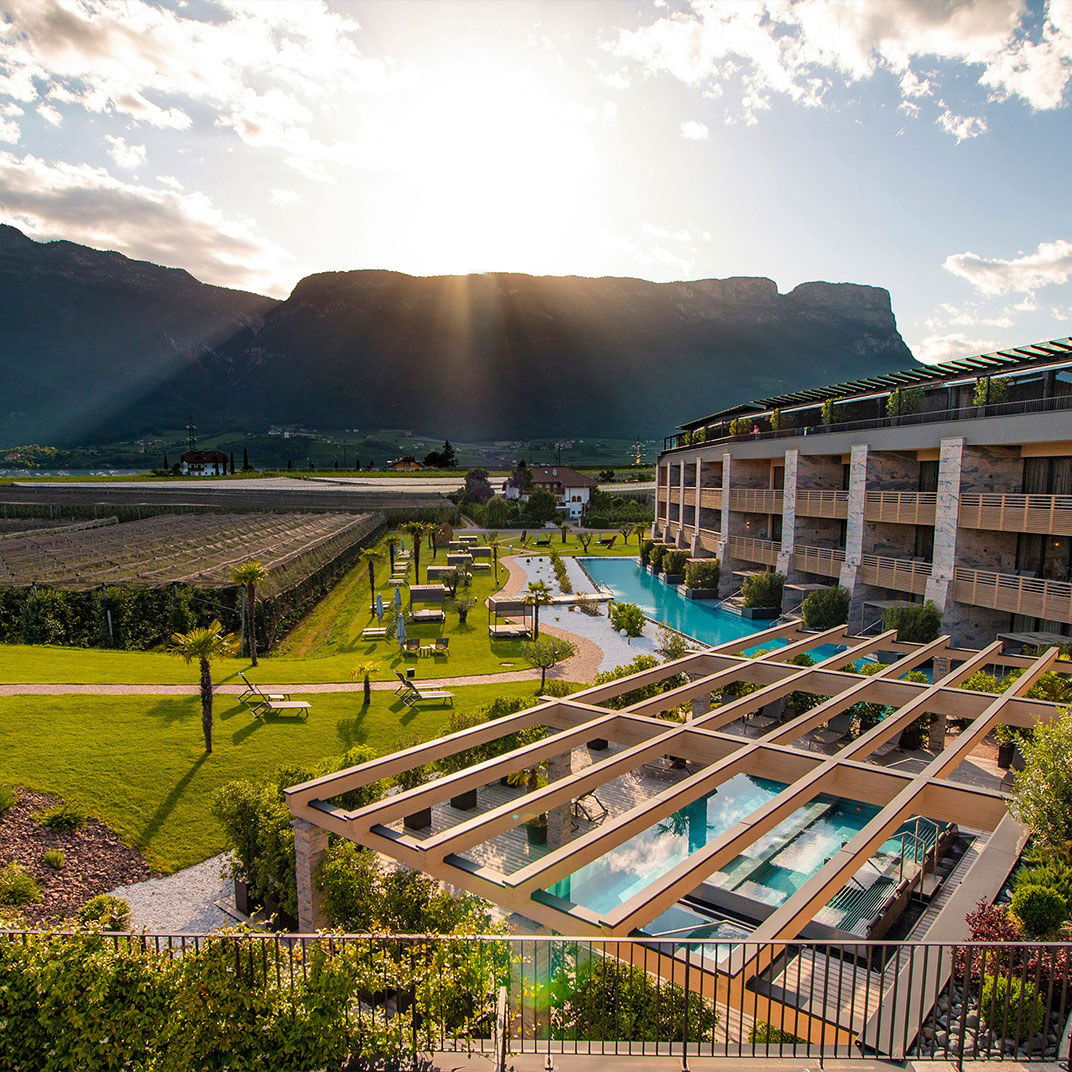
A Michelin Selected resort on the Strada del Vino, Weinegg Wellviva sits in the vineyard-threaded hills above Appiano where South Tyrol's Alpine and Mediterranean climates converge. The property pairs a wellness-led format with the visual language of the wine road — vine rows, mountain backdrops, and local stone — placing it in a small tier of Italian resort hotels that earn Michelin recognition outside the major cities.
Where the Wine Road Meets the Mountain Resort
The South Tyrolean wine road, the Strada del Vino, runs through one of Italy's most quietly productive viticultural corridors, threading between Bolzano and Caldaro through a range of apple orchards, Pinot Grigio and Gewürztraminer vineyards, and villages built in a hybrid vernacular that reflects centuries of movement between Italian and Austrian cultural spheres. Appiano sulla Strada del Vino sits at the centre of this corridor, a municipality composed of several hamlets whose collective altitude and aspect produce the mild, sun-forward microclimate that the region's winemakers depend on. It is in this context that the Weinegg Wellviva Resort occupies its position: not a city hotel, not an Alpine retreat in the strict mountain sense, but something in between — a property whose physical setting is inseparable from the agricultural and architectural character of the wine road itself.
The Michelin Selected designation, awarded through the 2025 guide to hotels and stays, places Weinegg in a category that Michelin reserves for properties it considers worth the attention of its readers — a tier below the starred distinctions but meaningfully above the general accommodation market. In northern Italy, this recognition tends to cluster around properties that combine a coherent sense of place with a level of finish that holds up against the competitive luxury hotel market across the broader region. For context, that market includes properties as varied as Aman Venice in Venice, Four Seasons Hotel Firenze in Florence, and Portrait Milano in Milan. Weinegg operates in a smaller, more rural register than any of those, which is precisely its editorial interest.
The Architecture of a Wine Road Property
South Tyrol has developed a distinct architectural conversation over the past three decades, one in which contemporary structures engage directly with the agricultural terrain rather than sitting above it. The region has produced some of Europe's most considered rural hospitality design, driven partly by the density of high-performing small producers who needed properties that could attract wine-focused visitors without importing the visual language of the Alps proper. Weinegg, positioned in Appiano at Via Lamm 22, participates in this tradition. The resort format, with its wellness orientation signalled directly in the name, reflects a design logic common to the area's better properties: the building is conceived not as a backdrop to the vineyard view but as a structure in genuine dialogue with it. Stone, wood, and agricultural reference points tend to define the material palette in properties of this type across South Tyrol, though the specific execution at Weinegg sits within verified data rather than extrapolation.
What the architectural editorial angle reveals here is broader than any single property. The South Tyrolean model of resort design has influenced wellness-forward mountain hotels across northern Italy and into Austria, producing a template in which the spa or wellness programme is treated as a primary function rather than an amenity add-on. Properties in this category invest in thermal and treatment infrastructure that rivals dedicated spa destinations, while maintaining the intimacy of a smaller room count. This is distinct from the grand palace hotel model visible at Grand Hotel Tremezzo in Tremezzo or Badrutt's Palace Hotel in St. Moritz, and equally distinct from the rural agriturismo format. Weinegg occupies the middle band: resort scale with a landscape-embedded identity.
Setting and Surroundings
Appiano is not a single-point destination. The municipality includes Cornaiano, San Michele, and San Paolo, each with its own elevation, aspect, and character. The wine road passes through all of them, and the vineyards that produce Appiano's Pinot Nero, Gewürztraminer, and Schiava are integrated into the built environment at close quarters. A resort in this setting is surrounded by working agriculture in a way that few Italian luxury properties can claim, which creates both an aesthetic advantage and a practical one: the proximity to wine production is a constant orientation device, giving guests a physical relationship to the region's primary industry rather than a curated version of it.
The broader region connects directly to Merano, roughly 30 kilometres north, where Castel Fragsburg in Merano represents another point on the South Tyrolean luxury hospitality map. The comparison is instructive: Merano operates at higher altitude with a more pronounced Alpine character, while Appiano's gentler hills and Mediterranean-influenced climate produce a different sensory register. Guests choosing between South Tyrolean options are effectively choosing between these two registers, and Appiano's wine road position gives Weinegg a distinct reason to exist within the regional offering.
For those building a broader Italian itinerary, the property fits naturally within a northern arc that might include Il Sereno in Torno on Lake Como or Passalacqua in Moltrasio, before extending south to Tuscan options like Rosewood Castiglion Del Bosco in Montalcino or Borgo San Felice Resort in Castelnuovo Berardenga. Weinegg's northern position and wine road identity differentiate it clearly within any such sequence.
The Wellness-Resort Format in Context
Across Italy, the resort hotel category has fractured into several distinct sub-types. Coastal properties like Borgo Santandrea on the Amalfi Coast or Il San Pietro di Positano trade on the drama of cliffside positioning. Rural Tuscan properties like Castello di Reschio in Lisciano Niccone work with the weight of historic estate architecture. Island properties like Therasia Resort in Lipari depend on geographic isolation. The northern Italian wellness-resort format, by contrast, earns its position through the integration of therapeutic programming with a landscape that is productive and inhabited rather than purely scenic. The vineyards outside the window are not ornamental; they are the economic and cultural spine of the territory. That distinction gives properties in this category a grounding that more scenically dramatic options sometimes lack.
The Michelin Selected status positions Weinegg within a peer group that Michelin's hotel editors consider worth the reader's attention on quality of experience, not just category or price. That the property holds this recognition in a municipality as small and specific as Appiano sulla Strada del Vino suggests a level of delivery that holds up under the kind of scrutiny that produces Michelin recommendations. For travellers building an itinerary around northern Italy's less-trafficked wine territories, the combination of the Strada del Vino setting, the wellness-resort format, and the Michelin acknowledgment constitutes a coherent and defensible case. See our full Appiano sulla Strada del Vino restaurants and hotels guide for the broader context of what the area offers.
Planning Your Stay
Appiano sulla Strada del Vino is accessible from Bolzano, which has rail connections to Verona, Innsbruck, and beyond, making it a practical stop on a northern Italian circuit rather than a dedicated pilgrimage. The wine road itself rewards slow travel: the distances between points are short, the terrain is walkable in sections, and the density of producers offering direct tastings is high enough to fill several days without leaving the municipality. The leading periods for the region align with the viticultural calendar: the harvest months of September and October bring both peak visual interest in the vineyards and the highest demand on local accommodation. Late spring, from May through June, offers cooler temperatures and lower occupancy. Summer stays at Weinegg benefit from the resort's wellness infrastructure on warmer days, while the surrounding landscape remains accessible for walking and cycling in the mornings and evenings.
Frequently Asked Questions
- What is the atmosphere like at Weinegg Wellviva Resort?
- Weinegg sits on the Strada del Vino in Appiano, a working wine road through South Tyrol where vineyards run directly up to the built environment. The atmosphere reflects this: the property operates in a wellness-resort register, which in the South Tyrolean context means a calm, landscape-oriented tone rather than the social energy of a city hotel. The Michelin Selected recognition for 2025 signals a level of finish and experience consistent with that positioning. Appiano's mild microclimate, shaped by its low altitude relative to the broader alpine region, means the outdoor environment is accessible across most of the year.
- What room should I choose at Weinegg Wellviva Resort?
- Specific room categories are not available in our current data. As a Michelin Selected property in a vineyard-set resort format, the general principle for properties of this type in South Tyrol is to prioritise rooms with south or west-facing aspects, which capture the full sweep of the vineyard terrain and the afternoon light that defines the wine road's visual character. Contacting the property directly before booking to discuss orientation and floor preference is the practical approach.
- What is the standout thing about Weinegg Wellviva Resort?
- The combination of location and category recognition. Appiano sulla Strada del Vino is one of the more specific and coherent wine territories in northern Italy, and a Michelin Selected resort within it occupies a narrow niche: rural, wellness-oriented, wine-road-embedded, and editorially acknowledged. That combination is less common in Italy than the coastal or Tuscan alternatives. For travellers whose interest is northern Italian wine culture alongside serious wellness infrastructure, the positioning is difficult to replicate elsewhere in the region.
Recognized By
Similar venues by awards
Related editorial
- Asia's 50 Best Restaurants 2026: The Chairman and Wing Go 1-2 from the Same BuildingThe Chairman takes No. 1 and Wing climbs to No. 2 at Asia's 50 Best Restaurants 2026. Both operate from the same Hong Kong building. Here's what it means.
- Four Seasons Yachts Debut: 95 Suites, 11 Restaurants, and a March 2026 Maiden VoyageFour Seasons I launches March 20, 2026, with 95 suites, a one-to-one staff ratio, and 11 onboard restaurants. Worth tracking if you want hotel-grade service at sea.
- LA Michelin Guide 2026: Seven New Restaurants from Tlayudas to Uzbek DumplingsMichelin's March 2026 California Guide update adds six LA restaurants and one Montecito newcomer, spanning Oaxacan tlayudas, Uzbek manti, and Korean-Italian pasta.
Save or rate Weinegg Wellviva Resort on Pearl
Keep this venue in your Pearl passport, rate it after you visit, and track it alongside every other place you collect.