
Hotel in Amsterdam, Netherlands
Sir Adam Hotel\u002c part of Sircle Collection
150ptsNoord Waterfront Positioning

About Sir Adam Hotel\u002c part of Sircle Collection
Sir Adam Hotel, part of the Sircle Collection, occupies a converted industrial tower on Amsterdam's IJ waterfront at Overhoeksplein 7, placing it firmly outside the canal-belt hotel circuit. Selected by the Michelin Guide for Hotels 2025, it represents a strand of Amsterdam accommodation that trades heritage interiors for contemporary design and cross-river location. The hotel is a reference point for music-forward, design-led stays in the city's northern regeneration zone.
The North Bank and What It Means to Stay There
Amsterdam's hotel geography has long been defined by the canal belt: grand addresses on the Herengracht, converted merchant houses in the Jordaan, and a handful of landmark properties clustered around Museumplein. The IJ waterfront north of Central Station represents a different logic entirely. Former industrial land, redeveloped over the past two decades into a zone of creative studios, cultural institutions, and residential blocks, the Noord side of the IJ sits a short free ferry ride from the city's historic core. Choosing to stay here is a statement about how you want to experience Amsterdam: at a remove from the tourist-dense centre, in a neighbourhood that still reads as a work in progress, where the morning commute involves watching cyclists board a ferry and the evening options run toward independent venues rather than heritage hotel bars.
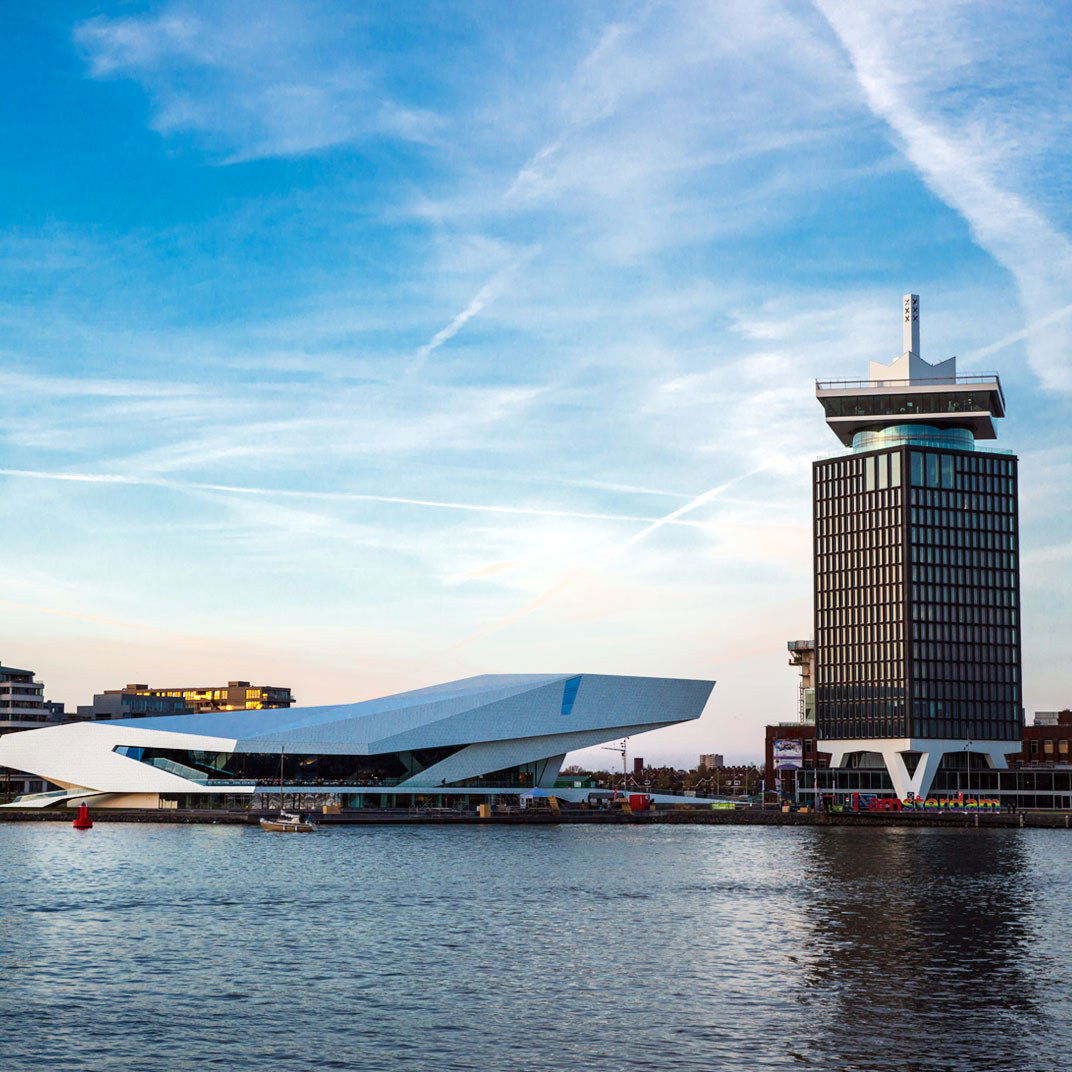
Sir Adam Hotel, part of the Sircle Collection, positions itself at the centre of that proposition. The hotel occupies a converted tower at Overhoeksplein 7, a location that places it directly within the Shell headquarters redevelopment zone, a site whose industrial past is visible in the architecture of the surrounding district. The address alone signals intent: this is not a hotel that competes with the Conservatorium or the Waldorf Astoria Amsterdam on heritage terms. It competes on character, access to a specific Amsterdam subculture, and a design language that connects to the city's contemporary creative identity rather than its Golden Age.
The Michelin Signal and What It Tells You About Peer Set
Inclusion in the Michelin Selected Hotels list for 2025 places Sir Adam inside a curated tier that spans Amsterdam's accommodation market, from canal-front design hotels to larger international properties. Michelin's hotel selection, launched as an extension of the guide's restaurant authority, applies similar logic: recognition requires consistent delivery across hospitality, comfort, and character rather than raw luxury spend. Sir Adam's selection positions it alongside properties that earn their place through execution rather than brand affiliation, a meaningful distinction in a city where the upper-mid tier is crowded with branded product.
Within the Sircle Collection's Amsterdam portfolio, Sir Adam sits alongside properties in different neighbourhoods, each with a distinct identity. The collection's approach, operating hotels with strong individual personality under a shared operational structure, is more common in European boutique hospitality than in the legacy chain model. For the traveller making a first Amsterdam visit and defaulting to canal-belt addresses like the Andaz Amsterdam Prinsengracht or the Canal House, Sir Adam offers an alternative argument: that the city's contemporary identity is more legible from the north bank than from a Prinsengracht window.
The Ritual of Arrival and the Room Above the City
The structural assignment here is the dining and stay ritual, which at Sir Adam begins before you reach the room. The approach from Central Station involves either a five-minute walk to the ferry dock at the rear of the station or an Uber across one of the IJ bridges, a journey that reorients your sense of Amsterdam's geography and puts distance, in the useful sense, between you and the Damrak. Arriving at Overhoeksplein, the tower's height immediately situates you differently from the low skyline of the canal belt.
The hotel's identity is built around music: a record shop, a rooftop bar, and programming that brings live sound into the building's public spaces. For guests, the practical consequence is that the lobby functions as a social space rather than a transactional one, closer in atmosphere to the public-floor design of citizenM properties such as citizenM Amstel Amsterdam than to the hushed reception areas of the Sofitel Legend or the InterContinental Amstel. The difference matters for the rhythm of a stay: you move through a building that has its own programme, not just a building that houses you.
Rooms at higher floors carry views over the IJ and back toward the city, a perspective that inverts the usual Amsterdam hotel proposition. Instead of looking out at a canal or a courtyard, you look at water at scale, with the city's historic towers in the middle distance. That shift in visual register affects how a visit feels at the close of each day, and it distinguishes Sir Adam from the compressed-street-level intimacy of a Breitner House or the heritage-room sensibility of a canal-house conversion.
Noord as Context: The Neighbourhood Feeding the Hotel
The ADAM Tower complex and its immediate surroundings contain a concentration of Amsterdam cultural infrastructure: the EYE Film Institute sits directly across the water, the Tolhuistuin hosts outdoor events, and a cluster of independent food and music venues has developed along the waterfront in both directions. For guests whose Amsterdam programme extends beyond the Rijksmuseum circuit, staying in Noord changes the evening equation. The ferry back to Central Station runs through the night, which eliminates the practical penalty of an off-centre address while preserving the neighbourhood's separation from the city's tourist-heavy core.
This locational logic is part of a broader pattern in European city hotels: properties in regenerating urban zones trading on the energy of an area in transition, where the amenity set is evolving and the guest is positioned as a participant in that evolution rather than a visitor to an established scene. For Amsterdam specifically, Noord represents the clearest expression of that pattern, more so than the Pijp or the developing eastern docklands. Guests who have previously tracked comparable properties in Rotterdam, such as Room Mate Bruno, or explored waterfront stays elsewhere in the Netherlands, will recognise the type.
Planning a Stay: Practical Considerations
Booking Sir Adam places you 15 to 20 minutes from the Rijksmuseum and the Vondelpark by ferry and tram, a journey that becomes routine by the second day but requires deliberate planning on the first. The citizenM Schiphol Airport property offers a useful comparison for travellers weighing off-centre convenience against central access: Sir Adam makes a stronger case for guests whose itinerary is weighted toward Noord's creative infrastructure, while central canal-belt addresses suit those for whom the Jordaan and the Nine Streets are the primary draw.
For Netherlands itineraries that extend beyond Amsterdam, Sir Adam functions as a logical base for day trips west toward Landgoed Duin en Kruidberg in Santpoort Noord and the dune coast, or south to Weeshuis Gouda and Park Centraal Den Haag in The Hague. Guests extending into the country's east or south can reference properties including Kasteel Daelenbroeck in Herkenbosch, Klein Zwitserland in Slenaken, and De Blanke Leading in Cadzand-Bad on the Zeeland coast.
For the wider Amsterdam hotel picture, including how Sir Adam's positioning compares to canal-belt alternatives and independent design properties like De Durgerdam and the Conscious Hotel Amsterdam City (The Tire Station), see our full Amsterdam restaurants and hotels guide.
Frequently Asked Questions
What is the main draw of Sir Adam Hotel?
The primary draw is location and identity in combination: a Michelin Selected property on the IJ waterfront in Amsterdam Noord, with a music-focused programming ethos and views over the river that no canal-belt address can replicate. The ferry connection to Central Station keeps the city accessible while the neighbourhood provides a version of Amsterdam that sits outside the heritage hotel circuit.
Which room category should I book at Sir Adam Hotel?
Given the Michelin Selected recognition and the tower's height, rooms on upper floors facing the IJ deliver the view that most differentiates Sir Adam from its central-Amsterdam peers. The hotel's Michelin placement implies a consistent base standard across categories, but the waterfront-facing upper rooms are the most specific argument for choosing this address over alternatives like the citizenM Amsterdam South or a Jordaan canal house.
How difficult is it to book Sir Adam Hotel?
Sir Adam is not a property with the acute scarcity of a small-key rural retreat or a highly allocated city address. Its Michelin Selected status reflects quality rather than exclusivity in the access sense. Availability follows standard urban hotel patterns: tighter during peak summer months and during Amsterdam's major event calendar, more open in the shoulder seasons of late autumn and early spring. Booking through the Sircle Collection's direct channels or established hotel booking platforms is the standard approach; no specialist access or extended lead time is generally required outside peak periods.
Recognized By

Explore Amsterdam
Similar venues by awards
Related editorial
- Asia's 50 Best Restaurants 2026: The Chairman and Wing Go 1-2 from the Same BuildingThe Chairman takes No. 1 and Wing climbs to No. 2 at Asia's 50 Best Restaurants 2026. Both operate from the same Hong Kong building. Here's what it means.
- Four Seasons Yachts Debut: 95 Suites, 11 Restaurants, and a March 2026 Maiden VoyageFour Seasons I launches March 20, 2026, with 95 suites, a one-to-one staff ratio, and 11 onboard restaurants. Worth tracking if you want hotel-grade service at sea.
- LA Michelin Guide 2026: Seven New Restaurants from Tlayudas to Uzbek DumplingsMichelin's March 2026 California Guide update adds six LA restaurants and one Montecito newcomer, spanning Oaxacan tlayudas, Uzbek manti, and Korean-Italian pasta.
Save or rate Sir Adam Hotel\u002c part of Sircle Collection on Pearl
Keep this venue in your Pearl passport, rate it after you visit, and track it alongside every other place you collect.