
Bar in Zafferana Etnea, Italy
Monaci delle Terre Nere, Relais & Chateaux
100ptsVolcanic Estate Hospitality
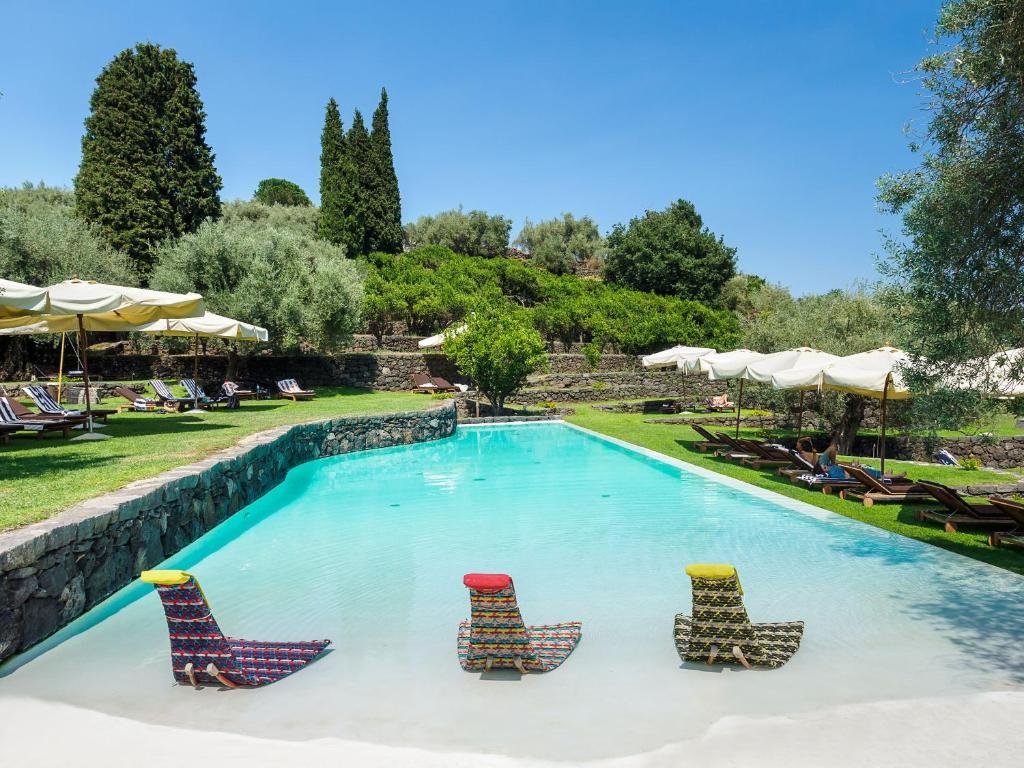
About Monaci delle Terre Nere, Relais & Chateaux
A Relais & Chateaux property on the volcanic slopes of Mount Etna, Monaci delle Terre Nere sits inside one of Sicily's most structurally distinctive hospitality settings. The estate draws on the region's Nerello Mascalese viticulture and lava-stone agricultural tradition to frame both its food and drink programmes. For travellers who treat the Etna DOC zone as a destination in itself, this is the property around which an itinerary is built.
Arrival on the Volcano
The eastern flank of Mount Etna has a particular quality at dusk: the lava fields cool from black to grey, the terraced vineyards catch the last lateral light, and the air carries the mineral sharpness of volcanic soil rather than the salt of the coast thirty kilometres below. Approaching Monaci delle Terre Nere along the narrow roads above Zafferana Etnea, you are already inside the premise of the property before you reach the gate. The estate does not announce itself; the landscape does it instead.
This is a meaningful distinction in the Relais & Chateaux category. That collection now spans over 580 member properties across 65 countries, and the brand's curatorial tension has always been between genuinely site-specific estates and well-appointed properties that could, in honesty, be transposed elsewhere. Monaci delle Terre Nere sits at the rooted end of that spectrum. The volcanic substrate, the Nerello Mascalese vines, and the altitude above the Ionian Sea are not decorative context; they are the operational logic of the property.
The Etna DOC Setting and What It Produces
The Etna DOC zone has shifted from peripheral Sicilian curiosity to one of Italy's most-discussed wine appellations over the past fifteen years. Nerello Mascalese, grown on the volcano's contrade at elevations between 400 and 1,000 metres, produces reds of notable structural tension: high acid, moderate tannin, and a mineral signature that many producers and critics have mapped to Burgundy's village-level hierarchy rather than to the broader southern Italian tradition of sun-driven concentration. The comparison is contested, but the attention it has generated is not: estates in the Etna DOC now attract buyers and critics who would have routed through Barolo or Brunello without pausing a decade ago.
For a property like Monaci delle Terre Nere, this shift in the appellation's reputation has amplified the logic of its positioning. Guests arriving primarily for the Etna wine experience find the estate already inside the territory they came to understand. Access to the estate's own agricultural land and proximity to the DOC's key contrade means that the food and drink offer connects to the landscape at a granular level rather than through sourced regional products alone. This kind of vertical rootedness is what separates credible agri-estate hospitality from properties that simply use regional ingredient names on a menu.
Drinks on the Estate: Volcanic Viticulture as the Frame
The editorial angle that matters here is not cocktail technique in the metropolitan sense. Programmes at properties like [Drink Kong in Rome](https://www.enprimeurclub.com/bars/drink-kong-rome) or [1930 in Milan](https://www.enprimeurclub.com/bars/1930-milan) operate inside an urban technical register where distillate sourcing, clarification methods, and service theatre define the offer. Estate properties in active wine appellations work from a different logic: the drink programme's credibility derives from its relationship to the land around it.
At Monaci delle Terre Nere, that means Nerello Mascalese and Carricante are not background choices on a wine list but the central argument. Carricante, the white grape of Etna's eastern slopes, produces wines of pronounced salinity and citrus tension that perform well as aperitivo anchors in a way that international varietals planted elsewhere on the island rarely replicate. Drinking a vineyard-specific Etna Bianco at altitude, looking across the lava flows toward the Ionian coast, delivers a kind of site coherence that no curated cocktail menu at an off-site bar can approximate. The context is the programme.
For guests who want a reference point in the broader Italian bar and wine-bar scene, properties like [Al Covino in Venice](https://www.enprimeurclub.com/bars/al-covino-venice-bar) and [Enoteca Historical Faccioli](https://www.enprimeurclub.com/bars/enoteca-historical-faccioli-enoteca-storica-vini-naturali-bologna-bar) in Bologna demonstrate how the wine-led format can function with rigour at smaller scales. [L'Antiquario in Naples](https://www.enprimeurclub.com/bars/lantiquario-naples) and [Gucci Giardino in Florence](https://www.enprimeurclub.com/bars/gucci-giardino-florence-bar) show how the cocktail-focused alternative operates in southern and central Italian contexts. Monaci delle Terre Nere occupies a different register from all of them: rural, agricultural, tied to an appellation rather than a city neighbourhood.
The Property in Its Regional Context
Zafferana Etnea sits at approximately 600 metres on Etna's southeastern slope, inside the honeybee-and-lava agricultural zone that produces both the island's most discussed wines and some of its most intact agrarian landscapes. The town itself is small enough that the estate operates as a destination anchor rather than one option among several. Guests who build itineraries around the Etna DOC typically use Zafferana Etnea or Linguaglossa as bases, with Catania — about 30 kilometres below on the coast — serving as the arrival and logistics hub.
The Relais & Chateaux membership places Monaci delle Terre Nere in a peer set that includes properties like Borgo San Felice in Chianti and Capofaro on the Aeolian island of Salina: wine-estate hotels where the appellation's identity is the organising principle of the stay. Within Sicily specifically, the Etna zone is a younger, less commercially consolidated appellation than Marsala or the Sicilian IGT tier, which gives Monaci delle Terre Nere a position at the front edge of the island's hospitality evolution rather than inside a well-worn tourist circuit.
For travellers building a southern Italian drinks itinerary, the geography works: [Fauno Bar in Sorrento](https://www.enprimeurclub.com/bars/fauno-bar-sorrento-bar) anchors the Campania end of the trip, with the ferry or flight to Catania connecting logically to Etna. Properties like [Cascate del Mulino in Manciano](https://www.enprimeurclub.com/bars/cascate-del-mulino-manciano-bar) demonstrate how geothermal and volcanic landscapes function as hospitality settings across central and southern Italy. For those extending further, [Lost & Found in Nicosia](https://www.enprimeurclub.com/bars/lost-found-nicosia) represents a credible next node across the Mediterranean.
Planning a Stay
The estate operates on a seasonal calendar typical of high-altitude Sicilian properties: summer occupancy is strong, and the harvest period in September and October represents the most site-relevant time to visit, when the Nerello Mascalese picking schedule structures the days around the vineyards. Booking in advance for those weeks is necessary, as the combination of harvest access and harvest-adjacent wine tourism from Italy and northern Europe compresses availability. The property's Relais & Chateaux membership means reservations are handled through both the estate directly and the R&C; central booking platform. For our broader guide to eating and drinking in the area, see [our full Zafferana Etnea restaurants guide](https://www.enprimeurclub.com/cities/zafferana-etnea).
For reference points in adjacent hospitality formats, [Bistrot Torrefazione Samambaia in Turin](https://www.enprimeurclub.com/bars/bistrot-torrefazione-samambaia-torino-turin-bar) and [Bar Leather Apron in Honolulu](https://www.enprimeurclub.com/bars/bar-leather-apron-honolulu) illustrate how estate and terroir-led drink programmes operate across very different latitudes , the common thread being a drink offer disciplined by what the surrounding land actually produces.
Frequently Asked Questions
- What should I expect atmosphere-wise at Monaci delle Terre Nere, Relais & Chateaux?
- The atmosphere is defined by the volcanic landscape rather than by interior design choices. At altitude on Etna's eastern flank, the estate's lava-stone architecture and terraced grounds create a setting that is agricultural and meditative rather than resort-like. Guests arriving without prior knowledge of the Etna DOC zone often describe the property as reorienting their expectations of what a luxury Italian stay can feel like. Relais & Chateaux membership signals a baseline of service rigour, but the sensory experience here is predominantly outdoor and geological.
- What's the leading thing to order at Monaci delle Terre Nere, Relais & Chateaux?
- Given the estate's position inside the Etna DOC, the wine list is the primary argument. Nerello Mascalese from high-altitude contrade and Carricante from the eastern slopes represent the appellation's two most structurally interesting expressions. Estate-grown or estate-adjacent produce structures the kitchen's offer, which in Sicilian agri-hotel settings typically means ingredient decisions driven by the harvest calendar rather than by menu continuity across seasons.
- What's the standout thing about Monaci delle Terre Nere, Relais & Chateaux?
- The property's position inside an active and critically watched wine appellation distinguishes it from most European luxury estates. Zafferana Etnea is not a heritage tourism destination in the conventional sense; the Etna DOC's current moment of critical attention makes the location structurally relevant to wine-led travel in a way that would not have applied a decade ago. Relais & Chateaux membership adds a verified service benchmark to that locational argument.
- How hard is it to get in to Monaci delle Terre Nere, Relais & Chateaux?
- Book early for the September-October harvest period, when demand from Etna DOC wine tourism and the estate's own harvest programming compresses availability significantly. Outside that window, summer months also fill quickly given Sicily's general tourism pressure and the Relais & Chateaux profile. The R&C; central booking platform provides an accessible booking channel alongside direct reservations.
- Is a night at Monaci delle Terre Nere, Relais & Chateaux worth it?
- For travellers whose itinerary is organised around the Etna DOC or Sicilian wine more broadly, yes: the property delivers site coherence that an off-estate hotel in Catania cannot approximate. Relais & Chateaux membership provides a service baseline, but the value proposition here is primarily geographic and viticultural. If your interest in Sicily is coastal and cultural rather than wine-led, the altitude and agricultural setting may feel remote rather than immersive.
- What makes Monaci delle Terre Nere different from other Relais & Chateaux properties in southern Italy?
- Most Relais & Chateaux properties in the Italian south are positioned around historical architecture, coastal access, or refined cuisine in a heritage setting. Monaci delle Terre Nere is organised around an active, critically evolving wine appellation on a live volcano. The Etna DOC's transformation over the past fifteen years from a marginal designation to a reference point for mineral, high-acid Italian reds gives the property a forward-facing cultural argument that heritage-led estates cannot replicate. For guests tracking the Nerello Mascalese story from early producers to estate-level hospitality, this represents a rare convergence of place and moment.
Related editorial
- Asia's 50 Best Restaurants 2026: The Chairman and Wing Go 1-2 from the Same BuildingThe Chairman takes No. 1 and Wing climbs to No. 2 at Asia's 50 Best Restaurants 2026. Both operate from the same Hong Kong building. Here's what it means.
- Four Seasons Yachts Debut: 95 Suites, 11 Restaurants, and a March 2026 Maiden VoyageFour Seasons I launches March 20, 2026, with 95 suites, a one-to-one staff ratio, and 11 onboard restaurants. Worth tracking if you want hotel-grade service at sea.
- LA Michelin Guide 2026: Seven New Restaurants from Tlayudas to Uzbek DumplingsMichelin's March 2026 California Guide update adds six LA restaurants and one Montecito newcomer, spanning Oaxacan tlayudas, Uzbek manti, and Korean-Italian pasta.
Save or rate Monaci delle Terre Nere, Relais & Chateaux on Pearl
Keep this venue in your Pearl passport, rate it after you visit, and track it alongside every other place you collect.