

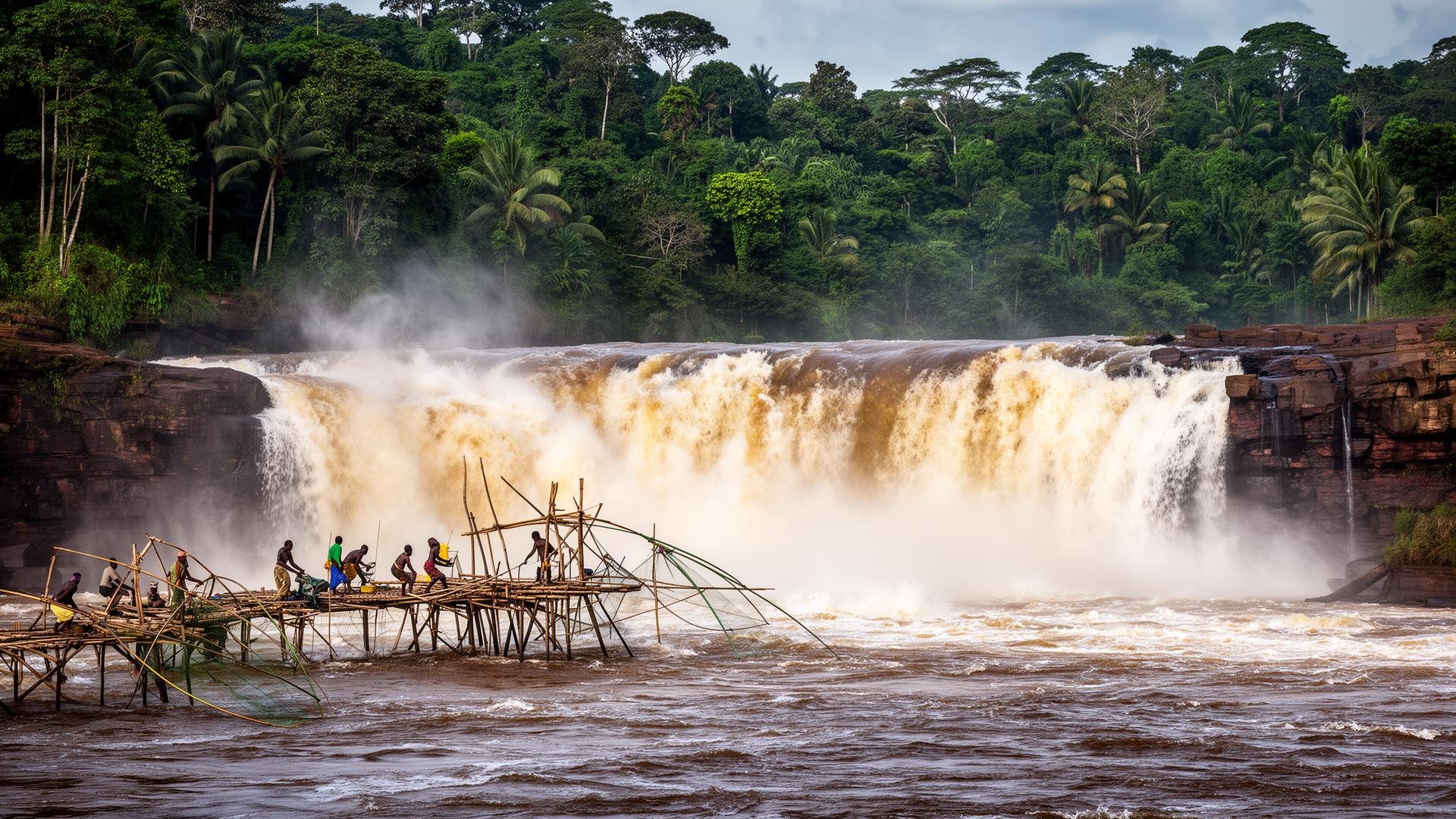
Boyoma Falls
Kisangani, Tshopo
Restaurant in Tshopo, Democratic Republic Of Congo
 Book with Pearl
The Read
Dress
Casual
Why go
Boyoma Falls is a remote natural landmark on the Congo River in Tshopo, DRC: one of the largest river systems by volume in the world. There is no managed visitor infrastructure, ticketing, or dining on record. Worth the journey only for experienced travellers with a local operator already arranged and a full understanding of current conditions in eastern DRC.
About Boyoma Falls
Verdict
Boyoma Falls is one of the most significant natural landmarks in Central Africa: a series of seven cataracts on the Congo River near Kisangani in the Tshopo province of the Democratic Republic of Congo. If you are considering a visit, go in with clear eyes: this is not a managed tourist attraction with ticketed access, dining options, or visitor infrastructure. It is a remote natural site that requires serious logistical planning, local guidance, and a realistic assessment of travel conditions in eastern DRC. Book this only if you are an experienced traveller who has already arranged ground transport, a trusted local operator, and appropriate travel insurance.
What to Expect
The falls themselves are visual in the most literal sense: the Congo River, the second-largest river by discharge in the world, compresses through a series of rocky channels over roughly 100 kilometres before reaching Kisangani. What you see is not a single dramatic plunge but a wide, churning progression of white water and rock, set against dense equatorial forest. The scale is the draw. There is no equivalent experience available at a managed attraction closer to home.
Because there is no confirmed venue infrastructure, no recorded hours, no pricing, no booking method, any comparison to a lunch-versus-dinner or daytime-versus-evening framework applies only to timing your arrival for the leading light. Early morning, when mist sits over the river and the equatorial sun is low, gives the most visually compelling conditions. Midday is harsh. If you are making a special occasion of a Congo River itinerary, time your visit to the falls for dawn or late afternoon.
For travellers building a broader itinerary in Tshopo, see our full Tshopo restaurants guide, our full Tshopo hotels guide, our full Tshopo bars guide, our full Tshopo experiences guide, and our full Tshopo wineries guide. For a dining reference point in the broader region, Fatimata Restaurant in Kindu is the most relevant listed option nearby.
If your appetite for ambitious travel extends to world-class dining destinations worth the journey, Pearl covers venues at that level, from Le Bernardin in New York City and Atomix in New York City to Waterside Inn in Bray, Uliassi in Senigallia, HAJIME in Osaka, Piazza Duomo in Alba, Reale in Castel di Sangro, Quattro Passi in Marina del Cantone, Dal Pescatore in Runate, Atelier Moessmer Norbert Niederkofler in Brunico, Lazy Bear in San Francisco, and Emeril's in New Orleans.
Practical Details
No phone, website, or booking method is on record. Access to the Boyoma Falls area depends entirely on local operators and current conditions in Tshopo. Check travel advisories from your government before planning any trip to eastern DRC. Booking difficulty is low in the sense that no reservation system exists, but logistical difficulty is high.
Planning details
- Location
- Congo - Kinshasa
The take
The Take
The Vibe
Boyoma Falls presents a raw, river‑first experience rather than a conventional dining room. The prose of the site stresses elemental forces, cascading cataracts, oxygen‑rich currents and time‑deep fishing traditions, which gives the place a rustic, historic character. Visitors encounter local techniques and materials, woven basket traps and age‑old harvesting logic, that emphasize craft and continuity. It reads less like a polished restaurant and more like a living food landscape: austere, tactile and anchored to the Congo River’s rhythms and seasonal cycles.
Best For
This venue is best for visitors seeking a direct encounter with local foodways and river ecology rather than standard restaurant service. It suits adventurous diners, students of regional fisheries and travelers drawn to experiential, place‑based meals. Expect an informal atmosphere where the ingredient story (fresh, endemic freshwater fish sourced at the falls) takes precedence over menu theatrics. Boyoma Falls is appropriate for solo exploration or casual, curiosity-driven visits, with the river as the focus.
Ordering Tips
Treat ordering here as an inquiry into origin and seasonality: ask what species were caught that day and how they’re prepared. Boyoma Falls has no cold chains or conventional distribution networks, so expect dishes built around the day’s freshwater catches and straightforward preparations that highlight texture and freshness. Be prepared to recalibrate expectations about service and presentation; the emphasis is on ecological provenance and traditional techniques rather than a polished, modern dining format.
Venue details
Ambiance
Riverside setting with water pattering against rocks, frothing rapids, and lively night atmosphere.
Tags
Vibe
Best For
Experience
View
At the Table
- Dress Code
- Casual
- Noise Level
- Lively
- Service Style
- Casual
- Capacity
- Small
- Outdoor Seating
- Yes
Know before you go
Know Before You Go
- Getting there
- Congo - Kinshasa
Planning details
Location
Congo - Kinshasa · Directions
Also consider
Also Consider
- Fatimata Restaurant: Notable alternative
Restaurant context
How It Compares
Within Tshopo, Fatimata Restaurant is the only Pearl-listed dining peer in the region, which tells you something about the depth of the hospitality infrastructure here. If you need a restaurant booking in the area, Fatimata is your clearest option. Boyoma Falls itself is not a dining venue and should not be assessed on those terms.
For travellers deciding between a natural-site itinerary in DRC and a more conventional special-occasion trip, the honest comparison is not between local venues but between travel formats. A structured dining experience at a destination restaurant, the kind covered elsewhere in Pearl's global listings, offers clear booking paths, defined price points, and predictable quality. A visit to Boyoma Falls offers none of that, but the visual scale of the Congo River at the falls has no equivalent you can book through a reservations platform.
If you are weighing where to direct your travel budget in Central and West Africa, the decision comes down to infrastructure tolerance. Boyoma Falls rewards travellers who are comfortable with uncertainty and have done the groundwork with a local operator. For everyone else, the Tshopo guides on Pearl restaurants, hotels, and experiences: are the better starting point for building a manageable itinerary.
Explore Tshopo
Around this place
Discover more on Pearl
Unlock the full Boyoma Falls guide in Pearl, including awards, comparisons, FAQs, planning details, and nearby places.
Compare Boyoma Falls
| Venue | Awards |
|---|---|
| Boyoma Falls | No published awards |
| Fatimata Restaurant | No published awards |
Key differences to consider before you reserve.
FAQ
Frequently Asked Questions
Does Boyoma Falls handle dietary restrictions?
Boyoma Falls is a natural landmark, not a dining venue, so there are no menus or dietary accommodations on site. Any food arrangements depend entirely on the local operators or guides you travel with to reach the Kisangani area. Plan provisions before you arrive: this is remote territory in Tshopo province with no documented on-site facilities.
What should I order at Boyoma Falls?
There is nothing to order here: Boyoma Falls is one of Central Africa's most significant river systems, not a restaurant or hospitality venue. The draw is the spectacle of the Congo River, the world's second-largest by discharge, compressing through seven cataracts. Come for the landscape, not a menu.
Is Boyoma Falls good for solo dining?
Boyoma Falls is a natural site, not a dining destination, so solo dining is not applicable. For a solo traveller, the more relevant question is whether you can access it safely alone: and the answer is generally no. Reaching the falls near Kisangani requires local operators and current on-the-ground intelligence about conditions in Tshopo province.
What are alternatives to Boyoma Falls in Tshopo?
Within the Tshopo province and greater Kisangani area, Fatimata Restaurant is a documented local dining option if you need a meal base before or after visiting the falls. For natural sites comparable in scale, alternatives exist elsewhere in the DRC, but none within Tshopo match Boyoma Falls for geographic significance: seven cataracts on the Congo River is a specific draw with no direct local substitute.
Is Boyoma Falls good for a special occasion?
If your idea of a special occasion is one of Central Africa's most dramatic natural landmarks on a river that moves more water than any other on the continent outside the Amazon, then yes. This is not a celebration venue with a reservation line: there is no phone or website on record. The occasion here is the scale of the place, and getting there is itself the commitment.
What should a first-timer know about Boyoma Falls?
Access depends entirely on local operators and current conditions in Tshopo province: there is no booking system, no official website, and no phone contact on record. Kisangani is the nearest significant city, and reaching the falls requires advance coordination with guides who know current road and river conditions. Do not arrive without a fixed local contact and a clear understanding of the security situation in the region.
Can Boyoma Falls accommodate groups?
There are no documented facilities, capacity limits, or group booking processes for Boyoma Falls: it is a natural site, not a managed attraction with infrastructure. Groups can visit, but logistics scale with group size and require more coordination through local operators. Larger groups face greater planning complexity given the remoteness of the Tshopo location.