



KIBUN
Contemporary · Minato, Tokyo
Restaurant in Tokyo, Japan
 Book with Pearl
The Read
Dual-Movement Prix Fixe
Price
$200–300per person
Chef
Ugo Perret-Gallix
Dress
Smart Casual
Why go
A 10-seat Franco-Japanese counter in Nishiazabu, KIBUN delivers a prix fixe that moves from Japanese technique to French saucing across two distinct halves. Chef Ugo Perret-Gallix holds a 2025 Michelin Plate and trained at a Kyoto ryotei before bringing his French background to the menu. At ¥¥¥, it is one of Tokyo's more accessible Michelin-recognised counter experiences.
About KIBUN
Ten seats. One direction: start Japanese, finish French.
KIBUN operates a 10-seat counter on the second floor of a former wine bar in Nishiazabu, and that physical constraint is the first thing to understand about booking here. There is no large-party option, no walk-in fallback, and no a la carte alternative. You are committing to a prix fixe counter meal before you arrive — the question is whether the experience justifies that commitment.
What KIBUN actually is
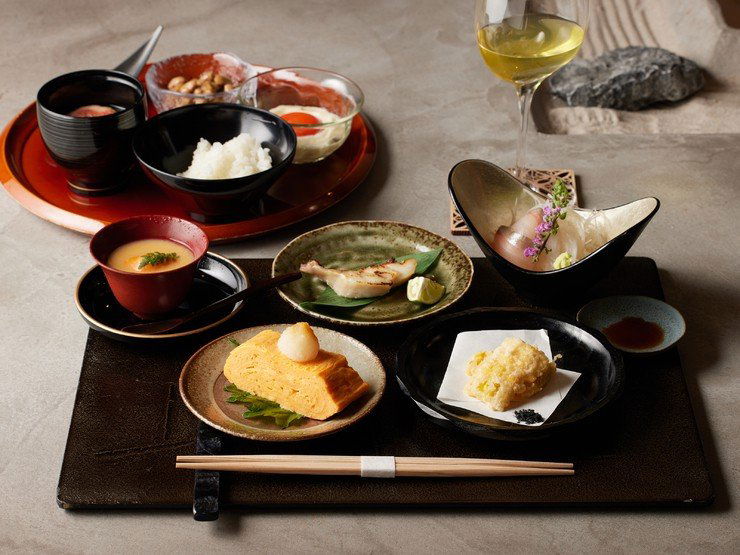
Chef Ugo Perret-Gallix was trained in French cooking before an apprenticeship at a Kyoto ryotei shifted his focus toward Japanese technique and food culture. That biographical arc is not just background colour — it is the literal structure of the meal. The prix fixe at KIBUN moves in two distinct halves: the first draws on Japanese culinary logic (including sushi preparations), the second pivots to French cuisine, with particular emphasis on saucing. The progression from Japanese to French is the format, not a loose inspiration.
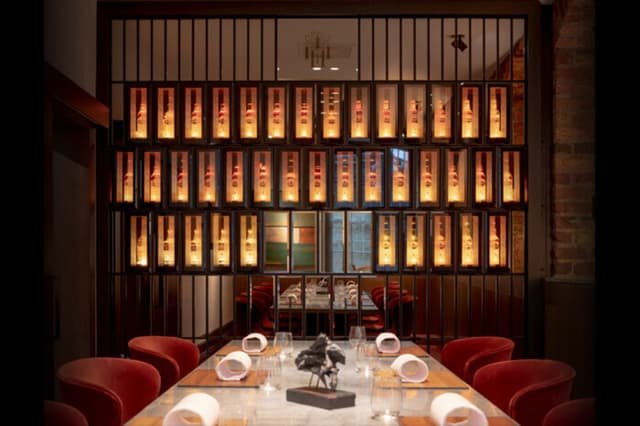
The room reinforces this dual register. The counter is blond hinoki wood, a material associated with Japanese craft and ceremony. Volcanic stone surfaces bring texture and weight. A single Hiroshi Sugimoto photograph anchors the space visually. The result is a compact, considered room that reads as Japanese in materiality and European in restraint. At ten seats, the atmosphere will be closer to a private dinner than a restaurant service, which is either the appeal or a dealbreaker depending on your tolerance for intimacy with strangers at a counter.
The sourcing logic behind the price
KIBUN is priced at ¥¥¥, which places it below the ¥¥¥¥ tier occupied by many of Tokyo's decorated counter restaurants. That positioning matters. The two-part menu structure, Japanese techniques applied to quality ingredients in the first half, French saucing discipline in the second, requires a kitchen that can source credibly across two culinary traditions simultaneously. The apprenticeship background at a Kyoto ryotei gives the Japanese half a verifiable grounding; Perret-Gallix's French training gives the sauce work a technical foundation. Where the sourcing choices land in practice is something only confirmed guest accounts can fully verify, but the structural logic of the menu demands dual-track quality.
For the food-focused traveller comparing value across Tokyo's contemporary counter scene, KIBUN at ¥¥¥ represents a lower financial commitment than most Michelin-starred peers while still delivering a format, prix fixe, counter service, chef-driven sequencing, that matches the experience architecture of more expensive rooms. If ingredient sourcing and technique are your primary criteria and you want a Franco-Japanese perspective rather than a purely Japanese one, this is the right price tier to be looking at.
When to go
The counter format and small seat count mean KIBUN will feel different depending on who fills the other nine seats on any given night. For the leading experience, book mid-week when the room is less likely to be dominated by a single group dynamic. Tokyo's fine dining season runs year-round, but spring (March to May) and autumn (October to November) bring the strongest seasonal produce to Japanese kitchens generally, worth factoring in if you are planning a trip around food. Because the menu's Japanese half draws on seasonal Japanese culinary logic, those windows may offer the most complete version of what KIBUN is trying to do.
Booking appears to be manageable relative to Tokyo's more heavily allocated counters. The small seat count does not automatically mean impossible to get, it means plan ahead by a few weeks rather than months. For context, securing a seat at KIBUN is considerably easier than booking Harutaka or RyuGin, both of which require significantly more lead time.
Who should book KIBUN
KIBUN is the right call if: you want a French-Japanese prix fixe at a price point below the top tier, you prefer a small counter format over a full dining room, and you are interested in a menu that takes both culinary traditions seriously rather than using one as flavouring for the other. It is not the right call if you want traditional kaiseki, direct sushi, or a large-group setting. For a purely French experience in a similar Nishiazabu neighbourhood bracket, HYÈNE and Crony are worth comparing. For a Japanese-first counter, hakunei is in the same general conversation. If you are building a broader Tokyo itinerary around serious eating, see our full Tokyo restaurants guide, and for context on how KIBUN sits within Japan's wider contemporary dining scene, HAJIME in Osaka and Gion Sasaki in Kyoto offer useful calibration points.
The 2025 Michelin Plate recognition signals quality without the reservation pressure that stars bring. That is a meaningful distinction in Tokyo, where the gap between a Plate and a Star often reflects the size of the operation more than the gap in cooking quality. At ten seats, KIBUN cannot absorb the volume that star recognition would generate, so the Plate status may actually be working in the diner's favour right now.
Quick reference
Location: 4 Chome-11-28 2F, Nishiazabu, Minato City, Tokyo. Price tier: ¥¥¥. Seats: 10 (counter). Format: prix fixe only. Recognition: Michelin Plate 2025. Booking difficulty: Easy to moderate, book 2-3 weeks ahead. Leading timing: mid-week; spring and autumn for seasonal produce.
Worth exploring nearby
If you are in Nishiazabu and want to extend the evening, nôl, FUSOU, and JULIA are all worth knowing about. For the full picture on where to stay, drink, and explore in the city, use our Tokyo hotels guide, our Tokyo bars guide, and our Tokyo experiences guide. Travellers connecting KIBUN to a broader Japan itinerary will find akordu in Nara, Goh in Fukuoka, 1000 in Yokohama, and 6 in Okinawa useful reference points across the country's contemporary dining tier. For international comparisons in the same contemporary counter format, César in New York City and Jungsik in Seoul share some structural DNA worth knowing before you go.
Planning details
- Location
- Japan, 〒106-0031 Tokyo, Minato City, Nishiazabu, 4 Chome−11−28 2F
- Reservations
- Book on Omakase
- Website
- kibuntokyo.com
- Phone
- +81 3-6433-5063
The take
The Take
The Vibe
KIBUN offers a quietly exacting dining room that favors restraint over spectacle. The second-floor, 10-seat counter is pared back — volcanic stone surfaces, a blond hinoki bar and a single Hiroshi Sugimoto photograph set a deliberately minimal stage. The atmosphere reads as intimate and controlled rather than boisterous; the neighbourhood’s preference for discretion is mirrored in the room’s scale and finish. Cooking at the counter functions as theatre, but everything else is calibrated to deflect attention to the meal itself. The result is a serene, minimalist space that signals an occasion the moment you step in.
Best For
This counter is built for meaningful meals and suits date nights, business dinners and small special occasions. The prix fixe is presented as a composed sequence — the first movement rooted in Japanese technique, the second pivoting to French technique — so the format rewards diners who want a focused, multi-course encounter. With only ten seats and an understated interior, KIBUN attracts a clientele that values discretion and craft; highlights such as bōzushi, hamo and ainame emerge as deliberate moments in a tightly edited progression.
Ordering Tips
Embrace the prix fixe: the meal is architected in two movements (Japanese then French), and the sequencing is integral to the experience. Take a counter seat if you want the theatrical aspect of the cooking; the 10-seat configuration makes the chef’s work central to the meal. Expect precise, technique-forward preparations rather than à la carte variety, and plan your visit with the venue’s limited seating in mind. Allow the progression to unfold — the menu is designed as a single, intentional narrative rather than a collection of standalone plates.
Venue details
Ambiance
Chic, calm hideaway with stylish, relaxing space featuring a lively counter and table seating in volcanic stone and hinoki wood.
Tags
Vibe
Best For
Experience
At the Table
- Dress Code
- Smart Casual
- Noise Level
- Conversational
- Service Style
- Upscale Casual
- Meal Pacing
- Leisurely
- Capacity
- Intimate
- Kitchen
- Modern
- Menu Format
- Tasting menu
- Wine Program
- Curated
- Drinks Focus
- Wine, Sake
Signature Dishes
- bōzushi
- hamo
- ainame
Know before you go
Know Before You Go
- Getting there
- Japan, 〒106-0031 Tokyo, Minato City, Nishiazabu, 4 Chome−11−28 2F
Planning details
Location
Japan, 〒106-0031 Tokyo, Minato City, Nishiazabu, 4 Chome−11−28 2F · Directions



Also consider
Also Consider
- Harutaka, Sushi, ¥¥¥¥
- L'Effervescence, French, ¥¥¥¥
- RyuGin, Kaiseki, Japanese, ¥¥¥¥
- HOMMAGE, Innovtive French, French, ¥¥¥¥
- Crony, Innovative, French, ¥¥¥¥
Restaurant context
KIBUN sits at ¥¥¥, which immediately separates it from most of its closest peers. L'Effervescence, HOMMAGE, and Crony all operate at ¥¥¥¥ and represent Tokyo's upper tier of French or innovative French dining. If a purely French experience is your goal and budget is not the deciding factor, HOMMAGE and L'Effervescence both carry stronger decorations and deeper wine programmes. KIBUN's case is different: it offers a dual-register meal at a lower price point, with the counter format and Michelin Plate giving it credibility at that tier. For travellers who want French technique without the full ¥¥¥¥ commitment, KIBUN is the more practical booking.
Against Harutaka and RyuGin, the comparison is less direct. Harutaka is a sushi counter at ¥¥¥¥ with a reputation for precise Edomae technique, if sushi is your primary interest, it will outperform KIBUN on specialisation. RyuGin operates kaiseki at ¥¥¥¥ and represents a very different kind of formality. Neither is trying to do what KIBUN does, which is move a single meal from Japanese culinary logic into French sauce-led cooking. The Franco-Japanese hybrid format is where KIBUN has no direct competition in this peer group.
On booking difficulty, KIBUN is the easiest room to get into here. Harutaka and RyuGin both require significant lead time and can be difficult for visitors without local contacts or booking services. KIBUN's 10-seat format sounds restrictive, but the lighter recognition profile means it is bookable weeks rather than months out. If you are planning a Tokyo trip with limited runway, KIBUN is the counter experience most likely to be available. For diners who want depth, dual culinary tradition, and a Michelin-recognised format without the booking friction of Tokyo's starred rooms, it is the practical first choice in this comparison set.
Explore Tokyo
Around this place
Discover more on Pearl
Unlock the full KIBUN guide in Pearl, including awards, comparisons, FAQs, planning details, and nearby places.
Compare KIBUN
| Venue | Cuisine | Price | Booking Difficulty | Awards |
|---|---|---|---|---|
| KIBUN | Contemporary | ¥¥¥ | Easy | Star Wine Lists 20262026 OAD Top Restaurants in Japan Recommended2026 Michelin 1 Star2025 Michelin Plate2025 The Best Chef One Knife2024 Michelin Plate |
| Harutaka | Sushi | ¥¥¥¥ | Unknown | 2026 Tabelog Silver · #312026 OAD Top Restaurants in Japan Ranked · #1282026 Michelin 3 Stars2026 La Liste Top RestaurantsTabelog 100 - Sushi - TOKYO - 2025 · #372025 Asia's 50 Best Restaurants · #762025 OAD Top Restaurants in Japan Ranked · #1172025 La Liste Top Restaurants2025 Tabelog Bronze |
| L'Effervescence | French | ¥¥¥¥ | Unknown | 2026 Tabelog Silver · #682026 OAD Top Restaurants in Japan Ranked · #103Star Wine Lists 20262026 Black Pearl 2 Diamond2026 Relais Chateaux Restaurants2026 La Liste Top Restaurants2026 Michelin 3 Stars2025 Asia's 50 Best Restaurants · #692025 OAD Top Restaurants in Japan Ranked · #92 |
| RyuGin | Kaiseki, Japanese | ¥¥¥¥ | Unknown | 2026 OAD Top Restaurants in Japan Ranked · #802026 Tabelog Bronze · #3772026 Michelin 3 Stars2026 La Liste Top RestaurantsTabelog 100 - Japanese cuisine - TOKYO - 2025 · #212025 OAD Top Restaurants in Japan Ranked · #542025 Michelin 3 Stars2025 La Liste Top Restaurants2025 The Best Chef Three Knives |
| HOMMAGE | Innovtive French, French | ¥¥¥¥ | Unknown | 2026 Tabelog Bronze · #1232026 OAD Top Restaurants in Japan Highly Recommended2026 Michelin 2 StarsTabelog 100 - French - TOKYO - 2025 · #762025 Asia's 50 Best Restaurants · #782025 OAD Top Restaurants in Japan Ranked · #1752025 Michelin 2 Stars2025 The Best Chef One Knife2025 La Liste Top Restaurants |
| Crony | Innovative, French | ¥¥¥¥ | Unknown | 2026 Asia's 50 Best Restaurants · #34Star Wine Lists 20262026 OAD Top Restaurants in Japan Recommended2026 Michelin 2 Stars2025 Asia's 50 Best Restaurants · #30Tabelog 100 - French - TOKYO - 2025 · #782025 OAD Top Restaurants in Japan Ranked · #227We're Smart World Top Restaurants 20252025 Michelin 2 Stars |
.png?width=1200&quality=80)











A quick look at how KIBUN measures up.
FAQ
Frequently Asked Questions
Is the tasting menu worth it at KIBUN?
Yes, at the ¥¥¥ tier it offers a clear point of difference: a prix fixe that moves deliberately from Japanese technique to French cuisine in a single sitting across 10 seats. Chef Ugo Perret-Gallix trained in France and apprenticed at a Kyoto ryotei, so the format reflects a real culinary arc rather than a superficial East-meets-West conceit. If you want that specific experience at a price point below Tokyo's ¥¥¥¥ decorated counters, it holds up. If you are after a straightforward omakase or a strictly French tasting, KIBUN is not the right fit.
What should I order at KIBUN?
KIBUN operates a prix fixe only format, so there is no à la carte ordering. The menu follows a fixed arc: Japanese-inspired courses first, including sushi roll, then a pivot to French cuisine with an emphasis on classical sauces. You eat what the chef serves that evening, which means the decision is whether to book, not what to order.
What should I wear to KIBUN?
The venue data does not specify a dress code, but the setting gives useful context: a 10-seat counter in a former Nishiazabu wine bar, with a hinoki wood counter and a Hiroshi Sugimoto photograph on the wall. The room signals considered, low-key refinement rather than formal ceremony. Neat, understated clothing is a reasonable read; overly casual dress would feel out of place at a ¥¥¥ prix fixe counter of this kind.
What are alternatives to KIBUN in Tokyo?
For French-leaning fine dining in Tokyo, L'Effervescence operates at a higher tier with stronger award recognition and a more overtly seasonal French framework. HOMMAGE is a closer price-tier alternative with a French-Japanese sensibility. If your priority is a pure Japanese counter experience, Harutaka at the sushi end or RyuGin for kaiseki both represent established options at the top of their respective formats. Crony offers a more casual counter format for those who want the intimacy without the prix fixe commitment.
Is KIBUN worth the price?
At ¥¥¥, KIBUN sits below Tokyo's most decorated counter restaurants and carries a Michelin Plate for 2025, which signals quality without the premium attached to starred venues. The value case is strongest if the French-into-Japanese format is specifically what you are after: you are paying for a 10-seat counter, an original culinary structure, and a chef with real credentials in both traditions. If price-to-prestige ratio is your primary metric, there are starred options in Tokyo at comparable or marginally higher spend.
Is KIBUN good for a special occasion?
Yes, with one caveat: the 10-seat counter means the atmosphere on any given night depends heavily on who else is in the room, which is worth factoring into your expectations. The physical setting, a reworked former wine bar with volcanic stone and a single Hiroshi Sugimoto photograph, is considered and intimate. For a two-person occasion where an unconventional French-Japanese prix fixe matters more than a grand dining room, KIBUN works well. For larger groups or events requiring a private dining space, this is not the venue.