.png?width=1200&quality=80)
Go La
Small eats · Mueang Phuket, Phuket
Restaurant in Phuket, Thailand
 Book with Pearl
The Read
Charcoal-Wok Hokkien
Price
฿
Dress
Smart Casual
Why go
Go La is a third-generation Hokkien noodle kitchen in Phuket's Talat Yai district, holding consecutive Michelin Plate awards for 2024 and 2025. At ฿ pricing with walk-in access, it is one of the clearest value decisions in Old Town Phuket. Order the yellow noodles with extra egg, arrive at lunch, and keep expectations calibrated to charcoal street food rather than sit-down dining.
About Go La
Verdict
Go La is one of the most direct decisions you can make in Phuket's Old Town eating scene: a third-generation family operation serving Hokkien-style fried noodles at single-baht price points, with back-to-back Michelin Plate recognition in 2024 and 2025 to confirm the quality. If you are in the Talat Yai area and want a bowl of yellow noodles cooked over charcoal with decades of muscle memory behind it, book this — or more accurately, just show up. Booking difficulty is easy, prices are minimal, and the charcoal wok smell will guide you in.
About Go La
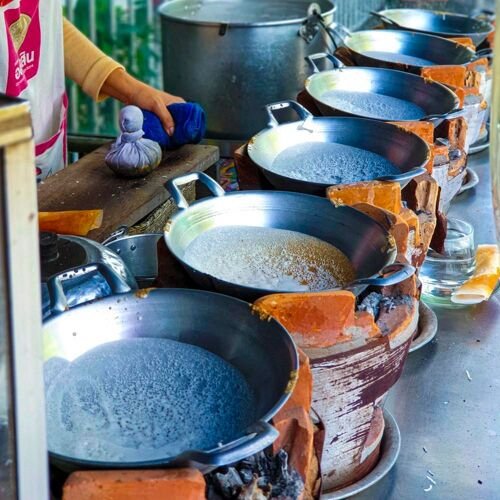
Go La sits on Kra Road in the heart of Phuket's Talat Yai district, the same neighbourhood grid that houses much of the island's surviving Peranakan and Hokkien food culture. The operation has passed through three generations of the same family, and that continuity matters here: the noodle technique, the wok temperature, the balance of pork fat and egg — these are not things you develop on a two-year lease. The charcoal setup is the detail that separates Go La from the gas-fired competition. Charcoal burns hotter and more unevenly than gas, which means the cook has to read the fire constantly. The result is a deeper, smoke-edged wok hei that you will not get from a gridded commercial burner.
The sounds of the wok, the hiss, the scrape of the spatula, the rolling smoke, are part of the experience. If atmosphere and ambiance matter to you when you eat, this is the version of a street-food kitchen that actually delivers on that. It is not curated or designed. It is functional, loud in the way that charcoal cooking is always loud, and honest about what it is. For a special occasion framed around food culture rather than fine dining, that authenticity carries real weight.
The headline order is yellow Hokkien noodles, and the standing recommendation from the venue itself is to request an extra egg for a creamier texture. That is worth following. Hokkien noodles at this price tier often come either too dry or too oily; the egg addition balances the fat distribution and makes the dish significantly more cohesive. Beyond that, the menu sits in the small-eats category, so expect a tight, focused range rather than a sprawling selection.
Lunch vs Dinner: When to Go
This is the question that most affects your visit. Go La operates in the Old Town street-food tradition, which means opening hours and peak timing are tied to local rhythms rather than tourist schedules. No hours are listed in available data, so arriving early, late morning through early afternoon, is the lower-risk move. Thai street-food operations of this type typically peak at lunch, when the wok is already hot and the cook is in full flow. Noodle quality at charcoal joints like this is often leading mid-session, when the wok has reached a stable temperature and the pace is fast enough to keep the cooking tight.
If you are aiming for a dinner visit, confirm hours directly before going, the venue is at เลขที่ 11 Kra Road, Mueang Phuket. Evening sessions at Hokkien street operations in this part of Thailand can be shorter or sell out of key ingredients, particularly egg-heavy dishes. For most visitors, a lunch visit is the more reliable choice and frankly the better fit for a Michelin Plate-recognised street spot: arrive hungry, order the noodles with extra egg, and eat standing or at a shared table. The experience is not designed for a long sit.
For travellers working through the Old Town food circuit, Go La pairs well with a broader morning or afternoon crawl. Loba Bang Niao and Roti Thaew Nam are both in the same neighbourhood and operate in a similar street-food register, while Roti Chaofa and A Pong Mae Sunee extend the small-eats circuit further. None of these require advance booking, and all sit at the ฿ price tier.
Is It Worth It for a Special Occasion?
Yes, with the right framing. Go La is not a celebration dinner in the white-tablecloth sense, there is no wine list, no private room, no dress code. But if your idea of a special occasion includes eating something genuinely rare (third-generation charcoal Hokkien noodles with consecutive Michelin recognition in a city increasingly dominated by resort restaurants), then Go La qualifies. It is the kind of place you bring someone who cares about food provenance and technique over presentation. Bring someone expecting tableside service and it will disappoint. Bring someone who gets excited about a wok that has been seasoned over decades and it will land exactly right.
Solo diners will find it completely comfortable. Counter or shared-table formats are natural for this category, the price makes over-ordering risk-free, and the single-dish focus means there is no decision fatigue. For groups, the practical limitation is the small-eats format, dishes come quickly and individually rather than as a shared spread, so larger parties should go in with realistic expectations about the pace and portion logic.
Know Before You Go
- Address: เลขที่ 11 Kra Road, Tambon Talat Yai, Mueang Phuket District, Phuket 83000
- Price range: ฿ (budget; one of Phuket's most affordable Michelin-recognised venues)
- Booking difficulty: Easy, walk-in friendly
- Awards: Michelin Plate 2024 and 2025
- Ideal time to visit: Lunch or mid-morning; confirm evening hours locally before visiting
- What to order: Yellow Hokkien noodles, ask for an extra egg for a creamier result
- Dress code: No code; casual street-food dress is standard
- Phone/website: Not publicly listed, visit directly or ask your hotel concierge
Pearl Picks: More Phuket and Beyond
- PRU, For a full fine-dining counter experience at the other end of the price spectrum in Phuket
- Loba Bang Niao, Old Town street food in the same neighbourhood
- Roti Thaew Nam, Phuket's celebrated roti, a short walk from Go La
- A Pong Mae Sunee, More Old Town small eats worth adding to the same circuit
- Sorn in Bangkok, Southern Thai cooking at the highest end, for context on the cuisine tradition
- Anuwat in Phang Nga, Regional cooking a short drive from Phuket
- A Cun Beef Soup in Tainan, For comparison: small-eats heritage dining in a different regional tradition
- A Hai Taiwanese Oden in Tainan, Another Michelin-recognised small-eats counter worth knowing
- Our full Phuket restaurants guide
- Our full Phuket hotels guide
- Our full Phuket bars guide
- Our full Phuket experiences guide
Frequently Asked Questions
Is Go La worth the price?
- At ฿ pricing, Go La carries essentially no financial risk. Two consecutive Michelin Plate awards at this price point make it one of the strongest value propositions in Phuket's food scene. The question is not whether it is worth it financially, it is, but whether the format (quick, standing, charcoal noodles) matches what you want from a meal. If it does, it over-delivers at the price.
Is Go La good for a special occasion?
- Go La works as a special occasion if the occasion is food-focused rather than service-focused. Third-generation charcoal Hokkien noodles with Michelin recognition in the ฿ tier is a genuinely rare combination. For a birthday dinner with tableside service and wine, it is the wrong venue. For a food-lover's Old Town crawl or a meaningful lunch with someone who appreciates craft over ceremony, it is an excellent choice.
Is Go La good for solo dining?
- Yes, without qualification. The small-eats format, counter or shared-table seating, and single-dish focus make Go La a natural solo destination. Prices are low enough that ordering two rounds to compare is practical, and there is no social awkwardness in the format. Solo diners who want Michelin-recognised food on a street-food budget will find Go La direct and rewarding.
Can Go La accommodate groups?
- Small groups of two to four will manage fine. For larger parties, the small-eats format means dishes come individually rather than as a shared spread, and seating is not designed for long group sessions. If you are bringing six or more, Go La is better treated as one stop on a broader Old Town circuit than as the main group dining event. Pair it with Loba Bang Niao or Roti Chaofa to build a fuller group food walk.
What should I wear to Go La?
- No dress code applies. This is a street-food kitchen in Phuket's Old Town, casual clothes are standard and expected. Light, breathable clothing is practical given the charcoal heat and open-kitchen environment. There is no formal dining room and no expectation of anything beyond clean, comfortable dress.
Planning details
- Location
- เลขที่ 11 Kra Rd, Tambon Talat Yai, Mueang Phuket District, Phuket 83000, Thailand
- Website
- guide.michelin.com/th/th/phuket-region/phuket/restaurant/go-la
- Phone
- +66 76 630 409
The take
The Take
The Vibe
Go La reads like a working piece of old-town Phuket rather than a designed dining destination. Charcoal smoke and the staccato percussion of a wok set the tonal register before you step in; the cookline faces the street and diners sit around the station, so the food’s production is part of the experience. That directness, combined with three generations of family practice, keeps the place grounded and unpretentious. The setting feels intimate and historic — less about staging and more about sustained technique — making it an authentic spot for anyone interested in regional Hokkien noodle craft.
Best For
This is a place for people who want to eat close to the action and prioritize technique over presentation. Solo diners and small, informal parties benefit most from the counter arrangement, where the rhythm of wok cooking is as much the attraction as the plate. It’s ideal for casual hangouts and for visitors who want to experience a lineage of Hokkien-style cooking handed down across generations. Avoid expecting a formal dinner setting; instead come ready to watch, listen, and taste a regional specialty executed with long-cultivated precision.
Ordering Tips
Order the yellow Hokkien noodles — the description highlights the thick wheat noodles fried over intense heat with egg and a sauce of dark soy and stock, a signature the family has refined across generations. Position yourself close to the cooking station so you can watch the wok and time your arrival with peak activity; the charcoal-fired technique and high-BTU heat are central to the dish’s flavor. Given the hawker-style setup, pick items that showcase the wok work and keep expectations practical: this is about texture, smoke and seasoning rather than elaborate plating.
Venue details
Ambiance
Casual small shop atmosphere filled with the sounds of the wok and charcoal aromas.
Tags
Vibe
Best For
At the Table
- Dress Code
- Smart Casual
- Noise Level
- Conversational
- Service Style
- Casual
- Meal Pacing
- Quick Bite
- Capacity
- Intimate
Signature Dishes
yellow hokkien noodles
Know before you go
Know Before You Go
- Getting there
- เลขที่ 11 Kra Rd, Tambon Talat Yai, Mueang Phuket District, Phuket 83000, Thailand
Planning details
Location
เลขที่ 11 Kra Rd, Tambon Talat Yai, Mueang Phuket District, Phuket 83000, Thailand · Directions
guide.michelin.com/th/th/phuket-region/phuket/restaurant/go-la
Recognition and awards
Also consider
Also Consider
- PRU, Thai, Modern Cuisine, ฿฿฿฿
- Blue Elephant, Thai, ฿฿฿
- Acqua, Italian, ฿฿฿฿
- Baan Rim Pa Patong, Thai, Thai
- Chuan Chim, Thai, ฿฿
Restaurant context
Go La operates at a completely different price tier and format than most of Phuket's award-recognised restaurants, which makes direct comparison more about decision logic than direct competition. If you are deciding between Go La and PRU (฿฿฿฿, modern Thai, farm-to-table tasting menu), the choice is not which is better, it is which format you want. PRU requires advance booking, a significant budget, and a full evening. Go La requires none of those things. They sit at opposite ends of the spectrum and are worth experiencing on the same trip if your schedule allows.
Blue Elephant (฿฿฿) and Baan Rim Pa Patong both offer Thai dining in more formal, atmosphere-forward settings with full service. Neither operates at the charcoal street-food register. If you want a sit-down Thai dinner with a longer menu and table service, those are the right picks. If you want Michelin-recognised cooking at a fraction of the price with no booking required, Go La wins outright. Chuan Chim (฿฿) is the closest peer in price positioning, operating in a similar affordable Thai format, and is worth knowing as an alternative if Go La is closed or sold out on a given day.
Acqua (฿฿฿฿, Italian) is a different cuisine category entirely and targets a resort-dining audience. It is not a relevant comparison for Go La's Hokkien noodle format. For travellers building a broader Phuket food itinerary, the practical recommendation is: use Go La and the Old Town street-food circuit for daytime eating, then allocate PRU or Blue Elephant for an evening session if budget allows. That combination covers the full range of what Phuket's recognised dining scene offers.
Explore Phuket
Around this place
Discover more on Pearl
Unlock the full Go La guide in Pearl, including awards, comparisons, FAQs, planning details, and nearby places.
Compare Go La
| Venue | Location | Cuisine | Awards | Price |
|---|---|---|---|---|
| Go La | Phuket | Small eats | 2026 Michelin Plate2025 Michelin Plate2024 Michelin Plate | ฿ |
| PRU | Phuket | Thai, Modern Cuisine | 2026 OAD Top Restaurants in Asia Highly Recommended2026 Wine Spectator Award of Excellence2026 Michelin 1 Star2025 OAD Top Restaurants in Asia Ranked · #144World's Best Wine Lists 2025We're Smart World Top Restaurants 20252025 Wine Spectator Award of Excellence2025 Michelin 1 Star2024 OAD Top Restaurants in Asia Ranked · #130 | ฿฿฿฿ |
| Blue Elephant | Phuket | Thai | 2025 Michelin Plate2024 OAD Top Restaurants in Asia Ranked · #4172024 Michelin Plate2023 OAD Top Restaurants in Asia Recommended | ฿฿฿ |
| Acqua | Phuket | Italian | Star Wine Lists 20262026 Wine Spectator Best of Award of Excellence2026 Michelin Plate2026 La Liste Top Restaurants2025 La Liste Top Restaurants2025 The Best Chef Two Knives2025 Michelin Plate2024 Michelin Plate | ฿฿฿฿ |
| Baan Rim Pa Patong | Phuket | Thai | No published awards | , |
| Chuan Chim | Phuket | Thai | 2026 Bib Gourmand2025 Michelin Bib Gourmand2024 Michelin Bib Gourmand | ฿฿ |









.png?width=1200&quality=80)

How Go La Phuket compares with similar nearby venues.
FAQ
Frequently Asked Questions
Can Go La accommodate groups?
Small groups of two to four should be fine for a casual stop, but Go La is a street-food operation on Kra Road, not a bookable restaurant. Larger groups will find the logistics harder — seating is limited and there's no evidence of reservations or private arrangements. If you're organising a group meal that needs a guaranteed table, Blue Elephant or Baan Rim Pa Patong offer structured group dining in Phuket.
Is Go La good for a special occasion?
Only if your version of a special occasion includes plastic stools and wok smoke — which, honestly, can be the right call. Go La is a third-generation family operation with Michelin recognition, so bringing someone here to share a bowl that's outlasted most restaurants in Phuket has its own meaning. For a formal celebration with wine and a set menu, look at Baan Rim Pa Patong or PRU instead. Go La is the move when the occasion is about eating well, not dressing up.
Is Go La good for solo dining?
Yes — this is probably the format Go La suits best. Street-food counters and hawker-style setups like this are built for solo diners: you order, you eat, you leave without waiting on a group. The Hokkien noodles are a single-bowl proposition, so there's no pressure to share or over-order. At ฿ per head, the financial commitment is minimal if you're working through Old Town on foot.
Is Go La worth the price?
At ฿ per head, Go La is one of the lowest-risk meals you can eat in Phuket. Michelin awarded it a Plate in both 2024 and 2025, which confirms the cooking is consistent and worth seeking out. For the price bracket, nothing in Phuket's Old Town competes on the same combination of pedigree and cost. Order the yellow Hokkien noodles with an extra egg for the version the venue itself recommends.
What should I wear to Go La?
Whatever you'd wear walking around Phuket's Old Town in the heat. Go La is a casual street-food spot — there's no dress code, no air-conditioned dining room to dress for. Light, comfortable clothing is the practical call. Save the smarter outfit for somewhere that requires it.