.png?width=1200&quality=80)
Antica Osteria Moirago
Italian Contemporary · Zibido San Giacomo, Moirago
Restaurant in Moirago, Italy
 Book with Pearl
The Read
North-South Seasonal Divide
Price
$50–100per person
Dress
Smart Casual
Why go
A Michelin Guide-selected osteria inside a monastery that has been welcoming guests since 1478, Antica Osteria Moirago delivers serious seasonal Italian cooking at a €€ price point that makes the drive south from Milan genuinely worthwhile. The kitchen shifts between Puglian-influenced vegetable and raw fish dishes in summer and richer northern Italian cooking in winter. Booking is easy and the setting — canal views, painted portico, old dining rooms — does real work.
About Antica Osteria Moirago
The Verdict
If you have already visited Antica Osteria Moirago once, you already know the answer: come back. What changes between visits is less about reinvention and more about season. The kitchen shifts its weight from raw fish and vegetable-forward plates in warmer months toward richer, northern Italian cooking in winter, which means the restaurant earns a second booking on culinary grounds alone. For a first-timer, this is one of the more compelling stops in the broader Milan day-trip orbit: a Michelin Plate-recognised restaurant inside a building that has been welcoming guests since 1478, priced at €€ and easy to book. That combination is harder to find than it sounds.
A Building That Has Been Doing This for 775 Years
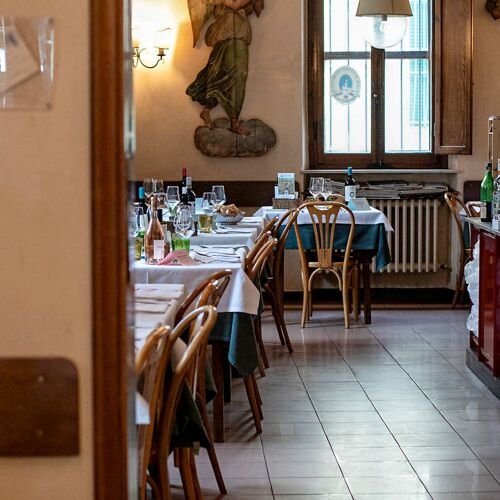
The monastery at Moirago was founded in 1250. It was converted into an inn in 1478, making Antica Osteria Moirago one of the oldest continuously hospitable buildings in Lombardy. That anniversary framing matters here because it shapes what the space actually delivers: not a renovated ruin dressed up in period detail, but a working dining room that has had centuries to settle into itself. The enclosed painted portico and the two interior dining rooms carry the kind of spatial calm that cannot be manufactured. Low ceilings, old walls, and a scale that keeps tables at a human distance from one another — this is a room where conversation carries without effort, and where the physical surroundings do genuine work as part of the meal.
For the explorer who travels to eat with full attention, the setting here is an argument in itself. The Naviglio Pavese canal runs past the building, connecting this stretch of the Milanese hinterland to the city's broader canal network. Moirago sits within the municipality of Zibido San Giacomo, south of Milan, and the drive or train trip out functions as a proper gear-change from the city. This is not a Milan restaurant. It is a Moirago restaurant, and that distinction matters to how you should plan the evening. Build time around arrival. The place rewards not rushing.
What the Kitchen Is Actually Doing
The chef's Puglian origins are the key to reading the menu correctly. Southern Italian cooking places vegetables at the centre rather than the margin, and raw fish preparations appear with a frequency that northern Italian kitchens would not typically sustain. This gives the warm-weather menu a lighter, more produce-focused character than the address — a medieval monastery in the Po plain, might suggest. Come winter, the kitchen pivots toward the north: braised preparations, richer sauces, and the heavier grain of cold-weather Lombard cooking. The result is a restaurant that is meaningfully different depending on when you visit, which is the honest case for a return trip rather than a marketing one.
The wine list includes a good selection by the glass, which matters at the €€ price point. You can work through several pours across a meal without the bill scaling uncomfortably, and the by-the-glass range gives a solo diner or a two-leading with different preferences genuine flexibility. No specific bottles are listed in the available data, so arrive with curiosity rather than a pre-researched order.
Who This Is For
Antica Osteria Moirago works well for diners who want a full sense of place alongside their meal. The building, the canal setting, the seasonal kitchen logic, these are the actual reasons to make the trip from Milan rather than staying in the city. If you are after a purely technical dining experience or a long tasting menu format, the €€ price range and the osteria format suggest a different register. This is serious cooking in an atmosphere that does not perform seriousness. That is a specific thing, and it suits a specific appetite.
Groups of two to four will find the dining rooms comfortable. The space is atmospheric rather than vast, so large parties should enquire ahead about configuration. There is no published dress code in the available data, but the medieval setting and the Michelin Plate recognition together suggest smart-casual is the appropriate register, neither a suit nor a football shirt.
Booking and Logistics
Booking is rated easy. No published phone number or website is available in Pearl's current data, so the most reliable route is to search directly for the venue by name to locate current contact details. Given the €€ price point and Michelin Plate status, this is not a venue that will be impossible to get into on reasonable notice, but a midweek or off-peak booking gives the most flexibility. The address is Via Pavese, 4, Zibido San Giacomo, which places it south of Milan with access via the SP494 road corridor. Driving is the practical choice; confirm current public transport options before relying on them.
It means the kitchen performs reliably across a spread of visits and a wide range of diners, not just on the nights when everything goes perfectly.
For broader context on what else the area offers, see our full Moirago restaurants guide, our full Moirago hotels guide, our full Moirago bars guide, our full Moirago wineries guide, and our full Moirago experiences guide. For Italian Contemporary cooking at a higher price point and with more destination-dining infrastructure, Enrico Bartolini in Milan is the most direct city-based comparison. Further afield, Uliassi in Senigallia, Piazza Duomo in Alba, and Le Calandre in Rubano represent the broader Italian Contemporary category at higher investment levels. For seasonal Italian cooking in similarly characterful settings, Casa Perbellini 12 Apostoli in Verona and Agli Amici Rovinj in Rovinj are worth considering on a wider itinerary. If the Puglian-inflected approach to vegetables and raw fish interests you, L'Olivo in Anacapri handles southern Italian produce in a comparably attentive way, albeit in a very different setting. Enoteca Pinchiorri in Florence is the reference point if wine depth across the full list is as important to you as the food.
Quick Reference
Price: €€. Booking: easy. Address: Via Pavese 4, Zibido San Giacomo (south of Milan). Setting: 13th-century monastery, enclosed portico, two dining rooms. Kitchen: Italian Contemporary with Puglian roots; seasonal shift from lighter/vegetable-forward (summer) to richer northern Italian (winter). Wine by the glass available.
Planning details
- Location
- Via Pavese, 4, 20058 Zibido San Giacomo MI, Italy
- Website
- anticaosteriamoirago.it
- Phone
- +39 02 9000 2174
The take
The Take
The Vibe
Antica Osteria Moirago reads as an old-world, quietly assured place. The building’s lineage — standing on the Naviglio Pavese since 1250 and later serving as an inn — lends genuine historic weight, and the enclosed painted portico and aged walls feel accumulated rather than staged. Two modest dining rooms keep the scale intimate and the focus squarely on the food; lighting and low warmth create a serious, contemplative atmosphere. The setting along the canal and the absence of tourist foot traffic make the osteria feel secluded and quietly charming, a place built on lineage and steady hospitality rather than flash.
Best For
This is primarily an evening restaurant for diners who prize serious cooking over neighborhood spectacle. It suits date nights, business dinners and special occasions where a measured, atmospheric table is preferable to a buzzy scene. The kitchen’s regional tensions — a Puglian leaning toward vegetables and crudo seafood — produce consistently cooked plates that draw the room. Signature items such as the crudité di pesce and risotto con asparagi e cappesante articulate the restaurant’s strengths, and the quiet canal-side location helps meals feel unhurried and deliberate.
Ordering Tips
Book ahead: the copy notes that the dining room fills because the kitchen earns it, so reservations are advisable. Focus your order on the kitchen’s specialties and the season: raw fish preparations feature frequently alongside vegetable-forward dishes reflecting the chef’s Puglian background. Standouts to try include the crudité di pesce and the risotto con asparagi e cappesante, with the millefeuille for a classic finish. Expect a menu that shifts with seasonality rather than tourist-driven trends; approaching the meal with an appetite for seafood and vegetables rewards best.
Venue details
Ambiance
Warm and atmospheric dining rooms in a painted portico, described as romantic, comfortable, familiar, and elegant by guests.
Tags
Vibe
Best For
Experience
View
Accessibility
At the Table
- Dress Code
- Smart Casual
- Noise Level
- Conversational
- Service Style
- Upscale Casual
- Meal Pacing
- Leisurely
- Capacity
- Medium
- Kitchen
- Traditional
- Menu Format
- A la carte
- Wine Program
- Curated
- Dietary
- Vegetarian friendly, Gluten-free options
- Private Dining
- Available
- Outdoor Seating
- Yes
Signature Dishes
- crudité di pesce
- risotto con asparagi e cappesante
- millefeuille
Know before you go
Know Before You Go
- Getting there
- Via Pavese, 4, 20058 Zibido San Giacomo MI, Italy
Planning details
Location
Via Pavese, 4, 20058 Zibido San Giacomo MI, Italy · Directions
Recognition and awards
Also consider
Also Consider
- Atelier Moessmer Norbert Niederkofler, Italian, Creative, €€€€
- Dal Pescatore, Italian, Italian Contemporary, €€€€
- Osteria Francescana, Progressive Italian, Creative, €€€€
- Quattro Passi, Italian, Mediterranean Cuisine, €€€€
- Reale, Progressive Italian, Modern Cuisine, €€€€
Restaurant context
Against the comparison set here, Antica Osteria Moirago occupies a completely different tier by design. Atelier Moessmer Norbert Niederkofler, Dal Pescatore, Osteria Francescana, Quattro Passi, and Reale are all €€€€ operations with multi-star Michelin recognition and the booking difficulty, ceremony, and financial commitment that come with that territory. Antica Osteria Moirago is €€, Michelin Plate, easy to book, and built around a casual osteria format. These are not competing restaurants. They are answers to different questions.
If your question is where to eat the best Italian Contemporary cooking in Italy at any price, the €€€€ set above is the relevant comparison pool. Dal Pescatore in Runate is the standard for multi-generational Italian hospitality at the highest level. Osteria Francescana in Modena is the reference for creative progressive cooking. Atelier Moessmer Norbert Niederkofler in Brunico represents a more ingredient-driven, mountain-context interpretation of the same broad category. None of these is a substitute for Moirago, and Moirago is not a budget version of any of them.
The practical case for Antica Osteria Moirago over its higher-priced peers is this: if you are already in Milan and want a full-evening meal in a setting with genuine historical weight, at a price that does not require planning around, with a kitchen that has earned Michelin recognition two years running, this is the booking to make. The €€€€ restaurants above all require more lead time, more financial commitment, and in most cases more travel. For the Milan-based visitor with one free evening and an appetite for a place that has been at this since 1478, Antica Osteria Moirago is the more practical answer.
Explore Moirago
Around this place
Discover more on Pearl
Unlock the full Antica Osteria Moirago guide in Pearl, including awards, comparisons, FAQs, planning details, and nearby places.
Compare Antica Osteria Moirago
| Venue | Cuisine | Price | Booking Difficulty | Awards |
|---|---|---|---|---|
| Antica Osteria Moirago | Italian Contemporary | €€ | Easy | 2026 Michelin Plate2025 Michelin Plate2024 Michelin Plate |
| Atelier Moessmer Norbert Niederkofler | Italian, Creative | €€€€ | Unknown | 2026 OAD Top Restaurants in Europe Ranked · #92026 Falstaff Restaurant Guide2026 Les Grandes Tables du Monde Members2026 Michelin 3 Stars2026 La Liste Top Restaurants2025 World's 50 Best Restaurants · #202025 OAD Top Restaurants in Europe Ranked · #362025 The Best Chef Three Knives2025 Michelin 3 Stars |
| Dal Pescatore | Italian, Italian Contemporary | €€€€ | Unknown | 2026 OAD Classical in Europe Ranked · #172026 Relais Chateaux Restaurants2026 Les Grandes Tables du Monde Members2026 La Liste Top Restaurants2026 Michelin 3 Stars2026 Falstaff Restaurant Guide2025 OAD Classical in Europe Ranked · #162025 Michelin 3 Stars2025 Relais Chateaux Award |
| Osteria Francescana | Progressive Italian, Creative | €€€€ | Unknown | 2026 OAD Top Restaurants in Europe Ranked · #212026 La Liste Top Restaurants2026 Les Grandes Tables du Monde Members2026 Michelin 3 Stars2026 Falstaff Restaurant Guide2025 OAD Top Restaurants in Europe Ranked · #27Chef's Table Featured Restaurants · 20252025 Michelin 3 Stars2025 The Best Chef Three Knives |
| Quattro Passi | Italian, Mediterranean Cuisine | €€€€ | Unknown | 2026 OAD Top Restaurants in Europe Ranked · #972026 Les Grandes Tables du Monde Members2026 La Liste Top Restaurants2026 Michelin 3 Stars2026 Falstaff Restaurant Guide2025 OAD Classical in Europe Ranked · #522025 La Liste Top Restaurants2025 Michelin 3 Stars2024 OAD Classical in Europe Ranked · #116 |
| Reale | Progressive Italian, Modern Cuisine | €€€€ | Unknown | 2026 OAD Top Restaurants in Europe Ranked · #222026 Les Grandes Tables du Monde Members2026 La Liste Top Restaurants2026 Michelin 3 Stars2026 Falstaff Restaurant Guide2025 World's 50 Best Restaurants · #182025 OAD Top Restaurants in Europe Ranked · #25We're Smart World Top 100 2025We're Smart World Top Restaurants 2025 |











Comparing your options in Moirago for this tier.
FAQ
Frequently Asked Questions
Is Antica Osteria Moirago worth the price?
At €€, this is one of the more straightforward yes answers in the greater Milan area. A Michelin Plate in 2024 and 2025 confirms the kitchen is doing something worth noticing, and the setting — a monastery founded in 1250, converted to an inn in 1478 — adds context no purpose-built restaurant can replicate. For comparable spend closer to Milan's centre, you get neither the history nor the canal-side atmosphere.
What should I order at Antica Osteria Moirago?
Pearl's data does not include specific menu items, so ordering advice here would be invention. What the database does confirm: the chef's Puglian origins shape a menu where vegetables and raw fish feature prominently in warmer months, while winter shifts the kitchen toward heartier northern Italian cooking. Ask the staff what arrived most recently — in a kitchen this seasonally driven, that question will get you somewhere.
What should I wear to Antica Osteria Moirago?
No dress code is specified in Pearl's data, but the setting — a painted portico in a 13th-century monastery with two formal dining rooms — suggests the kind of place where turning up in shorts would feel off. Neat, put-together clothing fits the atmosphere without requiring a jacket. When in doubt, err toward the more presentable option given the Michelin recognition and the nature of the space.
What are alternatives to Antica Osteria Moirago in Moirago?
Moirago has no direct competitor at this level. If you are willing to extend the radius, Dal Pescatore in Canneto sull'Oglio is the obvious step up for a special-occasion splurge in the Lombardy region, though it operates at a significantly higher price point. For canal-side dining in the broader Milan area, options thin out quickly, which is part of what makes Antica Osteria Moirago worth the trip from the city.
Is Antica Osteria Moirago good for a special occasion?
Yes, particularly if the occasion benefits from a setting with genuine history behind it. A monastery dating to 1250, a Michelin Plate kitchen, an enclosed painted portico, and €€ pricing make this a rare combination — meaningful atmosphere without the bill that usually comes with it. It suits couples and small groups better than large parties, and a winter visit adds the northern Italian dishes to the mix, which shifts the menu toward something richer and more occasion-appropriate.