
Restaurant in Tokyo, Japan
BON CHEMIN
290Pearl PointsSerious French technique, approachable price point.
.png?width=144&height=144&quality=80)
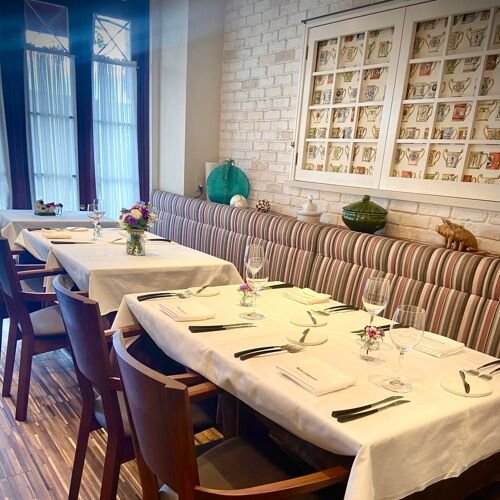
About BON CHEMIN
BON CHEMIN is a Michelin Plate-recognised French restaurant in Meguro, Tokyo, cooking classical Escoffier-based dishes with Japanese ingredients at the ¥¥¥ tier. It is the right booking for food-focused travellers who want serious French technique without the pricing of Tokyo's top-tier rooms, and it rewards repeat visits with clear signature dishes and seasonal variation.
Who Should Book BON CHEMIN — and When
BON CHEMIN is the right call for food-focused travellers who want serious French technique without the ceremony and price tag of Tokyo's top-tier French rooms. If you are visiting Meguro and want a French dinner that rewards attention — one built on classical Escoffier foundations but grounded in Japanese ingredients, this is where to book. It is particularly well-suited to diners who plan to return: the menu has enough depth that a second or third visit will reveal different dimensions of the kitchen's approach. At the ¥¥¥ price tier, it sits below the ¥¥¥¥ ceiling of L'Effervescence and Sézanne, which makes it a more accessible entry point for explorers building their Tokyo French dining shortlist.
The Portrait
The name translates as 'good road', and the cooking at BON CHEMIN follows that idea with consistency: classical French method, executed with sincerity, inflected with Japanese produce. The kitchen works from the recipes of Auguste Escoffier, the architect of the modern French brigade system and the person responsible for codifying much of what we recognise as classical French cuisine, and uses that framework as a platform rather than a constraint. Japanese ingredients pull familiar preparations into a different register, one that carries, according to the venue's own framing, the aroma of an earlier era of French cooking.
Two preparations stand out as long-running signatures. The sardine and vegetable soup is a study in restraint: a pairing that in lesser hands would read as austere, but here holds enough depth to justify its place on the menu across multiple visits. The pigeon and duck roti with offal sauce is the more assertive of the two, rich, direct, the kind of dish that anchors a tasting menu rather than decorating it. These are not shy plates. The flavour profile across both is rooted in the classical French tradition: concentrated stocks, fat-forward proteins, clean vegetable notes used as counterpoint. The Japanese ingredient thread does not announce itself loudly; it works underneath, adjusting aroma and seasonality rather than rebranding the food as fusion.
BON CHEMIN holds a Michelin Plate for both 2024 and 2025. A Plate is Michelin's signal that a kitchen is cooking well and worth your attention, it sits below Star level but above the background noise of the general restaurant guide. For context, Tokyo's French dining tier at ¥¥¥ has few entries that carry any Michelin recognition at all, which positions BON CHEMIN clearly within its price bracket.
The Meguro address, 2 Chome-40-5 Beat101, Gohongi, places it in a quieter residential pocket of the city, away from the concentration of high-profile dining rooms in Minami-Aoyama or Azabu-Juban. That geography is relevant to your decision. If you are staying central, factor in travel time. If you are already exploring the Meguro or Nakameguro corridor, a reasonable plan given the neighbourhood's concentration of independent restaurants and bars, BON CHEMIN fits naturally into an evening without backtracking. For a broader picture of what else is worth your time in the area, see our full Tokyo restaurants guide, our full Tokyo bars guide, and our full Tokyo hotels guide.
A Multi-Visit Strategy
BON CHEMIN is structured around a kitchen that has defined signatures and a consistent culinary philosophy rather than a menu that pivots dramatically with trends. That makes it well-suited to repeat visits with a clear progression. On a first visit, anchor around the two signature preparations, the sardine and vegetable soup and the pigeon and duck roti, to calibrate what the kitchen does well. On a second visit, move toward whatever seasonal Japanese ingredients are currently in rotation; the Escoffier-based method means the structural logic of each dish stays legible, but the ingredient-driven detail changes with the seasons, giving returning diners a different surface to read. A third visit is where you test the kitchen's range beyond the anchors. If the menu has expanded or shifted with the current season, this is the moment to order away from the signatures and see how the broader repertoire holds.
For travellers building a multi-stop Japan itinerary, BON CHEMIN is a useful reference point at the Tokyo end before moving to other regional French or innovative restaurants. HAJIME in Osaka operates at a significantly higher price tier and register, while akordu in Nara offers a different European-Japanese synthesis worth comparing directly. Gion Sasaki in Kyoto, Goh in Fukuoka, 1000 in Yokohama, and 6 in Okinawa round out a serious Japan dining itinerary for anyone committed to understanding how European technique is being reinterpreted across the country's different cities and culinary traditions.
For those with a specific interest in classical French technique applied outside France, BON CHEMIN is worth placing alongside Les Amis in Singapore and Hotel de Ville Crissier in Crissier as reference points for how the tradition travels and transforms.
Booking and Practical Details
Booking difficulty is rated Easy, which in practice means you do not need to plan weeks in advance the way you would for ESqUISSE or Château Restaurant Joël Robuchon. That accessibility is part of the value case at this price tier. Hours, phone, and website data are not currently in our database; contact the venue directly or check current reservation platforms before visiting. The ¥¥¥ price positioning places a multi-course dinner at a meaningful spend but below the ¥¥¥¥ tier of Tokyo's Michelin-starred French rooms. For context on where this sits relative to the broader French scene, see the comparison section below. For experiences beyond the table, our full Tokyo experiences guide and our full Tokyo wineries guide are useful companions.
Pearl's Take
Book BON CHEMIN if you want Michelin-recognised French cooking in Tokyo at a price point that leaves room in your trip budget for a second serious meal. The classical Escoffier backbone means the cooking is readable and rewarding for anyone who knows the French canon; the Japanese ingredient layer means it has enough local specificity to justify making the trip to Meguro rather than staying in a more central French room. The multi-visit angle is genuine: this is a kitchen with defined signatures and seasonal variation that rewards return. If you are only in Tokyo once and want the most technically ambitious French meal the city offers, Florilège at the same ¥¥¥ tier or L'Effervescence at ¥¥¥¥ may be stronger single-visit arguments. But if you are building a French Tokyo itinerary across multiple dinners, BON CHEMIN belongs on the list.
Frequently Asked Questions
How far ahead should I book BON CHEMIN?
Booking difficulty at BON CHEMIN is rated Easy, so you do not need to secure a table weeks out the way you would for L'Effervescence or Florilège. A few days' notice is typically sufficient for small parties. That said, weekend evenings fill faster, so booking 3 to 5 days ahead is a sensible habit for those dates.
Is the tasting menu worth it at BON CHEMIN?
If classical French structure is what you want, yes. The kitchen is built around Escoffier-rooted method and defined signatures — dishes like the sardine and vegetable soup and the pigeon and duck roti with offal sauce are long-standing menu anchors, not seasonal fillers. At the ¥¥¥ price range, this is substantially more accessible than Tokyo's top-tier French rooms while earning Michelin Plate recognition in both 2024 and 2025.
Is BON CHEMIN worth the price?
At ¥¥¥ in Tokyo's French dining tier, BON CHEMIN sits well below the spend required at Michelin-starred competitors like RyuGin or Florilège. You get Michelin Plate-level cooking — two consecutive years — with a philosophy rooted in classical French recipes and Japanese ingredient integration. For the price, it is one of the more defensible spends in Meguro.
Can BON CHEMIN accommodate groups?
The venue is a small restaurant in a Meguro residential address (Beat101, Gohongi 2-chome), so large group bookings are likely constrained by room size. Parties of two to four are the natural fit here. Groups of six or more should check the venue's official channels to confirm capacity before assuming availability.
Can I eat at the bar at BON CHEMIN?
Bar seating specifics are not confirmed in available venue data for BON CHEMIN. Given the scale of the space — a small neighbourhood French restaurant in Gohongi — counter or bar-adjacent seating may exist, but this is worth confirming at the time of booking rather than assuming.
Is BON CHEMIN good for a special occasion?
Yes, with the right expectations. BON CHEMIN is better suited to a food-focused celebration than a formal ceremony dinner — the atmosphere leans sincere and intimate rather than grand. If you want a Michelin-recognised French meal in Tokyo without the stiffness of a full white-tablecloth production, it works well for anniversaries or low-key milestone dinners. For maximum formality, L'Effervescence would be the stronger call.
Location
Japan, 〒153-0053 Tokyo, Meguro City, Gohongi, 2 Chome−40−5 Beat101
Tokyo, Japan
Compare BON CHEMIN
| Venue | Awards | Price |
|---|---|---|
| BON CHEMIN | ¥¥¥ | |
| Harutaka | Michelin 3 Star, World's 50 Best | ¥¥¥¥ |
| RyuGin | Michelin 3 Star, World's 50 Best | ¥¥¥¥ |
| L'Effervescence | Michelin 3 Star, World's 50 Best | ¥¥¥¥ |
| HOMMAGE | Michelin 2 Star, World's 50 Best | ¥¥¥¥ |
| Florilège | Michelin 2 Star, World's 50 Best | ¥¥¥ |
Key differences to consider before you reserve.
Also Consider
- Harutaka, Sushi, ¥¥¥¥
- RyuGin, Kaiseki, Japanese, ¥¥¥¥
- L'Effervescence, French, ¥¥¥¥
- HOMMAGE, Innovtive French, French, ¥¥¥¥
- Florilège, French, ¥¥¥
At the ¥¥¥ price tier, BON CHEMIN's closest French peer is Florilège, which operates in a more contemporary, vegetable-forward idiom and carries stronger single-visit name recognition among international visitors. If you want one French meal in Tokyo that travels well as a dinner-party conversation, Florilège edges ahead on profile. BON CHEMIN is the better call if the classical French tradition and a multi-visit approach matter more to you than novelty.
Step up to ¥¥¥¥ and the comparison set shifts significantly. L'Effervescence and HOMMAGE both operate at higher price points with stronger awards positioning and a more formal register. L'Effervescence in particular is the right choice if technical ambition and a longer tasting menu are your priority; it is harder to book and noticeably more expensive. HOMMAGE suits diners who want innovative French cooking with a longer tasting arc. BON CHEMIN undercuts both on price while holding Michelin Plate recognition, a meaningful gap if budget is a factor in your Tokyo itinerary.
Harutaka (sushi, ¥¥¥¥) and RyuGin (kaiseki, ¥¥¥¥) are not direct comparisons in cuisine terms, but they are relevant if you are deciding how to allocate your high-spend dinner slots across a Tokyo trip. Both sit at ¥¥¥¥ with significant awards pedigree and harder booking windows. If you have two big dinners to plan, one of those and BON CHEMIN is a coherent combination: different cuisines, different price tiers, and a useful contrast between Japan's own fine dining traditions and a classical European approach filtered through Japanese produce.
Recognized By

Explore Tokyo
Save or rate BON CHEMIN on Pearl
Keep this venue in your Pearl passport, rate it after you visit, and track it alongside every other place you collect.