
Hotel in Phnom Penh, Cambodia
Rosewood Phnom Penh
1,420Pearl PointsVertical Urban Resort




About Rosewood Phnom Penh
Occupying the top floors of the 39-story Vattanac Capital Tower, Rosewood Phnom Penh trades the colonial-era playbook for a vertical urban resort with 360-degree Mekong views, 175 rooms starting at 538 square feet, and a dining programme spanning French brasserie, Chinese cooking, and one of the city's most-discussed rooftop bars. Rates from $364 per night. Scored 91.5 points on the La Liste Top Hotels 2026 list.
A Different Kind of Phnom Penh Hotel
Phnom Penh's luxury accommodation has historically split between colonial-era institutions and the newer international flags that arrived as the city's economy accelerated. The colonial tier is anchored by properties like Raffles Hotel Le Royal, where the architecture itself is the editorial argument. Rosewood makes a different argument entirely: that a contemporary high-rise, positioned at the correct altitude, can do things to a low-rise Southeast Asian capital that no heritage building can. When it opened in 2018, occupying the upper floors of the 39-story Vattanac Capital Tower on Monivong Boulevard, it established a comparable set that had not previously existed in this city.
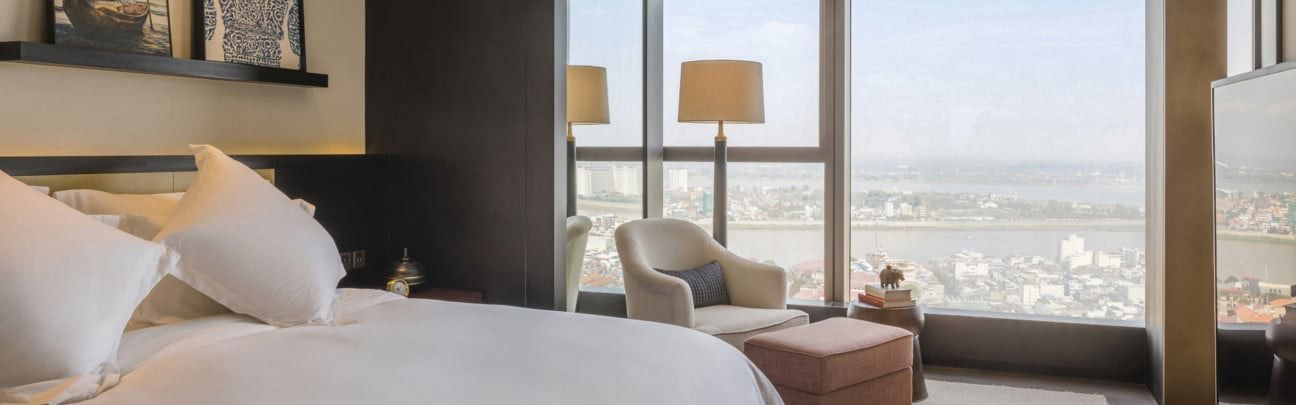
The immediate effect, arriving at the lobby floors of the tower, is vertical dislocation. Phnom Penh spreads below at a scale that makes its French-colonial grid and riverside pagodas legible all at once. That 360-degree panorama is not incidental to the property's identity, it is the identity, and every public space from the 33rd-floor pool to the cantilevered rooftop terrace is positioned to exploit it.
The Dining Programme as Social Infrastructure
Rosewood's most consequential contribution to Phnom Penh's hospitality scene may be its food and beverage operation, which functions less as hotel amenity and more as a cluster of independent-feeling venues sharing a single address. The range is wide enough that the property has become a fixture on the capital's dining circuit regardless of whether guests are staying there.
Brasserie Louis handles French comfort cooking, occupying the genre that sits between formal hotel dining and casual bistro without quite being either. Zhan Liang provides Chinese cooking, a sensible inclusion given the city's significant Chinese-Cambodian commercial community and the broader regional appetite for credible Chinese food within luxury hotel formats. These two venues alone would constitute a reasonable hotel F&B; programme. What lifts the overall operation is Sora.
Sora, the open-air bar and tapas venue on the rooftop terrace, occupies a cantilevered position that makes its views structurally dramatic rather than merely tall. Rooftop bars have proliferated across Southeast Asian capitals over the past decade, but the category has bifurcated sharply between large-capacity venues optimised for Instagram throughput and tighter, more considered formats where the drink programme justifies the altitude. Sora's position in that spectrum, and whether the cocktail list holds up against the view, is a question worth asking before assuming the height alone is the point.
The suite tier (37 suites in a 175-room hotel) comes with complimentary wines and beers from 5:30 to 7 p.m. daily in the Living Room.
Rooms: What the Numbers Mean
The 175 rooms begin at 538 square feet, a floor area that would be considered generous in most Asian cities and is notably spacious for a high-rise format where structural constraints typically compress room dimensions. Marble bathrooms and 600-thread-count Frette linens are category-standard at this price tier; the differentiator is the bedside panel system controlling lighting, air conditioning, and drapes from a single interface, which matters more than it sounds when the view through the window is worth preserving at various times of day without getting out of bed.
View allocation within the room inventory creates meaningful hierarchy. Rooms overlooking the heritage district have their own character, but the Premier River Room's sightline toward Tonle Sap lake, and the ability to observe river traffic from a horizontal position, represents the property's most coherent spatial experience. Signature suites extend to full residential configurations with dining rooms and kitchens, relevant for longer stays or for guests who want the hotel's address without total dependence on its restaurants.
Rosewood's brand-wide "sense of place" positioning is expressed here through locally sourced artwork and sculptures distributed across the rooms rather than through architectural pastiche. The building is glass-and-steel; the Khmer cultural reference comes through objects and materials rather than structure, which is an honest response to the tower's contemporary form.
Wellness and Practical Logistics
The 22-meter lap pool sits on the 33rd floor, a detail that rewards guests who treat hotel pools as actual training facilities rather than ornamental amenities. Sense, the spa, draws its conceptual frame from traditional Khmer practices and ingredients, placing it alongside regional peers that have moved away from generic international spa menus toward location-specific treatment rationales. The Pedi:Mani:Cure Studio by Bastien Gonzalez adds a brand-name specialist element that signals a particular tier of spa investment.
Practically, the hotel offers a fleet of complimentary tuk-tuks for getting into the city, a detail that matters in Phnom Penh, where the gap between a hotel's front door and anything culturally significant requires transport, and where ride-hailing apps and tuk-tuk negotiation involve varying degrees of friction depending on your familiarity with the city. The complimentary fleet removes that friction for standard excursions.
Rates start at $400 per night. The property earned 91.5 points on the La Liste Top Hotels 2026 list. Rosewood Hotels & Resorts carries weight as a brand signal:
Where It Sits in the Phnom Penh Market
Phnom Penh's luxury hotel market is smaller and more concentrated than equivalent capitals in the region. The options at the upper end of the market divide between the colonial-era prestige of Raffles Hotel Le Royal and the contemporary international-flag tier. Design-led boutique properties like The Balé Phnom Penh occupy a different niche, with smaller key counts and a locally inflected aesthetic that competes on intimacy rather than amenity range. Rosewood competes on scale, altitude, and the breadth of its dining and wellness programme, a vertical resort model that is more common in Hong Kong or Bangkok than in a city of Phnom Penh's size.
For those building a Cambodia itinerary beyond Phnom Penh, the temple circuit in Siem Reap is the natural extension. Options there range from Amansara in Siem Reap and Heritage Suites Hotel to the more contemporary Jaya House River Park Hotel. Along the coast, Shinta Mani Wild and Song Saa Private Island represent Cambodia's growing wilderness and island-resort tier, alongside PEARL BEACH RESORT & SPA in Sihanoukville, The Last Point in Prey Nob, and The Secret Garden at Otres Beach. For the Phnom Penh dining and hotel context more broadly, our full Phnom Penh restaurants guide maps the city's current scene.
Location
Monivong Boulevard, Vattanac Capital Tower, 66, Phnom Penh 12021
Phnom Penh, Cambodia
Recognized By


Explore Phnom Penh
Save or rate Rosewood Phnom Penh on Pearl
Keep this venue in your Pearl passport, rate it after you visit, and track it alongside every other place you collect.