
Hotel in Phnom Penh, Cambodia
Raffles Hotel Le Royal
1,200Pearl PointsColonial Grande Dame




About Raffles Hotel Le Royal
Open since 1929, Raffles Hotel Le Royal is Phnom Penh's most historically significant address, scoring 93 points in the 2026 La Liste Top Hotels ranking. Its 208 rooms blend Khmer, Art Deco, and French colonial architecture around a courtyard pool, while Restaurant Le Royal holds exclusive rights to ancient Royal Khmer recipes gifted directly from the Royal Palace. The Elephant Bar runs one of the city's longest happy hours.
A Building That Remembers Everything
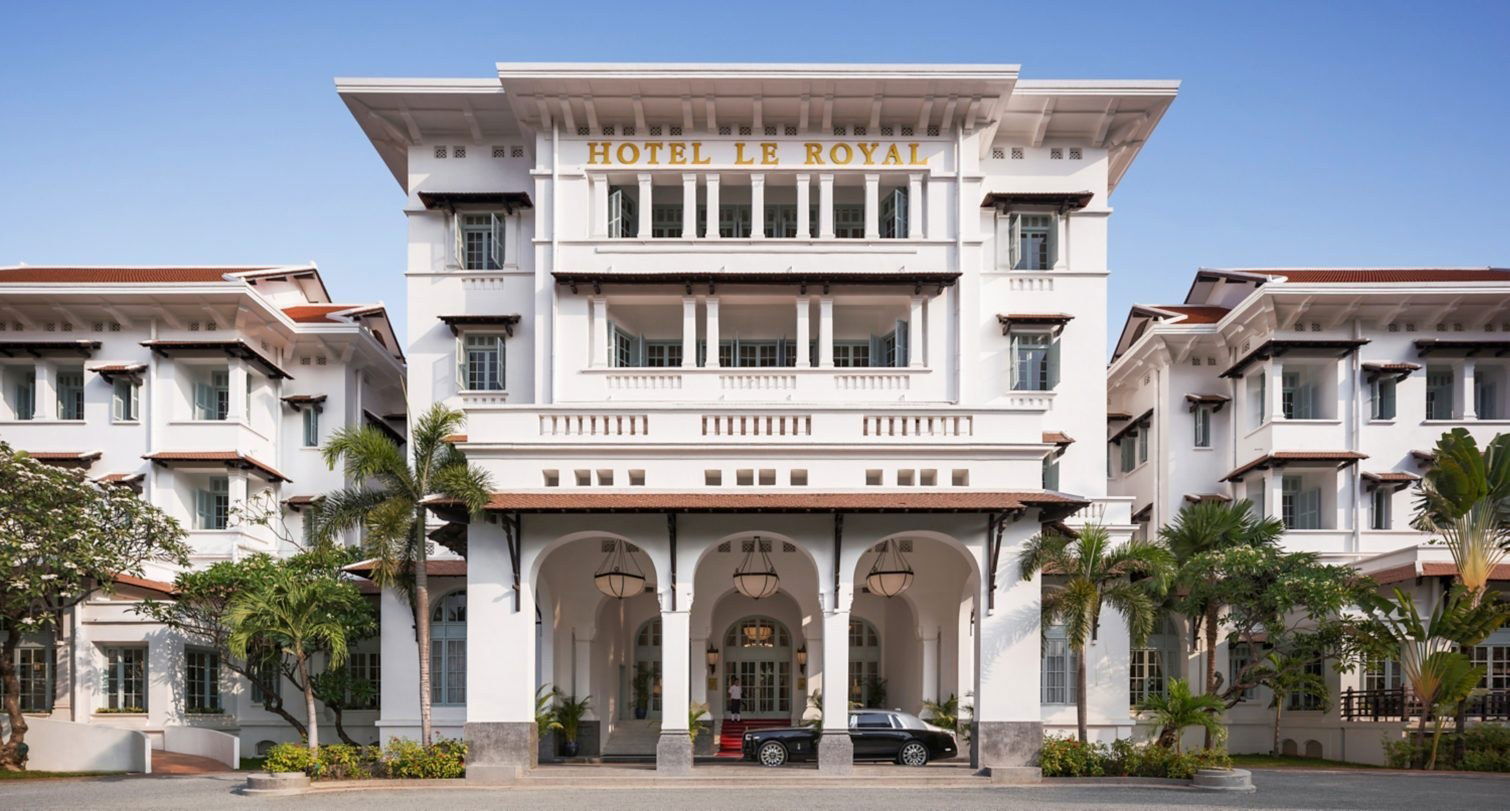
Approach Raffles Hotel Le Royal from Rukhak Vithei Daun Penh and the architecture makes its argument before you reach the entrance. The vanilla-coloured facade, high-pitched rooflines, and deep verandas belong to a specific moment in Southeast Asian building history: the interwar period when French colonial ambition met Khmer decorative tradition and the emerging geometric language of Art Deco. The result is not a pastiche of any single style but a layered structure that tells you something about the particular character of Phnom Penh itself, a city that absorbed French administration for nearly a century and filtered it through its own aesthetic sensibility.
That layering defines the interior as much as the exterior. The lobby reads as a resolved Art Deco composition: symmetry, polished surfaces, and restrained ornamentation that could credibly sit alongside the grande hotels of 1930s Saigon or the period rooms of Badrutt's Palace Hotel in St. Moritz. But move through the property and Khmer motifs reappear in carved details, lacquerwork, and the proportions of certain public spaces. The original 1929 building carries this tension most convincingly. The two later wings added during the property's 1990s renovation under Raffles (part of the Accor group) are architecturally coherent but lack the character density of the founding structure.
What the Rooms Actually Say
The 175 rooms and suites distribute across three distinct architectural zones, and where you stay shapes the experience considerably. The Landmark Rooms in the original wing are the most historically instructive: high ceilings, ceiling fans running alongside modern air conditioning, wooden floors, and claw-foot baths that have not been redesigned into irrelevance. They function as a working record of how the hotel looked at opening, maintained rather than museumified.
The four Personality Suites occupy a different register. Each is themed around a documented guest, including former French President Charles de Gaulle, giving them a curatorial quality that few hotels attempt seriously. These are not rooms decorated with generic period furniture and a framed photograph; they carry the weight of specific historical association. For travellers whose interest in a hotel lies partly in its capacity to locate them within a particular history, this matters.
Le Royal Suite is the property's largest, though scale here is less interesting than specificity. Persian rugs, Deco-period furnishings, and Cambodian objects of the period make the suite's design argument through accumulation of authentic detail rather than through contemporary design language. For comparison, the design-led luxury approach favoured by newer Phnom Penh properties like Rosewood Phnom Penh or Phnom Penh operates from a different premise entirely: contemporary luxury with local material references, rather than preserved historical character. Neither approach is inherently superior, but they serve different traveller motivations.
Rooms oriented toward the interior courtyard face the pool and the tree-lined gardens, which substantially reduces traffic noise. Street-facing rooms offer views of the city waking up, which carries its own appeal, but Phnom Penh's traffic begins early and loudly.
Dining as Part of the Historical Record
Restaurant Le Royal's position in Phnom Penh's dining scene rests on a specific credential: the Royal Khmer recipes served here were gifted to Raffles directly by the Royal Palace, giving the kitchen access to dishes that do not circulate through the city's broader restaurant culture. This is not a reconstructed heritage menu assembled from culinary research; it is sourced from the institution that originated it. The restaurant runs this alongside a modern French offering, a pairing that reflects the hotel's own architectural hybridity.
The Elephant Bar operates as a distinct institution within the property. Its happy hour runs from 4 to 9 p.m., one of the longer windows in the city, and its spirits collection runs to more than 110 botanical gins and whiskies. The bar's most documented cocktail is the Femme Fatale, created for Jacqueline Kennedy during her stay. Whether you read that as compelling historical texture or mild theme-park nostalgia will depend on your tolerance for grand hotel mythology, but the bar's social function is real: it draws local residents alongside hotel guests in a way that most hotel bars at this price point do not manage.
The weekend champagne brunch is the hotel's most publicised recurring event and books ahead consistently. Reservations are worth making before arrival rather than at the hotel itself.
Location and the City Around It
Address on Rukhak Vithei Daun Penh places the hotel within walking distance of the Royal Palace, the National Museum, and the riverside, which together constitute the most architecturally coherent section of central Phnom Penh. This proximity is a genuine logistical advantage: a morning on foot covers the city's principal historical sites before the heat becomes punishing. The concierge can arrange tuk-tuks for longer runs, including the 1937 Art Deco Central Market, which operates as an extension of the city's interwar architectural narrative that the hotel itself began.
Phnom Penh's broader hotel market has expanded significantly since the 1990s, when Le Royal was effectively the only luxury address in the city. Properties like The Balé Phnom Penh and SUN & MOON, Riverside Hotel now offer alternatives at various price points and design orientations. Le Royal's competitive position no longer rests on being the only option but on being the one whose physical fabric carries the city's history in a way no new-build can replicate. The property holds one Michelin Key.
Rooms from approximately $175 per night put Le Royal in the upper tier of Phnom Penh's market, though significantly below the rates of comparable historic grand hotels elsewhere in Asia, or internationally at properties like Cheval Blanc Paris or Aman New York in New York City.
For travellers extending their Cambodia itinerary beyond Phnom Penh, Raffles operates a sister property in Siem Reap adjacent to the Angkor UNESCO World Heritage site. Independent alternatives in that city include Amansara in Siem Reap, Heritage Suites Hotel, and Jaya House River Park Hotel. For coastal Cambodia, Song Saa Private Island in Koh Rong Archipelago, Shinta Mani Wild, PEARL BEACH RESORT & SPA in Sihanoukville, The Last Point in Prey Nob, and The Secret Garden at Otres Beach represent the range of options.
Planning a Stay
The spa covers local and classic treatments alongside a gym and pool, operating as a full facility rather than a hotel amenity added as an afterthought. The pool sits at the centre of the interior courtyard and remains functional as a working pool rather than an ornamental water feature. After a morning walking the riverside district, the pool has a specific, unhurried utility that fits the pace the hotel's architecture suggests.
Location
92 Rukhak Vithei, Phnom Penh 12302
Phnom Penh, Cambodia
Recognized By


Explore Phnom Penh
Save or rate Raffles Hotel Le Royal on Pearl
Keep this venue in your Pearl passport, rate it after you visit, and track it alongside every other place you collect.
Around this place
Restaurants in Phnom Penh
- Le Royal at The RafflesPhnom PenhLe Royal at The Raffles is Phnom Penh's most formal French-Cambodian dining room, recognised by La Liste at 75 points in both 2025 and 2026, with a Google rating of 4.7 across more than 2,000 reviews. It is the clearest special-occasion choice in the capital, a colonial hotel setting with consistent service and enough culinary ambition to justify the premium over mid-range Cambodian alternatives. Booking is easy, with no significant lead time required.
- CUTSPhnom PenhCUTS sits on the 38th floor of Vatanac Capital Tower, making it one of Phnom Penh's highest dining addresses and a strong call for group dinners and special occasions where the setting does the work. Booking is easy relative to comparable venues. For full city context, see our Phnom Penh restaurants guide.
Critically similar venues
- La MamouniaMarrakechLa Mamounia is worth the splurge if medina access, major gardens, a serious spa, and palace-hotel scale are central to the trip. At $1,457 a night, value depends on using the facilities rather than treating it as just a room near Jemaa el-Fnaa. Compare Royal Mansour for privacy and Amanjena for resort calm.
- La Réserve ParisParisBook La Réserve Paris if you want a discreet palace-level stay that feels closer to a private mansion than a hotel scene. The strongest value is in the suites, where the 40-key format, butler service, rare 16-meter indoor pool, and Three MICHELIN Keys recognition make the high price tier easier to justify.
Related editorial
- Four Seasons' Tokyo to Seoul Package: Worth Booking?Four Seasons just packaged Asia's most popular dual-city trip with hotel credits, airport transfers, and two award-winning properties. Here's whether it's worth it.
- Obaya Lounge High Tea at Four Seasons Riyadh: Worth It?Four Seasons Riyadh launches a Kingdom Centre-inspired High Tea at Obaya Lounge — SAR 365, daily through August 2026.
- La Terrazza at Castille Paris Returns This SummerCastille Paris reopens its hidden Italian courtyard for summer 2026 with a Bollinger partnership and a Northern Italian aperitivo menu. Here's why it belongs on your Paris shortlist.