
Hotel in Paris, France
Hôtel Barrière Fouquet's
950ptsBrasserie-Anchored Palace Hotel




About Hôtel Barrière Fouquet's
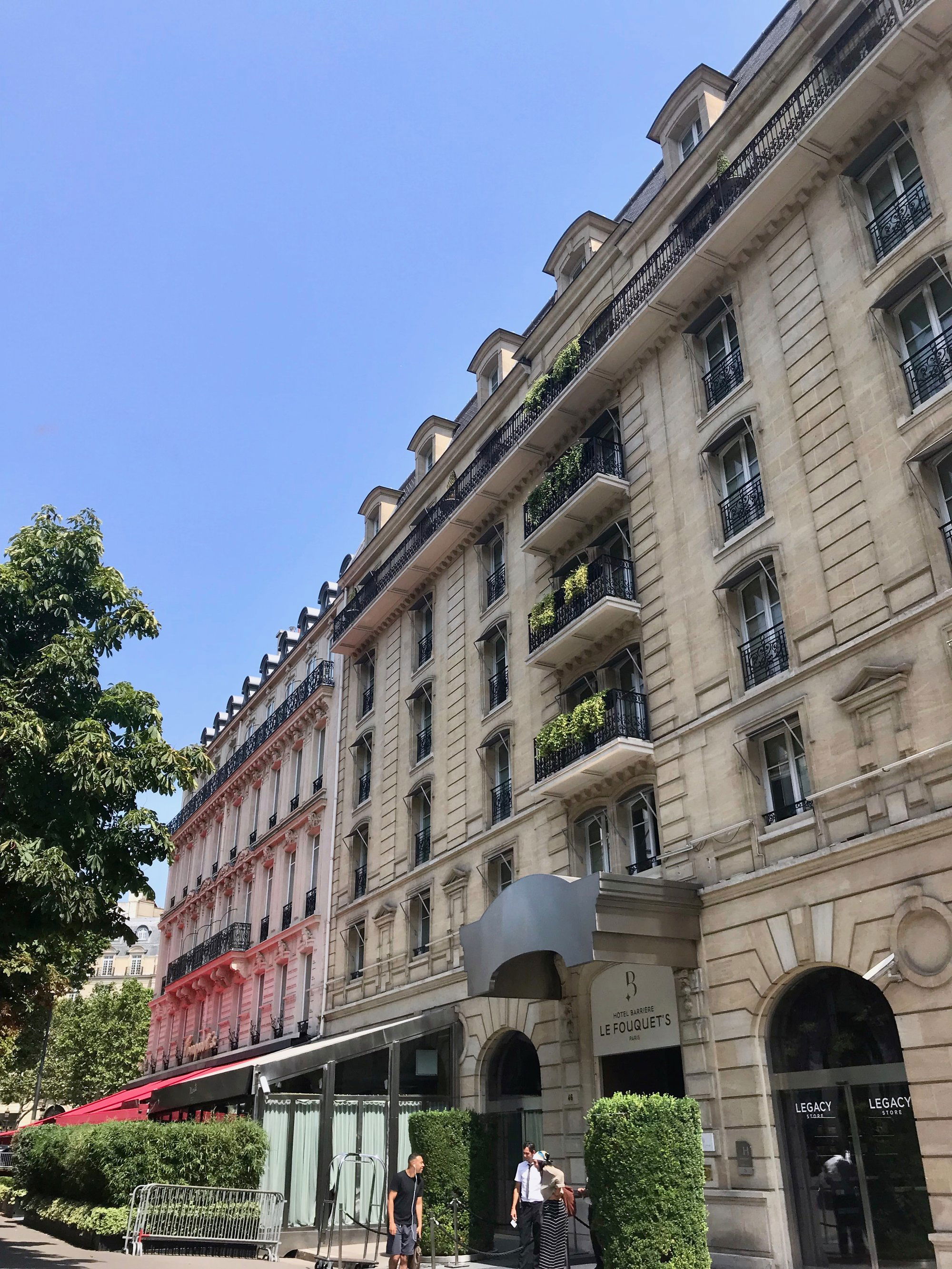
Positioned at the corner of Avenue George V and the Champs-Élysées, Hôtel Barrière Fouquet's occupies one of the 8th arrondissement's most recognisable addresses. The hotel's 101 rooms and suites, designed by Jacques Garcia, sit above a brasserie that has operated since 1899, while the Spa Decorté and Le Marta rooftop add layers of programming that extend well beyond a standard luxury stay. La Liste ranked it at 91.5 points in its 2026 Top Hotels ranking.
The Address That Frames Everything
Standing at the junction of Avenue George V and the Champs-Élysées, the red-and-gold awnings of Fouquet's brasserie have marked this corner since 1899. The hotel that rose behind and above that brasserie when it opened in 2006 inherited both the address and the weight of association that comes with it. For guests arriving from the direction of the Arc de Triomphe, the building reads as a natural continuation of the avenue's institutional character: Haussmann-scale facades, restrained signage, doormen in livery. What happens inside, across multiple dining formats, a spa programme rooted in Japanese beauty philosophy, and a rooftop garden concealed from the street, takes longer to read.
Paris's ultra-luxury hotel tier has grown more competitive in the two decades since Fouquet's opened. Properties including Cheval Blanc Paris, Hôtel de Crillon, and Four Seasons George V all compete within a few blocks of the same arrondissement, each with distinct identity propositions. What separates Fouquet's within this peer set is the institutional weight of the brasserie itself: the dining room predates the hotel by over a century, and that asymmetry shapes the property in ways that purpose-built luxury hotels do not replicate. Membership of the Leading Hotels of the World and a La Liste Leading Hotels score of 91.5 points (2026) confirm its position within that upper bracket without requiring further qualification.
What the Spa Decorté Programme Actually Offers
Paris's luxury hotel wellness offer has consolidated around two broad models: large spa floors with extensive treatment menus anchored to international beauty brands, and smaller, more curated programmes built around a single methodology. Spa Decorté at Fouquet's belongs to the second model. The collaboration pairs French hospitality context with Decorté, a Japanese skincare house whose formulations draw on Kyoto botanical research. The result is a programme that reads differently from the ESPA or Carita partnerships more common across the city's palace-category properties.
The facility includes a 15-metre heated swimming pool, an aquatic circuit, sauna, steam room, and an ice room with an ice wall — a configuration that supports contrast therapy protocols rather than purely passive relaxation. For guests whose wellness routines at home include cold exposure or thermotherapy sequences, this infrastructure matters in ways that a single treatment room tucked beside the fitness suite does not. The spa is positioned within the hotel rather than as an add-on, which affects both availability and the ease of integrating treatments into a multi-day stay. Guests looking for properties where the wellness component drives the itinerary rather than supplementing it will find the Fouquet's programme a credible basis for that approach, and it compares favourably with the spa infrastructure at peers like Le Bristol Paris and Hotel Plaza Athénée.
For travellers planning wellness-centred stays across France, the contrast with destination spa properties is worth considering. Properties like Les Sources de Caudalie in Bordeaux or La Réserve Ramatuelle frame the spa as the primary reason to visit. Fouquet's positions the Decorté programme as a serious component within a full urban itinerary, not the sole justification for the stay.
The Dining Architecture
Multi-format dining within a single hotel is now standard across Paris's upper bracket, but the formats at Fouquet's span a wider register than most. The brasserie operates in a tradition that pre-dates the hotel: opened in 1899, it has functioned as a backdrop for French cultural and political life through successive eras, with black-and-white portraits of cinema figures lining the walls as a record of that history. Pierre Gagnaire, one of France's most decorated chefs, designs the brasserie menu, applying considered technique to classics including escargots, sole meunière, and millefeuille without repositioning the venue as a gastronomic destination. The terraces face the Arc de Triomphe directly.
Joy, the hotel's second restaurant, operates at a different register: a smaller, cosy format with alcoves, an art-book library, and an inner garden view. Executive Chef Bruno Guéret and Joy's Chef Mathieu Mécheri work from a strictly seasonal product brief, which places this room closer to the contemporary Parisian dining mode than the brasserie's more ceremonial approach. The bar component at Joy adds a cocktail programme alongside the dining.
Le Marta operates as the property's nightlife anchor. Accessed through a concealed door, it combines exclusive cocktails and sharing plates with DJ programming. During summer, Le Marta Rooftop opens as a suspended garden designed by Cordelia de Castellane. The rooftop is the hotel's most atmosphere-dependent asset: the design concept, the garden character, and its position above one of Paris's most-trafficked intersections make it a different experience from the property's interior spaces. Those planning around it should note the seasonal window. For a broader view of Paris dining across these different registers, the EP Club Paris guide maps the full scene.
Rooms, Design, and the Jacques Garcia Logic
The 101 rooms and 35 suites were designed by Jacques Garcia, whose portfolio of French hospitality interiors has long favoured deep colours, layered textiles, and historicist references executed with precision rather than nostalgia. At Fouquet's, the design brief centred on Parisian atmosphere rather than contemporary minimalism, which places the rooms in clear contrast to the cleaner lines of newer properties like La Réserve Paris. Rooms begin at 37 square metres (approximately 400 square feet) with large bathrooms, and overlook one of three orientations: the Champs-Élysées, Avenue George V, or the inner garden. The inner garden rooms offer the quietest sleep environment; the avenue-facing rooms offer the more cinematic context. Among Paris properties with genuine Champs-Élysées proximity, the tradeoff between view and noise is a consistent consideration, and one worth raising at booking.
For guests comparing the Fouquet's room offering against neighbouring properties, Four Seasons George V sits directly on the same avenue with a similarly historic positioning, while Airelles Château de Versailles offers a contrasting approach for those whose itinerary extends beyond central Paris. Further afield in France, Cheval Blanc Courchevel, Hotel Du Cap-Eden-Roc, and The Maybourne Riviera represent the French Riviera's different proposition for guests whose travel extends south. Mountain alternatives worth considering include Four Seasons Megève. Provence options with serious spa infrastructure include Villa La Coste, La Bastide de Gordes, and Hôtel & Spa du Castellet.
Planning the Stay
The hotel sits at 46 Avenue George V, 75008 Paris, placing it within walking distance of the Champs-Élysées flagship retail corridor and the 8th arrondissement's gallery and cultural venues. Charles de Gaulle Airport is accessible via the RER B to Châtelet and a connection, or by private transfer in roughly 45 minutes under normal traffic conditions. Booking through the Leading Hotels of the World programme may carry rate or amenity advantages depending on travel dates. Summer guests targeting the Le Marta Rooftop should confirm opening dates in advance, as the season-dependent schedule varies year to year. The Spa Decorté treatments are likely to require advance reservation, particularly during peak travel periods in spring and autumn when the hotel's occupancy aligns with Paris's major fashion and trade calendar.
Comparable international properties for guests building multi-city itineraries include Aman New York, The Fifth Avenue Hotel, Aman Venice, and, for Champagne region extensions, Royal Champagne Hotel & Spa and Domaine Les Crayères in Reims. For Saint-Tropez alternatives with strong spa programming, Airelles Saint-Tropez Château de la Messardière is the relevant reference point.
Frequently Asked Questions
What room should I choose at Hôtel Barrière Fouquet's?
Room orientation is the primary variable. Avenue-facing rooms look toward the Champs-Élysées or George V, delivering the address's most recognisable visual context but with corresponding street-level noise. Inner garden rooms are quieter and better suited to guests prioritising sleep or recovery around a wellness-focused itinerary. All rooms begin at 37 square metres with large bathrooms, and the 35 suites extend that floor plan for guests requiring more space. The Jacques Garcia design language is consistent across categories, so the decision is almost entirely about outlook and noise tolerance.
What makes Hôtel Barrière Fouquet's worth visiting?
The combination of institutional dining history, a genuinely specified spa programme, and multi-format food and beverage across one building is relatively uncommon in the 8th arrondissement's competitive hotel set. The Fouquet's brasserie has operated since 1899 and carries cultural weight that newer hotels cannot replicate by design. La Liste's 91.5-point ranking (2026) and Leading Hotels of the World membership confirm its standing in the city's upper tier. The address, at the corner of George V and the Champs-Élysées, removes any need for ground-level orientation on arrival.
What's the leading way to book Hôtel Barrière Fouquet's?
If you are a frequent traveller at the ultra-luxury tier, booking through the Leading Hotels of the World programme is worth investigating for potential rate and amenity benefits. Direct booking through the Barrière group may offer flexibility advantages for specific requests. For stays during Paris Fashion Week or major trade calendar events in September and October, lead time of several months is advisable given the hotel's limited inventory of 101 rooms and suites.
When does Hôtel Barrière Fouquet's make the most sense to choose?
The hotel performs well year-round given the brasserie's all-season relevance and the spa's indoor infrastructure, but it is particularly coherent in summer when Le Marta Rooftop opens and the terrace facing the Arc de Triomphe becomes one of Paris's more atmospheric dinner settings. Spring and autumn suit guests building itineraries around Paris's cultural calendar. Those prioritising spa and retreat programming over the rooftop and terrace experience will find the property equally functional in winter, when competitor hotels with primarily outdoor wellness assets lose ground.
Does Fouquet's brasserie accept guests who are not staying at the hotel?
The Fouquet's brasserie at the corner of the Champs-Élysées and Avenue George V has historically operated as a standalone dining destination as well as a hotel restaurant, a distinction that matters for non-resident guests planning a meal there. Pierre Gagnaire's involvement in the menu design positions it within a broader gastronomic tradition even within the brasserie format. Reservations are advisable regardless of hotel guest status, particularly for terrace seating during the warmer months when the view toward the Arc de Triomphe is the primary draw.
Recognized By


More hotels in Paris
- 42 Av. Gabriel42 Av. Gabriel sits in one of Paris's most competitive hotel corridors, steps from the Champs-Élysées gardens in the 8th arrondissement. Full pricing and awards data are not yet confirmed, so book direct and verify upgrade eligibility at reservation. For verified alternatives nearby, see Le Bristol Paris, Hôtel de Crillon, or La Réserve Paris.
- Auberge FloraAuberge Flora is a boutique hotel in Paris's 11th arrondissement, offering a neighbourhood-embedded alternative to the palace-district properties at a lower price point. It books easily, sits close to the Marais and Bastille, and suits travellers who want a design-forward base rather than full concierge service. A practical choice if location flexibility and value matter more than brand prestige.
Related editorial
- Best Fine Dining Restaurants in ParisFrom three-Michelin-star icons to the next generation of Parisian chefs pushing boundaries, these are the restaurants that define fine dining in the world's culinary capital.
- Best Luxury Hotels in RomeFrom rooftop terraces overlooking ancient ruins to Michelin-starred hotel dining, these are the luxury hotels that make Rome unforgettable.
- Best Cocktail Bars in KyotoFrom sleek lounges to hidden speakeasies, Kyoto's cocktail scene blends Japanese precision with global influence in ways you won't find anywhere else.
Save or rate Hôtel Barrière Fouquet's on Pearl
Keep this venue in your Pearl passport, rate it after you visit, and track it alongside every other place you collect.