
Hotel in Florence, Italy
Grand Hotel Minerva
625Pearl PointsMid-Century Modernism Over the Piazza


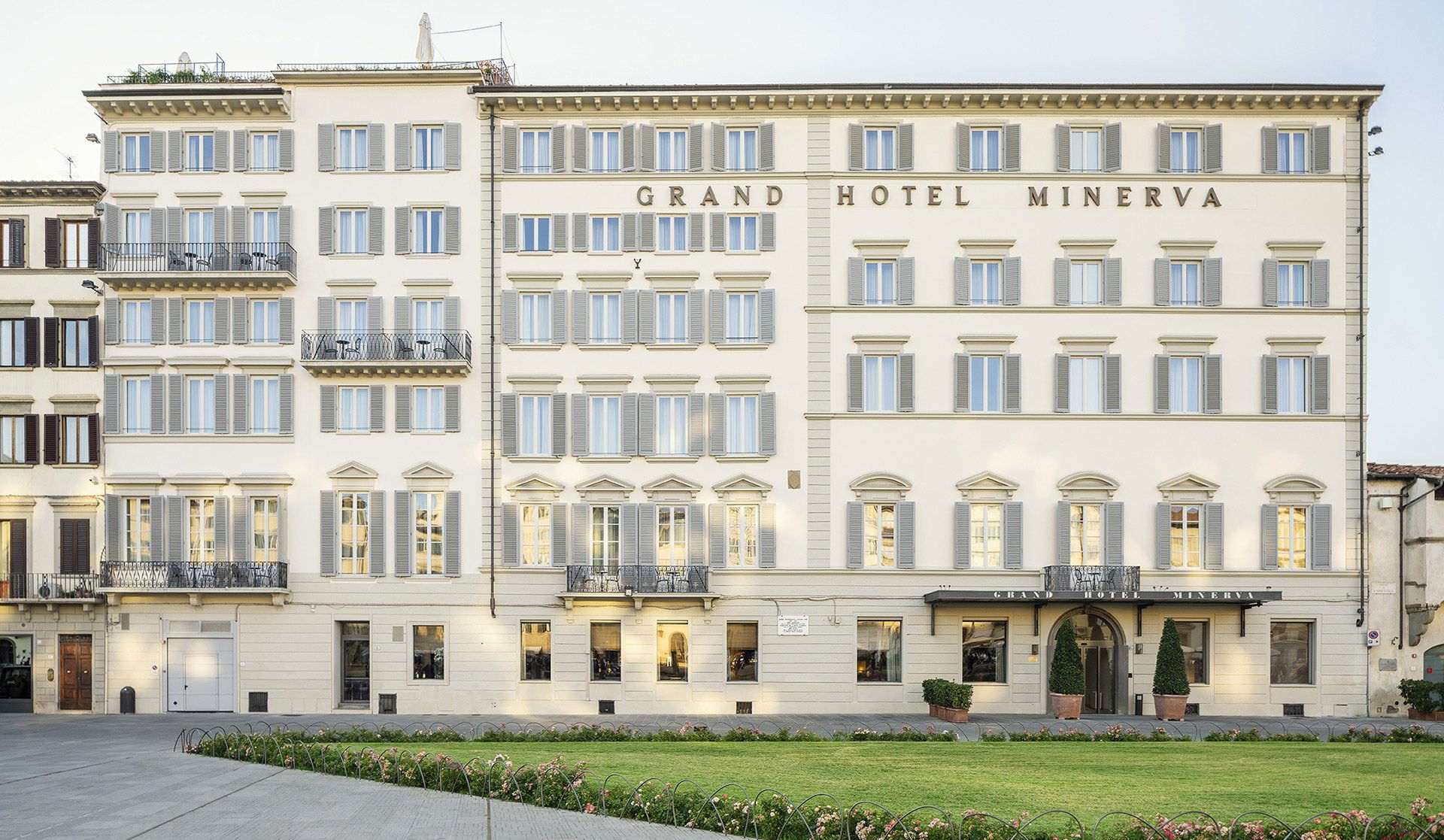
About Grand Hotel Minerva
On Piazza Santa Maria Novella, the Grand Hotel Minerva occupies a 13th-century palazzo redesigned in 1957 by architect Carlo Scarpa, with 97 rooms, a rooftop pool open May through September, and a terrace restaurant serving contemporary Tuscan cuisine. Priced from around $427 per night, it sits between the rail station and the historic centre, with Via Tornabuoni's luxury shopping within a five-minute walk.
What Florence Looks Like at Dawn
Open the curtains at the Grand Hotel Minerva and the façade of Santa Maria Novella fills the frame — white and green marble geometry so close it reads less like a view and more like a painting someone has positioned against your window. The piazza below is still quiet at that hour, the stone cooling from the night, pigeons tracing arcs across the square before the tour groups arrive. This is the hotel's primary argument, and it makes it without effort: few places in Florence put you this directly in contact with the city's medieval and Renaissance fabric before you have even had coffee.
Florence's central hotel stock is heavily weighted toward grand-palazzo conversions — the Four Seasons Hotel Firenze occupies two separate historic buildings in a private park, while the Palazzo Portinari Salviati Residenza D'Epoca commits fully to Renaissance restoration. The Minerva occupies different territory: a 13th-century palazzo whose bones were reworked in 1957 by Carlo Scarpa, one of the most consequential Italian architects of the 20th century, and refreshed again by Piera Tempesti Benelli in a more recent renovation. The result sits in a peer group defined less by period authenticity than by the productive tension between historical structure and modernist intervention.
The Scarpa Inheritance
Scarpa's 1957 involvement is the detail that separates the Minerva from most of its category peers. His approach to historic buildings favoured dialogue over deference , new elements declared themselves as new, rather than pretending to belong to earlier centuries. That sensibility persists through the 97 rooms and suites, where a coffered ceiling from the 1300s can occupy the same space as deliberately contemporary furnishing. Some rooms run to bold colour; others hold to a cleaner, more monochromatic register. What connects them is the sense that the design has been thought through rather than assembled from a luxury-hotel template.
The artworks distributed through the property , works by Emilio Greco, Renato Guttuso, and Giuseppe Chiari , are strictly 20th-century and later. If you have come to Florence for Botticelli and Masaccio, the Uffizi is roughly a fifteen-minute walk south across the Arno side of the historic centre; the Minerva makes no attempt to compete with that. Its interior is a record of a different set of aesthetic choices, ones that read as an argument for Italian modernism rather than Renaissance grandeur. The room with coffered ceilings from the 1300s is the exception that proves the rule: the original structure is present, acknowledged, and then set in conversation with everything that came after.
Above the Rooftops
The rooftop terrace is the element that most clearly differentiates the Minerva within Florence's accommodation market. A rooftop pool in this city is a relative rarity , the density of protected historic fabric makes structural additions complicated, and most hotels rely on ground-floor gardens or internal courtyards for outdoor space. The Minerva's pool, positioned on a 13th-century palazzo's uppermost level, operates from May through September, paired with a bar that serves drinks against a 360-degree spread of the city's skyline. The Duomo is visible. So is the tower of Palazzo Vecchio. So are the terracotta rooflines that define Florence's horizontal character at every compass point.
Terrace itself is open year-round for the view alone, with the pool and full bar service running seasonally from approximately April to October. The Terrace Negroni has acquired enough of a reputation to be referenced by name in the hotel's own positioning , a drink served with the Duomo at sunset as its backdrop is doing most of its atmospheric work before it reaches the table. Hotels like Villa Cora and Villa La Massa offer garden pools in their respective hillside and riverside settings; the Minerva trades garden serenity for urban panorama, which is a different calculation entirely.
The Piazza Table and What It Serves
La Buona Novella, the hotel's ground-floor restaurant, runs from morning through to dinner and expands onto the pedestrian piazza during warmer months. The menu positions itself around contemporary Tuscan cooking , dishes shaped by traditional regional ingredients and technique but not confined to historical recreation. The outdoor terrace on Piazza Santa Maria Novella is one of the more straightforwardly pleasurable places to eat in this part of the city, not because the food is doing anything architecturally ambitious but because the setting frames a meal differently than a courtyard or a rooftop can. You are at the same level as the piazza, watching the square function as a piazza has for centuries, with the church's marble façade as the visual anchor.
Aperitivo, light snacks, and dinner are all available, which gives the restaurant genuine flexibility across a full day's use. For guests who want to eat beyond the hotel, the broader Santa Maria Novella neighbourhood connects quickly to the city's central dining corridor. Our full Florence restaurants guide maps the range across price points and cooking styles.
Location as Infrastructure
The address on Piazza Santa Maria Novella is logistically efficient in a way that matters for a city as walk-intensive as Florence. Santa Maria Novella station is close enough that arrival from the train is direct. Via Tornabuoni , the concentration of luxury retail that anchors the city's fashion presence , is five to ten minutes on foot. The Duomo complex, the Accademia, and Piazza della Signoria are all reachable without a taxi. For guests arriving by car or travelling to other parts of Tuscany, the proximity to the main rail hub also means onward connections to Siena, the Chianti, and the Mugello are manageable without a vehicle.
Comparable central positions belong to properties like the Brunelleschi Hotel, set around a Byzantine tower in the historic core, and the Hotel Calimala, positioned near Mercato Nuovo. The Hotel Lungarno takes the Arno as its frame of reference. The Minerva's piazza placement gives it a civic-square quality that those alternatives trade for different kinds of urban character.
For those considering broader Italian itineraries, the Minerva fits naturally into a sequence that might include Aman Venice to the northeast, Rosewood Castiglion Del Bosco south into the Val d'Orcia, or Castello di Reschio in Umbria. For coast access, Il Pellicano in Porto Ercole or Borgo Santandrea on the Amalfi Coast offer contrasting southern alternatives. The Minerva also pairs logically with a Modena stop at Casa Maria Luigia or a Milan night at Portrait Milano.
Planning a Stay
Rates start at around $427 per night. The 97 rooms and suites span intimate single-aspect rooms with piazza views through to duplex configurations and larger family-format suites. The rooftop pool and bar run seasonally from April through October; the terrace remains accessible year-round. La Buona Novella operates morning through evening. Guests arriving at Santa Maria Novella station can reach the hotel on foot. Via Tornabuoni shopping is five minutes in the opposite direction. The fitness centre is available to guests with views that continue the property's general approach to making the city visible at every level.
For other Italian properties across different scales and settings, see also Ad Astra in Florence, Borgo Egnazia in Puglia, Bulgari Hotel Roma, JK Place Capri, Il San Pietro di Positano, Passalacqua on Lake Como, and Corte della Maestà in Civita di Bagnoregio. For international reference points in the same design-conscious tier, The Fifth Avenue Hotel in New York, Aman New York, and Amangiri in Utah each demonstrate what considered architectural intervention can do to a property's character.
Frequently Asked Questions
How would you describe the overall feel of Grand Hotel Minerva?
The Minerva reads as a mid-century modernist hotel that has been layered carefully over a medieval structure , the result of Carlo Scarpa's 1957 redesign and subsequent renovation by Piera Tempesti Benelli. The atmosphere is more composed and design-conscious than the grand-palazzo warmth of properties like the Four Seasons Firenze, but less minimal than a purely contemporary hotel would be. The piazza location means the city's energy is immediately present: Santa Maria Novella's marble façade is visible from a significant proportion of rooms, and the ground-floor terrace puts guests directly on one of Florence's most active civic squares. Rates from around $427 per night position it in the upper-mid tier of central Florence accommodation.
What room should I choose at Grand Hotel Minerva?
The clearest choice is between piazza-facing rooms, which look directly onto Santa Maria Novella's façade, and interior or alternative-aspect rooms, which trade the view for quieter nights. The property's 97 rooms include duplex suites and family-format configurations for groups needing more than a single sleeping level. Given the Carlo Scarpa architectural heritage and the art collection , works by Emilio Greco, Renato Guttuso, and Giuseppe Chiari distributed through the building , rooms that show more of the original structure, including the room with 14th-century coffered ceilings, tend to offer the densest version of the hotel's design argument. The rooftop pool and seasonal bar are accessible to all guests from May through September, so the view differential applies primarily to the room itself rather than to the overall stay experience.
Location
P.za di Santa Maria Novella, 16, 50123 Firenze FI
Florence, Italy
Recognized By


Explore Florence
Save or rate Grand Hotel Minerva on Pearl
Keep this venue in your Pearl passport, rate it after you visit, and track it alongside every other place you collect.