
Bar in New York City, United States
Soothr
100ptsEast Village Thai Precision
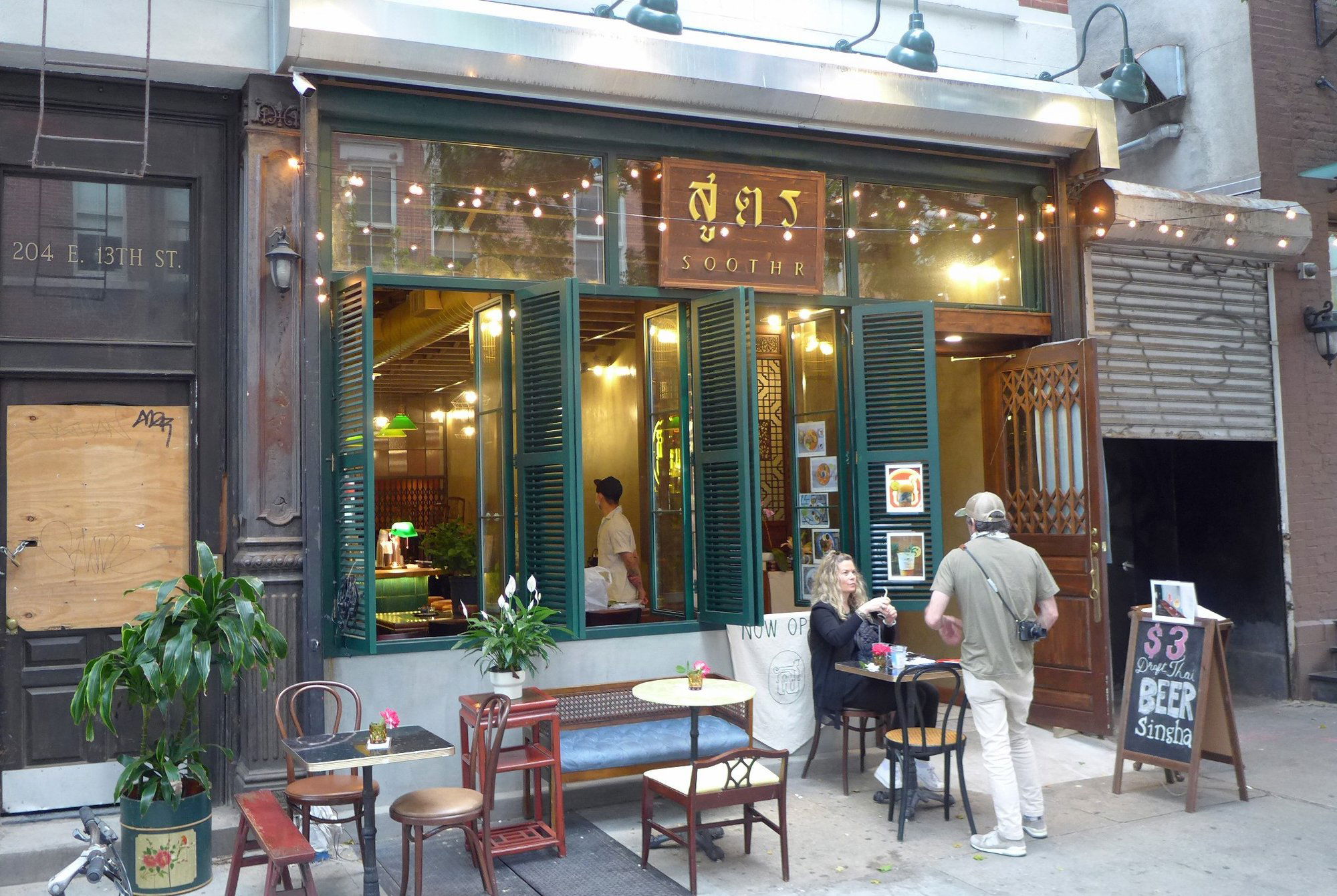
About Soothr
On East 13th Street in the East Village, Soothr occupies a quiet stretch of Manhattan that rewards those paying attention to the city's Thai dining scene. The restaurant operates at the intersection of traditional technique and New York's appetite for regional specificity, offering a point of entry into Central Thai cooking that differs from the broader pad-Thai-and-curry template that long defined the category here.
East Village Thai, in the Context That Matters
New York's relationship with Thai food has gone through a slow correction. For years, the city's Thai restaurants clustered around a shorthand version of the cuisine, one built around familiarity and accessibility rather than regional depth. That began shifting in the 2010s as a smaller group of kitchens started treating Central Thai cooking as a serious culinary tradition rather than a delivery-friendly category. Soothr, at 204 East 13th Street, belongs to that corrective wave. The East Village address places it in a neighbourhood already dense with serious dining, where the competition is sophisticated and the audience expects more than approximation.
The historical context here matters. Thai cuisine in the United States was shaped heavily by the Thai government's Global Thai programme in the early 2000s, which encouraged Thai nationals to open restaurants abroad as a form of culinary diplomacy. The result was an enormous proliferation of restaurants, but not necessarily depth. What emerged in cities like New York was a readable, exported version of the cuisine, useful but narrow. The restaurants that have earned sustained attention in the years since are largely the ones that rejected that template and moved toward specificity: proper nam priks, fermented pastes, fresh herb profiles that vary by region, heat that isn't calibrated for avoidance.
Daytime vs. Evening: How the Experience Shifts
The lunch-versus-dinner divide in East Village Thai restaurants is worth understanding before you book. At the daytime end of service, the neighbourhood draws a mix of locals, remote workers, and the kind of deliberate eater who treats a weekday lunch as a proper meal rather than a fuel stop. This generally means shorter waits, a quieter room, and a version of the menu that plays slightly more accessible. It is the session for someone approaching the kitchen for the first time, where rice dishes and curry bases can be worked through without the pressure of a packed evening room.
Evening service at restaurants operating at this level in the East Village tends to attract a more committed diner, one who has read the menu in advance and arrives with specific intentions. The energy in the room changes, tables turn more slowly, and the kitchen is typically running at full capacity, which often means the more labour-intensive preparations are more reliably available. For repeat visitors, this is where the real territory opens up: the dishes that require longer prep, the heat levels that a first-timer might not navigate confidently, and the combination plates that reward familiarity with the flavour vocabulary. If the lunch visit is an orientation, the dinner visit is the examination.
From a value standpoint, lunch service at mid-range Thai restaurants in Manhattan generally offers better per-dish returns, with portions sized for a solo or shared lunch rather than a full evening progression. For a single diner eating at the bar or a two-leading looking to sample across the menu, a daytime visit typically delivers more range per dollar. The evening format, by contrast, is built for pacing, for drinks between courses, and for the kind of leisurely ordering that fills two to three hours rather than one.
Where Soothr Sits in the New York Thai Picture
The East Village and its adjacent blocks have accumulated enough serious Thai options that the category is no longer served by a single reference point. Soothr operates in the mid-to-upper tier of that picture, where the expectation is technique-led cooking rather than comfort-led approximation. This is a different proposition from the Midtown lunch counters and the delivery-optimised kitchens further north. It is closer in spirit to the small group of restaurants, primarily in Elmhurst, Queens, that built their reputations on specificity and immigrant-community trust before Manhattan began paying attention.
The East 13th Street address also places it within walking range of some of New York's more serious cocktail destinations. The Lower East Side and East Village corridors have produced a consistent run of technically driven bars over the past decade. Amor y Amargo on East 6th Street has built a programme almost entirely around amaro and bitters, making it a useful pre- or post-dinner option for the aperitif-minded. Attaboy NYC, further east on Eldridge Street, operates a guest-led, no-menu format that suits the kind of diner who already knows what they like. For those who want something with more neighbourhood character and cocktail range, Superbueno on Avenue A offers a Latin-leaning programme with serious depth.
Comparison with East Village bars is useful because the neighbourhood eating-and-drinking circuit here is more integrated than in other parts of Manhattan. A meal at Soothr sits naturally within an evening that begins at a bar like Angel's Share in the East Village, where the quiet, reservation-based format rewards advance planning. The geography makes sequencing easy; the walk between venues is short enough to anchor an entire evening within a four-block radius.
For those building out a wider picture of American cocktail culture, the same technical seriousness that defines the East Village bar scene appears in different forms across the country: Kumiko in Chicago works at the Japanese-American intersection, Jewel of the South in New Orleans draws on the city's deep cocktail history, Julep in Houston focuses on Southern American traditions, ABV in San Francisco operates with a spirits-forward, approachability-first ethos, Allegory in Washington, D.C. anchors a hotel programme with serious creative ambition, Bar Leather Apron in Honolulu brings Japanese technique to a Pacific context, and The Parlour in Frankfurt on the Main extends the conversation to a European frame.
Planning Your Visit
East Village restaurants at this level typically operate without the months-long booking windows of the city's tasting-menu counters, but the better sessions, Friday and Saturday evenings in particular, fill within a week or two of opening. A Tuesday or Wednesday dinner, or a weekend lunch, generally offers the most direct path to a table without extended planning. For first-time visitors, a lunch visit to establish familiarity with the kitchen's approach, followed by an evening return with a larger group, is the sensible progression. See our full New York City restaurants guide for broader context on how Soothr fits into the city's current dining picture.
Quick reference: 204 East 13th Street, East Village, Manhattan. Confirm current hours and booking availability directly with the restaurant before your visit.
Frequently Asked Questions
- What should I try at Soothr?
- The Central Thai tradition that Soothr draws from puts relish-style dishes, herb-heavy salads, and paste-based preparations at the centre of the menu rather than the periphery. A table ordering across those categories will cover more of the kitchen's range than one anchored to a single protein curry. The East Village context, with its experienced dining audience, suggests the kitchen is comfortable executing technically demanding preparations.
- What is Soothr leading at?
- In the New York Thai picture, Soothr sits among the restaurants committed to Central Thai specificity rather than a pan-regional export version. That means the kitchen's strengths are most apparent in preparations that depend on fresh herb profiles and layered pastes, the dishes where technique is visible in the result, rather than in the broadly familiar dishes that most of the city's Thai restaurants do competently.
- How far ahead should I plan for Soothr?
- East Village restaurants at this tier rarely require the two-to-three-month advance planning of Manhattan's leading tasting counters. For a weekday dinner or weekend lunch, a one-to-two-week window is generally workable. Peak weekend evenings fill faster; if a specific night matters, book as soon as the window opens. Confirm the current booking method and availability directly with the restaurant, as policies change.
- Is Soothr better for first-timers or repeat visitors?
- If you are new to Central Thai cooking, a lunch visit with a smaller group gives you space to work through the menu without committing to a full evening pacing. If you have a frame of reference for the cuisine and an understanding of what to order, a dinner visit with four or more people, where dishes can be shared across a broader range, will deliver considerably more. The restaurant rewards the visitor who arrives with intent.
- How does Soothr compare to Thai restaurants in Elmhurst, Queens?
- The two contexts serve different purposes in New York's Thai dining picture. Elmhurst's Thai restaurants built their credibility on immigrant-community trust and regional specificity over decades, and the price-to-depth ratio there is hard to match. Soothr operates in a Manhattan neighbourhood with Manhattan overheads and an audience that skews toward the deliberate diner rather than the community regular. The tradeoff is access and neighbourhood integration; the East Village address makes it a practical anchor for an evening that includes serious cocktail stops, while a trip to Elmhurst requires more planning and a distinct commitment.
More bars in New York City
- (SUB)MERCER(SUB)MERCER occupies a basement address on Mercer Street in SoHo, positioning it as a deliberate destination rather than a drop-in. The subterranean format tends to keep ambient noise lower than street-level alternatives, making it a reasonable call for groups of four or more. Book ahead for weekends and confirm group capacity directly with the venue.
- 1 OR 81 OR 8 on DeKalb Avenue is a low-key Fort Greene bar that works best for two people on a weeknight when the room is quiet enough for conversation. Walk-ins are easy, no advance planning required. If a specialist cocktail program is your priority, Attaboy or Amor y Amargo offer more defined experiences — but for a neighbourhood drink without the fuss, this delivers.
- 230 Fifth Rooftop Bar230 Fifth is the easiest rooftop bar in Midtown to walk into, and the Empire State Building views justify the trip. The crowd skews groups and tourists, and the drinks are solid rather than craft-focused. Go early on a weekday for the best version of the experience; after 9 PM on weekends it tips firmly into party-group territory.
- 4 Charles Prime Rib4 Charles Prime Rib is a compact, reservation-required West Village dining room built around a focused prime rib format. It works well for dates and pairs but is too small for groups of four or more. Booking is easy relative to Manhattan peers, and the narrow menu signals a kitchen that executes one thing consistently well.
- 44 & X Hell's KitchenA low-key Hell's Kitchen neighborhood bar-restaurant that earns its place for easy weeknight dates and pre-theatre dinners. Booking is simple, the room is intimate enough for conversation, and there's no dress pressure. Not a cocktail destination, but a reliable, pressure-free option in Midtown West when you want comfort over spectacle.
- 58-22 Myrtle Ave58-22 Myrtle Ave is a low-key Ridgewood neighborhood spot that rewards return visits more than first impressions. Easy to get into, with no reservation headaches, it suits regulars looking for an unpretentious room rather than a structured cocktail program. If a strong drinks list or kitchen ambition matters to you, look to Attaboy or Amor y Amargo instead.
Related editorial
- Best Fine Dining Restaurants in ParisFrom three-Michelin-star icons to the next generation of Parisian chefs pushing boundaries, these are the restaurants that define fine dining in the world's culinary capital.
- Best Luxury Hotels in RomeFrom rooftop terraces overlooking ancient ruins to Michelin-starred hotel dining, these are the luxury hotels that make Rome unforgettable.
- Best Cocktail Bars in KyotoFrom sleek lounges to hidden speakeasies, Kyoto's cocktail scene blends Japanese precision with global influence in ways you won't find anywhere else.
Save or rate Soothr on Pearl
Keep this venue in your Pearl passport, rate it after you visit, and track it alongside every other place you collect.