
Bar in New York City, United States
P.J. Clarke's Third Avenue
100ptsOld-Guard Saloon Continuity
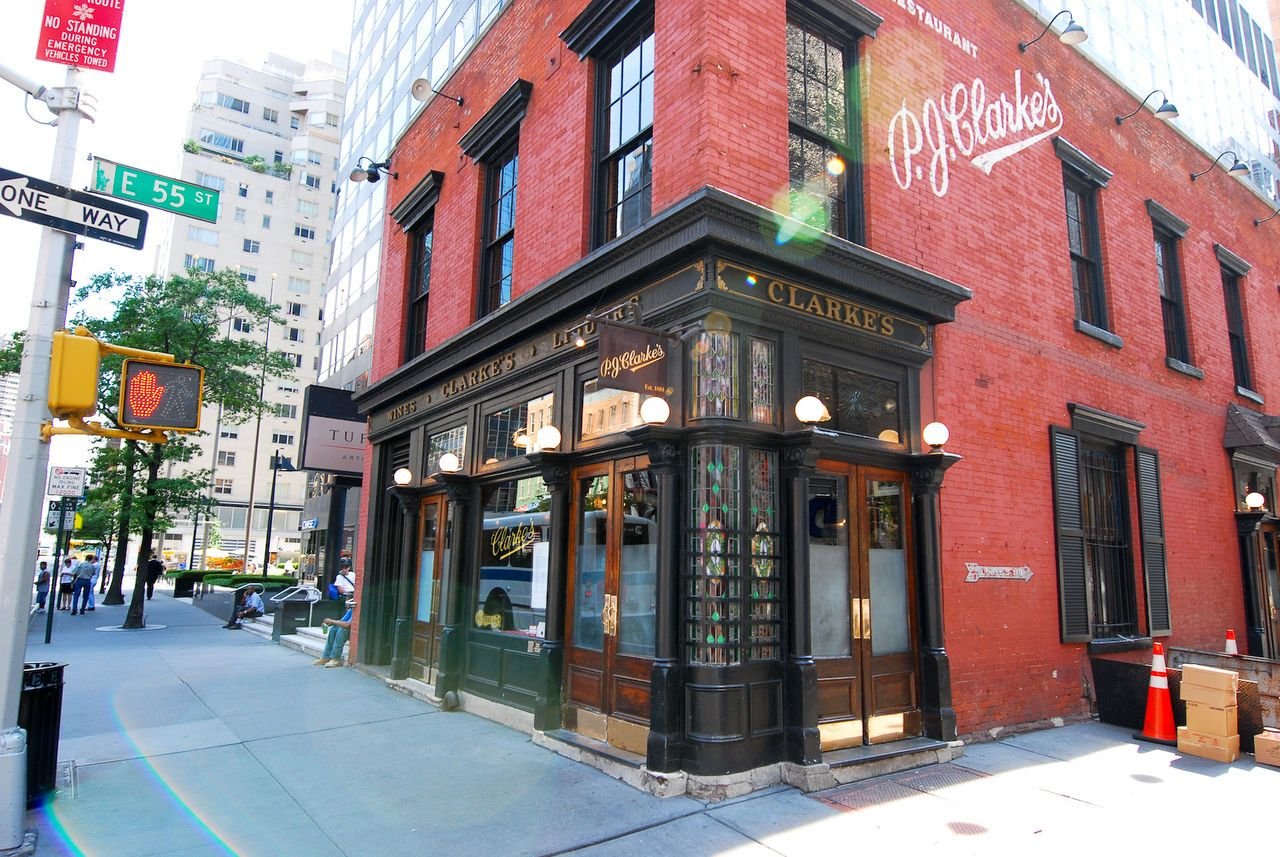
About P.J. Clarke's Third Avenue
P.J. Clarke's Third Avenue is a Midtown Manhattan saloon with one of New York's longest-running commitments to the American bar tradition. At 915 Third Avenue, it occupies the space between serious drinking and unfussy eating that few establishments in the city sustain across decades. The bar program draws on classic American and Irish-American hospitality codes that pre-date the craft cocktail era and continue to define the room's character.
The Saloon That Midtown Built Around
There is a particular kind of New York bar that exists before and after trends: the saloon that functions as neighborhood anchor, lunch counter, post-work refuge, and late-night institution simultaneously. P.J. Clarke's Third Avenue, at 915 Third Avenue in Midtown East, sits inside that tradition. The address is not incidental. Third Avenue in the Fifties has been a working corridor for office workers, construction crews, and professionals since the refined train came down in the mid-twentieth century, and the bars that survived that transition did so by serving everyone rather than anybody in particular. P.J. Clarke's is one of the institutions that shaped what that street became.
Walking into a room like this, the context arrives before the menu does. The long wooden bar, the mix of suited regulars and visitors who found the place through reputation rather than algorithm, the absence of the performed casualness that defines so many newer bars — these are signals about what kind of drinking is on offer. American saloon hospitality operates on different codes than the technique-forward programs at places like Attaboy NYC or the bitters-focused pedagogy at Amor y Amargo. Here the point is continuity and comfort, not education or spectacle.
Behind the Bar: Craft as Consistency
The editorial frame of EA-BR-04 — the bartender's craft , applies differently to an institution like P.J. Clarke's than it does to a cocktail bar built around a single practitioner's vision. The craft here is institutional rather than individual. What the bartenders at a long-running American saloon know is hospitality tempo: how to manage a three-deep Friday crowd, how to remember a regular's order on a Tuesday, how to pour a proper Martini without theatre and a proper Guinness without rushing it. That form of knowledge is transmitted through apprenticeship inside the bar itself, not through external certification or competition circuits.
This places P.J. Clarke's in a different peer conversation than the technically ambitious programs you find at Superbueno or Angel's Share. Those rooms reward the guest who wants to discuss fermentation sources or ask about the derivation of a house shrub. The Third Avenue saloon rewards the guest who wants a cold beer and a burger delivered without negotiation. Neither is a lesser skill. The bartender who can hold a packed room at 6pm on a winter Thursday, keeping drinks moving and temperaments even, is exercising a form of craft that the cocktail competition circuit rarely measures.
New York has moved substantially toward the transparent-technique model over the past fifteen years. The clarified drinks and fat-washed spirits programs that now define bars like Kumiko in Chicago or the format discipline at Allegory in Washington, D.C. represent one direction the industry went. The saloon tradition represents another, older branch , one with deeper roots in the daily lives of working New Yorkers and less investment in self-documentation. P.J. Clarke's has persisted in that lane without apology.
The American Bar Tradition in Context
The American saloon as a form peaked in the nineteenth century and has been in various states of reinvention ever since. Prohibition broke the physical and cultural continuity of the bar trade, and what emerged after repeal was a mixed inheritance: some establishments rebuilt on the original saloon model, others borrowed from European café culture, and the postwar decades added the sports bar, the fern bar, and eventually the craft cocktail bar as distinct American typologies. The saloons that survived from before or immediately after Prohibition did so by serving a local population that had nowhere else equivalent to go.
P.J. Clarke's original location on 55th Street and Third Avenue , a nineteenth-century building that survived intact while the surrounding blocks were redeveloped , became a reference point for what a Midtown bar could be when it refused to update its character to match the decade. The Third Avenue address covered in this profile carries that institutional identity forward into a room that functions for the same audience, even if the physical container is newer.
The comparison to bars operating in other American cities is instructive. Jewel of the South in New Orleans and Julep in Houston both operate with serious awareness of American bar history, but they are curator-led programs , the historical record filtered through a specific practitioner's point of view. ABV in San Francisco runs a technically rigorous program that uses the American bar canon as a starting point for something more contemporary. P.J. Clarke's occupies the original tier: the institution that is the history, rather than one that references it.
Internationally, the comparison gets interesting. Bars like Bar Leather Apron in Honolulu and The Parlour in Frankfurt on the Main operate with high craft precision in the Japanese-influenced bartending tradition , quiet, deliberate, technically precise. The saloon tradition that P.J. Clarke's represents runs on opposite principles: volume, directness, and the democratic proposition that a good bar is for everyone who walks in.
When to Go and What to Expect
The Midtown East corridor has distinct rhythms. Lunch runs from roughly noon through mid-afternoon, drawing from the surrounding office towers. The post-work window between 5pm and 8pm is the room's most characteristic hour , when the bar fills with the convergence of different professional worlds and the energy is less choreographed than a dinner reservation and more genuinely sociable than a standing cocktail event. Late evening on weekends attracts a wider mix. Winter evenings are particularly well-suited to the saloon format: the warmth and noise of a full room work with the season rather than against it.
For visitors working through our full New York City restaurants guide, P.J. Clarke's Third Avenue belongs in the same itinerary as institutions rather than discoveries. This is not a bar you find; it is a bar that New York already found and has been using for decades.
Planning Your Visit
Address: 915 Third Avenue, New York, NY 10022. Neighbourhood: Midtown East, accessible from the Lexington Avenue subway lines. Reservations: The saloon bar format means walk-in is the primary mode; check directly with the venue for dining reservations. Dress: No formal code; the room handles everything from business casual to jackets without friction. Budget: Consistent with Midtown bar pricing , expect standard New York range for drinks and American bar food. Timing: Post-work weekday evenings are the most characteristic hour; the bar is at its most fully itself between 5pm and 8pm on a winter Thursday or Friday.
Frequently Asked Questions
- What should I try at P.J. Clarke's Third Avenue?
- P.J. Clarke's has built its reputation on American bar fundamentals: a properly made Martini, a cold draft beer, and a burger that has been on the menu long enough to be a reference point rather than a trend. Start with whatever the bar does at its most classical , the drinks and food that have been on the list longest are usually the most reliable indicators of a room's actual strengths.
- What is P.J. Clarke's Third Avenue leading at?
- Across New York City's bar spectrum , from the technique-focused programs of the cocktail bar tier to the neighborhood dive , P.J. Clarke's sits in the institutional American saloon category. It is leading at the combination of reliable hospitality, a full bar program without pretension, and food that functions as actual sustenance rather than garnish. In Midtown, where most bars cater to a transient audience, that consistency across decades is itself a form of distinction.
- Is P.J. Clarke's Third Avenue reservation-only?
- The saloon bar format at P.J. Clarke's is walk-in by default, which is part of the point. If you are planning a larger group or want to guarantee a dining table, contact the venue directly , the Third Avenue location handles events and larger parties. For a solo drink or a pair at the bar, walk in.
- Who is P.J. Clarke's Third Avenue leading for?
- The room works for anyone who wants a full bar, American bar food, and a Midtown East location without the pressure of a tasting menu or the self-consciousness of a concept bar. It is a functional choice for business meals conducted without ceremony, a practical option for post-work drinks, and a reference point for visitors who want to understand what the New York saloon tradition actually looks like in practice rather than in nostalgia.
- How does P.J. Clarke's Third Avenue fit into New York's longer bar history?
- P.J. Clarke's is one of the few operating bar brands in New York that connects directly to the pre-craft-era American saloon tradition, with the original 55th Street location's nineteenth-century building acting as a physical record of that continuity. The Third Avenue address extends that identity into a Midtown corridor that has been a working bar district since the refined train came down. For anyone mapping New York's bar typology , from the technique-led programs at places like Attaboy to the heritage saloon , P.J. Clarke's anchors the institutional end of that spectrum.
More bars in New York City
- (SUB)MERCER(SUB)MERCER occupies a basement address on Mercer Street in SoHo, positioning it as a deliberate destination rather than a drop-in. The subterranean format tends to keep ambient noise lower than street-level alternatives, making it a reasonable call for groups of four or more. Book ahead for weekends and confirm group capacity directly with the venue.
- 1 OR 81 OR 8 on DeKalb Avenue is a low-key Fort Greene bar that works best for two people on a weeknight when the room is quiet enough for conversation. Walk-ins are easy, no advance planning required. If a specialist cocktail program is your priority, Attaboy or Amor y Amargo offer more defined experiences — but for a neighbourhood drink without the fuss, this delivers.
- 230 Fifth Rooftop Bar230 Fifth is the easiest rooftop bar in Midtown to walk into, and the Empire State Building views justify the trip. The crowd skews groups and tourists, and the drinks are solid rather than craft-focused. Go early on a weekday for the best version of the experience; after 9 PM on weekends it tips firmly into party-group territory.
- 4 Charles Prime Rib4 Charles Prime Rib is a compact, reservation-required West Village dining room built around a focused prime rib format. It works well for dates and pairs but is too small for groups of four or more. Booking is easy relative to Manhattan peers, and the narrow menu signals a kitchen that executes one thing consistently well.
- 44 & X Hell's KitchenA low-key Hell's Kitchen neighborhood bar-restaurant that earns its place for easy weeknight dates and pre-theatre dinners. Booking is simple, the room is intimate enough for conversation, and there's no dress pressure. Not a cocktail destination, but a reliable, pressure-free option in Midtown West when you want comfort over spectacle.
- 58-22 Myrtle Ave58-22 Myrtle Ave is a low-key Ridgewood neighborhood spot that rewards return visits more than first impressions. Easy to get into, with no reservation headaches, it suits regulars looking for an unpretentious room rather than a structured cocktail program. If a strong drinks list or kitchen ambition matters to you, look to Attaboy or Amor y Amargo instead.
Related editorial
- Best Fine Dining Restaurants in ParisFrom three-Michelin-star icons to the next generation of Parisian chefs pushing boundaries, these are the restaurants that define fine dining in the world's culinary capital.
- Best Luxury Hotels in RomeFrom rooftop terraces overlooking ancient ruins to Michelin-starred hotel dining, these are the luxury hotels that make Rome unforgettable.
- Best Cocktail Bars in KyotoFrom sleek lounges to hidden speakeasies, Kyoto's cocktail scene blends Japanese precision with global influence in ways you won't find anywhere else.
Save or rate P.J. Clarke's Third Avenue on Pearl
Keep this venue in your Pearl passport, rate it after you visit, and track it alongside every other place you collect.