
Bar in New York City, United States
La Mercerie
100ptsContinental All-Day Format
About La Mercerie
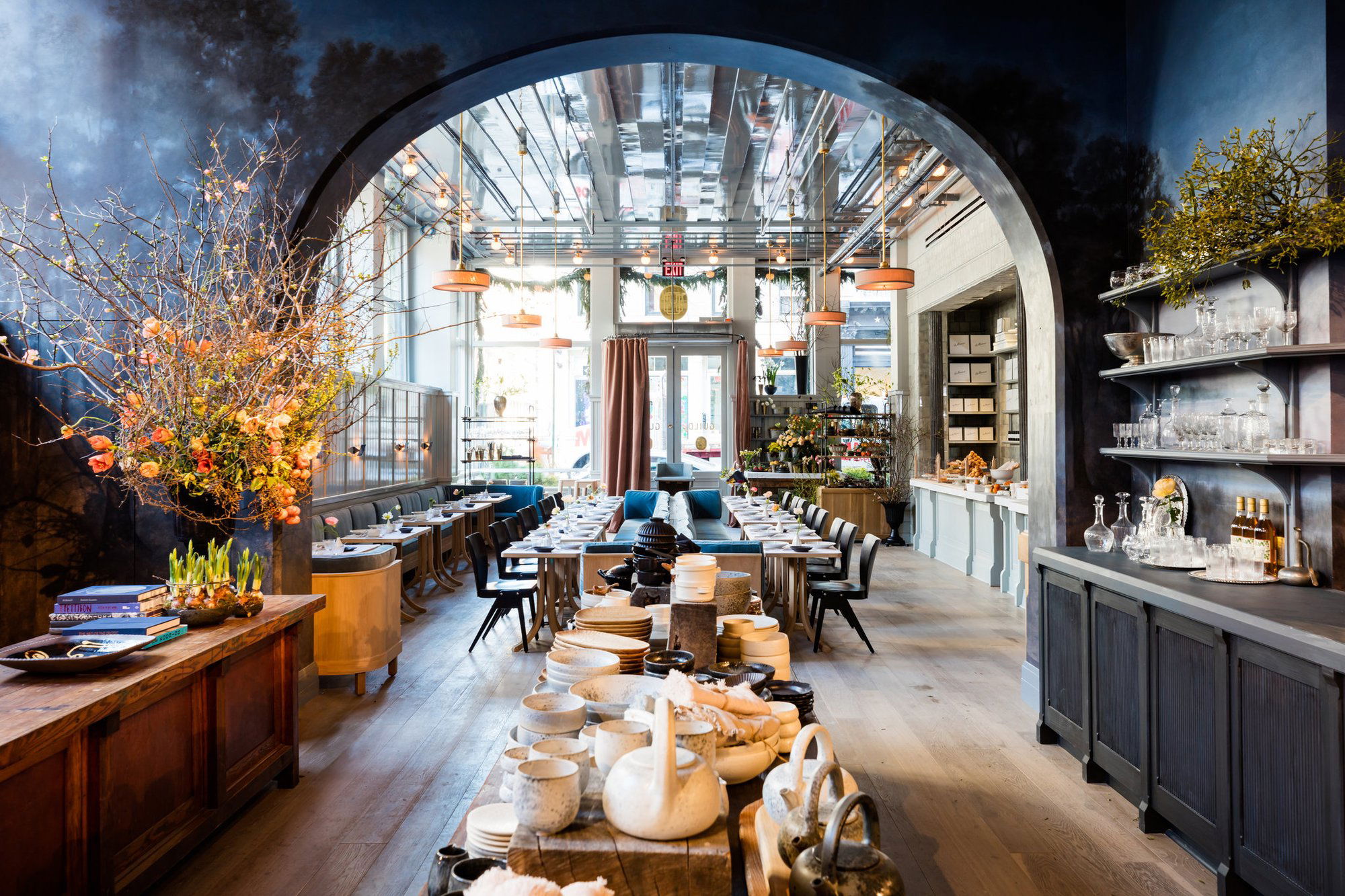
La Mercerie sits on Howard Street in SoHo, occupying the ground floor of the Roman and Williams Guild building and drawing from a French café tradition that positions it closer to an all-day Parisian brasserie than a conventional New York restaurant. The dining room's light-washed aesthetic and leisurely pacing set it apart from the neighbourhood's more assertive dining options.
SoHo's French Café Tradition, Planted on Howard Street
When the Roman and Williams Guild opened its Howard Street address in SoHo, it arrived with a premise that had largely disappeared from New York: a proper French café operating across the full arc of the day, from morning pastry to evening plate. La Mercerie, occupying the ground floor of that building at 53 Howard St, belongs to a continental format that New York has historically imported rather than developed — the all-day café-restaurant that functions as neighbourhood anchor rather than destination event. That positioning matters more than it might first appear.
SoHo's dining character has shifted substantially over the past two decades. The neighbourhood that once housed low-rent artist studios and converted-loft restaurants now carries rents that push venues toward either high-volume throughput or premium positioning. Amid that compression, the French café format — unhurried, architecturally considered, calibrated to repeat visits rather than once-a-year occasions , occupies a distinct and relatively uncrowded tier. La Mercerie operates within that tier, drawing comparison not to SoHo's louder Italian-American rooms or to the tasting-menu counters further downtown, but to the kind of room where a solo diner feels as comfortable at noon as a four-leading does at eight in the evening.
The Room Before the Menu
The Roman and Williams Guild building is, in itself, a meaningful piece of context. Roman and Williams is the design firm responsible for interiors at some of New York's most discussed hospitality spaces, and the Guild concept , a retail and dining hybrid oriented around craft objects and considered living , sets a specific register before a guest sits down. The dining room at La Mercerie reflects that sensibility: natural materials, controlled light, a palette that doesn't compete with the food. In a city where restaurant interiors frequently function as brand statements rather than dining environments, a room designed to recede is a curatorial choice with real consequences for how long people stay and how they eat.
For the reader assessing where La Mercerie fits relative to SoHo's broader options, this context is instructive. Venues like Dirty French on Ludlow operate in an overtly theatrical French-American register, with high energy and a late-night crowd. La Mercerie's format reads differently: the pace is slower, the register more European, and the function more genuinely all-day. Those are structural differences, not matters of better or worse, but they determine who the room suits on any given visit.
Howard Street as Address and Argument
Howard Street runs through a section of SoHo that sits slightly south of the neighbourhood's highest-traffic retail corridors. The address gives La Mercerie a particular kind of remove from the pedestrian density of Spring and Prince Streets, while keeping it accessible enough to function as a working lunch or early-evening option for the broader SoHo and Tribeca population. That micro-location is part of what allows the café format to hold , foot traffic is intentional rather than incidental, and the clientele skews toward people who came specifically rather than people passing through.
Practical logistics follow from the address. Howard Street sits within easy reach of the Canal Street and Spring Street subway stations, and the immediate block retains the mixed character of lower SoHo, with design studios and independent retailers alongside the hospitality. For visitors working through our full New York City restaurants guide, La Mercerie anchors the lower-SoHo pocket that also includes access to the Tribeca bar scene and the more concentrated dining of the West Village to the north.
Where La Mercerie Sits in New York's French Café Conversation
New York's relationship with French café culture has always been mediated rather than direct. The city produces celebrated French-influenced fine dining and a long tradition of French-American bistro cooking, but the genuine all-day café , where the croissant in the morning and the roast chicken in the evening are expressions of the same culinary logic , has been harder to sustain at commercial rents. La Mercerie's persistence in that format, anchored within a design-retail building that gives it a structural reason to exist across dayparts, represents one workable solution to that commercial problem.
The bar dimension is worth addressing directly, because SoHo and its surrounds support a number of rooms where the drink list is as considered as the food. New York's cocktail conversation has matured well past the speakeasy moment, with venues like Attaboy NYC and Amor y Amargo representing the city's more specialist, technique-oriented end of the market. Angel's Share in the East Village and Superbueno further illustrate how varied New York's bar formats have become. La Mercerie operates within a more European drinks register , wine and aperitif-oriented, calibrated to complement food across a long afternoon or evening rather than to perform as standalone destination. That places it in a different conversation from the cocktail-forward rooms, but not a lesser one.
For readers contextualising New York against other American cities, it's worth noting that the all-day European café format has found strong footing in cities with distinct neighbourhood dining cultures. Venues like Kumiko in Chicago and ABV in San Francisco demonstrate how all-day or broad-daypart hospitality concepts have taken root in different urban contexts. Internationally, The Parlour in Frankfurt on the Main represents a comparable European-inflected room philosophy. New Orleans' Jewel of the South, Julep in Houston, and Allegory in Washington, D.C. each reflect how regional character shapes the daypart café or bar concept. Bar Leather Apron in Honolulu shows the format working at the further geographic edge of the American market. The common thread across successful examples is a clear editorial point of view about who the room is for and when.
Planning Your Visit
La Mercerie is located at 53 Howard Street in SoHo, Manhattan. The address is most easily reached via the Canal Street subway station (A, C, E, 1 lines) or the Spring Street station (C, E lines), placing it within a short walk of both. Given the room's format as an all-day operation, timing a visit outside peak lunch hours or before the dinner rush tends to produce the most relaxed experience , the European café format rewards unhurried visits, and the room is designed to accommodate them. For current hours, reservations, and menu details, checking directly via the venue or current booking platforms is advisable, as operational details change and the venue database record does not include confirmed hours or booking method at time of publication.
Frequently Asked Questions
What is La Mercerie known for?
La Mercerie is known for operating a French all-day café format within the Roman and Williams Guild building in SoHo. The room draws from a continental tradition , breakfast pastries through to evening plates , and positions itself within the more considered, design-led tier of New York's French-influenced dining rather than the high-energy bistro or tasting-menu categories.
What drink is La Mercerie famous for?
The drinks program at La Mercerie aligns with a French café register, leaning toward wine and aperitif-style options that work across different points in the day. The emphasis is on drinks that complement food over a longer visit, rather than a cocktail list designed as the primary draw.
Should I book La Mercerie in advance?
If you are visiting SoHo specifically for La Mercerie, a reservation is advisable, particularly for dinner and weekend lunch. The room's format attracts a repeat clientele alongside destination visitors, and the combination can compress availability. Checking current booking availability through the venue directly or a booking platform will give you the most accurate picture, as details were not confirmed in the venue data available at publication.
Is La Mercerie better for first-timers or repeat visitors?
The all-day café format is one of the few in New York that genuinely rewards repeat visits more than first-time events. First-timers benefit from the room's coherence and the novelty of the European pacing within a SoHo context; returning visitors tend to settle into the daypart flexibility and use it as a reliable neighbourhood anchor. Neither visit type is wrong, but the room arguably reveals more on the second or third visit.
Is a night at La Mercerie worth it?
For a dinner experience calibrated to a slower, more continental pace than most of SoHo's available options, the evening format at La Mercerie delivers something the neighbourhood's more assertive rooms do not. The value calculation depends on what you are comparing it against: it sits in a different register from high-energy French-American venues and from fine-dining counters, and should be assessed against that specific tier.
Does La Mercerie serve food throughout the day, or only at set meal times?
La Mercerie operates as an all-day venue, a format relatively uncommon in SoHo at the French café register it occupies. The building's Roman and Williams Guild context supports a clientele that moves through the space across different dayparts, and the kitchen operates accordingly. This distinguishes it from restaurants in the neighbourhood that operate only for lunch and dinner service, and is one of the structural arguments for the venue's continued position in lower SoHo's dining mix.
More bars in New York City
- (SUB)MERCER(SUB)MERCER occupies a basement address on Mercer Street in SoHo, positioning it as a deliberate destination rather than a drop-in. The subterranean format tends to keep ambient noise lower than street-level alternatives, making it a reasonable call for groups of four or more. Book ahead for weekends and confirm group capacity directly with the venue.
- 1 OR 81 OR 8 on DeKalb Avenue is a low-key Fort Greene bar that works best for two people on a weeknight when the room is quiet enough for conversation. Walk-ins are easy, no advance planning required. If a specialist cocktail program is your priority, Attaboy or Amor y Amargo offer more defined experiences — but for a neighbourhood drink without the fuss, this delivers.
- 230 Fifth Rooftop Bar230 Fifth is the easiest rooftop bar in Midtown to walk into, and the Empire State Building views justify the trip. The crowd skews groups and tourists, and the drinks are solid rather than craft-focused. Go early on a weekday for the best version of the experience; after 9 PM on weekends it tips firmly into party-group territory.
- 4 Charles Prime Rib4 Charles Prime Rib is a compact, reservation-required West Village dining room built around a focused prime rib format. It works well for dates and pairs but is too small for groups of four or more. Booking is easy relative to Manhattan peers, and the narrow menu signals a kitchen that executes one thing consistently well.
- 44 & X Hell's KitchenA low-key Hell's Kitchen neighborhood bar-restaurant that earns its place for easy weeknight dates and pre-theatre dinners. Booking is simple, the room is intimate enough for conversation, and there's no dress pressure. Not a cocktail destination, but a reliable, pressure-free option in Midtown West when you want comfort over spectacle.
- 58-22 Myrtle Ave58-22 Myrtle Ave is a low-key Ridgewood neighborhood spot that rewards return visits more than first impressions. Easy to get into, with no reservation headaches, it suits regulars looking for an unpretentious room rather than a structured cocktail program. If a strong drinks list or kitchen ambition matters to you, look to Attaboy or Amor y Amargo instead.
Related editorial
- Best Fine Dining Restaurants in ParisFrom three-Michelin-star icons to the next generation of Parisian chefs pushing boundaries, these are the restaurants that define fine dining in the world's culinary capital.
- Best Luxury Hotels in RomeFrom rooftop terraces overlooking ancient ruins to Michelin-starred hotel dining, these are the luxury hotels that make Rome unforgettable.
- Best Cocktail Bars in KyotoFrom sleek lounges to hidden speakeasies, Kyoto's cocktail scene blends Japanese precision with global influence in ways you won't find anywhere else.
Save or rate La Mercerie on Pearl
Keep this venue in your Pearl passport, rate it after you visit, and track it alongside every other place you collect.