
Bar in New York City, United States
Gray's Papaya
100pts24-Hour Counter Institution
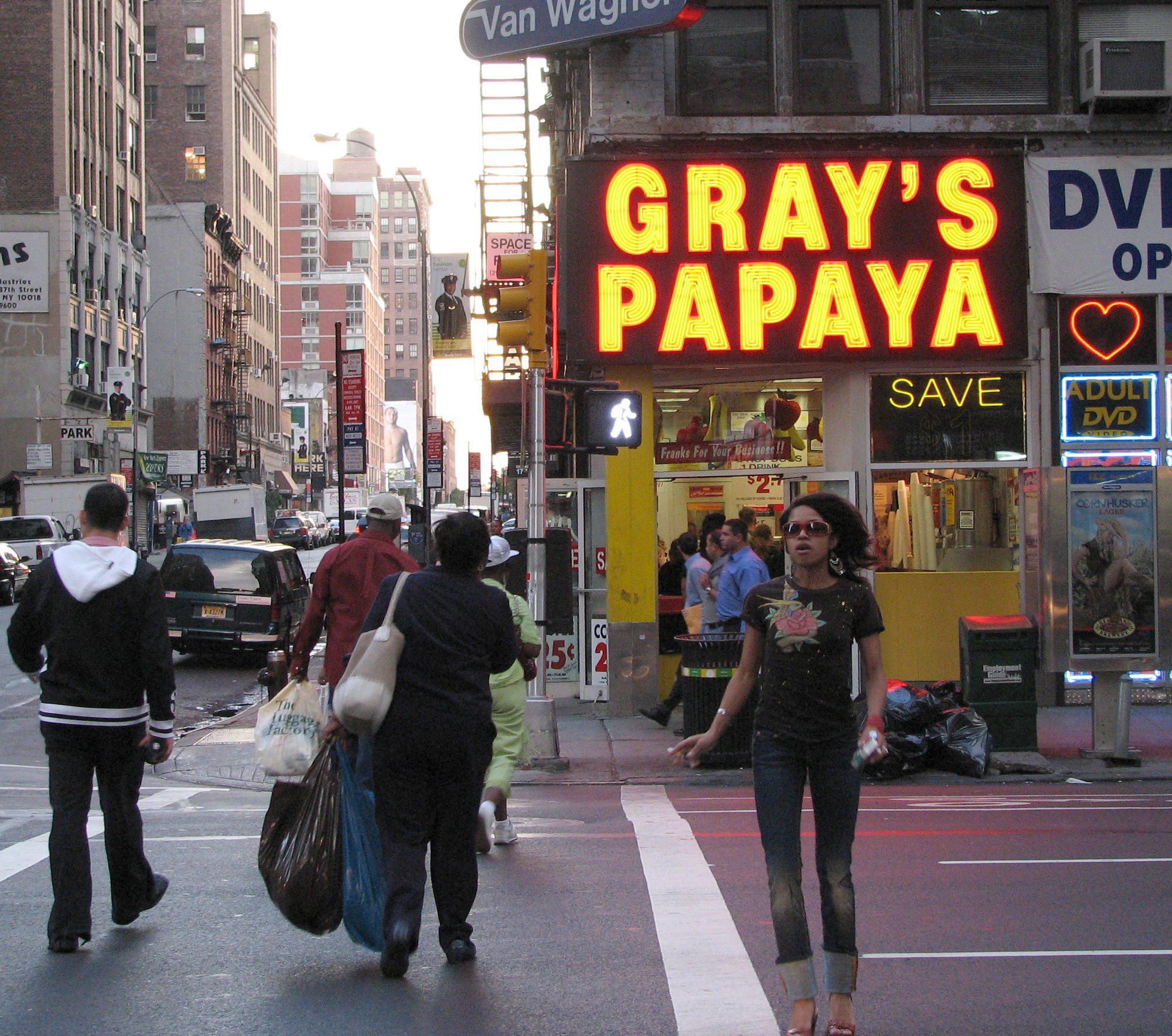
About Gray's Papaya
Gray's Papaya at 2090 Broadway has been a fixture of Upper West Side street life for decades, serving hot dogs and tropical drinks at a counter where the city's social mix flattens into something unusually democratic. It operates at a price point well below any sit-down alternative on the block, and its hours make it the default option when the rest of the neighbourhood has closed.
Broadway at All Hours
The stretch of Broadway around 72nd Street runs on a particular rhythm: morning dog-walkers, afternoon stroller traffic, late-night bar exits. Gray's Papaya at 2090 Broadway sits at that intersection without ceremony. There is no door to push open into a dimmed foyer, no host station, no moment of transition between street and dining room. The counter faces the sidewalk and the fluorescent light spills out in both directions. You are, functionally, still outside, which is the point.
New York has a category of institution that resists the usual vocabulary of dining criticism. No tasting menu, no reservation system, no chef biography posted near the entrance. What these counters offer instead is a kind of spatial honesty: the transaction is visible, the product is consistent, and the price does not shift based on the hour or the neighbourhood's recent press coverage. Gray's Papaya operates inside that tradition, and understanding it requires setting aside the critical apparatus built for sit-down restaurants.
The Counter Format and What It Demands
Counter service in New York occupies a different register than it does in cities where fast-casual is primarily a suburban format. Here, the counter is where the city's social compression becomes most visible. On any given visit to Gray's Papaya, the line includes people arriving from Lincoln Center, people who have been working a night shift, and people who live in the building directly overhead. The format enforces a kind of equality that a table-service restaurant, regardless of its price point, structurally cannot replicate.
The drink program at Gray's Papaya deserves its own framing. The papaya drink that gives the venue its name belongs to a specific New York counter tradition: fruit drinks served alongside hot dogs, a combination with roots in the mid-century street food culture of the city. The drinks are blended, sweetened, and served in cups that move quickly. They are not craft cocktails, and the editorial angle appropriate to craft bartending does not map onto them cleanly. What they are, instead, is a demonstration that a beverage can carry a venue's identity as completely as any spirits program at a more formally positioned bar.
Compare this to what is happening elsewhere in the city's drink scene. Superbueno and Amor y Amargo represent the considered-cocktail end of the spectrum, where the person behind the bar is making decisions about bitters ratios and ice formats. Angel's Share and Attaboy NYC sit in the bespoke, hospitality-led tier where the bartender's training is the product. Gray's Papaya operates at the opposite pole: the drink is fixed, the preparation is standardized, and the craft is in the consistency rather than the variation. Neither end of that spectrum is more legitimate than the other. They are answers to different questions.
Why the Papaya Drink Matters as a Category
The tropical fruit drink as a New York street food staple has a lineage that runs back through the papaya stands that proliferated on Manhattan avenues from the 1950s onward. The format arrived with a specific price logic: a hot dog and a drink at a cost that made it accessible to the broadest possible cross-section of the city. Gray's Papaya has maintained that logic through multiple decades of neighbourhood gentrification that have pushed most of its peer institutions out of operation.
That persistence is its own credential. The Upper West Side today is a premium residential neighbourhood where retail turnover is high and the economics of low-margin food service are unfavorable. The survival of a counter-service hot dog and fruit drink operation at a Broadway corner over multiple decades is not the outcome market conditions would predict. It is worth treating that fact as information rather than nostalgia.
Elsewhere in the country, bars and drink programs that operate with similar commitment to a defined, consistent product have found critical recognition precisely because of that discipline. Kumiko in Chicago and Jewel of the South in New Orleans each built their reputations on format clarity as much as on individual drinks. Bar Leather Apron in Honolulu, Julep in Houston, and ABV in San Francisco each occupy a defined lane within their local drink scenes. Allegory in Washington, D.C. and The Parlour in Frankfurt on the Main demonstrate that the principle applies across formats and geographies. Gray's Papaya makes the same argument from a different position: know what you are, execute it consistently, and the category you occupy becomes yours.
Placing Gray's Papaya in the New York Food Context
The Upper West Side has the full range of Manhattan dining options within a short walk of 2090 Broadway: sit-down restaurants across multiple price tiers, wine bars, neighborhood institutions of varying vintage. Gray's Papaya competes with none of them directly. Its competitive set is not other restaurants. It is the city itself, at the moment when the city needs feeding quickly and cheaply at an hour when other options have closed or require a wait.
That positioning makes it relevant to any honest account of how New York eats. The critical press and the awards infrastructure attend to the sit-down sector almost exclusively, which means the counter-service tier is systematically under-documented relative to its actual use. Any visitor who constructs their New York dining experience entirely from Michelin-tracked restaurants will have an accurate picture of one slice of the city and a significant gap where the rest of it lives. For the fuller picture, see our full New York City restaurants guide.
Know Before You Go
- Address: 2090 Broadway, New York, NY 10023
- Neighbourhood: Upper West Side, Manhattan
- Format: Counter service, stand-up or take-away
- Price tier: Well below the neighbourhood average; cash-friendly
- Reservations: Not applicable
- Hours: Check current hours directly; has historically operated extended hours into late night
- Leading approach: Walk-in only; no wait beyond the line at the counter
Frequently Asked Questions
- What's the vibe at Gray's Papaya?
- Gray's Papaya runs at the lower end of Manhattan's price spectrum, which in practice means the room contains a wider social mix than almost any sit-down restaurant in the neighbourhood. The atmosphere is defined by the counter format and the Broadway foot traffic rather than by any designed ambience. It has no awards in the conventional restaurant sense, but its longevity on a premium Manhattan block is its own form of recognition.
- What should I drink at Gray's Papaya?
- The papaya drink is the defining order. It sits within a specific New York counter tradition of blended tropical fruit drinks served alongside hot dogs, a format with roots in mid-century Manhattan street food culture. It is not positioned against craft cocktail programs or spirits-led menus; it is its own category, and within that category, it carries the venue's identity completely.
- What's the standout thing about Gray's Papaya?
- The combination of a below-market price point, extended operating hours, and a location on one of the Upper West Side's most active Broadway corners creates an offer that no sit-down restaurant in the area replicates. In a neighbourhood where the economics of low-margin food service have closed most comparable operations, its continued presence is the distinguishing fact.
- Why has Gray's Papaya survived when similar New York papaya stands have not?
- The papaya stand format that was once common across Manhattan avenues has contracted significantly over the past few decades as real estate costs and changing consumer habits reshaped the street food sector. Gray's Papaya at the 72nd Street and Broadway location has maintained its position through a period when the Upper West Side has gentrified substantially around it. The specific address, the extended hours, and the density of pedestrian traffic at that corner have all contributed to its durability in a city where comparable counter-service formats have largely disappeared from prime avenues.
More bars in New York City
- (SUB)MERCER(SUB)MERCER occupies a basement address on Mercer Street in SoHo, positioning it as a deliberate destination rather than a drop-in. The subterranean format tends to keep ambient noise lower than street-level alternatives, making it a reasonable call for groups of four or more. Book ahead for weekends and confirm group capacity directly with the venue.
- 1 OR 81 OR 8 on DeKalb Avenue is a low-key Fort Greene bar that works best for two people on a weeknight when the room is quiet enough for conversation. Walk-ins are easy, no advance planning required. If a specialist cocktail program is your priority, Attaboy or Amor y Amargo offer more defined experiences — but for a neighbourhood drink without the fuss, this delivers.
- 230 Fifth Rooftop Bar230 Fifth is the easiest rooftop bar in Midtown to walk into, and the Empire State Building views justify the trip. The crowd skews groups and tourists, and the drinks are solid rather than craft-focused. Go early on a weekday for the best version of the experience; after 9 PM on weekends it tips firmly into party-group territory.
- 4 Charles Prime Rib4 Charles Prime Rib is a compact, reservation-required West Village dining room built around a focused prime rib format. It works well for dates and pairs but is too small for groups of four or more. Booking is easy relative to Manhattan peers, and the narrow menu signals a kitchen that executes one thing consistently well.
- 44 & X Hell's KitchenA low-key Hell's Kitchen neighborhood bar-restaurant that earns its place for easy weeknight dates and pre-theatre dinners. Booking is simple, the room is intimate enough for conversation, and there's no dress pressure. Not a cocktail destination, but a reliable, pressure-free option in Midtown West when you want comfort over spectacle.
- 58-22 Myrtle Ave58-22 Myrtle Ave is a low-key Ridgewood neighborhood spot that rewards return visits more than first impressions. Easy to get into, with no reservation headaches, it suits regulars looking for an unpretentious room rather than a structured cocktail program. If a strong drinks list or kitchen ambition matters to you, look to Attaboy or Amor y Amargo instead.
Related editorial
- Best Fine Dining Restaurants in ParisFrom three-Michelin-star icons to the next generation of Parisian chefs pushing boundaries, these are the restaurants that define fine dining in the world's culinary capital.
- Best Luxury Hotels in RomeFrom rooftop terraces overlooking ancient ruins to Michelin-starred hotel dining, these are the luxury hotels that make Rome unforgettable.
- Best Cocktail Bars in KyotoFrom sleek lounges to hidden speakeasies, Kyoto's cocktail scene blends Japanese precision with global influence in ways you won't find anywhere else.
Save or rate Gray's Papaya on Pearl
Keep this venue in your Pearl passport, rate it after you visit, and track it alongside every other place you collect.