
Bar in New York City, United States
Dame
100ptsSequenced Room Dining
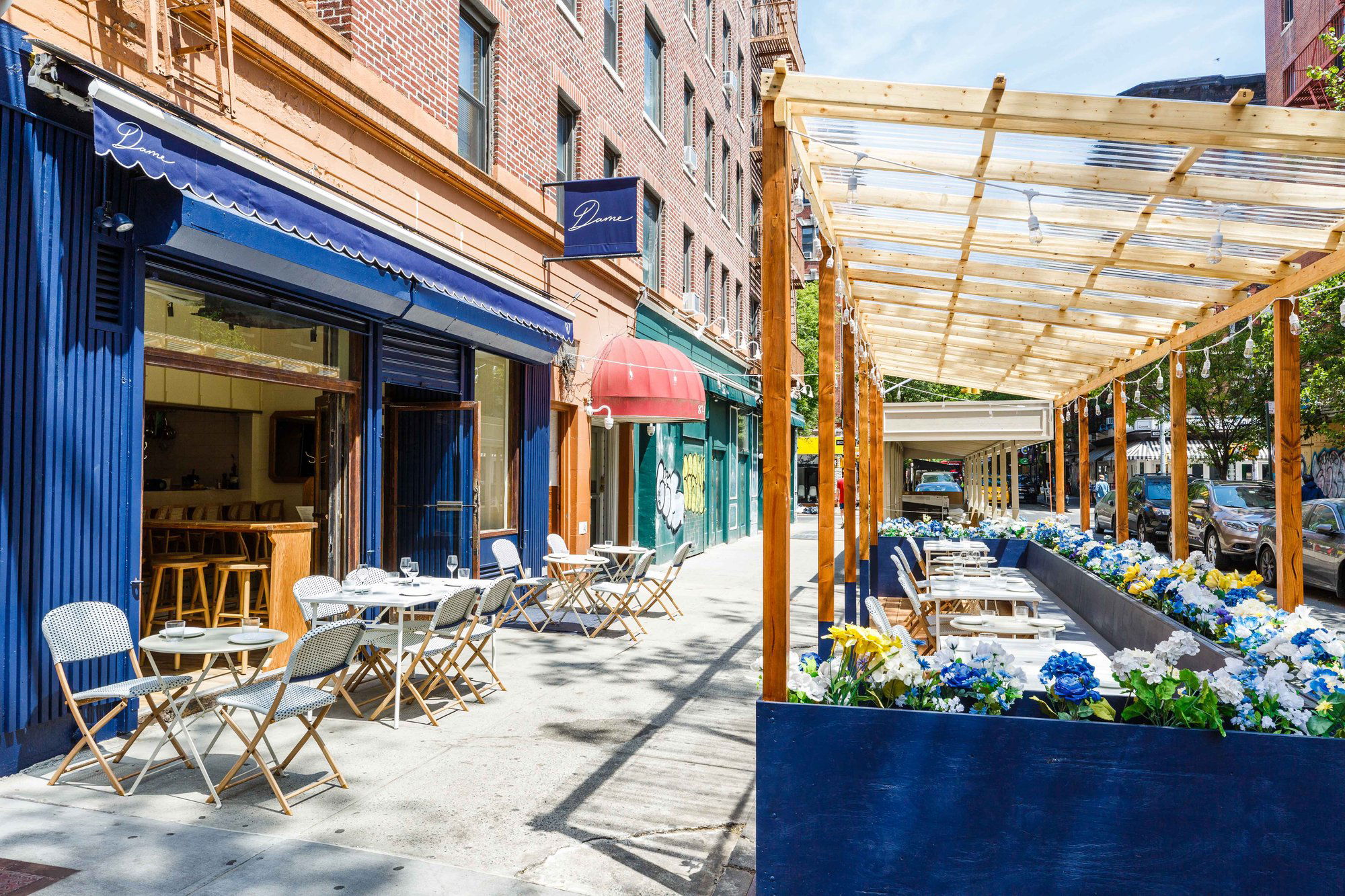
About Dame
On MacDougal Street in Greenwich Village, Dame occupies the quieter, more considered end of downtown New York dining. The room draws a neighbourhood crowd that returns for the food rather than the spectacle, placing it closer in spirit to London-style wine bars than to the louder bistro energy a few blocks north.
MacDougal Street and the Mood Before You Sit Down
Greenwich Village has always housed two kinds of restaurants: the ones that trade on the street's mythology and the ones that ignore it entirely. The stretch of MacDougal between Bleecker and Houston leans toward the former, dense with the noise and foot traffic that the neighbourhood's reputation attracts. Dame, at number 87, operates closer to the latter register. Before you reach the door, the block itself sets a slightly lower temperature than the tourist corridor a hundred metres south, and that calibration carries through once you're inside.
The physical address matters here because location in the Village is not just geography but editorial positioning. A room on MacDougal that resists the bistro-energy default is making an implicit argument about what the meal should feel like, and Dame's argument is that dinner ought to unfold at a pace that gives each stage room to register.
How the Meal Sequences in a Room Like This
New York's downtown dining rooms have spent the past decade splitting into two distinct formats. One format maximises covers and noise, banking on energy as a substitute for precision. The other runs fewer seats, a tighter menu, and a pace controlled enough that the progression from first plate to last reads as deliberate rather than accidental. Dame belongs to the second category, and the sequencing logic that defines that category is worth understanding before you sit down.
In rooms built around tasting progression rather than volume, the opening passes carry more weight than they do in a conventional à la carte setting. They establish acidity, temperature, and texture references that the kitchen will either confirm or subvert as the meal continues. A cold, acid-forward start followed by something richer and warmer is not a coincidence in restaurants operating at this level of intentionality; it is the argument the kitchen is making in real time. The reader who understands this will get more from the meal than one who arrives treating each dish as an isolated transaction.
Greenwich Village has a small cluster of rooms that operate this way, places where the wine list and the kitchen are designed around the same logic rather than independently. Dame sits in that cluster, positioned closer to the wine-bar-with-serious-food model that has migrated from London and Paris into downtown Manhattan over the past several years than to the white-tablecloth tasting-menu format that dominates the midtown tier.
The Wine Program as a Structural Element, Not an Afterthought
One of the clearest signals that a room is built around meal progression rather than individual dishes is how the wine program is integrated. In rooms where the beverage list is treated as a separate revenue stream, the pairings feel coincidental. In rooms where the wine is considered part of the sequencing, the list tends to be shorter, more specific, and oriented toward bottles that work across multiple courses rather than showcasing individual labels.
The downtown New York bar and restaurant scene has produced several venues where the beverage program operates at that higher level of integration. [Amor y Amargo](https://www.enprimeurclub.com/bars/amor-y-amargo) on East 6th Street is the clearest local example of a room entirely structured around a single beverage philosophy. [Attaboy NYC](https://www.enprimeurclub.com/bars/attaboy-nyc) on Eldridge demonstrates a different version, where the absence of a fixed menu forces every decision to be made in response to the guest. Dame's approach sits between those two poles: a room with a kitchen, but one where the drink selection shapes the experience as much as the plate sequence does.
Nationally, comparable integration appears in rooms like [Kumiko in Chicago](https://www.enprimeurclub.com/bars/kumiko), where Japanese whisky and seasonal ingredients share the same conceptual framework, and [Jewel of the South in New Orleans](https://www.enprimeurclub.com/bars/jewel-of-the-south-new-orleans), where the cocktail program draws on the city's culinary archive rather than trend cycles. The broader point is that the most useful way to drink at Dame is to let the room's logic guide the selection rather than arriving with a fixed order in mind.
Placing Dame in the Downtown Village Context
The Village dining scene operates across a wide price and format range. At one end, the neighbourhood's older institutions have calcified into reliable but unadventurous territory. At the other, a generation of smaller, more format-conscious rooms has opened since roughly 2018, drawing from the natural wine movement, the small-plates shift, and a general recalibration toward hospitality that does not require a 90-minute wait on the sidewalk.
Dame lands in that newer cohort, but without the self-consciousness that sometimes accompanies it. The address is not hidden, the format is not conceptually laboured, and the room does not require the diner to decode a thesis statement before ordering. This is a meaningful distinction in a neighbourhood where the line between considered and precious can be thin. Comparable downtown rooms include the Dirty French axis of relaxed French bistro energy further east, and the more cocktail-forward programming at [Superbueno](https://www.enprimeurclub.com/bars/superbueno-new-york-city), which runs a different flavour register but shares the same rejection of high-volume performance dining.
For visitors building a fuller picture of where Dame sits relative to the city's bar and restaurant scene, [our full New York City restaurants guide](https://www.enprimeurclub.com/cities/new-york-city) maps the relevant tiers and neighbourhoods in detail.
What the Progression Feels Like from First to Last
Rooms designed around sequencing tend to reward guests who arrive without a fixed end time. The pacing in these formats is calibrated to feel unhurried without becoming slow, and the transition between courses is usually the moment where the kitchen's intentions become clearest. A shift in temperature, a change in fat level, or a sudden move toward something sweet and acidic after several savoury passes are all structural signals rather than random variation.
At Dame, the meal's arc tends to favour restraint over accumulation. The room does not build toward a single theatrical centrepiece; it sustains a consistent register across the full run of dishes, which is harder to execute than it sounds and more satisfying to experience than a format that peaks early and coasts to the close. This is the version of downtown New York dining that does not photograph dramatically but earns the return visit.
Internationally, this approach appears in rooms like [The Parlour in Frankfurt](https://www.enprimeurclub.com/bars/the-parlour-frankfurt-on-the-main) and [Bar Leather Apron in Honolulu](https://www.enprimeurclub.com/bars/bar-leather-apron-honolulu), both of which operate in the same quiet-precision register, using beverage and food together to shape an experience that accumulates rather than announces itself. [Angel's Share](https://www.enprimeurclub.com/bars/angels-share) in the East Village and [ABV in San Francisco](https://www.enprimeurclub.com/bars/abv) represent the bar-led version of the same sensibility. [Allegory in Washington, D.C.](https://www.enprimeurclub.com/bars/allegory) and [Julep in Houston](https://www.enprimeurclub.com/bars/julep-houston) extend the pattern further across the country, confirming that the integrated food-and-drink progression model is now a recognisable American format rather than a London or Paris import.
Planning Your Visit
Dame is located at 87 MacDougal Street in Greenwich Village, Manhattan. The format suits guests who want a full meal progression rather than a quick drop-in, so arriving without time pressure is advisable. Given the room's size and the neighbourhood's density, advance booking is the reliable path for anyone with a fixed date in mind.
Quick reference: 87 MacDougal St, New York, NY 10012. Greenwich Village, downtown Manhattan. Reservation recommended.
Frequently Asked Questions
- What's the vibe at Dame?
- Dame runs at a lower temperature than most MacDougal Street options, closer to a considered wine-bar format than a high-energy bistro. In the context of downtown New York, where volume and pace tend to dominate, the room's quieter register is a deliberate choice rather than a byproduct of its size or location.
- What should I drink at Dame?
- The beverage program is structured to work alongside the food progression rather than independently of it. The most productive approach is to take direction from whoever is running the floor, particularly for wine, where the list is likely organised around bottles that move well across multiple courses rather than showcasing labels for their own sake.
- What's the standout thing about Dame?
- Among downtown Village rooms in this format and price tier, Dame's consistency of register across the full meal is its clearest differentiator. The kitchen does not build toward a single theatrical moment; it sustains a measured tone from the first plate to the last, which is less common than it sounds.
- Do I need a reservation for Dame?
- In a neighbourhood as dense as Greenwich Village, walk-ins at rooms of this scale are unreliable for anyone with a fixed plan. If you have a specific evening in mind, booking ahead removes the variable. Check the venue's current booking channels directly, as policies at smaller downtown rooms change more frequently than at larger operations.
- Is Dame worth visiting?
- For guests whose preference is a meal that sequences deliberately and pairs food with a wine program built around the same logic, Dame represents one of the more coherent examples of that format currently operating in downtown Manhattan. The room does not trade on spectacle, which makes it a poor choice for guests who equate energy with quality, but a strong one for those who do not.
- How does Dame compare to other wine-forward rooms in Manhattan?
- Dame sits in a small tier of downtown Manhattan venues where the kitchen and the beverage program are designed around the same sequencing logic rather than operating as separate departments. This places it in a different competitive set from larger natural-wine bars that prioritise the list over the food, and from formal tasting-menu rooms where the wine pairing is a fixed add-on. The Greenwich Village address, the room's scale, and the format's informality collectively position it closer to the London or Paris wine-bar model than to either extreme of the New York dining spectrum.
More bars in New York City
- (SUB)MERCER(SUB)MERCER occupies a basement address on Mercer Street in SoHo, positioning it as a deliberate destination rather than a drop-in. The subterranean format tends to keep ambient noise lower than street-level alternatives, making it a reasonable call for groups of four or more. Book ahead for weekends and confirm group capacity directly with the venue.
- 1 OR 81 OR 8 on DeKalb Avenue is a low-key Fort Greene bar that works best for two people on a weeknight when the room is quiet enough for conversation. Walk-ins are easy, no advance planning required. If a specialist cocktail program is your priority, Attaboy or Amor y Amargo offer more defined experiences — but for a neighbourhood drink without the fuss, this delivers.
- 230 Fifth Rooftop Bar230 Fifth is the easiest rooftop bar in Midtown to walk into, and the Empire State Building views justify the trip. The crowd skews groups and tourists, and the drinks are solid rather than craft-focused. Go early on a weekday for the best version of the experience; after 9 PM on weekends it tips firmly into party-group territory.
- 4 Charles Prime Rib4 Charles Prime Rib is a compact, reservation-required West Village dining room built around a focused prime rib format. It works well for dates and pairs but is too small for groups of four or more. Booking is easy relative to Manhattan peers, and the narrow menu signals a kitchen that executes one thing consistently well.
- 44 & X Hell's KitchenA low-key Hell's Kitchen neighborhood bar-restaurant that earns its place for easy weeknight dates and pre-theatre dinners. Booking is simple, the room is intimate enough for conversation, and there's no dress pressure. Not a cocktail destination, but a reliable, pressure-free option in Midtown West when you want comfort over spectacle.
- 58-22 Myrtle Ave58-22 Myrtle Ave is a low-key Ridgewood neighborhood spot that rewards return visits more than first impressions. Easy to get into, with no reservation headaches, it suits regulars looking for an unpretentious room rather than a structured cocktail program. If a strong drinks list or kitchen ambition matters to you, look to Attaboy or Amor y Amargo instead.
Related editorial
- Best Fine Dining Restaurants in ParisFrom three-Michelin-star icons to the next generation of Parisian chefs pushing boundaries, these are the restaurants that define fine dining in the world's culinary capital.
- Best Luxury Hotels in RomeFrom rooftop terraces overlooking ancient ruins to Michelin-starred hotel dining, these are the luxury hotels that make Rome unforgettable.
- Best Cocktail Bars in KyotoFrom sleek lounges to hidden speakeasies, Kyoto's cocktail scene blends Japanese precision with global influence in ways you won't find anywhere else.
Save or rate Dame on Pearl
Keep this venue in your Pearl passport, rate it after you visit, and track it alongside every other place you collect.