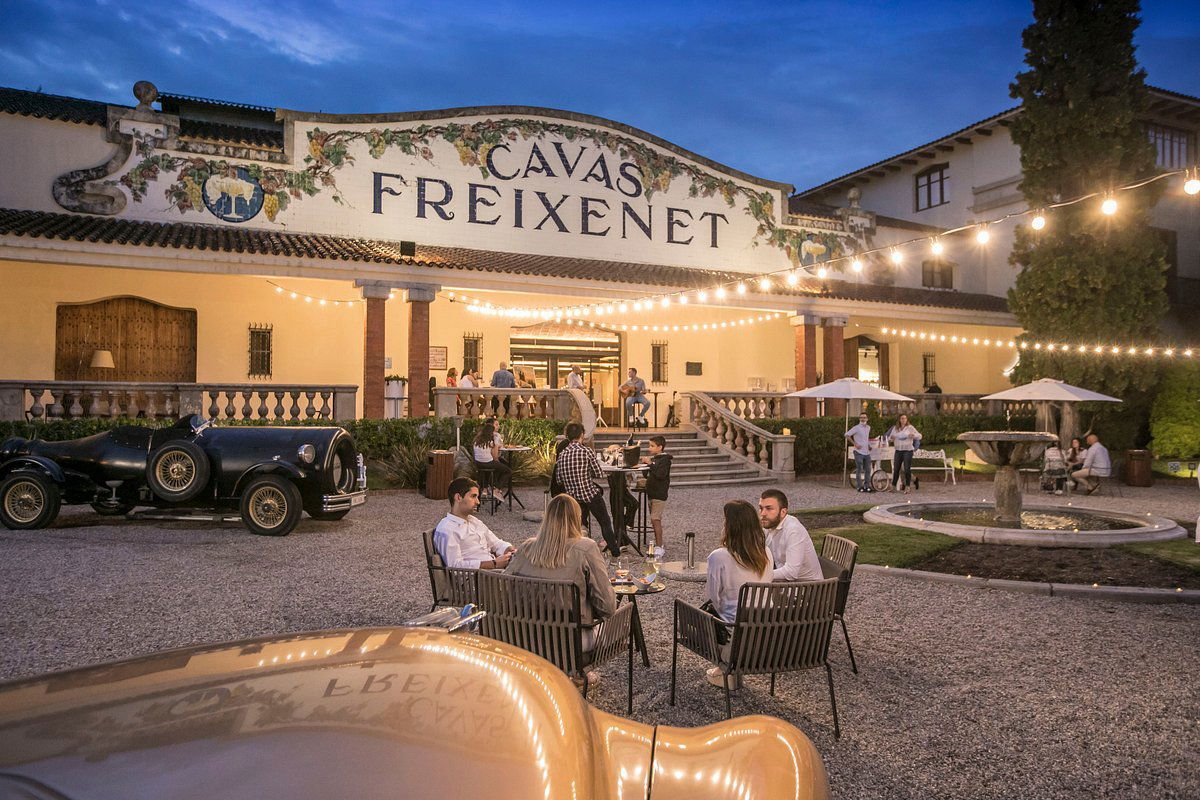
Winery in Sant Sadurní d'Anoia, Spain
Freixenet
750ptsUnderground Cava Production

About Freixenet
Freixenet is one of Cava's most recognisable names, operating from its historic cellars in Sant Sadurní d'Anoia, the heartland of Spain's sparkling wine tradition. Awarded a Pearl 3 Star Prestige rating in 2025, the house represents a reference point for understanding Cava at scale — where industrial ambition and regional identity have long intersected. A visit places the wine in its full geographical and technical context.
Where Cava's Commercial Scale Meets Catalan Terroir
Sant Sadurní d'Anoia sits roughly 40 kilometres southwest of Barcelona in the Alt Penedès comarca, and the town's identity is inseparable from the sparkling wine it has produced for well over a century. The Carrer de Joan Sala address for Freixenet is not simply a winery entrance; it opens onto one of the most visited wine production sites in Europe, where the scale of the cellars — kilometres of underground galleries carved beneath the town — communicates something that no tasting note can fully replace. The physical environment is the first argument Freixenet makes for Cava as a serious category, not merely a budget alternative to Champagne.
Cava's Denominació d'Origen framework covers a wide geographic area, but Sant Sadurní d'Anoia remains its commercial and symbolic centre. Houses like Codorníu, Juvé & Camps, Raventós i Blanc, Gramona, and Recaredo all operate within a few kilometres of one another, and the cumulative effect is a wine town with genuine depth , one where a single afternoon visit scarcely does justice to the range of approaches on offer. Freixenet occupies a specific position within that peer set: it operates at a volume that none of its local neighbours match, which makes its production philosophy and quality positioning a different kind of editorial subject than a small-grower Cava house.
The Cava Tradition and Freixenet's Place Inside It
Sparkling wine made by the traditional method , secondary fermentation in bottle, extended lees ageing, disgorgement , has been produced in the Penedès since the 1870s. The indigenous grape varieties that define Cava's character, principally Macabeu, Xarel·lo, and Parellada, thrive in the calcareous clay soils of the region and produce wines that differ structurally from Champagne's Chardonnay and Pinot-driven profile: lower acidity at harvest, broader texture, and an aromatic register that tends toward white stone fruit and herbs rather than green apple and chalk.
Freixenet's production model , supplying sparkling wine at international scale across dozens of markets , has always required consistency above provenance storytelling. This is not a criticism; it reflects a genuine strategic choice that separates the house from grower-focused neighbours like Gramona or Recaredo, where extended lees contact and single-estate sourcing sit at the centre of the proposition. Understanding that distinction is what allows a visitor or buyer to read Freixenet's 2025 Pearl 3 Star Prestige award correctly: it signals quality performance within the framework of a large-production house, which is a meaningful credential rather than a diminished one.
The traditional method at this scale demands rigorous process control. Secondary fermentation management, riddling (whether by hand or gyropallet), and disgorgement across millions of bottles annually require a technical operation that few wine regions in the world have replicated with comparable reliability. The cellars beneath Sant Sadurní d'Anoia, maintained at the near-constant cool temperatures that long lees ageing requires, are in many respects as technically demanding as any small-batch production environment.
Reading the 2025 Pearl 3 Star Prestige Recognition
Freixenet holds a Pearl 3 Star Prestige rating from EP Club for 2025. Within the EP Club framework, Pearl designations mark producers whose output meets a consistently high standard across their range , not a single exceptional bottling, but a demonstrable floor of quality that a visitor or buyer can rely on. At a house operating at Freixenet's volume, that consistency signal carries specific weight: it suggests the technical controls in place are producing results above the category average for large-format Cava production.
Positioning Freixenet against its Sant Sadurní d'Anoia neighbours is instructive. Houses like Gramona and Recaredo have built reputations primarily on prestige and extended-aged cuvées, attracting a collector and sommelier audience that approaches Cava as a serious fine-wine category. Freixenet's competitive set is broader and more international , it occupies shelf space alongside Prosecco, Champagne, and Crémant in global retail, which means its quality signals operate differently than those of a 5,000-case artisan producer.
Visiting the Cellars: What the Experience Addresses
Winery visits at Freixenet are structured around the underground galleries, which serve as both a production facility and an educational environment. The sensory immediacy of walking through kilometres of ageing bottles, understanding the role of temperature stability in lees development, and seeing the scale of disgorgement operations gives visitors a grounding in traditional method production that classroom explanation cannot replicate.
Sant Sadurní d'Anoia is accessible by regional rail from Barcelona's Plaça de Catalunya station , the R4 line runs direct and takes approximately 50 minutes, making a day visit from the city practical without requiring a car. This logistics profile sets the town apart from many Spanish wine regions, where cellar access typically demands either a rental vehicle or a guided tour transfer. Visitors planning to cover multiple houses in a single day , combining Freixenet with a call to Juvé & Camps or Raventós i Blanc, for instance , will find the town's compact geography accommodating. See our full Sant Sadurní d'Anoia guide for a structured itinerary across the region's producers.
For context on how large-format traditional-method wine tourism operates elsewhere in Spain, the comparison with CVNE (Cune) in Haro is useful: both houses combine significant production history with visitor infrastructure designed to explain a regional category at scale. Similarly, Lustau in Jerez de la Frontera offers a comparable model in the Sherry context, where the cellar environment itself is central to understanding what the wine is and why it tastes the way it does.
Planning Your Visit
Freixenet's cellars are located at Carrer de Joan Sala, 2, in Sant Sadurní d'Anoia, Barcelona province. Tours are bookable in advance through the winery's own channels; given the volume of visitors the site receives, advance reservation is advisable rather than optional, particularly during spring and autumn weekends when the Alt Penedès draws significant tourist traffic from Barcelona. Specific pricing, tour formats, and opening hours are subject to change and are leading confirmed directly with the winery before travel.
Visitors with an interest in contrasting Freixenet's production model against smaller, terroir-focused Cava producers should consider also visiting Gramona or Recaredo, both of which represent the artisan end of the Sant Sadurní d'Anoia spectrum. For those building a broader Spanish wine itinerary beyond Cava, Bodegas Protos in Peñafiel, Emilio Moro in Pesquera de Duero, Clos Mogador in Gratallops, Marqués de Cáceres in Cenicero, and Marqués de Griñón (Dominio de Valdepusa) in Malpica de Tajo each represent different regional traditions worth anchoring a visit around. Further afield, Aberlour in Aberlour and Accendo Cellars in St. Helena demonstrate how visitor experience at serious producers operates across entirely different wine categories and climates.
Frequently Asked Questions
What is the signature bottle at Freixenet?
Freixenet's most globally distributed wine is its Cordon Negro Brut, made from the traditional Cava grape trio of Macabeu, Xarel·lo, and Parellada and aged by the traditional method in the house's underground cellars in Sant Sadurní d'Anoia. As a large-production house operating across international markets, the range extends across multiple tiers and styles, from entry-level non-vintage Cava to prestige cuvées with extended lees ageing. The 2025 Pearl 3 Star Prestige recognition from EP Club applies across the house's output, not a single bottling.
What should I know about Freixenet before I go?
Freixenet operates in Sant Sadurní d'Anoia, the core Cava production town roughly 40 kilometres southwest of Barcelona and accessible by direct regional train. The experience is structured around the cellar galleries rather than an intimate tasting-room format , this is a large-scale production site with visitor infrastructure to match. The house holds a 2025 Pearl 3 Star Prestige rating from EP Club. Specific pricing and tour formats should be confirmed in advance; booking ahead is advisable given visitor volumes.
Do they take walk-ins at Freixenet?
Freixenet's cellar tours attract substantial visitor numbers, and advance reservation is the more reliable approach, particularly during peak periods in spring and autumn. Walk-in availability depends on daily capacity and group bookings already in place. For confirmed hours, availability, and booking options, checking directly with the winery before travelling is the safest course. The winery's Sant Sadurní d'Anoia location, served by direct rail from Barcelona, makes it easy to combine with pre-booked visits to neighbouring producers such as Codorníu on the same day.
Related editorial
- Best Fine Dining Restaurants in ParisFrom three-Michelin-star icons to the next generation of Parisian chefs pushing boundaries, these are the restaurants that define fine dining in the world's culinary capital.
- Best Luxury Hotels in RomeFrom rooftop terraces overlooking ancient ruins to Michelin-starred hotel dining, these are the luxury hotels that make Rome unforgettable.
- Best Cocktail Bars in KyotoFrom sleek lounges to hidden speakeasies, Kyoto's cocktail scene blends Japanese precision with global influence in ways you won't find anywhere else.
Save or rate Freixenet on Pearl
Keep this venue in your Pearl passport, rate it after you visit, and track it alongside every other place you collect.