
Winery in Saint-Marcel, Italy
Distilleria La Valdôtaine
500ptsHigh-Altitude Alpine Distillation
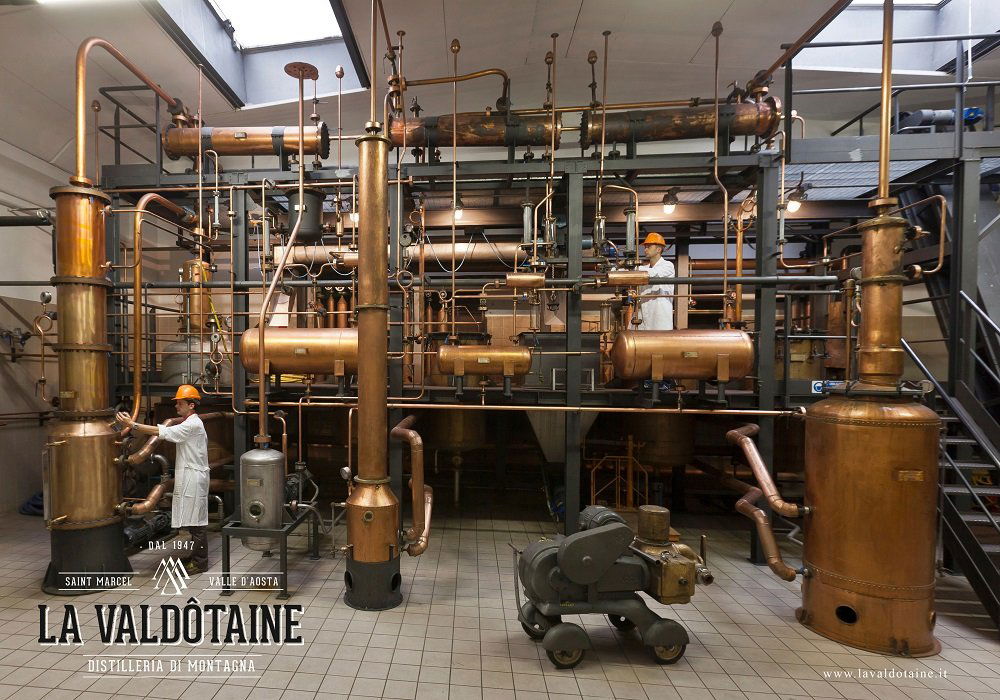
About Distilleria La Valdôtaine
A grappa and spirits producer operating from the industrial zone above Saint-Marcel in the Aosta Valley, La Valdôtaine earned a Pearl 2 Star Prestige rating in 2025, placing it among the more decorated distilleries in northern Italy. The setting is austere by design: this is a working distillery rather than a tasting-room destination, and the spirits reflect the altitude, climate, and grape varieties of one of Italy's most geographically extreme wine regions.
Where the Alps Set the Terms
The Aosta Valley does not make things easy for producers. At elevations that regularly exceed 600 metres, with a continental climate compressed between the western Alps and the Mont Blanc massif, growing seasons are short, yields are constrained, and the varietals that survive here — Petit Rouge, Fumin, Cornalin, Prié Blanc — are found almost nowhere else on the Italian peninsula. These are not grapes that arrived with fashion. They predate the DOC system, predate modern viticulture as Italy understands it, and they carry in their skins a particular mineral austerity that the Aosta Valley's granitic and schist-heavy soils tend to produce. Distilleria La Valdôtaine, operating from the Zona industriale above Saint-Marcel, works with this raw material as its primary argument.
The distillery's 2025 Pearl 2 Star Prestige award places it in the upper tier of recognised Italian spirits producers, a recognition that carries weight in a category , grappa and Alpine distillates , where the peer set includes [Nonino Distillery in Pavia di Udine](https://www.enprimeurclub.com/wineries/nonino-distillery-pavia-di-udine-winery), [Distilleria Marzadro in Nogaredo](https://www.enprimeurclub.com/wineries/distilleria-marzadro-nogaredo-winery), [Poli Distillerie in Schiavon (Vicenza)](https://www.enprimeurclub.com/wineries/poli-distillerie-schiavon-vicenza-winery), and [Distilleria Romano Levi in Neive](https://www.enprimeurclub.com/wineries/distilleria-romano-levi-neive-winery). Each of those houses draws on a distinct regional raw material. What separates La Valdôtaine is the specificity of its source geography: the Aosta Valley contributes grape pomace with a character that is categorically different from Piedmont, Trentino, or Veneto , leaner, more mineral, with a floral register that tracks back to high-altitude viticulture.
The Logic of Alpine Distillation
Grappa as a category has spent the last three decades earning serious critical attention, moving from a rough digestivo drunk to close a meal at trattorie to a product that sommeliers in Milan and London now place with the same care as aged Armagnac or single-malt Scotch. That repositioning has been driven partly by producers in the northeast of Italy , notably Nonino's introduction of single-varietal expressions in the 1970s , but the Alpine arc from Piedmont through Valle d'Aosta and into Trentino represents the category's most geographically coherent story. For comparison: [Distilleria Marzadro in Nogaredo](https://www.enprimeurclub.com/wineries/distilleria-marzadro-nogaredo-winery) draws on Trentino varietals; [Distilleria Romano Levi in Neive](https://www.enprimeurclub.com/wineries/distilleria-romano-levi-neive-winery) works with Piedmontese pomace, much of it Moscato and Nebbiolo. La Valdôtaine sits at the western end of this arc, where the mountains are steeper and the viticultural tradition more isolated.
The terroir argument for grappa follows the same logic as the terroir argument for wine, though the mechanism differs. Pomace carries the residual compounds , polyphenols, aromatic precursors, mineral signatures , that transfer into the distillate. When the pomace comes from Petite Arvine grown at 900 metres, or from Fumin vines on south-facing schist terraces above the Dora Baltea river, the resulting grappa carries a profile that is traceable to its source. This is the editorial case for La Valdôtaine and for Valle d'Aosta distillation more broadly: the raw material here is unusual enough that even a technically competent distillation produces something with a distinct regional identity. For visitors who follow spirits with the same rigour they apply to wine, this northwest corner of Italy is a logical stop that complements itineraries built around [Aldo Conterno in Monforte d'Alba](https://www.enprimeurclub.com/wineries/aldo-conterno-monforte-dalba-winery) or [Ca' del Bosco in Erbusco](https://www.enprimeurclub.com/wineries/ca-del-bosco-erbusco-winery) to the south and east.
Saint-Marcel and the Industrial Zone Setting
The address , Zona industriale, 12 , signals what this is not. La Valdôtaine is not a showpiece estate built for the wine-tourism circuit, and the surrounding area reflects that honestly. Saint-Marcel sits above the valley floor between Aosta and Châtillon, in a stretch of the valley where light industry and small-scale agriculture occupy the same terraced terrain. For visitors accustomed to the designed-for-hospitality estates of Barolo or Chianti , the kind of approach associated with [Castello di Volpaia in Radda in Chianti](https://www.enprimeurclub.com/wineries/castello-di-volpaia-radda-in-chianti-winery) or [Lungarotti in Torgiano](https://www.enprimeurclub.com/wineries/lungarotti-torgiano-winery) , the industrial zone setting requires a recalibration of expectations. What it offers instead is the functional austerity of a producer whose primary relationship is with the still and the raw material, not the tasting room.
That positioning matters in a category where producers increasingly compete on visitor experience as much as on product quality. La Valdôtaine's 2 Star Prestige recognition suggests the product warrants serious attention regardless of staging. For spirits-focused visitors, the Aosta Valley's own wine infrastructure provides useful context: the regional DOC covers a narrow corridor of the valley, and producers of Torrette, Enfer d'Arvier, and Blanc de Morgex et de La Salle work in conditions that feed directly into the distillery's raw material supply. The connection between valley viticulture and valley distillation is tighter here than in regions where pomace is sourced across broader geographic areas. See our [full Saint-Marcel restaurants guide](https://www.enprimeurclub.com/cities/saint-marcel) for surrounding context on the local food and drinks scene.
Situating La Valdôtaine in the Italian Spirits Field
Italy's spirits sector beyond grappa also rewards comparison. [Campari in Milan](https://www.enprimeurclub.com/wineries/campari-milan-winery) represents the industrial-scale, internationally distributed pole of Italian spirits production. La Valdôtaine operates at the opposite end of that spectrum: small-scale, geographically specific, and oriented toward a buyer who treats distillate origin with the same seriousness they apply to appellation wine. The 2 Star Prestige award in 2025 positions it alongside, rather than beneath, the more celebrated names in the category. For reference: Nonino holds its own significant tier of recognition; [Poli Distillerie in Schiavon (Vicenza)](https://www.enprimeurclub.com/wineries/poli-distillerie-schiavon-vicenza-winery) has built a strong international presence on a museum-and-tasting model. La Valdôtaine's recognition comes from the product rather than from visitor infrastructure, which is a different kind of credential.
That distinction also shapes how Italian wine estates in the premium tier, including [Planeta in Menfi](https://www.enprimeurclub.com/wineries/planeta-menfi-winery) and [Poggio Antico in Monte San Vito](https://www.enprimeurclub.com/wineries/poggio-antico), have incorporated grappa programs: as a secondary expression of their own pomace, building regional specificity into the spirit just as they do in the wine. La Valdôtaine, as a dedicated distillery rather than a winery with a spirits annex, takes that logic to its conclusion , the entire operation is oriented around extracting the maximum expression from Alpine pomace, rather than treating distillation as an ancillary product line. For comparison across the Italian premium spirits and wine estate field, [L'Enoteca Banfi in Montalcino](https://www.enprimeurclub.com/wineries/lenoteca-banfi) and [Accendo Cellars in St. Helena](https://www.enprimeurclub.com/wineries/accendo-cellars) each represent the estate model where wine remains the central product and spirits play a supporting role. Internationally, the same product-first logic applies to single-malt Scotch houses such as [Aberlour in Aberlour](https://www.enprimeurclub.com/wineries/aberlour-aberlour-winery), where the distillery's geographic specificity is the primary editorial argument.
Planning Your Visit
The address at Zona industriale, 12 in Saint-Marcel is accessible by road from the A5 autostrada, with the Val d'Aosta motorway corridor connecting the area to Aosta (roughly 15 kilometres to the west) and to Turin further south. Contact and booking information are not publicly listed in the EP Club database at time of publication; visitors planning a specific tasting or facility visit should approach through the distillery's direct channels before travelling. Given the industrial zone setting and the production-focused operation, arrival without prior arrangement is unlikely to produce a structured tasting experience. For visitors building a northern Italian spirits and wine itinerary, integrating La Valdôtaine with Piedmontese producers to the south makes geographic sense, and the Aosta Valley itself offers enough to justify a dedicated overnight stay: the valley's DOC wines, the Roman archaeology in Aosta, and the Alpine terrain add depth to a visit that goes beyond a single producer call.
Frequently Asked Questions
What is the atmosphere like at Distilleria La Valdôtaine?
La Valdôtaine occupies the industrial zone above Saint-Marcel, in the Aosta Valley, which sets an expectation of functional production premises rather than a designed hospitality environment. The 2025 Pearl 2 Star Prestige award signals product seriousness rather than experience staging. Visitors who reach this corner of northwest Italy for its spirits will find the setting consistent with a working distillery rather than an estate built for tourism. Contact the distillery directly before visiting to establish what access is available.
What is the leading spirit to try at Distilleria La Valdôtaine?
Without a confirmed current product list in the EP Club database, specific expression recommendations are not possible here. What the regional context suggests is that grappa produced from indigenous Aosta Valley varietals , Petit Rouge, Cornalin, Prié Blanc, Fumin , would carry the most distinct regional character of any expression on offer. These are grape varieties grown in one of Italy's geographically most extreme wine regions, at high altitude on schist and granite soils, and the distillate from their pomace carries a mineral and floral register that is specific to this part of the Alpine arc. The 2025 Pearl 2 Star Prestige recognition confirms the technical execution warrants serious attention.
What is Distilleria La Valdôtaine known for?
La Valdôtaine is an Aosta Valley distillery recognised for Alpine grappa production from one of Italy's most isolated and geographically extreme wine regions. Its 2025 Pearl 2 Star Prestige award places it in the upper tier of Italian spirits producers at that assessment cycle. The distillery's case rests on the distinctiveness of its raw material: Valle d'Aosta grape pomace from indigenous high-altitude varietals produces a distillate profile that is genuinely different from Piedmontese or Trentino grappa, with leaner body and more pronounced mineral character.
How far ahead should I plan for Distilleria La Valdôtaine?
Phone and website details are not publicly listed in the EP Club database, so the appropriate planning window depends on direct contact with the distillery to confirm visit formats and availability. Given the industrial zone address and production-focused operation, this is not a venue where arrival without arrangement is likely to produce a structured experience. For visitors incorporating La Valdôtaine into a longer northern Italian itinerary, establishing contact at least several weeks in advance is a sensible baseline, particularly during the autumn harvest period when distillery operations are at peak intensity.
Related editorial
- Best Fine Dining Restaurants in ParisFrom three-Michelin-star icons to the next generation of Parisian chefs pushing boundaries, these are the restaurants that define fine dining in the world's culinary capital.
- Best Luxury Hotels in RomeFrom rooftop terraces overlooking ancient ruins to Michelin-starred hotel dining, these are the luxury hotels that make Rome unforgettable.
- Best Cocktail Bars in KyotoFrom sleek lounges to hidden speakeasies, Kyoto's cocktail scene blends Japanese precision with global influence in ways you won't find anywhere else.
Save or rate Distilleria La Valdôtaine on Pearl
Keep this venue in your Pearl passport, rate it after you visit, and track it alongside every other place you collect.