
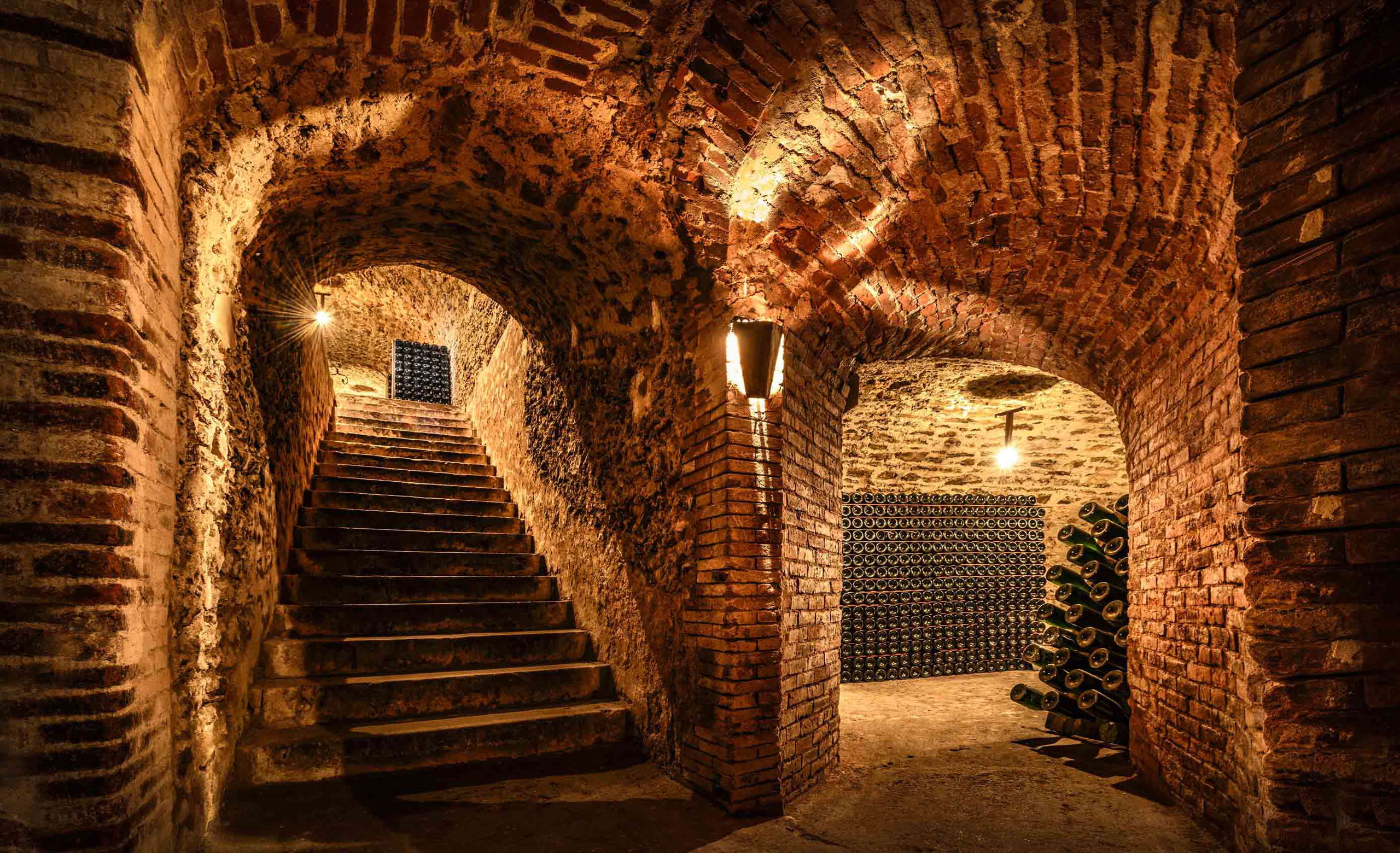


Winery in Le Mesnil-sur-Oger, France
Champagne Salon
2,000ptsSingle-Vineyard Monoculture

About Champagne Salon
Champagne Salon has produced a single-vineyard, single-varietal blanc de blancs from Le Mesnil-sur-Oger's Grand Cru chalk since its first vintage in 1921, releasing only in years the harvest meets its threshold. Under winemaker Didier Depond, the house holds a Pearl 5 Star Prestige rating (2025) and occupies a tier of Champagne production defined by deliberate scarcity and extreme terroir specificity.
Chalk, Time, and the Logic of Restraint
The village of Le Mesnil-sur-Oger sits at the southern end of the Côte des Blancs, where the chalk geology runs particularly deep and the east-facing slopes produce a Chardonnay with a mineral tension that sets it apart from the broader Champagne appellation. This is not a marketing narrative — it is a measurable geological condition. The belemnite chalk beneath Le Mesnil retains water during dry periods and drains rapidly after rain, forcing vine roots deep and producing grapes with high acidity, low sugar, and a precision that makes the village's Grand Cru classification legible in the glass. That geology is the foundation on which Champagne Salon has built its entire production logic since 1921.
Few wine categories reward geographical specificity the way Champagne does, yet most houses blend across villages, vintages, and grape varieties to construct a house style that transcends any single harvest. Salon inverts that model entirely. The house produces one wine: a blanc de blancs from a single Grand Cru parcel in Le Mesnil-sur-Oger, from Chardonnay alone, released only in years judged to express the site at a level the house considers sufficient. The result is a production schedule defined by abstention as much as output. Across a century of activity, fewer than forty vintages have been released — a ratio that places Salon in a different conversation from almost any other producer in the region. For broader context on the Le Mesnil-sur-Oger producing environment, see our full Le Mesnil-sur-Oger guide.
What the Terroir Argument Actually Means Here
Terroir is one of the most overused words in wine writing, applied to everything from marketing copy to genuine geological argument. At Salon, the terroir claim is specific and defensible. The house draws from a defined parcel within a Grand Cru village whose chalk composition and microclimate have been documented over decades of comparison with neighbouring plots. The Chardonnay planted there produces grapes that, in the right vintage conditions, carry a salinity and mineral intensity that persists through extended lees ageing , typically a decade or more before disgorgement. That ageing period is not decorative; it is the mechanism by which the chalk character integrates with autolytic complexity to produce the tension the house is known for.
Under winemaker Didier Depond, the house holds a Pearl 5 Star Prestige rating in 2025, the highest tier in EP Club's assessment framework. That classification reflects not just product quality but the coherence of a production philosophy applied consistently across generations. Depond's role is custodial in the leading sense: the decisions that define Salon , single village, single variety, single vineyard, selective vintage release , predate his tenure and will outlast it. What changes under each steward is the calibration of the threshold, the judgement call about whether a given harvest clears the bar.
The nearby house of Delamotte shares the same Le Mesnil-sur-Oger address and operates under the same ownership structure, producing a more accessible blanc de blancs that draws on similar chalk terroir. The relationship between the two houses is a useful illustration of how the same appellation can sustain radically different production registers: Delamotte offers regularity and availability; Salon offers rarity and compression. Neither approach is a compromise , they are distinct editorial statements about what Champagne can be. Similarly, Pierre Peters, another Le Mesnil-sur-Oger producer, demonstrates how Grand Cru chalk can be expressed across a range of formats, from non-vintage blends to prestige cuvées, while remaining rooted in the same geological conditions.
The Architecture of Scarcity
Scarcity in wine takes two forms: manufactured and structural. Manufactured scarcity is a marketing tool, applied post-production to create demand. Structural scarcity arises from the production logic itself , from a commitment to conditions that cannot always be met. Salon operates on structural scarcity. The decision not to release a vintage is not a branding exercise; it is the logical consequence of a single-site, single-vintage, no-reserve-wine model applied in a climate that produces highly variable harvests. When the conditions do not produce a wine that expresses Le Mesnil at the level the house requires, no wine is made. That constraint is self-imposed, but its effect is real: it limits total production to a fraction of what the physical infrastructure could theoretically support.
The first vintage in 1921 establishes a historical baseline that few houses in any wine region can match. A century of selective release means the archive of Salon vintages functions as a longitudinal record of Le Mesnil-sur-Oger's leading growing seasons, with the gaps in the sequence as informative as the releases themselves. Collectors and sommeliers reading the release history can map it against meteorological and viticultural data in ways that genuinely illuminate the relationship between climate and chalk expression in this specific corner of the Côte des Blancs.
This kind of long-arc commitment to a single terroir is rare in Champagne but has parallels in other French wine traditions. Houses like Albert Boxler in Niedermorschwihr demonstrate how Alsatian producers have built comparable cases for parcel-level specificity over multiple generations. In Bordeaux, the classification system at estates like Château Bélair-Monange in Saint-Emilion, Château Batailley in Pauillac, and Château Branaire Ducru in St-Julien similarly creates frameworks for understanding how specific soils express themselves across decades. In Pomerol, Château Clinet and in Haut-Médoc, Château Cantemerle provide further reference points for how French fine wine has consistently argued that place, more than producer intervention, is the primary variable.
Positioning Within the Premium Champagne Tier
The premium Champagne tier has expanded considerably over the past two decades, with houses across the region launching prestige cuvées and grower-producer bottlings that compete on terroir specificity. Salon operates above this expanded tier, in a bracket defined by a combination of historical depth, production constraint, and critical consensus that is difficult to replicate quickly. The Pearl 5 Star Prestige rating awarded in 2025 places it alongside a small number of producers globally who meet the threshold across all assessment dimensions: terroir coherence, production integrity, critical recognition, and collector demand.
For context, other EP Club 5 Star Prestige producers in unrelated categories , from Château d'Arche in Sauternes to Accendo Cellars in St. Helena , share the classification tier without sharing production models. The rating reflects a floor condition, not a production template. What distinguishes Salon within that peer group is the single-variable logic: every decision , village, grape, vintage release , removes a degree of freedom in service of the terroir argument. That argument, sustained since 1921, is the house's primary credential.
Planning a Visit and Acquiring the Wine
Salon is located at 5 Rue de la Brèche d'Oger in Le Mesnil-sur-Oger, a small village in the Marne that receives visitors primarily through appointment-based cellar access rather than walk-in tourism. The house does not operate as a public tasting room in the conventional sense; access is typically arranged through trade contacts or via allocation relationships established over time. Given the scarcity of releases and the collector demand they generate, secondary market pricing for current and back vintages runs considerably above release levels, and availability through standard retail channels is limited. Visitors to the region who want to understand the Le Mesnil terroir more broadly will find the village itself instructive , the chalk geology is visible in the soil cuts along vineyard paths, and the density of Grand Cru plantings makes the area one of the more concentrated expressions of single-village Champagne production anywhere in the appellation.
Comparable fine wine experiences in France that reward similar levels of pre-planning include Château Boyd-Cantenac in Cantenac, Château Bastor-Lamontagne in Preignac, and, outside the wine category entirely, the heritage distillery experience at Chartreuse in Voiron or the single malt tradition explored at Aberlour in Aberlour , all properties where the product logic is inseparable from place and cannot be understood without some engagement with the physical site.
Frequently Asked Questions
- What's the must-try wine at Champagne Salon?
- There is only one wine to try: the Salon Blanc de Blancs, a single-vineyard, single-vintage, 100% Chardonnay Champagne from Le Mesnil-sur-Oger's Grand Cru chalk. Winemaker Didier Depond oversees a production model unchanged since the first vintage in 1921 , one wine, one village, one grape variety. The Pearl 5 Star Prestige rating (2025) reflects the critical consensus that has built around this wine over decades.
- What's the defining thing about Champagne Salon?
- The defining characteristic is the binary release logic: Salon produces wine only in vintages it considers expressive of Le Mesnil-sur-Oger at the required level. No release means no wine that year, with no secondary blending or reserve program to compensate. That constraint, applied in a village in the Côte des Blancs where the chalk geology is among the most documented in Champagne, produces a wine whose price and collector demand reflect both scarcity and historical depth.
- How hard is it to get in to Champagne Salon?
- Access to Salon , whether as a visitor or as a buyer , requires advance arrangement. The house does not operate walk-in visits, and wine availability through retail channels is limited by low release volumes and high collector demand. Visits are typically arranged through trade or allocation relationships. If you are planning travel to Le Mesnil-sur-Oger specifically to engage with the Salon operation, allow several months of lead time and approach through established wine trade contacts rather than direct cold inquiry.
- When does Champagne Salon make the most sense to choose?
- Salon is the appropriate choice when the purpose of the bottle is specifically to examine what a single Grand Cru chalk site in Le Mesnil-sur-Oger produces under ideal vintage conditions, with a decade or more of lees ageing applied. It is not a casual aperitif selection, and its price point reflects production constraints rather than positioning strategy. For occasions where the argument of a wine , its terroir logic, its historical continuity since 1921, its Pearl 5 Star Prestige standing , is itself part of what is being served, Salon is coherent in a way few houses can match.
- Why does Champagne Salon release so few vintages compared to other prestige houses?
- Because Salon operates without a reserve wine program, it cannot blend difficult harvests into a non-vintage base or soften an underperforming year with older parcels held in reserve. The single-vintage, single-site model means that when Le Mesnil-sur-Oger does not produce Chardonnay at the threshold the house requires, no release is made. Across more than a century since the first 1921 vintage, fewer than forty vintages have been declared , a figure that illustrates how demanding the threshold is and why each released bottle carries the weight of a specific, documented growing season rather than a blended house average.
Recognized By
Related editorial
- Best Fine Dining Restaurants in ParisFrom three-Michelin-star icons to the next generation of Parisian chefs pushing boundaries, these are the restaurants that define fine dining in the world's culinary capital.
- Best Luxury Hotels in RomeFrom rooftop terraces overlooking ancient ruins to Michelin-starred hotel dining, these are the luxury hotels that make Rome unforgettable.
- Best Cocktail Bars in KyotoFrom sleek lounges to hidden speakeasies, Kyoto's cocktail scene blends Japanese precision with global influence in ways you won't find anywhere else.
Save or rate Champagne Salon on Pearl
Keep this venue in your Pearl passport, rate it after you visit, and track it alongside every other place you collect.


