
Winery in Isle of Jura, United Kingdom
Jura Distillery
750ptsIsland-Shaped Single Malt
About Jura Distillery
On the remote Isle of Jura, reachable only by ferry and a single-track road, Jura Distillery has earned a Pearl 3 Star Prestige rating in 2025, placing it among Scotland's most closely watched whisky producers. The distillery operates from Craighouse, the island's only village, where the surrounding peat bogs, Atlantic weather, and near-total isolation shape every aspect of what ends up in the bottle.
Where Geography Does the Work
Scotland's whisky map divides cleanly along geographic lines, and the island distilleries occupy a category of their own. Islay's cluster of heavily peated producers, the lone Campbeltown survivors like Glen Scotia in Campbeltown, and the Highland estates such as Balblair Distillery in Edderton each carry a legible regional logic. Jura sits slightly outside the usual categorisations. Administratively grouped with the island distilleries, it faces Islay across the Sound of Islay but produces whisky with a character quite distinct from its peat-forward neighbour. That distance, physical and stylistic, is part of what makes the place worth attention.
Jura Distillery is located at Craighouse, the island's only real settlement, on the eastern shore of an island that supports roughly 200 people and a deer population several times that. Getting here requires a ferry from Kennacraig on the Kintyre peninsula to Islay's Port Askaig, then a second, shorter crossing to Feolin on Jura's southwestern tip, followed by a drive along the island's single road. That sequence of crossings is not incidental. It structures the visit before you arrive, and it means that anyone standing at Craighouse has already made a deliberate choice. Among Scottish distilleries, very few share that level of physical commitment from their visitors, and the ones that do, including Ardnahoe in Port Askaig just across the sound, tend to attract a more engaged, less casual audience.
Terroir as Constraint and Character
The concept of terroir applies to Scotch whisky with genuine force, even if the industry has been slower than viticulture to adopt the language. At Jura, the conditions are unusually legible. The island receives substantial Atlantic rainfall, sits at a latitude that produces long summer days and compressed winters, and is surrounded by waters that maintain a relatively stable temperature year-round. Distillery warehouses exposed to coastal air take on saline, mineral qualities through the wood over time, a phenomenon documented across island and coastal producers from Clynelish Distillery in Brora on the northeastern mainland coast to the Hebridean islands.
Jura's peat deposits are lighter and less dense than Islay's, a geological fact that translates directly into flavour. The island's landscape is predominantly quartzite rock and thin soils, which shapes the water sources feeding the distillery. These are not marketing abstractions. They are the underlying reasons why Jura's spirit has historically read differently from its neighbours, carrying less phenolic weight and more fruit-forward, sometimes waxy character. The 2025 Pearl 3 Star Prestige award reflects recognition of a production output that consistently expresses those island-specific conditions rather than conforming to a generic island whisky template.
For comparison, Dornoch Distillery in Dornoch has built its identity around heritage grain varieties and minimal intervention, a different route to terroir expression. Auchentoshan Distillery in Clydebank works the Lowland triple-distillation tradition. Each producer's regional logic is distinct. Jura's argument is geographic isolation and the particular hydrology and peat chemistry of a sparsely inhabited Hebridean island.
The Distillery Itself
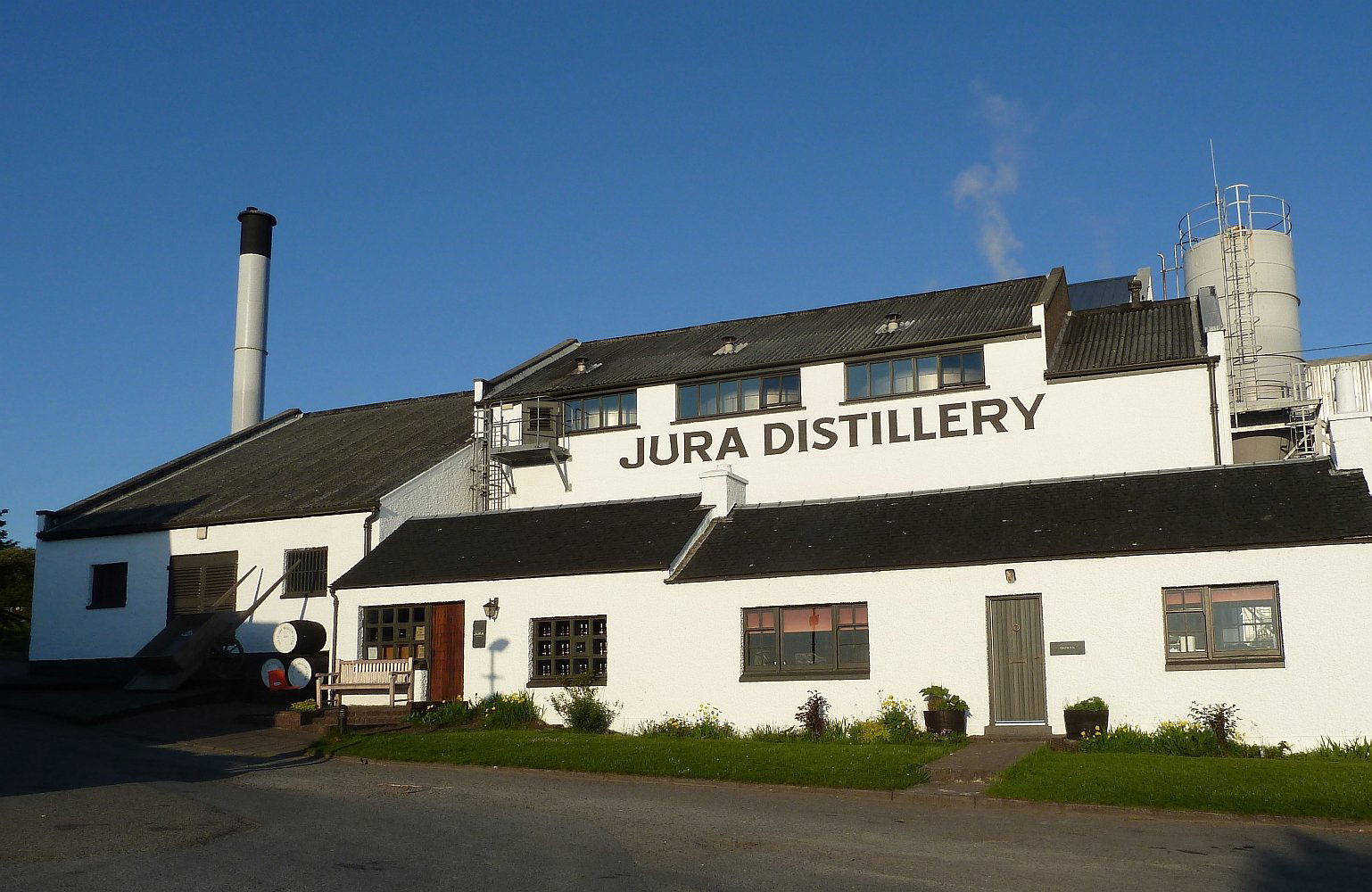
Arriving at Craighouse, the distillery is immediately visible from the bay. The whitewashed buildings sit close to the shore, backed by hills that rise steeply behind the village. The setting matches what the whisky implies: exposure to weather, proximity to water, the absence of anything else competing for attention. Visitors arriving by the ferry route from Port Askaig will have passed Ardnahoe, the newer Islay distillery that opened in 2019, which offers a useful point of contrast. Ardnahoe is a purpose-built contemporary facility; Jura's operation at Craighouse has a longer industrial and community history, functioning as one of the economic anchors of an island with almost no other industry.
That community dimension matters to how the distillery operates and presents itself. On an island of this size, the distillery is not simply a production facility or a tourism asset in isolation. It is woven into the daily life of Craighouse in ways that differ from mainland producers, including well-regarded operations like Deanston in Deanston or Glen Garioch Distillery in Oldmeldrum, both of which operate in closer proximity to population centres and established tourism infrastructure.
Peer Set and Recognition
The Pearl 3 Star Prestige rating awarded in 2025 places Jura Distillery within a tier of Scottish producers recognised for consistent quality and geographic specificity. Across the Scottish whisky spectrum, prestige-tier recognition now distributes across multiple regional identities: Speyside houses like Aberlour in Aberlour and Cardhu in Knockando hold their positions through depth of archive and blending heritage; southern producers such as Bladnoch Distillery in Bladnoch represent Scotland's Lowland edge; newer operations like Dunphail Distillery in Dunphail are building reputations through small-batch precision. Jura's position in that landscape is earned through longevity, island-specific character, and sustained output rather than through the kind of heritage brand architecture that dominates Speyside.
For drinkers who approach whisky the way serious wine buyers approach terroir-driven bottles, the island's isolation is not a logistical inconvenience. It is the credential. The argument that remoteness produces a more unmediated expression of place has parallels elsewhere. Accendo Cellars in St. Helena occupies a similar position in Napa, where a constrained, site-specific approach functions as a differentiator against the high-volume appellation norm. Achaia Clauss in Patras carries a different logic, one built on historic provenance in a region defined by indigenous grape varieties. The underlying principle in each case is the same: place matters more than marketing, and the product reflects the site conditions directly.
Planning the Visit
Reaching Jura requires forward planning that most Scottish whisky itineraries do not demand. The Kennacraig to Port Askaig ferry (operated by CalMac) runs daily, though frequency varies by season, and the Islay to Jura crossing at Feolin is a short vehicle ferry with limited capacity. Travelling in summer, roughly May through September, gives the most reliable crossing conditions and the longest days, which matter considerably when the island's road runs single-track for its full length. Accommodation on Jura is limited, and the Jura Hotel in Craighouse functions as the island's primary hospitality base, meaning visitors who plan to spend more than a day on the island should book well ahead. The distillery at Craighouse is the natural anchor for any visit, and combining it with time on Islay, where Ardnahoe sits a short drive from the Port Askaig crossing, gives a useful point of contrast between two adjacent island whisky traditions. See our full Isle of Jura restaurants and producers guide for broader context on what the island offers beyond the distillery itself.
Frequently Asked Questions
- What is the atmosphere like at Jura Distillery?
- The distillery sits at the edge of Craighouse, the island's only village, with the bay directly in front and open hillside behind. The setting is functional and unpretentious, shaped by its role as a working production facility in a remote community rather than as a designed visitor attraction. The Pearl 3 Star Prestige recognition in 2025 signals serious quality, but the atmosphere at Jura reflects the island itself: quiet, direct, and defined by geography rather than amenity.
- What do visitors recommend trying at Jura Distillery?
- Jura's production is shaped by the island's lighter peat character, quartzite-filtered water, and Atlantic coastal maturation conditions. The distillery's 2025 Pearl 3 Star Prestige rating confirms the output quality, but the specific expressions available to visitors depend on current releases. As with island distilleries generally, the core range tends to demonstrate the house character most clearly, and comparing Jura's style against the heavily peated Islay tradition, represented by neighbours including Ardnahoe in Port Askaig, gives useful calibration for understanding what makes Jura's approach distinct.
- What is the main draw of Jura Distillery?
- The primary draw is geographic: Jura is one of the most remote operational distilleries in Scotland, situated on an island with a population of around 200 and accessible only by two ferry crossings. That isolation is a production condition, not just a backdrop, and it distinguishes Jura from mainland producers regardless of category tier. The 2025 Pearl 3 Star Prestige award places the distillery's output on a level consistent with the best-regarded regional producers across Scotland.
Related editorial
- Best Fine Dining Restaurants in ParisFrom three-Michelin-star icons to the next generation of Parisian chefs pushing boundaries, these are the restaurants that define fine dining in the world's culinary capital.
- Best Luxury Hotels in RomeFrom rooftop terraces overlooking ancient ruins to Michelin-starred hotel dining, these are the luxury hotels that make Rome unforgettable.
- Best Cocktail Bars in KyotoFrom sleek lounges to hidden speakeasies, Kyoto's cocktail scene blends Japanese precision with global influence in ways you won't find anywhere else.
Save or rate Jura Distillery on Pearl
Keep this venue in your Pearl passport, rate it after you visit, and track it alongside every other place you collect.