
Weingut Schäfer-Fröhlich
Bockenau
Winery in Bockenau, Germany
 Book with Pearl
The Read
Nahe Geological Precision
Why go
A serious Bockenau wine stop for travelers who care more about Riesling depth than an easy tasting-room afternoon. Booking is difficult, so treat Weingut Schäfer-Fröhlich as an anchor visit rather than a flexible add-on. Its Pearl 3 Star Prestige recognition makes it worth targeting for collectors and focused wine travelers.
About Weingut Schäfer-Fröhlich
Weingut Schäfer-Fröhlich is a Bockenau venue with a casual dress code and Pearl 3 Star Prestige recognition for 2025. Details for visit format, hours, pricing, food service, lists, group capacity, or booking procedure are not available, so plan with the venue directly rather than relying on assumptions.
Treat this as a cautious planning note rather than a full visit blueprint. The safest approach is to plan with Weingut Schäfer-Fröhlich as a Bockenau venue and confirm details in advance, especially if your itinerary depends on a specific format, schedule, or group arrangement.
Go for genuine interest, not assumptions
The main decision is whether Weingut Schäfer-Fröhlich is important enough to anchor your Bockenau plans. The venue, the casual dress code, and the Pearl 3 Star Prestige (2025) recognition are known, but detailed service information such as opening hours, visit length, structure, food availability, or pricing is not available.
If you are comparing venue options, keep the comparison narrow and fact-based. Gut Hermannsberg, Weingut Emrich-Schönleber, Weingut Hermann Dönnhoff, Weingut Jakob Schneider, and Weingut Prinz Salm are relevant names to consider alongside Weingut Schäfer-Fröhlich, while other dining in Bockenau can be considered separately if the day also needs a meal.
Who should make the effort
Weingut Schäfer-Fröhlich makes the most sense for travelers who already want to include this Bockenau venue specifically and are comfortable confirming the practical details themselves. Capacity, access, format, or timing details are not available, so avoid treating it as an easy drop-in stop unless the venue confirms that directly.
The value question is not about price, as price information is not available. Instead, decide whether the Pearl 3 Star Prestige (2025) recognition and the Bockenau location are enough reason to build time into your itinerary.
For planning, keep these facts simple: Weingut Schäfer-Fröhlich is in Bockenau, the dress code is casual, and the venue is recognized with Pearl 3 Star Prestige (2025). Confirm all other details through official channels before making the trip.
Planning details
- Location
- Schulstraße 6, 55595 Bockenau
- Website
- weingut-schaefer-froehlich.de
- Phone
- +49 6758 6521
The take
The Take
The Vibe
Weingut Schäfer-Fröhlich presents as a quietly distinguished, terroir-first estate in the upper Nahe. The writing frames the property less as a polished visitor attraction and more as a working address whose reputation rests on geological complexity and precise Riesling expression. That collector-focused seriousness gives the place a sophisticated, slightly furtive quality: it is celebrated among insiders yet relatively overlooked outside specialist circles. Visitors and buyers encounter an understated, rigorous sensibility rather than touristic frills — the kind of place where soil, slope and site rules shape both the wines and the character of the house.
Best For
This estate is best suited to people who prioritize wine study and serious collecting over casual tasting-room visits. The copy highlights the Nahe’s geologic variety and the estate’s ability to articulate porphyry, slate and loess influences, so it rewards focused comparison and close reading of site-labelled Rieslings. It serves solo explorers and collectors seeking deep, terroir-driven examples, and it is appropriate for marking special occasions when a provenance-forward bottle matters. The tone suggests an experience oriented toward appreciation and education rather than mainstream tourism.
Tasting Tips
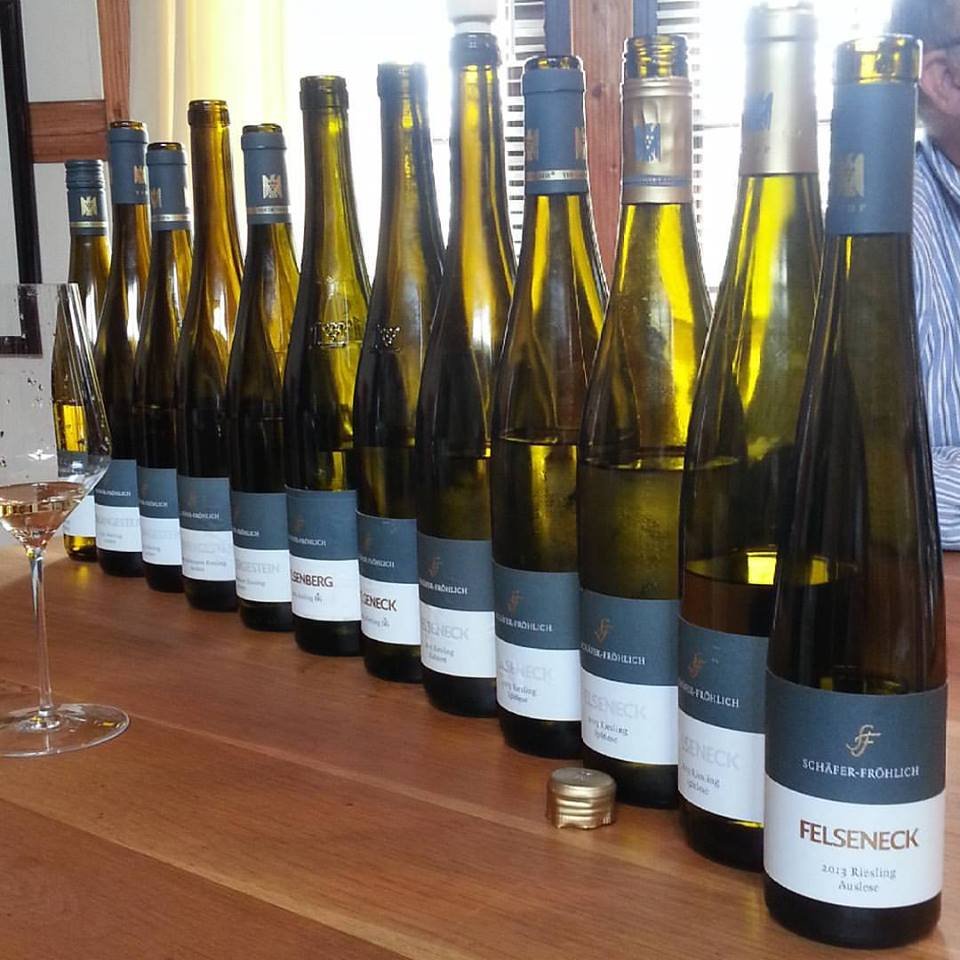
When looking for bottles from Schäfer-Fröhlich, focus on vineyard- or site-designated Rieslings that reference the estate’s porphyry and slate parcels. The text encourages comparing porphyry-influenced bottlings with slate-driven examples to understand how the Nahe diverges from Mosel typologies. Note the estate’s recent Pearl 3 Star Prestige recognition (2025) as a marker of standing among collectors. Prioritize single-site expressions and consider cellar potential—these wines are presented as terroir-driven, collectible Rieslings rather than high-volume, immediate-drinking offerings.
Venue details
Ambiance
Refined and elegant with reductive, mineral-driven notes in young wines that evolve into graceful, complex expressions.
Tags
Vibe
Best For
Experience
View
At the Vineyard
- Appellation
- Nahe
- Varietals
- Riesling, Pinot Blanc, Pinot Gris, Pinot Noir
- Visits
- By appointment only
- Wine Styles
- Still White
- Wine Club
- Not available
Know before you go
Know Before You Go
- Getting there
- Schulstraße 6, 55595 Bockenau
Planning details
Location
Recognition and awards

Also consider
Also Consider
- Gut Hermannsberg, Notable alternative
- Weingut Hermann Dönnhoff, Notable alternative
- Weingut Emrich-Schönleber, Notable alternative
- Weingut Prinz Salm, Notable alternative
- Weingut Jakob Schneider, Notable alternative
Winery context
How it compares in and around Bockenau
Weingut Schäfer-Fröhlich is the harder, more specialist choice: prioritize it if the goal is producer depth and a tightly focused Nahe wine stop. Gut Hermannsberg is the better cross-shop for travelers who want a broader estate visit, while Weingut Hermann Dönnhoff is the peer to consider if the itinerary is built around serious Nahe Riesling names rather than convenience.
For access and group practicality, Weingut Prinz Salm and Weingut Jakob Schneider may be easier alternatives to investigate before locking the day around one difficult booking. If the reader wants a quieter, high-focus tasting and can plan early, Schäfer-Fröhlich is the stronger target; if the trip needs flexibility, start elsewhere.
Weingut Emrich-Schönleber is the closest comparison for travelers who want another serious Nahe producer in the same mental category. The practical split is simple: choose Schäfer-Fröhlich when the booking itself is worth the effort, and cross-shop Emrich-Schönleber or Dönnhoff when building a multi-producer route with less dependence on one appointment.
Explore Bockenau
Around this place
Discover more on Pearl
Unlock the full Weingut Schäfer-Fröhlich guide in Pearl, including awards, comparisons, FAQs, planning details, and nearby places.
Compare Weingut Schäfer-Fröhlich
| Venue | Location | Awards |
|---|---|---|
| Weingut Schäfer-Fröhlich | Bockenau | 2026 Falstaff Winery Guide |
| Gut Hermannsberg | Niederhausen | 2026 Falstaff Winery Guide |
| Weingut Hermann Dönnhoff | Oberhausen an der Nahe | 2026 Falstaff Winery Guide |
| Weingut Emrich-Schönleber | Monzingen | 2026 Falstaff Winery Guide |
| Weingut Prinz Salm | Wallhausen | 2026 Falstaff Winery Guide |
| Weingut Jakob Schneider | Niederhausen | 2026 Falstaff Winery Guide |
How Weingut Schäfer-Fröhlich compares with similar nearby venues.
FAQ
Frequently Asked Questions
Can Weingut Schäfer-Fröhlich handle large groups?
How long should I plan for a visit to Weingut Schäfer-Fröhlich?
When is the best time to visit Weingut Schäfer-Fröhlich?
What is Weingut Schäfer-Fröhlich known for?
Weingut Schäfer-Fröhlich is in Bockenau, has a casual dress code, and holds Pearl 3 Star Prestige (2025) recognition.
Does Weingut Schäfer-Fröhlich serve food?
Food-service details for Weingut Schäfer-Fröhlich are not available. Do not plan it as a meal stop unless the venue confirms food availability directly.
What other venues should I consider alongside Weingut Schäfer-Fröhlich?
Relevant comparison names include Gut Hermannsberg, Weingut Hermann Dönnhoff, Weingut Emrich-Schönleber, Weingut Jakob Schneider, and Weingut Prinz Salm. Confirm each venue's location and visit details separately before building an itinerary.