
Restaurant in Osaka, Japan
Yoshiko
450Pearl PointsOne ingredient, one chef, book it.

About Yoshiko
A second-generation fugu specialist in Osaka's Sonezakishinchi district, Yoshiko serves wild-caught tora fugu from Shimonoseki at a counter inherited from an earlier sushi shop. At ¥¥¥¥ pricing, it earns its place through focused craft: botan-zukuri sashimi, chirinabe hotpot, and aged homemade ponzu from a chef with wholesaler and ryotei training. Best visited November to March.
Yoshiko, Osaka: Verdict
Yoshiko is not a theatrical fugu experience designed for curious tourists. It is a counter-format specialist restaurant in Sonezakishinchi where a second-generation chef with a wholesaler and ryotei pedigree prepares wild-caught tora fugu from Shimonoseki with the seriousness the ingredient demands. If you are in Osaka and want to eat fugu cooked by someone who has spent a career learning nothing else, this is the right booking. If you want spectacle or a broad menu, look elsewhere.
The Space
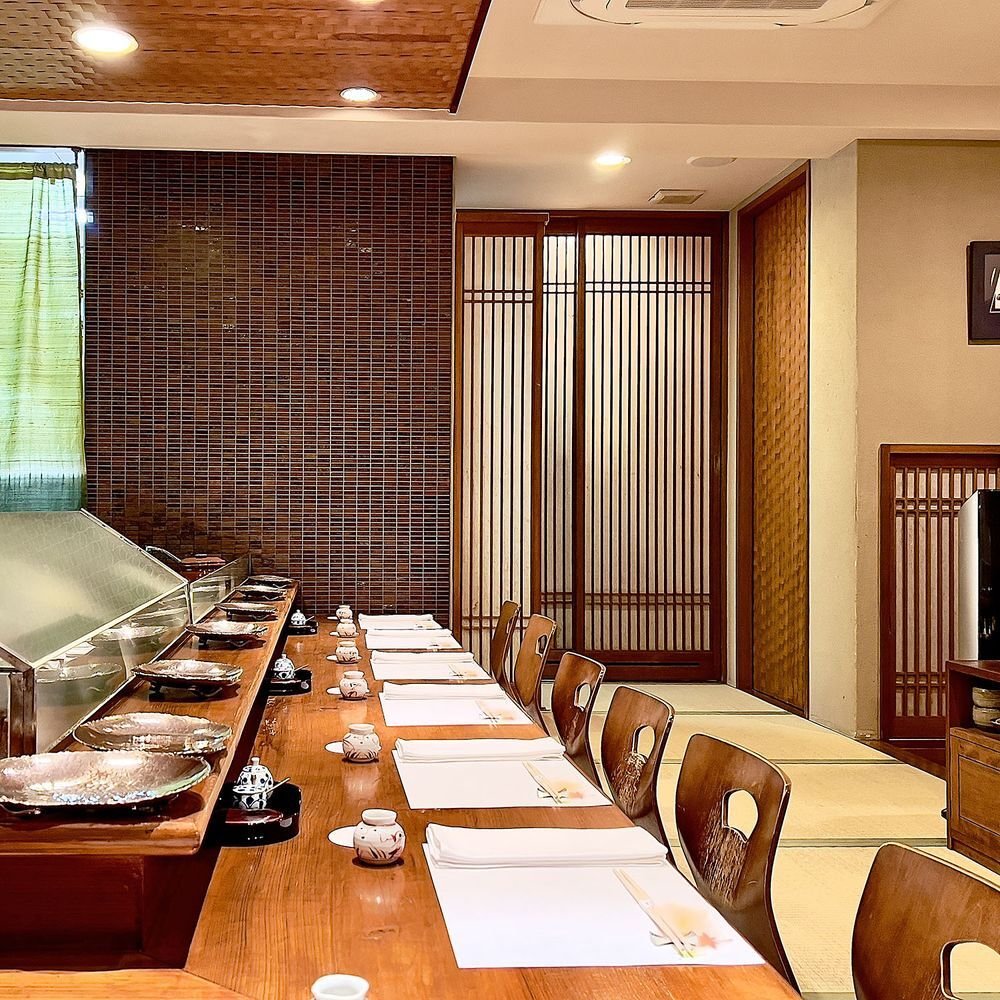
The counter at Yoshiko is a remnant of its previous existence as a sushi shop — the same physical surface, repurposed for fugu. That detail matters more than it sounds. A sushi counter is built for the relationship between chef and diner: close, quiet, transactional in the leading sense. You watch preparation, you receive courses, you eat without distraction. The room is compact, which keeps the focus on the food and gives the meal a pace that larger dining rooms rarely achieve. Solo diners and couples will feel at home here; larger groups may find it less comfortable. The spatial logic of the place is inherited from a different tradition, and that inheritance shapes the meal.
What You're Eating
The menu is anchored in the classic fugu canon, executed with care. Fugu sashimi arrives arranged in the botan-zukuri style — thin slices fanned into a floral pattern on celadon plates, which is both the traditional presentation and a useful signal of how the chef approaches the craft: precise, orthodox, and visually considered. Chirinabe hotpot, followed by zosui rice gruel made from the remaining broth, is the expected progression and is handled by the book. What distinguishes Yoshiko from a technically competent but anonymous fugu restaurant is the detail work: homemade ponzu sauce aged with patience, appetisers of fugu skin or jellied fugu, and stone-grilled fugu that show where the chef's own sensibility enters the meal. These are not dramatic departures from tradition, they are refinements within it, which is the correct approach for a restaurant at this price point.
On the Drinks
Fugu cuisine has a well-established drinks pairing logic in Japan: hot sake, specifically hirezake, sake warmed with a grilled fugu fin, is the canonical accompaniment, and at a counter restaurant of this type you should expect to order within that framework. Yoshiko's drinks program is not a cocktail bar operation; it is structured around what complements the food, which means sake, likely some Japanese whisky, and the hirezake tradition. This is not a venue where the drinks program operates independently of the meal. The drinks exist in service of the fugu, and the right approach for the diner is to let the chef or staff guide the pairing rather than arriving with a fixed preference. If a strong cocktail or wine program is a meaningful part of what you are looking for, the Osaka bars guide will point you to dedicated programs that deliver on that front. Here, the drinks are correctly subordinate to one of the more technically demanding ingredients in Japanese cuisine.
Practical Details
Reservations: Bookings appear to be accessible, this is categorised as easy to book relative to Osaka's more competitive counters, but fugu specialists of this calibre still warrant advance planning; do not assume walk-in availability. Dress: Smart casual is appropriate for a ¥¥¥¥ counter restaurant in this neighbourhood; there is no indication of a formal dress code, but the setting demands a degree of effort. Budget: ¥¥¥¥ pricing puts Yoshiko at the top tier of Osaka dining, expect a meaningful per-head spend that reflects both the premium cost of wild-caught tora fugu from Shimonoseki and the skill required to prepare it legally and well. Group size: Counter seating favours parties of one or two; larger groups should confirm availability before booking. Location: Sonezakishinchi, Kita Ward, a central Osaka neighbourhood that is direct to reach and well-served by the surrounding Osaka restaurant and hotel options if you are building a broader itinerary.
Timing
Fugu is a seasonal ingredient at its peak in the colder months, roughly November through March, when tora fugu from the Shimonoseki region are at their leading. Visiting in that window is the practical choice if the quality of the primary ingredient matters to you. Summer visits are possible but you are not eating the fish at its peak. Within any given week, an early-evening booking at a counter of this size will give you more of the chef's attention and a quieter room than a later seating.
How It Compares
For Osaka's wider dining scene at the ¥¥¥¥ tier, see our comparisons below. For fugu specifically outside Osaka, Kumsu Bokguk and Torafuguga in Busan represent the Korean pufferfish tradition for context. Elsewhere in the Kansai region, Gion Sasaki in Kyoto and akordu in Nara operate at comparable ambition levels in different cuisines. For broader Japan itinerary planning, Harutaka in Tokyo, Goh in Fukuoka, 1000 in Yokohama, and 6 in Okinawa each anchor their respective cities at the serious end of the market.
Pearl's Take
Yoshiko earns its ¥¥¥¥ positioning through specificity. The chef has spent a career on one ingredient, sourced from the right place, prepared with the correct techniques, and refined with small personal touches that give the meal a character beyond the standard fugu itinerary. Book this for a focused fugu meal, ideally between November and March, at a counter that has earned its place in one of Japan's most seriously food-focused cities. Use the Osaka experiences guide and Osaka wineries guide to build around it.
Frequently Asked Questions
What should I order at Yoshiko?
The fugu sashimi in botan-zukuri style — thin slices fanned into a floral pattern on celadon plates — is the centrepiece and worth ordering. Follow it with the chirinabe hotpot and the zosui rice gruel that closes it out. The stone-grilled fugu and jellied fugu appetisers show the chef's range beyond the classic format. The housemade ponzu, patiently aged, is not an afterthought — it is part of what you are paying for.
What should I wear to Yoshiko?
Yoshiko is a counter-format specialist restaurant in Sonezakishinchi, not a hotel dining room or formal ryotei. Neat, considered dress fits the setting — the counter is intimate and the tone is serious without being stiff. Avoid overly casual clothing, but there is no evidence of a strict dress code.
Is Yoshiko good for solo dining?
Yes. The counter format, inherited from the restaurant's previous life as a sushi shop, is well-suited to solo diners. You will be facing the chef and watching preparation directly, which is most of the point at a specialist counter like this.
What are alternatives to Yoshiko in Osaka?
For ¥¥¥¥ dining in Osaka that is not fugu-specific, Taian, La Cime, and Kashiwaya Osaka Senriyama are the relevant tier comparisons. For fugu specifically, Yoshiko's focus on wild-caught tora fugu from Shimonoseki positions it as the dedicated option in the city — generalist kaiseki restaurants at this price point do not offer the same depth on a single ingredient.
Is the tasting menu worth it at Yoshiko?
At ¥¥¥¥, you are paying for an entire meal built around a single, technically demanding ingredient sourced from Shimonoseki. If fugu is what you want to eat properly — not as a novelty dish inside a broader menu — then the format here is the right one. If you want a multi-cuisine progression, look at La Cime or Fujiya 1935 instead.
Is Yoshiko good for a special occasion?
Yes, with the right expectations. The counter setting is intimate rather than grand, and the experience is driven by the chef's craft rather than ceremony or spectacle. For a food-focused occasion — a birthday dinner for someone who takes Japanese cuisine seriously — it works well. For a proposal or a group celebration requiring a private room, the format is likely too spare.
Is Yoshiko worth the price?
At ¥¥¥¥, yes — if fugu is what you are there for. The chef apprenticed at a wholesaler and then a ryotei before specialising entirely in fugu; wild-caught tora fugu arrives from Shimonoseki, which is the correct source. The value case is built on specificity and ingredient quality, not on room design or brand prestige. If you want broader value at this price tier, HAJIME or Kashiwaya Osaka Senriyama offer more format variety.
Location
Japan, 〒530-0002 Osaka, Kita Ward, Sonezakishinchi, 1 Chome−8−5 よし光ビル
Osaka, Japan
Compare Yoshiko
| Venue | Cuisine | Price | Booking Difficulty |
|---|---|---|---|
| Yoshiko | Fugu / Pufferfish | ¥¥¥¥ | Easy |
| HAJIME | French, Innovative | ¥¥¥¥ | Unknown |
| La Cime | French | ¥¥¥¥ | Unknown |
| Kashiwaya Osaka Senriyama | Japanese | ¥¥¥ | Unknown |
| Taian | Kaiseki, Japanese | ¥¥¥ | Unknown |
| Fujiya 1935 | Innovative | ¥¥¥¥ | Unknown |
How Yoshiko stacks up against the competition.
Also Consider
- HAJIME, French, Innovative, ¥¥¥¥
- La Cime, French, ¥¥¥¥
- Kashiwaya Osaka Senriyama, Japanese, ¥¥¥
- Taian, Kaiseki, Japanese, ¥¥¥
- Fujiya 1935, Innovative, ¥¥¥¥
At the ¥¥¥¥ tier in Osaka, Yoshiko occupies a category of its own: every other serious restaurant at this price point is competing on range, technique across multiple ingredients, or a defined culinary philosophy. Yoshiko competes on depth within a single, technically demanding ingredient. That makes direct comparisons difficult, but the decision logic is clear. If you want the most ambitious cooking in the city at this price, HAJIME and Fujiya 1935 both offer innovative menus with broader intellectual scope. La Cime sits at the same tier with a French framework that gives it a different kind of coherence. None of them are fugu specialists. If fugu is specifically why you are eating in Osaka, Yoshiko has no equivalent competitor in this comparison set.
For diners who want serious Japanese cuisine at one tier lower in price, Kashiwaya Osaka Senriyama and Taian are both ¥¥¥ options that deliver kaiseki-level craft with better value-for-money than the ¥¥¥¥ tier. If budget is a consideration and fugu is not the specific goal, either of those is a stronger argument for your money than Yoshiko.
The practical booking picture favours Yoshiko over most of its peers: it is categorised as easy to book at a time when several of Osaka's most sought-after counters require weeks or months of advance planning. That accessibility is a real advantage if you are building a Japan itinerary with limited lead time. Book Yoshiko for a focused, ingredient-led counter meal in the colder months. Book HAJIME or La Cime if you want the full-spectrum ¥¥¥¥ experience with a broader culinary canvas.
Recognized By

Explore Osaka
Save or rate Yoshiko on Pearl
Keep this venue in your Pearl passport, rate it after you visit, and track it alongside every other place you collect.